
I had an alarm set for 11:45 p.m. on a Friday on the East Coast, because Kona doesn't care what time zone you live in, and I wasn't missing the start of the first fully reunited Ironman World Championship in four years. For a long stretch of Saturday morning, nothing dramatic happened. Strong swims, a hard bike leg, the usual shuffling of positions. Then, in the span of about twenty minutes near the end of the women's race, the sport produced one of the strangest and most human finishes I've ever watched: a defending champion sitting on the hot pavement of Palani Road, less than a mile from a title she'd all but secured, while the woman she'd beaten in almost the exact same spot a year earlier ran straight past her to the win.
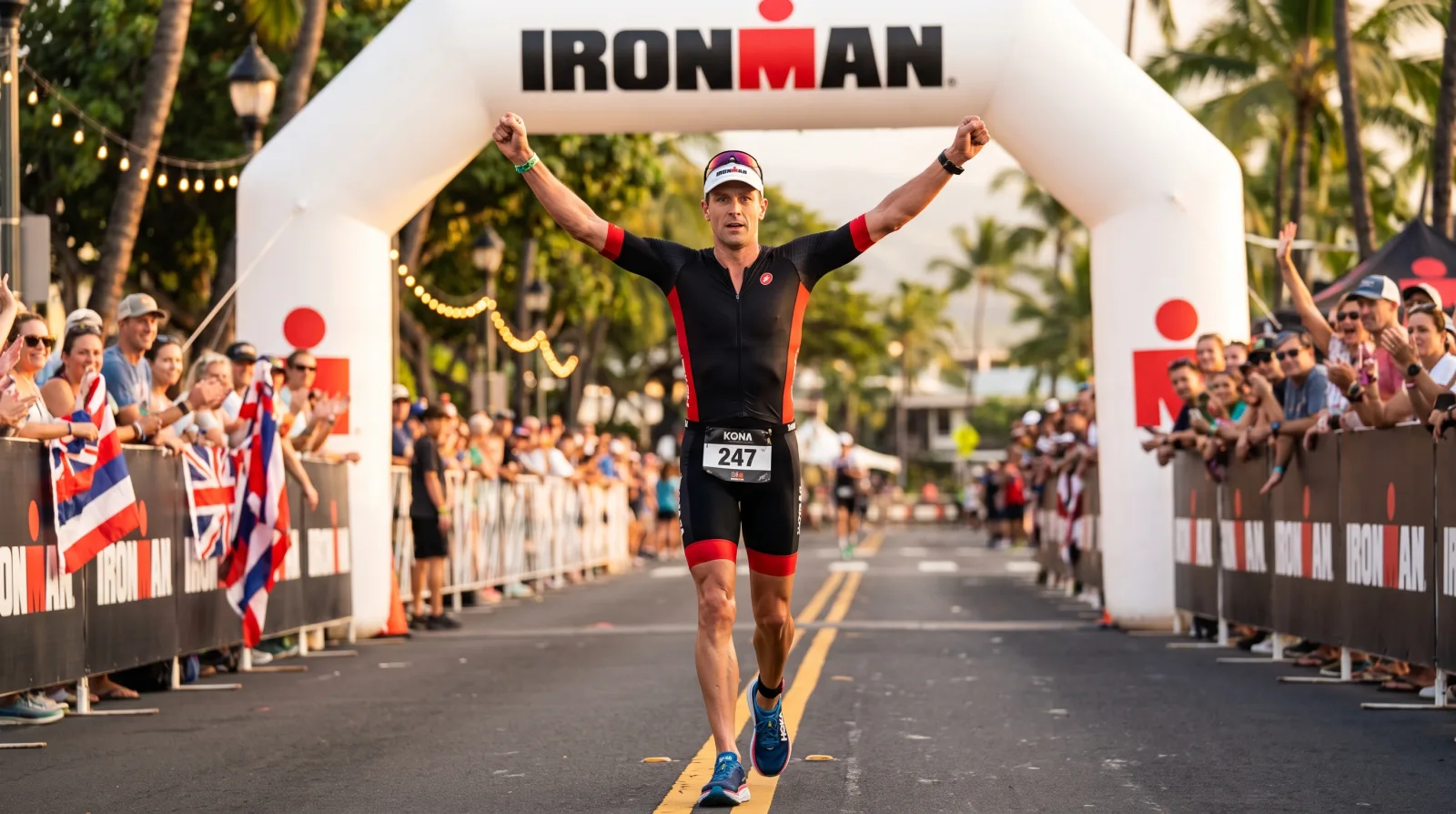
Kona Is Whole Again
Some context before the race itself, because the setting is half the story this year. Kona hosted both the men's and women's world titles on the same day for most of the event's history, until the backlog of pandemic deferrals forced a two-day format in 2022. Women raced on a Thursday, men two days later. IRONMAN discovered that Kona's small-town infrastructure couldn't support two full race days, so from 2023 through 2025 the championship split by location instead, alternating the men's and women's races between Kona and Nice, France, year to year.
Almost nobody liked it. IRONMAN Group CEO Scott DeRue said in an open letter that a survey of more than 10,000 athletes made it "abundantly clear" that a significant majority of competitors, across every age group, wanted the same two things: to race together, and to race in Kona specifically. Formats that didn't include Kona polled lowest no matter how they were framed. The company's own data backed it up in a way that's hard to argue with. In the year the men raced Nice and the women raced Kona, global coverage reached roughly 44 million people for Nice against 160 million for Kona. Splitting the race also didn't do what IRONMAN hoped it would for women's participation; athletes who reached the pinnacle of the sport in Nice were, by the company's own numbers, considerably more likely to retire from long-distance racing afterward than athletes who got to race in Hawai'i.
So in 2026, Kona got the whole thing back: nearly 3,000 athletes, professional men starting at 6:20 a.m., professional women ten minutes behind at 6:30, age-group waves following at 6:38, with equal broadcast coverage built into the new format from the ground up. It's the first time since 2019 that every triathlete chasing a Kona world title has raced the same course, on the same day, with the same wind and the same lava fields deciding everyone's fate at once.
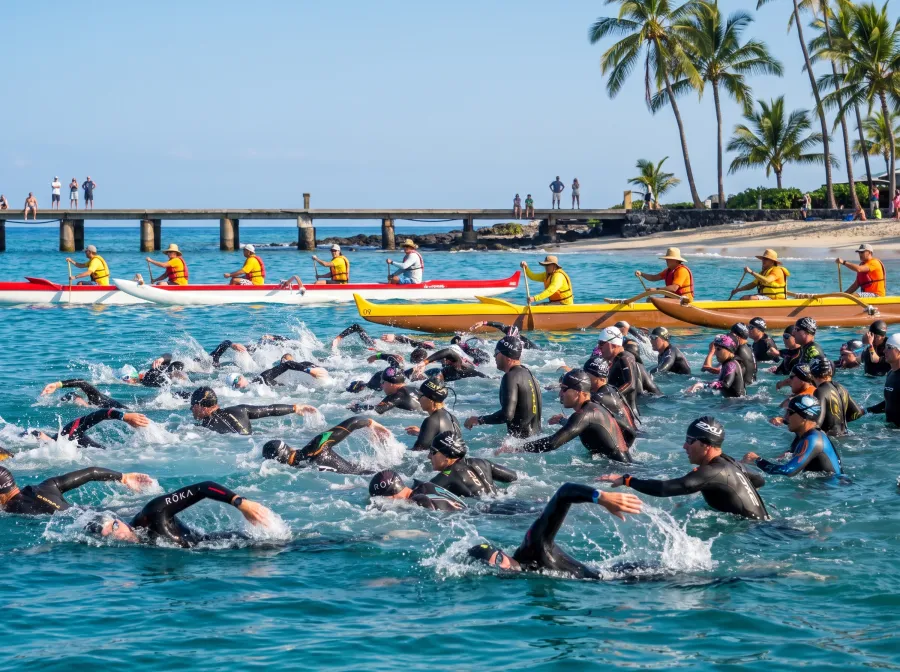
A Day Built for Collapse
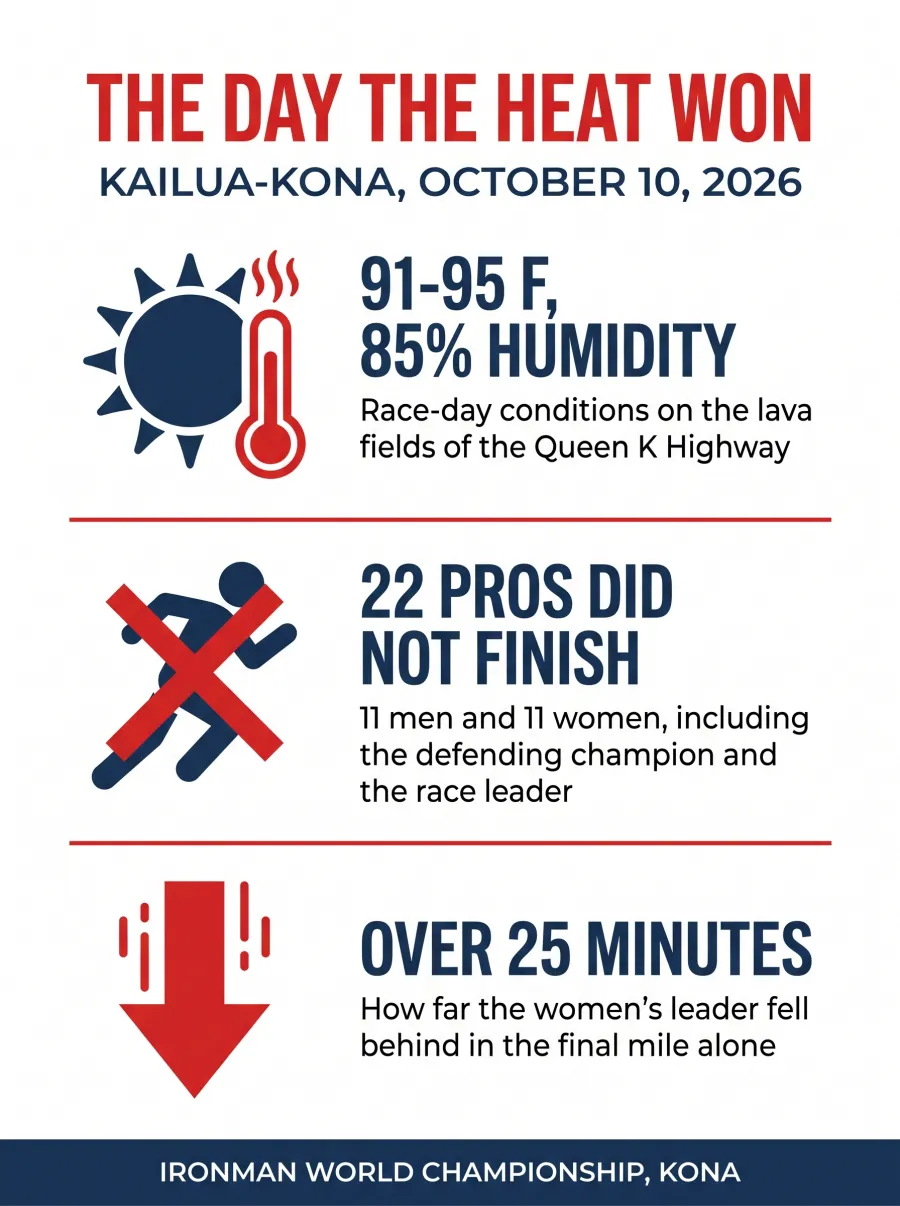
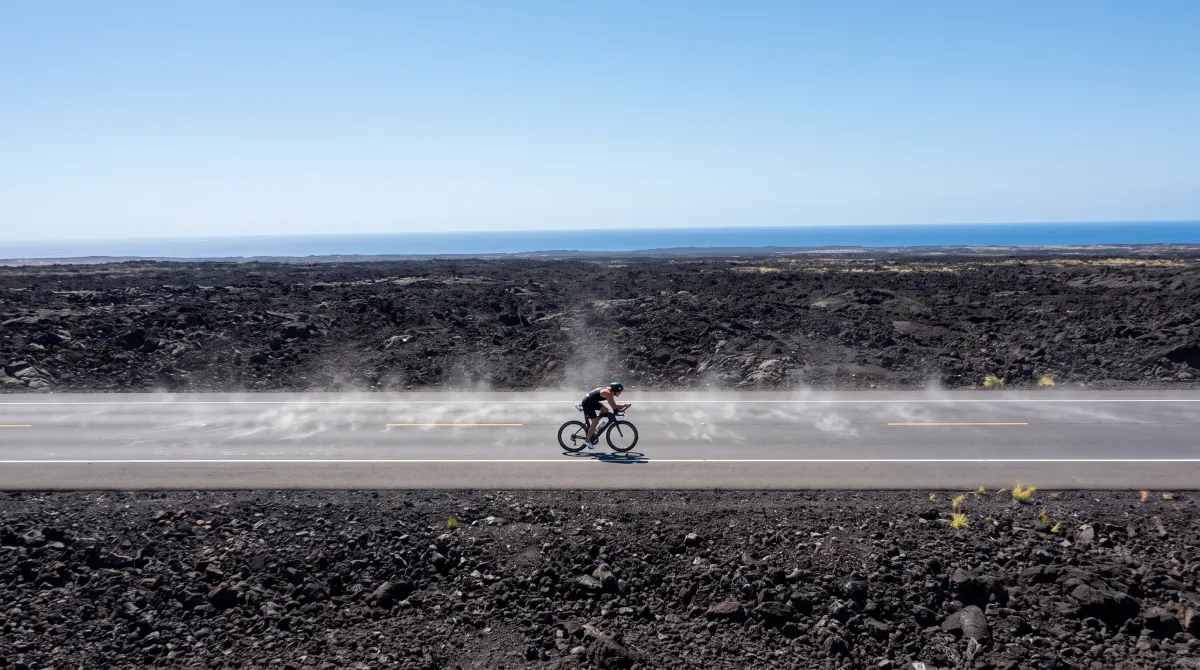
And then conditions decided to make the reunion as miserable as possible. Race day brought air temperatures of roughly 91 to 95°F with humidity hovering near 85 percent, the kind of combination that doesn't just slow athletes down but actively shuts bodies off. By the time the pro fields finished, 22 professionals had not: 11 men and 11 women, a staggering number for a field of this caliber. One theory going around the sport afterward is that deeper, more competitive fields leave nobody room to ease off even for a moment; everyone's racing flat-out from the gun because the gaps are too close to concede anything, and on a day like this, that's exactly the kind of racing that ends with people on the ground.
Vincent Luis's Last Race, and His Best One
For most of the men's marathon, this wasn't supposed to be Vincent Luis's day. Magnus Ditlev came out of the swim a few minutes down, rode the fastest bike split of the field to grab a commanding lead into transition, and held it through the bulk of the run over the likes of Luis and a quietly struggling Kristian Blummenfelt. The Dane was, by his own account afterward, executing his pacing and cooling plan almost perfectly. Then, heading back from the Energy Lab, he said "the lights suddenly went out." He walked. He kept trying. With less than 30 minutes between him and the title he's chased his entire career, he collapsed and didn't finish. It's his second heartbreak at this exact event. He'd been runner-up in 2024 and third the year the race was held in Nice.
Luis inherited the lead with about eight kilometers to go and ran the day's second-fastest marathon split, 2:38:35, to cross in 7:47:27. What makes that number remarkable is who was chasing him: Gustav Iden, the 2022 champion, actually ran the single fastest marathon of the entire men's field at 2:36:57 and still finished 1:35 behind. A three-minute penalty picked up on the bike leg is almost exactly the difference. Run the splits forward without that penalty and Iden wins by more than a minute. That's Kona in one sentence: one mistake, three minutes, an entire world title.
The story behind the winner matters as much as the race itself. Luis is 37, a two-time short-course world champion (2019 and 2020), an Olympic mixed-relay bronze medalist from Tokyo, and someone who spent most of his career chasing an Olympic medal that narrowly slipped away before Paris 2024. He'd made a late switch to full-distance racing, hadn't podiumed at an Ironman before Saturday, and had quietly told people this would be his final professional race regardless of outcome. He even skipped the Ironman 70.3 World Championship in Nice earlier in the year to protect his heat-specific build for Kona, a decision that looked questionable at the time and looks obvious in hindsight. He crossed the line and embraced his partner, fellow Olympic medalist Georgia Taylor-Brown, before the laurel wreath went on. Asked afterward whether the win changes his retirement plans, he gave one of the better quotes of the season: "There are two things in the world of triathlon worth fighting for. It's an Olympic gold and a Kona title. I have one of them, and all the rest is good enough for bookshelves. Now I have the Kona title, I think maybe the job's done." He's the second Frenchman to win the men's world title, after Sam Laidlow's 2023 win in Nice, and the first to do it on the Big Island itself.
Blummenfelt, who'd been installed as the pre-race favorite in just about every preview written this year (including ours), finished a distant eighth, 10:39 behind, one more major-race result that didn't go his way in a season that's had a few of them. Matthew Marquardt took third for the Americans, and the top ten included three Dutch and American finishers who've been building toward exactly this kind of day for years without quite breaking through.
Taylor Knibb's Redemption, and the Longest Mile of Solveig Løvseth's Life
The women's race was its mirror image, and then it got stranger than that. A year ago, on this same stretch of road, it was Taylor Knibb sitting down in the heat while Solveig Løvseth ran past her with two miles to go to win. On Saturday the roles flipped completely, then flipped again.
Knibb had the race largely under control through the bike and into the run, carrying a lead that looked comfortable for a long stretch of the marathon. Then the heat caught up with her too. She walked through an aid station, got sick, and had her support team hold up a whiteboard reading "vomiting is normal" so she wouldn't panic about it mid-race. Løvseth, who'd started the run in third more than four minutes back, spent the next several miles methodically erasing that gap. She took the lead with roughly five miles to go and had opened it up past a minute. By every reasonable measure, she was about to defend her world title.
Then, with just over a kilometer left (about seven-tenths of a mile from the finish), Løvseth simply stopped being able to run. She wobbled, sat down on the pavement, and lost the lead to Knibb, then to Laura Philipp and Julie Derron as well, finishing eighth in 9:02:09, more than 25 minutes behind the winner. She got back up and walked it in to a standing ovation, smiling, hands raised. Knibb, for her part, said she drew on something unexpected in those final miles: hearing three-time world champion Jan Frodeno, working the broadcast as an on-course reporter, tell her over a loudspeaker that Løvseth was "dying" and that she had this. She crossed in 8:36:29 for her first Ironman World Championship title, just weeks after also winning the Ironman 70.3 World Championship in Nice, a short-and-long-course double that's genuinely rare at this level.
What's wild about the splits is that Knibb didn't even run the fastest marathon on the day. Philipp's 2:50:42 run was nearly seven minutes quicker than Knibb's 2:57:45, and Kat Matthews ran 2:52:49, both faster than the winner. Knibb's margin came from the swim and bike: she exited the water in 52:54, roughly seven minutes ahead of Philipp, and backed it up with a bike split three minutes quicker. She built enough of a cushion early that even a rough marathon couldn't give it back. Matthews, who'd been tipped as the form athlete of the season after shattering the course record at Ironman New Zealand in March, ran well enough for the podium but a slower bike (4:55:33) left her fourth.
Løvseth has since said she still doesn't have a clear explanation for what happened. "I felt actually really good on the run and felt really in control," she told reporters. "From one second to another, I went from feeling in control to not being able to stand up at all. I still don't know exactly what happened, probably some sort of overheating, but I guess I need to try to look into that." Her team pointed to the combination of extreme heat (33 to 35°C, close to 85 percent humidity) and insufficient nutrition and electrolyte intake late in the race, though no formal medical diagnosis has been released. She also said something that cut through the drama of it: "I guess I am a little bit competitive. I just did not want to DNF."
Lucy Charles-Barclay didn't get that choice. The 2023 champion, who'd skipped the 70.3 Worlds entirely to focus on fixing last year's Kona heartbreak, started the run in second place looking strong, then stopped running at almost exactly the same spot on the course where her 2025 race had unraveled, visibly sick, her husband and coach Reece Barclay rushing in to help her just as he had the year before. Broadcasters floated possible seasickness from the swim as an explanation; nobody has confirmed anything. It's now two consecutive years that one of the sport's most decorated swimmers has watched a Kona title slip away in almost the exact same place.
What Winning Kona Is Actually Worth
The pro purse for 2026 was $750,000, split across the top 15 finishers in each race:
- 1st: $125,000
- 2nd: $65,000
- 3rd: $45,000
- 4th: $25,000
- 5th: $20,000
- 6th–10th: $18,000 down to $11,000
- 11th–15th: $8,000 down to $3,000
Which puts Luis and Knibb's wins at $125,000 apiece: real money, but a fraction of what a top finish at a World Triathlon Championship Series race or an Olympic medal is worth in sponsorship value afterward. Luis would know. He's held both kinds of prizes now, and by his own account, only one of them ever really mattered to him.
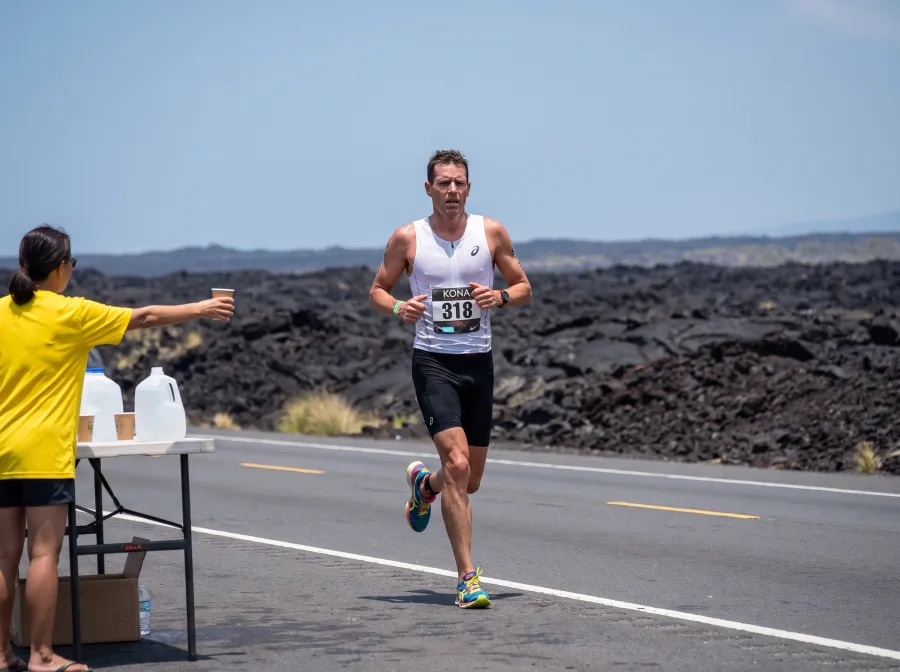
I keep coming back to the image of Løvseth getting back on her feet with the race already lost, finishing anyway, hands in the air to a crowd that had no idea what to do except cheer louder. That's not really a story about one race going wrong. It's what happens when you put nearly 3,000 of the fittest endurance athletes on the planet on a stretch of black lava in 95-degree heat and ask them to hold nothing back, because for the first time in four years, everyone chasing the title is on the same road at the same time. Whether that's a feature of Kona or the whole reason it's dangerous again depends on who you ask. I know which answer I believe. Does the sport need a hard look at pacing and medical protocol on days like this, or is a race that occasionally breaks its best athletes exactly the point? I don't think that's a settled question, and after Saturday, I don't think it should be.


