
Nobody put Jeremy MacLean in their Chattanooga fantasy lineup. Nobody. A 21-year-old British-American junior at Queens University of Charlotte, three professional starts to his name, zero podiums — and going up against a field that included Matt Hanson, one of the most prolific 70.3 winners in North America, and Sam Long, the man who has a habit of making everyone else's race look like a training day.
And yet. On May 20, 2026, in Chattanooga, Tennessee, MacLean crossed the finish line in 3:45:37 — arms up, legs done, shoe probably still somewhere on the bike course — as the winner of IRONMAN 70.3 Chattanooga. His margin of victory? Ten. Seconds. In a 70.3. Over four hours of racing, settled by less time than it takes to read this sentence.
It was the kind of race that makes you remember why you fell in love with this sport in the first place.
The Swim: MacLean Means Business from the Gun
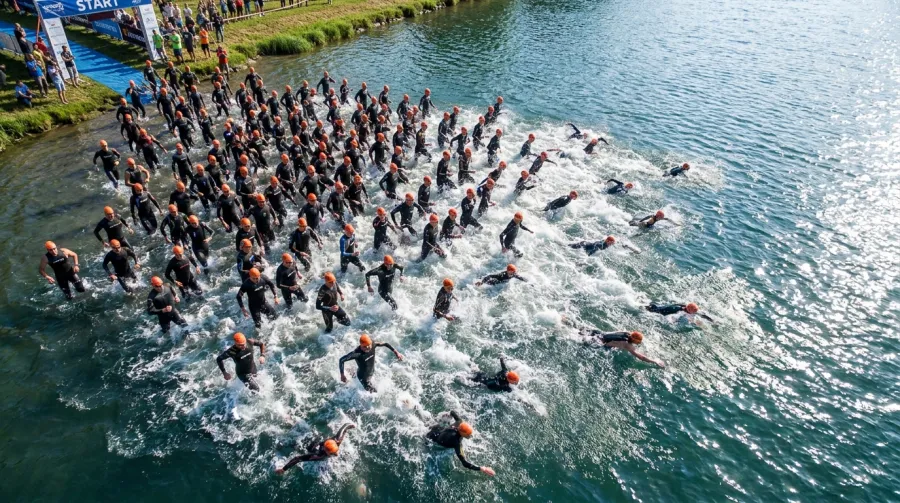
The signs were there early — if you were paying close enough attention. MacLean exited the Tennessee River with the fastest swim split of the day: 27:11. He wasn't in a lonely break; a lead group of nine men came through together, but the damage was being done right there in the water.
Hanson, one of the best runners in the sport, came out of the swim trailing by over a minute — not ideal when you're betting on your legs to save the day. Long, who can usually close any gap on the bike, was more than two and a half minutes back. In a 70.3, that is not an impossible hole to climb out of. But it is a hole.
MacLean was already racing his race. Everyone else was already reacting to him.
The Bike: Chaos, a Missing Shoe, and a Growing Lead
On the bike is where this story gets truly cinematic. MacLean linked up with Benjamin Zorgnotti and the two of them went to work, riding away from the rest of the field and watching their gap balloon toward four minutes. The math was looking brutal for Long, who — to his credit — was probably riding out of his skin to claw back time that just wasn't coming back fast enough.
Here is where you need to pause and appreciate what else was happening: somewhere on that bike course, MacLean lost a shoe. Not a tire. Not a water bottle. A shoe. A thing you need to run a half marathon. MacLean finished the bike leg, pulled into T2, and dealt with the situation — presumably with the quiet calm of someone who had no idea how close the next four hours were about to get.
In the final kilometers of the ride, MacLean opened up an additional half-minute gap on Zorgnotti, giving himself a cushion heading into the run. He entered T2 with a lead that felt comfortable. On paper. What happened next had nothing to do with paper.
The Run: Cramps, Klau, and Ice-Cold Nerves
The cramps came around mile 8. If you've ever had a full-body triathlon cramp — the kind where your quads decide to file a formal protest against the entire enterprise — you know what MacLean was dealing with. His body was sending very clear signals that it had opinions about the pace. MacLean, apparently, declined to listen.
Meanwhile, Hanson and Long were reeling him in. They gained back just over a minute on the run — a respectable chunk, but not enough. The real threat was coming from Ari Klau, who put together a spectacular comeback half marathon and charged all the way up to second place. In the final meters of the race, Klau closed to within ten seconds of MacLean.
Ten seconds. Three hours and forty-five minutes of racing, and the margin was ten seconds. If you blinked at the finish line, you missed the drama.
MacLean held. He crossed in 3:45:37. Klau came through in 3:45:47. Hanson took third in 3:48:11. Long — who is Sam Long — settled for fourth in 3:48:35. The man who came to Chattanooga with zero pro podiums left with a win and a spot at the 70.3 World Championship in Nice.
The Women's Race: Grace Alexander Owns It Wire to Wire
The women's field had its own dominant story to tell. Grace Alexander was out of the water in 28:06 — already 1 minute and 15 seconds ahead of the chasing pack. She extended her lead on the bike to just over two minutes and never gave it back, finishing in 4:16:42 for a convincing wire-to-wire victory.
Paula Findlay — the Canadian veteran who has had her share of heartbreak and redemption across a long pro career — came through in second at 4:18:47. Jackie Hering rounded out the podium in 4:20:02. No drama, no late charges, no lost footwear required. Alexander simply raced better than everyone else and let the clock confirm it.
What MacLean's Win Means for the 2026 Season
MacLean didn't just win a race on Tuesday. He served notice that the long-distance professional field is genuinely deep in youth right now. At 21, he's competing with an engine that's still being built. His swim is elite-level. His bike can shred fields when he goes on the offensive. His run — even cramping, even with a shoe situation — was strong enough to hold off one of the best chasers in the business.
He's heading to Worlds in Nice. That conversation is going to get a lot more interesting over the next several months.
For Sam Long, this is one of those races that stings — not because Long ran poorly, but because a kid showed up and simply had more on the day. That's triathlon. For age-groupers watching from the sidelines: if a 21-year-old can lose a shoe, cramp like a first-timer, and still hold his nerve against the best in the world, the lesson is written in neon. Suffering is negotiable. Quitting isn't.
"The cramps came around mile 8. MacLean declined to listen to them."
Takeaways for Age-Groupers
- Lead from the front — it works. MacLean didn't wait to see what Long and Hanson were doing. He went hard in the swim, found a partner on the bike, and built a gap. Reactive racing can work, but proactive racing wins races like Chattanooga.
- Your catastrophe doesn't have to end your race. A dropped shoe. Cramping at mile 8. Pick your disaster — MacLean had two of them and still won. When things go sideways, your job is to keep moving, not to stop and evaluate your life choices.
- Pacing a 70.3 run on pre-fatigued legs is a skill. MacLean came off a blistering bike split and still ran smart enough to hold off Klau's charge. That takes training, race experience, and a very calm internal voice that you have to cultivate over years.
- Worlds spots are earned at races nobody's watching. Nobody had Chattanooga circled as a marquee event on the 2026 calendar. MacLean did. Now he's going to Nice.
Welcome to the professional ranks, Jeremy MacLean. You arrived with quite a statement.


