
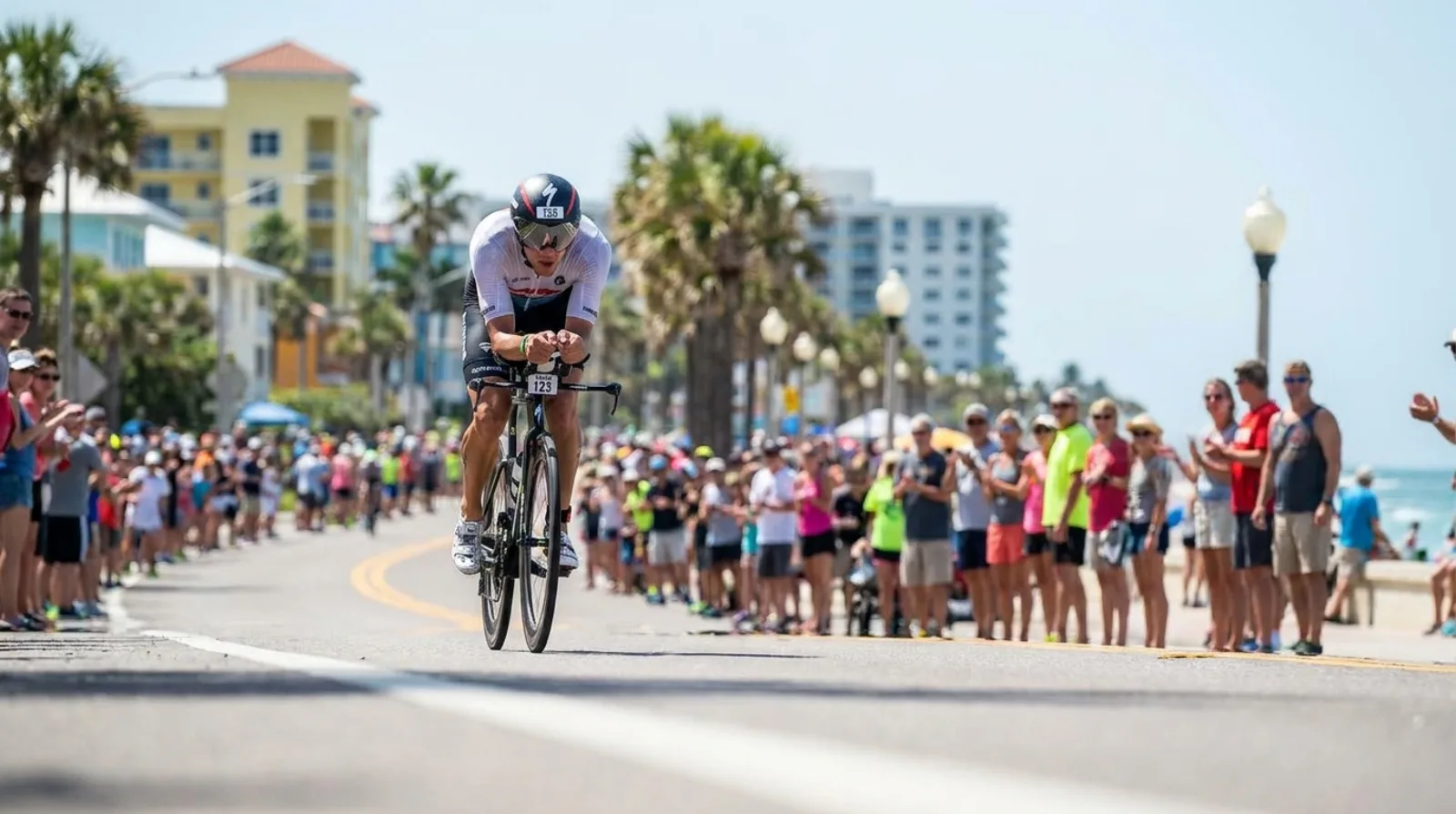
Panama City Beach, May 9, 2026. The swim at IRONMAN 70.3 Gulf Coast had been shortened to 1,000 meters due to overnight swells — which, depending on your perspective, either leveled the playing field or handed the advantage firmly to the field's best swimmers. Sam Long exited the water in 16th place, 1 minute and 22 seconds behind swim leader Greg Harper. For most athletes, a deficit like that in a professional 70.3 field is a race over before the bike shoes go on. Long spent the next 90km turning it into a masterclass.
His final time: 3:11:41, with a 1:49:32 bike split that broke the fastest men's 70.3 bike split ever recorded — a 49.4 km/h average over 90 kilometers. Seth Rider finished second at 3:13:01, with Marc Dubrick rounding out an all-American podium at 3:14:09. Long was defending his Gulf Coast title from the prior year, and he did it in a way that gave everyone — athletes, coaches, and data nerds alike — a lot to think about.
How the Race Actually Unfolded
The shortened swim created an unusual dynamic. With less time to separate the field in the water, the early bike was a compressed, tactical affair. Dubrick, Rider, and Italian athlete Zorgnotti established a 38-second lead over Long by the 17km mark — which meant Long was already deep in chase mode before he'd found his rhythm.
The move came around the 33km mark, where Long had clawed back to within striking distance of the leaders. By 50km he'd taken the lead outright, entering T2 with a 20-second cushion over Rider. Dubrick, who had averaged a reported 326 watts on the bike, was dropped. Long's own power numbers were teased on social media post-race but never officially published — the implication being they were higher.
The run told the rest of the story. Rider stayed within 10–30 seconds through the first 15 kilometers, close enough that the race remained genuinely open. Long pulled away decisively in the final kilometer and finished comfortably clear. His run split of 1:10:38 was not exceptional by Long's own standards — it didn't need to be. He'd already done the damage.
The Bike Split That Changed the Conversation
The 1:49:32 is worth sitting with for a moment. A 49.4 km/h average over a full 90km 70.3 bike course, in race conditions, against a pro field — this is the kind of number that gets put on a whiteboard in coaching conversations and stared at. For context, elite amateur age-groupers at the same race are typically averaging 35–38 km/h. Long averaged nearly 15 km/h more over the same course.
Long has spoken publicly about his approach to the bike leg in recent seasons: extended VO2 max development during the winter, sustained efforts at IM-threshold power (~290 watts for him), with controlled surges on climbs rather than full-gas punchy efforts. The philosophy is less "go as hard as possible" and more "manage the ceiling so the run doesn't collapse." The fact that he ran 1:10:38 after a bike split that would have destroyed most age-groupers is the proof of concept.
Dubrick's 326 watts gives us a useful reference point. If Long was producing meaningfully more than that to bridge a 38-second gap and then hold it to the finish, his functional threshold power for a 90km effort in race conditions is operating in territory that redefines what's possible at the distance. This is an athlete at his ceiling, not coasting.
What Sam Long's Race Actually Teaches Age-Groupers
The temptation when watching performances like this is to conclude they're simply irrelevant to the age-group athlete. Long is a professional. He trains 30+ hours a week. His FTP is somewhere most of us would need supplemental oxygen to sustain for 30 seconds.
But the structural lessons from how he raced Gulf Coast translate directly:
Damage control in the swim is a strategy, not a failure. Long didn't have a bad swim — he had a controlled swim that kept his legs fresh for the bike. For age-groupers who aren't elite swimmers, the same applies: finishing the swim with something left is better than going out hard and spending the first 30km of the bike recovering. A 90-second swim deficit is bridgeable. A dead set of legs at kilometer 20 is not.
The bike determines the race, the run confirms it. Long's Gulf Coast win was decided on the bike. The run didn't need to be heroic — it needed to be competent. Age-groupers who invest disproportionate training time in running relative to cycling are often making the wrong bet. For most triathlon distances, the bike leg represents the single largest time investment and the single largest opportunity gap between athletes at similar fitness levels.
Pacing isn't about going easy — it's about going consistently. Long's bike split wasn't produced by going hard for the first 45km and hanging on. It was produced by a calibrated, sustainable output maintained across the entire course. The gap he opened didn't come from a spectacular surge — it came from not slowing down. For age-groupers, this means resisting the instinct to sprint off T1 with the adrenaline of the transition. The athletes who finish strong are the athletes who start honest.
An All-American Podium and What Comes Next
The Long, Rider, Dubrick podium was a notable moment for American long-course triathlon — three US athletes on the same 70.3 professional podium is not common. Rider, who finished just 1:20 behind Long, is an athlete to watch for the rest of the 2026 season. He held a deficit to Long that most professionals couldn't for nearly the entire run, which suggests he has a race somewhere in him this season that goes even further.
For Long, Gulf Coast was a statement that his transition back to the IRONMAN Pro Series — after a period focused on the T100 circuit — hasn't dulled any of his ability on the bike. If anything, the extended base work from T100 preparation may have expanded his ceiling. The 2026 IRONMAN World Championship is going to be interesting.
In the meantime: go watch his bike split data when he releases it. Take notes. Then go ride your intervals.


