

If you've ever scrolled through r/IronmanTriathlon during peak training season, you know the drill: someone posts their 25-hour training week, another person replies that they haven't seen the inside of a gym since 2021, and a third person shares a spreadsheet of their annual swim volume that makes professional coaches weep. The eternal question — what do I cut when life gets busy? — gets asked approximately every 72 hours.
The answers vary. Sleep? Debatable. Brick workouts? Maybe. The long ride? Controversial. But ask experienced Ironman athletes which strength training for triathletes exercises they never drop, and something interesting happens: five exercises keep coming up. Over and over again. From beginners to Kona qualifiers. From coached athletes to self-coached chaos merchants training at 5am before their families wake up.
These aren't random. They're the exercises that survived the ruthless triage of triathlon training — the ones that demonstrably move the needle on swim, bike, and run performance without destroying your legs before your next key session. They're the exercises that the research backs, that the coaches recommend, and that experienced triathletes have independently discovered work. They're the reason you should be in the gym — even when you'd rather be on the bike.
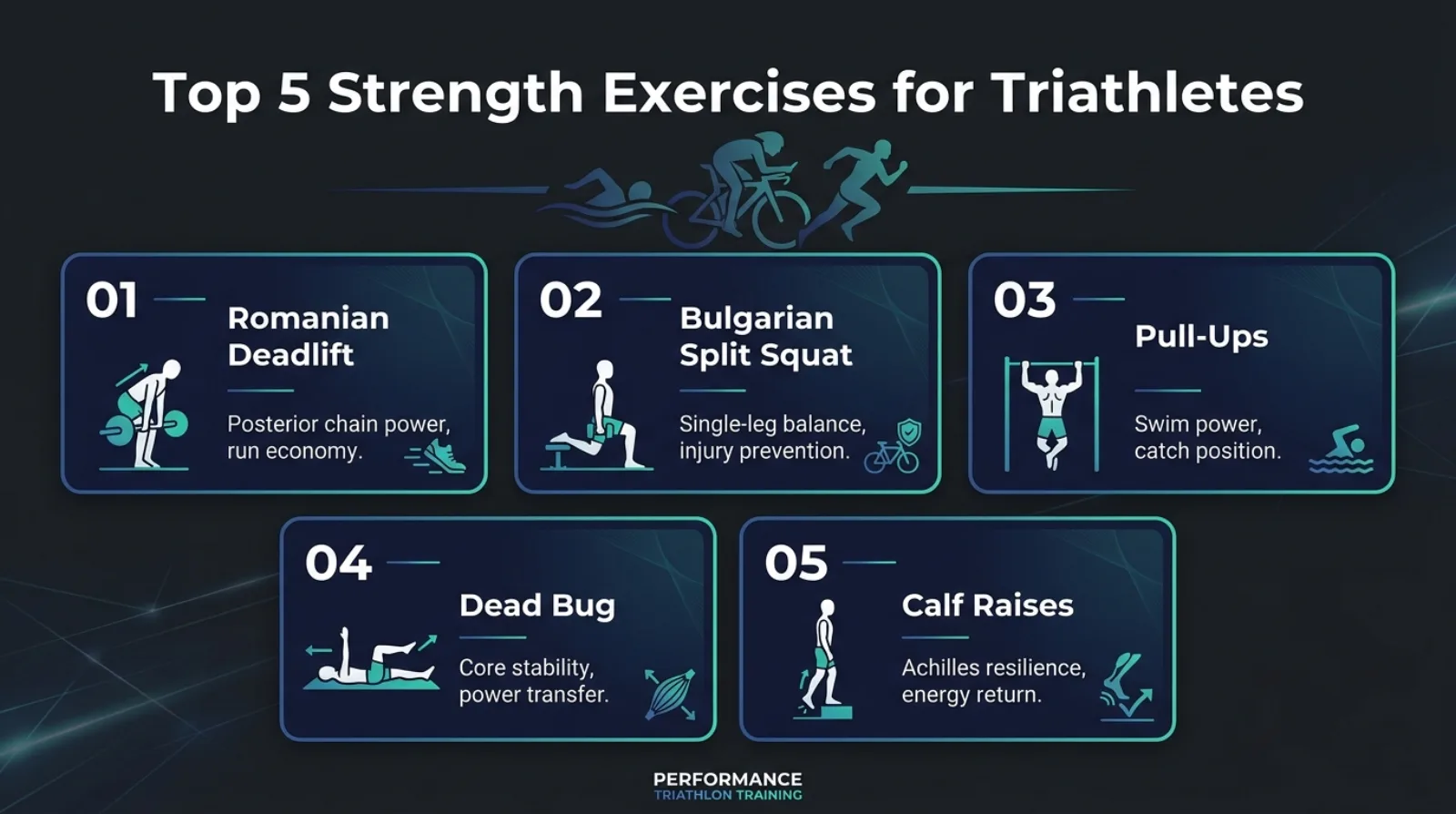
Here's why strength training for triathletes matters, and which five exercises you should treat as untouchable in your program.
Why Strength Training for Triathletes Is Different
Let's be clear: this isn't a generic fitness article. You're not training for aesthetics. You're not trying to bench press a small car. You're trying to finish a 140.6-mile race without your body betraying you somewhere on the run course — ideally not in front of cameras.
The science on strength training for triathletes is surprisingly clear. A 2019 meta-analysis published in Sports Medicine found that concurrent strength and endurance training improved running economy by 2–8% in trained endurance athletes. That's not nothing. That's the difference between holding pace on the Ironman run and doing the shuffle-walk-shuffle that haunts your finish-line photos.
The mechanisms are well understood. Stronger muscles generate more force per stride, delaying recruitment of less efficient fast-twitch fibers. Heavy resistance training increases musculotendinous stiffness — the "spring" in your step — which reduces energy expenditure with every footfall. And stronger stabilizing muscles mean better form preservation over 140.6 miles, which matters enormously when your running economy at mile 22 of a marathon looks nothing like mile 2.
The key is knowing which exercises actually transfer to the sport. Not every gym movement belongs in a triathlete's program. The five below do. Here's why.
Exercise 1: The Hip Hinge / Romanian Deadlift — The Posterior Chain King
If you're only going to do one strength exercise as a triathlete — and please don't limit yourself to one — make it the Romanian deadlift (RDL). This is the exercise that coaches, athletes, and researchers consistently put at the top of the list, and with good reason.
The RDL targets the entire posterior chain: glutes, hamstrings, lower back, and the stabilizing muscles of the hip. In a sport dominated by forward-direction repetitive movement, most triathletes develop chronically weak posterior chains relative to their quad-dominant cycling and running patterns. This imbalance is a one-way ticket to IT band issues, hip flexor tightness, and the kind of lower back fatigue that makes sitting in aero position feel like a medieval torture device by hour four of the bike.
The run economy connection is direct. Glute activation drives hip extension in the running stride. Weak glutes mean your hamstrings and lower back compensate — inefficiently. Research from the Journal of Strength and Conditioning Research shows that athletes who consistently trained heavy hip hinge movements improved both peak running speed and running economy, with benefits that persisted late into long-distance events when untrained athletes' form degraded.
How to program it: 2–3 sets of 6–8 reps at moderate-to-heavy load during your base and build phases. Do not schedule it the day before a long ride or key run — your hamstrings will unfriend you. Monday strength + Tuesday easy swim is a classic pairing. By race-specific phase, drop volume but keep the movement with lighter loads to maintain neuromuscular patterns without accumulated fatigue.
The triathlete's note: Don't ego-lift this. You're not a powerlifter. The goal is controlled hip hinge mechanics and posterior chain activation, not proving anything to the guy next to you who is definitely training for powerlifting and will be confused by your tri kit.
Exercise 2: Single-Leg Work — The Great Imbalance Corrector
Triathletes love bilateral symmetry on paper. In reality, most of us have one leg that does slightly more work than the other, and after years of cycling and running, these asymmetries compound into the kind of muscle imbalances that biomechanics coaches get very excited about and you experience as a nagging knee or hip.
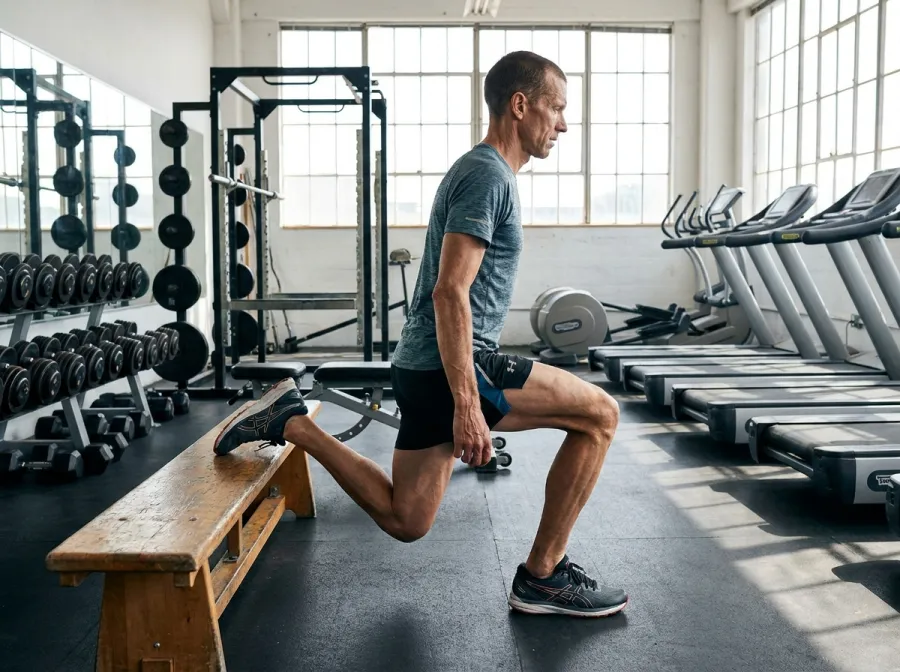
The Bulgarian split squat (rear-foot elevated split squat) is the exercise that systematically addresses this. By training each leg independently, you can't hide weaknesses behind your dominant side. It targets the quad, glute, and hip stabilizers in a single-leg stance that mimics the demands of the run gait — one leg at a time, just like actual running.
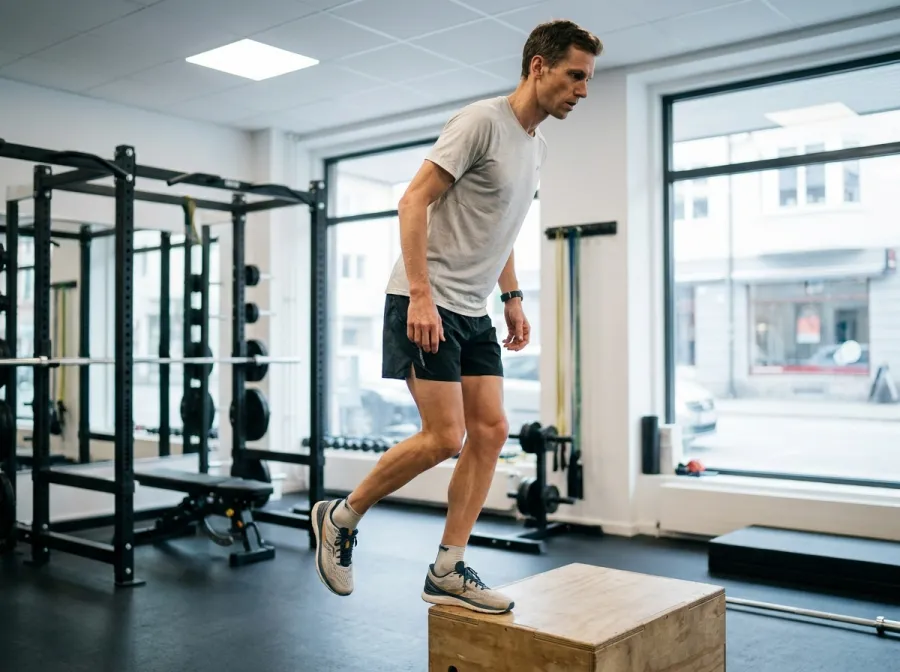
The step-up variation is another excellent option, particularly for athletes who find the Bulgarian split squat too aggressive on hip flexors early in a training block. Both movements train frontal plane stability that bilateral squats can't replicate — the side-to-side control that determines how efficiently your hips move during the run and how well you maintain position on the bike saddle over long efforts.
Injury prevention data is compelling. A study in the British Journal of Sports Medicine found that athletes who included single-leg strength work in their programs showed significantly reduced rates of lower limb overuse injuries compared to those who trained exclusively with bilateral movements. For triathletes accumulating massive repetitive-movement volume, this matters enormously.
How to program it: 2–3 sets of 8–10 reps per leg. Don't load heavily — the instability is the point. Add dumbbells once bodyweight feels controlled. Pair with your upper-body-dominant strength day to minimize leg fatigue heading into key bike/run sessions.
Exercise 3: Pull-Up / Lat Pulldown — Your Swim Power Multiplier
Ask most triathletes about their weakest discipline and they'll say swimming. Ask most triathletes about their gym upper body work and they'll look at you like you've suggested something unreasonable. These two facts are related.
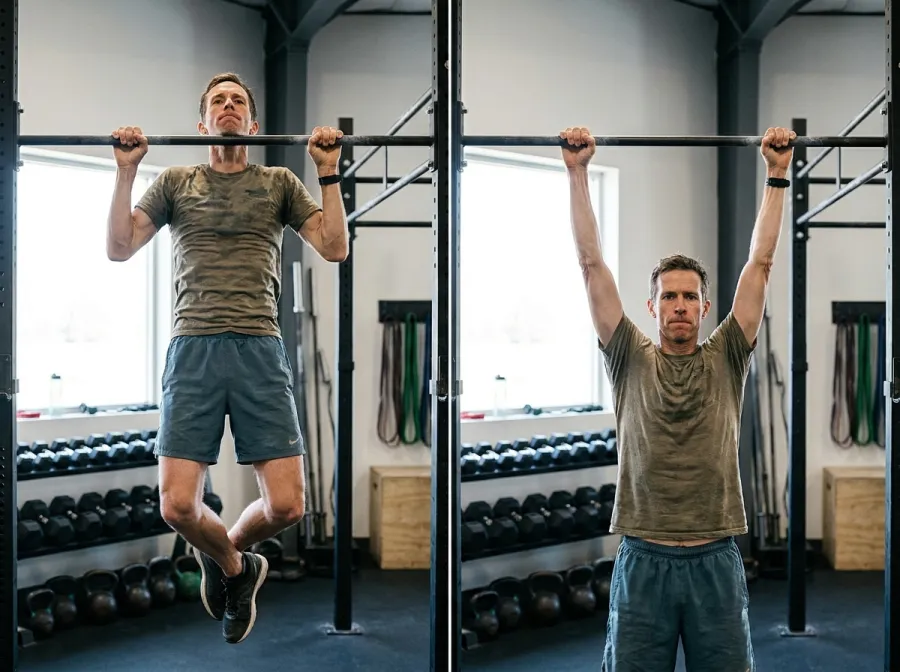
The pull-up (and its accessible cousin, the lat pulldown) develops the latissimus dorsi — the primary driver of the pull phase in freestyle swimming. The catch-and-pull is where swimming power comes from. When your lats are weak, your stroke falls apart under fatigue, your body rotation becomes inefficient, and you spend more energy going slower. It's a bad combination.
Beyond the pool, lat strength contributes to maintaining a stable aero position on the bike. Holding your torso in a low, aerodynamic position for four to six hours requires significant upper body muscular endurance. Athletes with stronger lats and upper back maintain aero position longer before defaulting to a more upright posture — and that upright drift costs watts.
There's also a breathing mechanics angle. Tight, weak lats restrict thoracic mobility, which compromises respiratory efficiency at high intensity. Training the lat through full range of motion maintains the thoracic extension needed for optimal lung capacity during hard efforts.
How to program it: If you can do pull-ups, aim for 3 sets of 6–8 quality reps with full range of motion. If you can't yet, the lat pulldown is a completely legitimate tool — no shame in it. Swim-specific programming often benefits from face pulls and horizontal pulling movements (rows) as well to balance the shoulder joint. 2x/week is plenty for most triathletes.
Exercise 4: Dead Bug / Core Work — The Glue That Holds Your Race Together
At mile 20 of the Ironman run, your body will try to negotiate with you. It will suggest that leaning forward at the waist is acceptable, that your hips can drop a little, that crossing your arms over the center line is fine. Every one of these compensations costs you energy and speed. The athletes who resist them longest are the ones who did their core work.
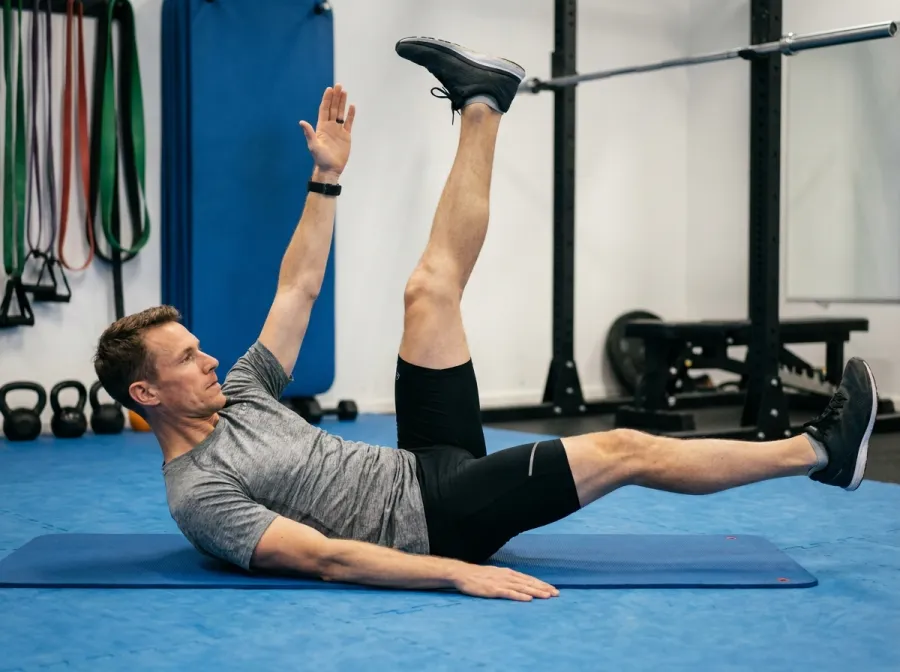
The dead bug is the exercise that specifically trains the deep core stabilizers — the transverse abdominis, multifidus, and internal obliques — that maintain lumbar position under load. Unlike crunches (which train the superficial rectus abdominis to do exactly nothing useful for triathletes), the dead bug teaches your core to resist extension while your limbs move. That's precisely what your body needs to do during every running stride for 26.2 miles after swimming 2.4 miles and riding 112.
The Pallof Press is another excellent option that trains anti-rotation — the core's ability to resist twisting forces. During the run, rotational forces increase with fatigue. Athletes who can resist these forces waste less energy on counterproductive movement and maintain more efficient running mechanics late in the race.
The cycling power transfer connection is equally important. Every watt you generate in the cycling position must transfer through your core. A stable, non-collapsing core means more of the power your legs generate reaches the pedals. A soft, unstable core is an energy leak — and in a long-course race, energy is everything.
How to program it: Dead bugs and Pallof presses can be done frequently — 3x/week is reasonable — because they don't generate meaningful muscle damage or fatigue. 3 sets of 8–10 reps each side is a solid starting point. Add them as a warm-up to your strength sessions or as a standalone 10-minute core block after easy runs.
Exercise 5: Calf Raises / Soleus Work — The Underrated Injury Shield
Nobody puts calf raises on their "never skip" list until they've had an Achilles tendon issue. After that, they talk about calf raises the way reformed smokers talk about cigarettes — with the fervent intensity of the newly converted.
The Achilles tendon absorbs and releases enormous forces during running — roughly 8–10x body weight with each foot strike. The calf complex (gastrocnemius + soleus) must be strong enough to manage those loads across thousands of repetitions. When it isn't, the tendon does extra work it's not designed for, and eventually it sends you a message in the form of sharp, morning-step pain that will ruin your entire training block.
Research published in the British Journal of Sports Medicine found that progressive eccentric calf loading — specifically the heel-drop protocol on a step — was effective for both prevention and rehabilitation of Achilles tendinopathy. For triathletes running high weekly mileage on top of cycling, calf strength is a genuine insurance policy.
The energy return dimension matters too. The Achilles functions as a spring — storing elastic energy during ground contact and releasing it during propulsion. Stiffer, stronger tendons store and release energy more efficiently, improving running economy. This is why strength training's effect on tendon properties is now considered one of the key mechanisms behind improved running economy in strength-trained endurance athletes.
How to program it: Single-leg calf raises, 3 sets of 15–20 reps per leg. For Achilles resilience, do them on a step with a controlled 3-second eccentric (lowering phase). Add a slight knee bend to target the soleus specifically — the deeper muscle that's often undertrained. This is genuinely low-fatigue work that can be done almost any day without affecting your run or bike sessions meaningfully.
When to Lift: Programming Strength Without Sabotaging Swim-Bike-Run
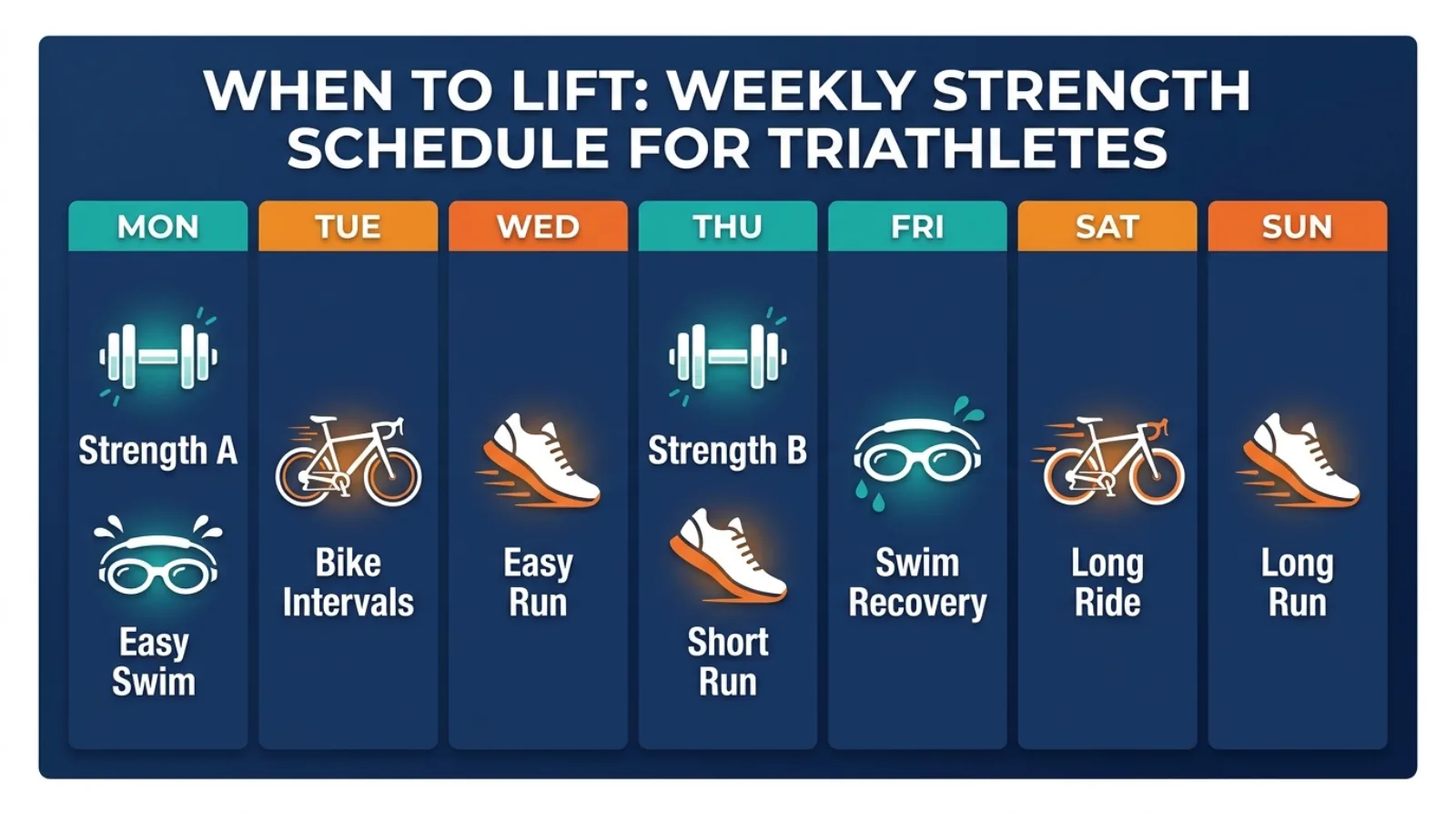
Here's where most triathletes go wrong with strength training for triathletes: they either skip it entirely or schedule it the afternoon before their long ride and then wonder why their legs feel like concrete for the first 40 miles.
The timing rules are simple:
- Never lift heavy the day before a key session (long ride, hard intervals, race-pace run). Give yourself at least 48 hours between heavy leg work and your most important training of the week.
- Pair strength with lower-priority swim or recovery days. Strength A (lower body focus — RDL, split squats, calf raises) pairs well with an easy or moderate swim. Strength B (upper body/core focus — pull-ups, dead bugs, Pallof press) can precede or follow almost any session.
- 2 sessions per week is the sweet spot for most age-group Ironman athletes. Research suggests this is sufficient to generate meaningful neuromuscular adaptation without creating excessive fatigue accumulation.
- Reduce volume approaching races, keep frequency. In race-specific training, drop to 1 session per week, reduce sets by ~40%, and keep loads moderate. The goal is maintenance, not progress. Stay out of junk fatigue.
Sets and reps guidance:
- Base phase: 3×8–10 at moderate load — building movement competency and baseline strength
- Build phase: 3–4×5–8 at heavier load — neuromuscular adaptation and peak strength gains
- Race-specific phase: 2×6 at moderate load — maintenance with minimal fatigue
One more rule: don't program strength after your hardest bike or run of the week. If you do a 5-hour ride Saturday, Sunday's long run is not the day to add a gym session. Your body has one job on Sundays: survive the long run and recover. Let it.
Strength Is the Fourth Discipline — Stop Treating It Like the Optional One
Here's the uncomfortable truth about triathlon: you're training three disciplines, but your competition is training four. The athletes who consistently perform well in Ironman events aren't just fit in the water, on the bike, and on the run — they've built the muscular foundation that lets them maintain form and efficiency when everything else is telling them to fall apart.
Strength work isn't sexy. It doesn't give you a Garmin file to post or a Strava segment to chase. Nobody's going to say "nice hip hinges this week" at your next group ride. But it's the work that keeps you healthy enough to do the volume you want to do, efficient enough to race at the level you're capable of, and resilient enough to make it to the finish line without the wheels coming off.
The five exercises in this article — the Romanian deadlift, the Bulgarian split squat, pull-ups, dead bugs, and calf raises — aren't a complete strength program. They're the core that experienced Ironman athletes have independently decided is non-negotiable. They survived the triage. They kept working when everything else got cut.
You don't need to spend three hours a week in the gym. You need 45–60 minutes, twice a week, with purpose. Your swim split, your bike power, your run economy, and your Achilles tendon will all thank you — even if your training log doesn't have a category for it yet.
Add the fourth discipline. Stop treating it like the option you drop when life gets busy. It's not optional. It's the thing that makes the other three sustainable.


