
Triathlon has a strange relationship with pain. Ask any age-grouper about their training and they'll happily tell you about the hill repeats that made them nauseous, the open water swim where a jellyfish became a personal rival, or the century ride that ended with them face-down on their handlebars at a gas station. What they're much less likely to mention is the dull ache behind their kneecap they've been ignoring since March, or the shoulder that's started clicking on every third stroke. Triathletes are excellent at pushing through discomfort and remarkably bad at admitting when discomfort has quietly become an injury.
That's a problem, because this sport is uniquely good at manufacturing them. You're loading three different movement patterns onto the same body, often in the same week, sometimes in the same session. The swim beats up your shoulders. The bike beats up your lower back and hip flexors. The run beats up basically everything below your waist. Stack all three and you get a level of cumulative stress a single-sport athlete never has to manage — which is exactly why the injuries below account for the overwhelming majority of triathlon seasons that end early, quietly, and avoidably.
A quick note before we start: this is a training guide, not a diagnosis. If something hurts sharply, hurts at rest, or isn't improving, see a sports physiotherapist instead of self-treating off an article — including this one.

Why Triathletes Get Hurt (It's Rarely One Big Thing)
Almost nobody blows out a knee jumping off a curb. Triathlon injuries build slowly, from repeated load that outpaces your body's ability to adapt and recover. Physiotherapists call this an overuse pattern, and it's the dominant injury type across the sport — not a single dramatic event, but weeks of a small imbalance compounding into a real problem. The classic trigger is a training load spike: you add a long ride, a hard brick, and a race simulation run in the same week because the race is close and you're feeling fit. Your fitness says yes. Your connective tissue, which adapts far more slowly than your cardiovascular system, says otherwise.
The general safety net is the 10% rule — don't increase your weekly volume (in any single discipline) by more than about 10% from one week to the next. It's not a law of physics, but it's a genuinely useful guardrail, and violating it is the single most common thread running through the five injuries below.
Swimmer's Shoulder (Rotator Cuff Impingement)
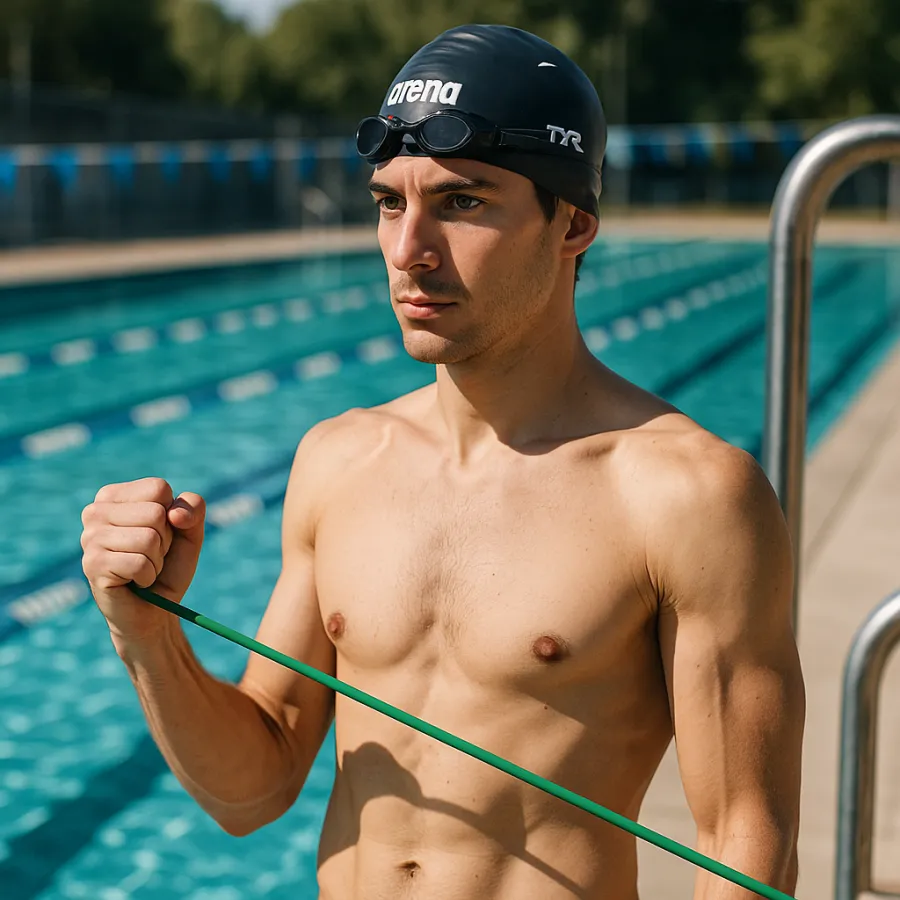
Swimmer's shoulder shows up as an ache during the catch phase of your freestyle stroke — right as your hand enters the water and starts pulling — that can progress to a shoulder that aches at rest and gets worse reaching overhead. It's caused by repetitive overhead motion combined with the rounded, internally-rotated shoulder posture that hours in the aero position and hunched over a laptop both encourage. High swim volume without technique correction is the accelerant: triathletes swimming 15,000–20,000 meters a week with a mediocre catch are prime candidates, and it's a genuinely common problem in competitive swimming generally.
Prevention is mostly about counteracting the forward, rounded posture that cycling and desk life build into your shoulders, and strengthening the small rotator cuff muscles that stabilize the joint during the stroke:
- Band external rotation: elbow at 90°, band at elbow height, 3 sets of 15 reps, slow and controlled (2 seconds out, 2 seconds back)
- Band pull-aparts: 3 sets of 15, opens the chest and activates the muscles between your shoulder blades
- Wall slides: 3 sets of 10, forearms on the wall, slide arms upward while staying in contact — this wakes up the muscles responsible for rotating your shoulder blade properly overhead
- Side-lying Y-T-W raises: 3 sets of 15 with light dumbbells, targets scapular stability directly
Do these two to three times a week, and if you can get your stroke reviewed by a coach or filmed underwater, do it — a lot of shoulder pain traces back to a catch that's crossing the midline or a stroke that's rotating too little through the torso.
Runner's Knee and IT Band Syndrome
These two get confused constantly because they both show up in the knee and both get worse with running, but they're distinct problems with the same root cause. Runner's knee (patellofemoral pain syndrome) is a diffuse ache behind or around the kneecap that's worse going down stairs, and sometimes comes with a grinding sensation. IT band syndrome is sharper and more specific — a stabbing pain on the outside of the knee that tends to show up 20–30 minutes into a run, right around 30 degrees of knee flexion, forcing you to stop.
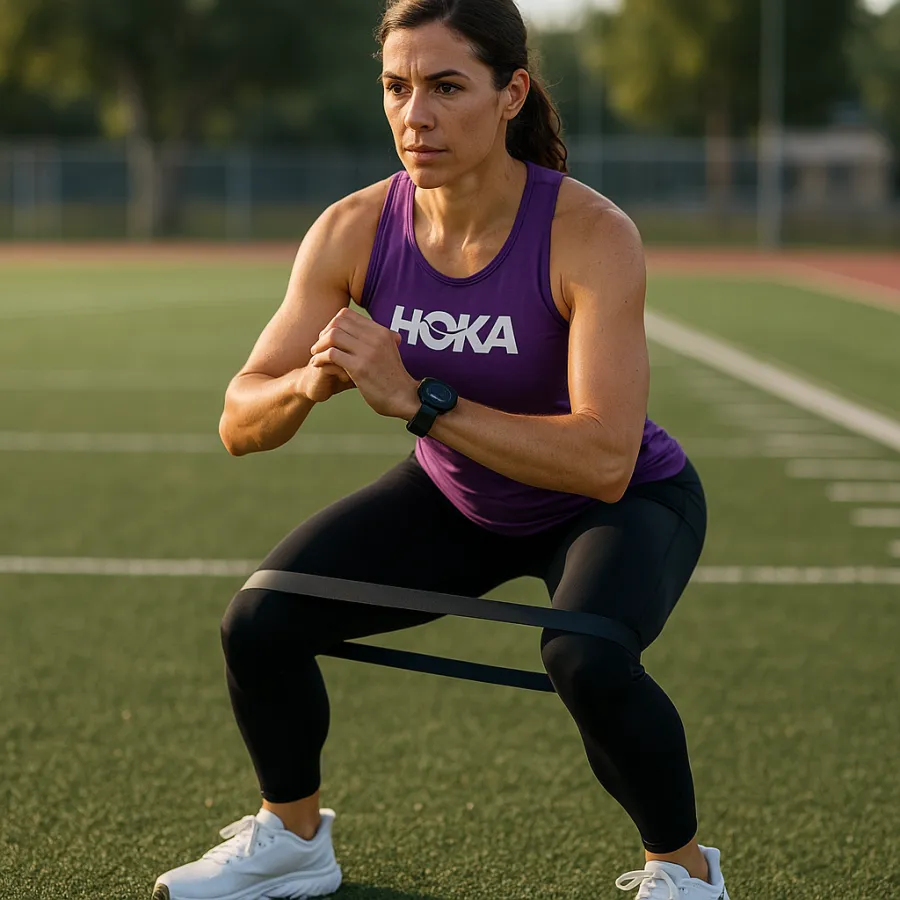
Both trace back overwhelmingly to weak glutes and hip abductors. When your hip stabilizers can't do their job, your knee collapses slightly inward on every stride, and something downstream — the kneecap tracking or the IT band rubbing across the femur — ends up absorbing the consequences. Training load spikes make it worse; hip weakness makes it inevitable.
- Lateral band walks: 3 sets of 20 steps each direction, band above the knees, stay low
- Single-leg squats: 3 sets of 12 per side, slow and controlled — this is harder than it sounds and that's the point
- Glute bridges: 3 sets of 15, pause at the top and squeeze
- Copenhagen adductor holds: 3 sets of 30 seconds per side — unglamorous but effective for hip stability
For the IT band specifically, foam roll the glutes and outer hip, not the band itself — rolling directly over an already-irritated IT band tends to make things angrier, not calmer. And respect the 10% rule; this is the injury most directly tied to "I felt great so I added 8 miles this week."
Achilles Tendinopathy
The tell here is stiffness and pain in the Achilles that's worse first thing in the morning or after sitting for a while, and that actually loosens up somewhat once you get moving — which is exactly what makes it dangerous, because it tricks people into training through it. It's typically triggered by a sudden jump in run volume or intensity, or by switching too quickly from a heavily cushioned trainer to a minimal or racing flat.
This one does not respond well to being ignored, and it does not resolve fast — insertional Achilles tendinopathy (pain right where the tendon meets the heel) tends to take 12–16 weeks to fully settle with proper loading, while mid-portion tendinopathy (pain higher up the tendon) is more like 8–12 weeks. That's not a typo, and it's exactly why catching it early matters so much.
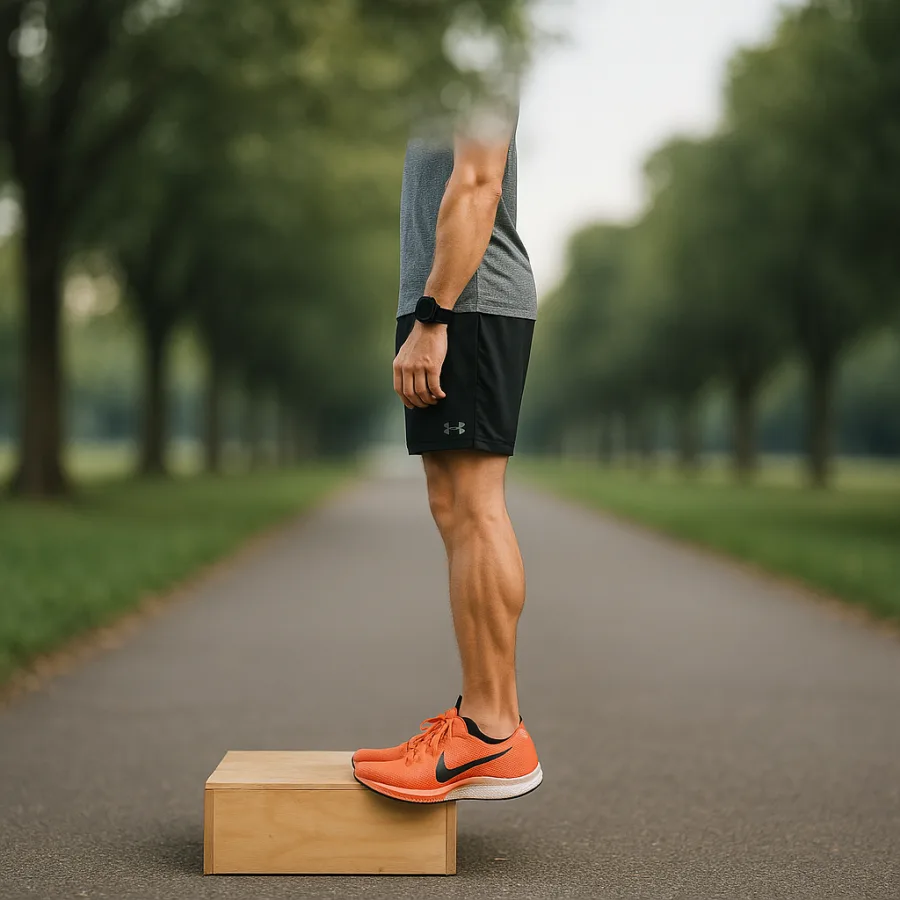
The single best-supported prevention and early-treatment tool is the eccentric calf raise — the slow, controlled lowering phase is what actually reloads the tendon correctly:
- Eccentric calf raises: 3 sets of 15, off the edge of a step, 3-second count on the way down — daily, not just on run days
- Single-leg calf raise progression: once double-leg raises feel easy, move to single-leg for a bigger training stimulus
- Load management: introduce new shoes and new intensity separately, not in the same week
Skip the aggressive static stretching here — pulling on an already-irritated tendon tends to aggravate it rather than help it.
Lower Back Pain From the Aero Position
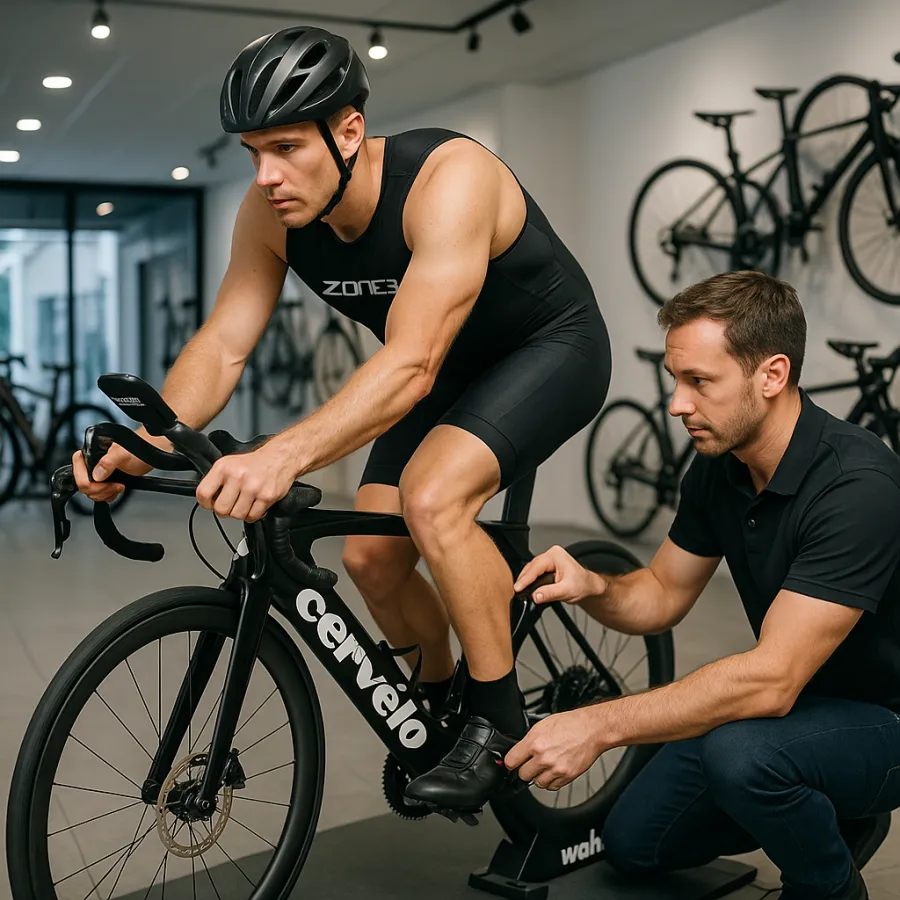
Hours spent hunched into an aggressive aero position load your lower back and shorten your hip flexors in a way running and swimming don't undo. Add race-day fatigue, and a lower back that was merely tight in June can turn into a genuine problem by September. This one is also the injury most directly tied to equipment rather than just training load — a bike fit that puts you in a position you can't actually hold without compensating through your spine will get you every time, no matter how strong your core is.
- Dead bugs: 3 sets of 10 per side — anti-extension core work that directly supports your position on the bike
- Hip flexor stretch: 60-second static holds per side, post-ride, not pulsed
- A professional bike fit: genuinely non-negotiable if you're spending serious hours in an aero position — this is the one injury on this list where a piece of gear adjustment can matter more than an exercise
The Weekly Habits That Actually Prevent All of This
None of the five injuries above are exotic. They're the predictable output of a few repeatable mistakes, which means they're also predictably preventable:
- Respect the 10% rule on weekly volume increases, in every discipline — this is the single highest-leverage habit on this list
- Get a proper bike fit before you rack up hundreds of aero-position hours, not after your back starts complaining
- Rotate and replace running shoes before they're visibly dead, and introduce new pairs gradually rather than switching cold on a long run
- Do dedicated strength and prehab work twice a week, even 20 minutes — the exercises above cover the highest-incidence failure points in the sport
- Don't stack your hardest sessions across disciplines in the same 48 hours without a reason — a hard bike, a hard swim, and a hard run in three consecutive days is asking for trouble
- Prioritize sleep during heavy training blocks — recovery capacity, not just training stimulus, is what determines whether load turns into fitness or turns into an injury
One more thing worth saying plainly: if you notice your training load creeping up while your appetite, energy, or (for women) your cycle start behaving strangely, that's not a niggle to foam-roll away — it's a fueling problem, and it needs a sports dietitian or physician, not a training tweak.
When to Stop Guessing and See a Professional
Self-treatment off a training article — again, including this one — has limits. Get an actual assessment if:
- Pain is sharp, sudden, or came on during a single session rather than building gradually
- Pain is present at rest, not just during training
- Pain changes your gait, your stroke, or your bike position to compensate
- Two to three weeks of the prevention work above hasn't moved the needle at all
A sports physiotherapist can differentiate runner's knee from IT band syndrome, or a stress reaction from garden-variety shin soreness, in a single visit with a gait or stroke analysis — something no article, including a very thorough one, can actually do for you.
The Takeaway
If you only take one thing from this: the two exercises that cover the most common failure points in triathlon are lateral band walks and eccentric calf raises. They're unglamorous, they take about ten minutes combined, and they directly address the hip weakness and tendon overload behind the majority of triathlon injuries. Add them to your week now, while nothing hurts, and you'll spend a lot more of this season racing and a lot less of it explaining to your training partners why you're on the sidelines again.


