

You've just come off a 180km ride followed by a 20km run. Your legs are not angry — they're filing a formal legal complaint. The kind of fatigue that sits in your quads and calves isn't going anywhere on its own overnight, and by tomorrow morning your training schedule doesn't care how you feel. You have a swim session at 6am.
This is why compression boots exist. They are not a luxury item. They are not something you use once and stick under the bed. For triathletes logging 10+ hours per week — especially in the deep build phases before a 70.3 or full Ironman — pneumatic compression is one of the most well-supported recovery modalities available. The science is solid, the results are measurable, and the athletes using them consistently are getting to their next session fresher than the ones who aren't.
We've dug into the full 2026 market. Here are the five systems worth owning.
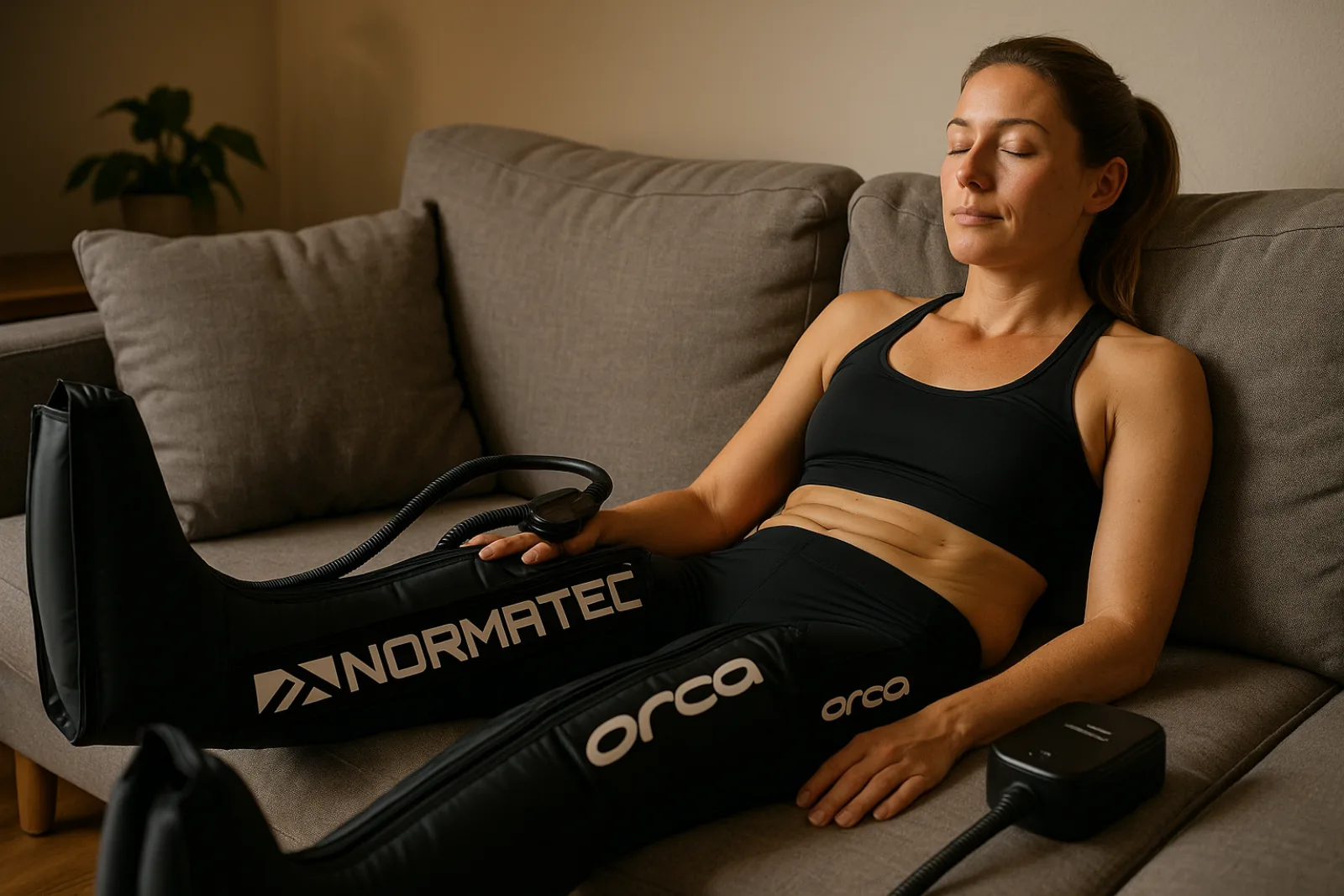
Why Compression Boots Work (And Why This Isn't Just Marketing)
Pneumatic compression works by systematically inflating and deflating air chambers around the legs in a sequential pattern that mimics the action of the lymphatic system. It pushes deoxygenated blood and metabolic waste — lactate, cytokines, the general biochemical wreckage of hard training — up and out of the legs, while simultaneously improving circulation of fresh, oxygen-rich blood back into tired muscle tissue.
The clinical evidence has been building for years. Multiple peer-reviewed studies have demonstrated that pneumatic compression reduces perceived muscle soreness and DOMS after high-intensity exercise, accelerates creatine kinase clearance (a marker of muscle damage), and improves subsequent performance in repeat-bout scenarios. For triathletes training across three disciplines simultaneously, that last point is not academic — it's the difference between a quality track session on Wednesday and a garbage one.
The practical protocol is simple: 20–40 minutes post hard session or before sleep, at a medium compression level for general recovery. Most athletes who start using boots consistently report noticeably fresher legs within the first two weeks. The ones who don't notice are usually using the wrong settings, not using them long enough, or are undertrained enough that passive rest does the same job.
What to Look For Before You Spend $500+
- Compression pressure range: You want adjustable levels across at least 5–7 settings, ranging from ~25 mmHg (gentle) to 100+ mmHg (aggressive). The ability to fine-tune matters — race week recovery feels different from day-after-brick recovery.
- Number of overlapping zones: More zones = more specific and effective sequential compression. Four zones is the minimum; five overlapping zones is noticeably better. ZoneBoost (Normatec) lets you target one specific zone for extra attention.
- Wireless vs. wired: Wired systems with an external control unit work fine at home. If you travel regularly for races and training camps, a wireless system saves you significant bag-packing grief.
- Battery life: 3 hours is standard. Most athletes run 20–30 minute sessions, so that's 6–9 sessions per charge — fine for most. If you share the device or run back-to-back sessions, longer matters.
- Coverage: Full-leg boots (hip to foot) are standard. Some systems offer hip attachments, arm sleeves, or targeted calf units. For triathletes, full leg is almost always the right choice.
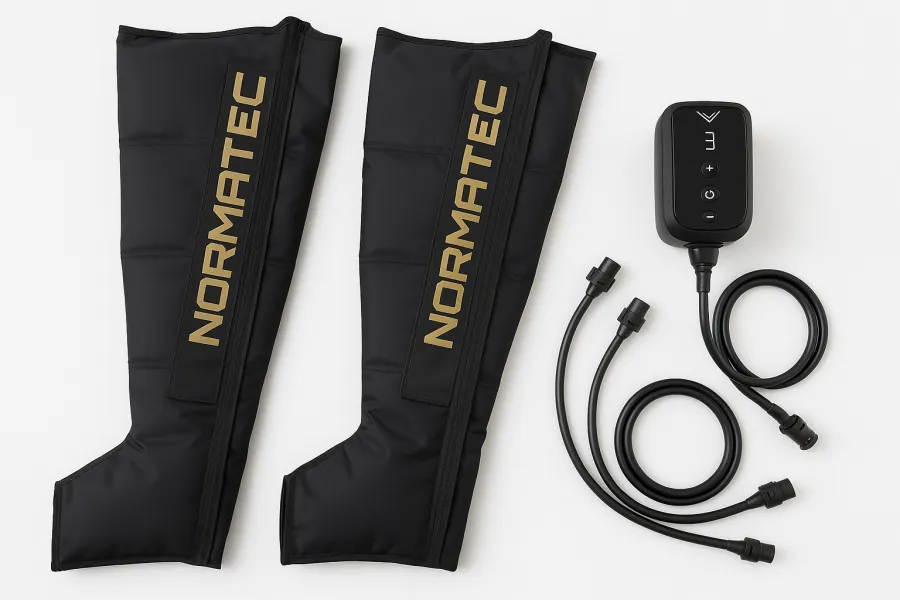
The 5 Best Compression Boot Systems for Triathletes in 2026
1. Hyperice Normatec 3 Legs — Best Overall
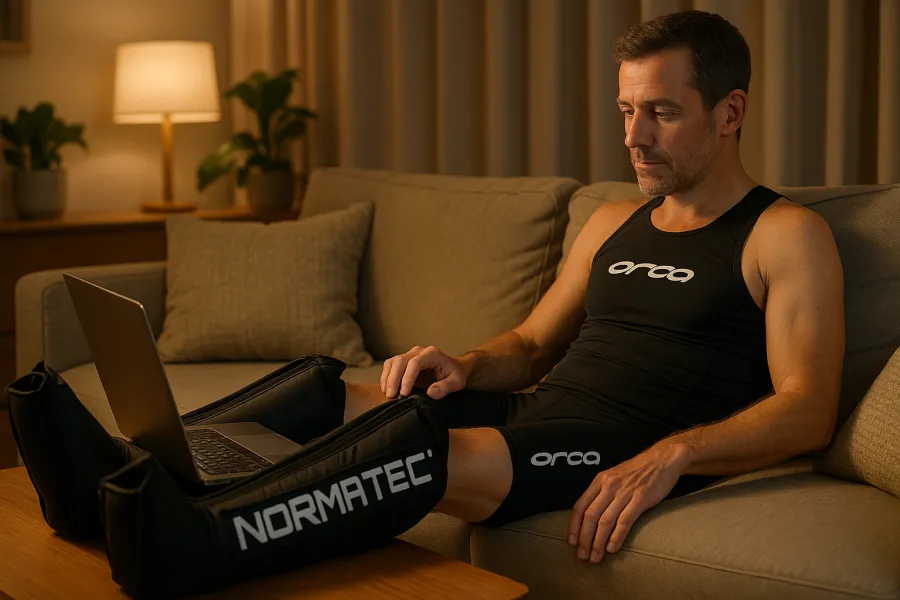
The Normatec 3 Legs is the system most professional triathletes and coaches point to when someone asks what they use. It's been refined through multiple generations, and the third generation hits the right balance of performance, customization, and reliability that makes it the default recommendation for serious age-groupers.
The core technology: five overlapping compression zones across the full leg, from foot to upper thigh. The proprietary Pulse technology creates a biomimetic compression pattern — not a simple inflate-deflate, but a dynamic peristaltic action that actually moves fluid up the leg in sequence. ZoneBoost allows you to select any individual zone for an extra compression pass, which is useful when you have one specific trouble spot (typically the calf or quad after a hard session).
Compression is adjustable across seven levels up to approximately 100–110 mmHg. The control unit is compact and connects via Bluetooth to the Hyperice app, where you can fine-tune sessions, access guided recovery routines, and track usage. Battery life on the control unit runs about 3 hours. The leg sleeves themselves are made from durable ripstop material with easy-clean interiors and sturdy zippers that hold up to daily use.
The system does require an external control unit and connecting hoses, which some athletes find inconvenient for travel. A carry case is sold separately, which is a minor annoyance at $699. Neither issue affects the performance, which remains class-leading.
- Zones: 5 overlapping | Pressure: 7 levels, up to ~110 mmHg | Battery: ~3 hrs | Connection: Bluetooth + Hyperice app
- ✅ ZoneBoost targeted compression
- ✅ Most customizable session control available
- ✅ Proven over multiple generations of refinement
- ✅ Durable, professional-grade build
- ❌ Requires external control unit + hoses
- ❌ Carry case sold separately
Price: ~$699 | Available on Amazon and Hyperice.com
2. Therabody RecoveryAir JetBoots Prime — Best for Portability
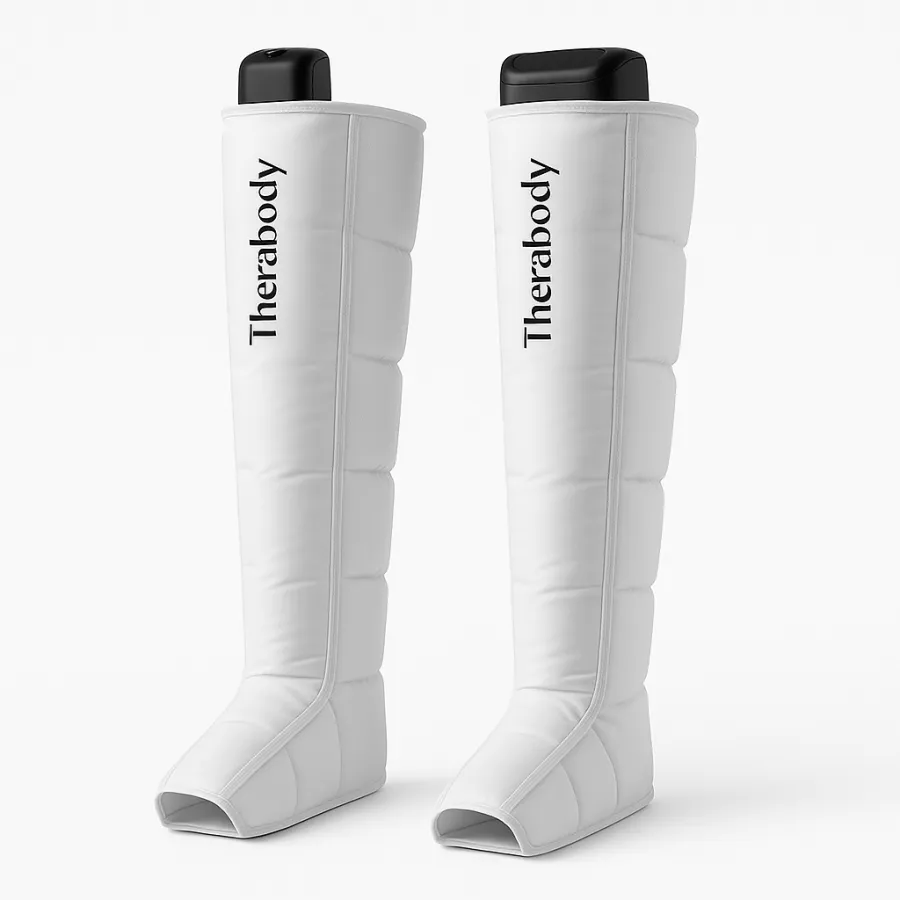
The JetBoots Prime is what happens when someone at Therabody looked at a compression boot setup and asked "why is there a box attached to this by tubes?" The integrated pump design eliminates the external control unit entirely — the pump mechanism is built directly into the boots. You zip in, tap the Therabody app, and you're running. There are no hoses to tangle, no separate unit to pack, and no setup ritual that makes you feel like you're prepping for minor surgery.
For athletes who travel to races regularly, this is a meaningful practical advantage. The JetBoots Prime packs flat into a carry-on, doesn't require a TSA inspection of a separate control box, and sets up in under 60 seconds in a hotel room the night before a race.
Performance is genuinely solid: four compression zones, four pressure levels (25, 50, 75, 100 mmHg), two pre-set programmes (Warm-up and Recovery), and about 3 hours of battery life. The compression cycle feels faster and firmer than the Normatec 3 — Therabody boots inflate quickly and with authority, which some athletes prefer for the more aggressive sensation.
The tradeoff is customization. Four zones versus Normatec's five, and four pressure levels versus Normatec's seven. For most age-groupers, the difference is academic. For athletes with very specific recovery needs or high training volumes, it may be worth the $150 premium the Normatec 3 commands.
- Zones: 4 | Pressure: 4 levels (25–100 mmHg) | Battery: ~3 hrs | Connection: Therabody app (Bluetooth)
- ✅ No hoses, no external unit — fully wireless
- ✅ Best-in-class portability for travel
- ✅ Fast, firm compression feel
- ❌ Less zone customization than Normatec 3
- ❌ Fewer pressure levels
Price: ~$549 | Available on Amazon and Therabody.com
3. Therabody RecoveryAir Pro — Best for Customization at This Price
The RecoveryAir Pro sits above the JetBoots Prime in Therabody's lineup and adds meaningful customization: five individually controllable overlapping compression zones (matching Normatec), a wider pressure range of 20–100 mmHg, and more granular session control via the Therabody app. It also ships with a carrying case, which earns points after the Normatec case situation.
The Pro uses a traditional control unit and hose setup rather than integrated pumps, which slightly reduces the portability advantage the JetBoots line offers. Battery life comes in at 3–4 hours. The construction is high quality with seamless interior material that cleans easily and resists the particular combination of sweat and general grimness that accumulates in daily-use recovery gear.
At ~$649–699, it sits at roughly the same price point as the Normatec 3 and the comparison is direct. Both offer five overlapping zones and similar customization depth. The RecoveryAir Pro compresses faster and firmer; the Normatec 3's ZoneBoost is more precise for targeted work. Choosing between them comes down to whether you prefer Hyperice's app ecosystem or Therabody's, and which compression feel you personally respond better to. Neither is wrong.
- Zones: 5 overlapping | Pressure: 20–100 mmHg | Battery: 3–4 hrs | Connection: Therabody app
- ✅ Five zones matches Normatec at similar price
- ✅ Case included
- ✅ Fast compression cycle
- ❌ External control unit (less portable than JetBoots)
- ❌ No ZoneBoost equivalent
Price: ~$649–699 | Available on Amazon and Therabody.com
4. Hyperice Normatec Elite — Best Premium Wireless Option
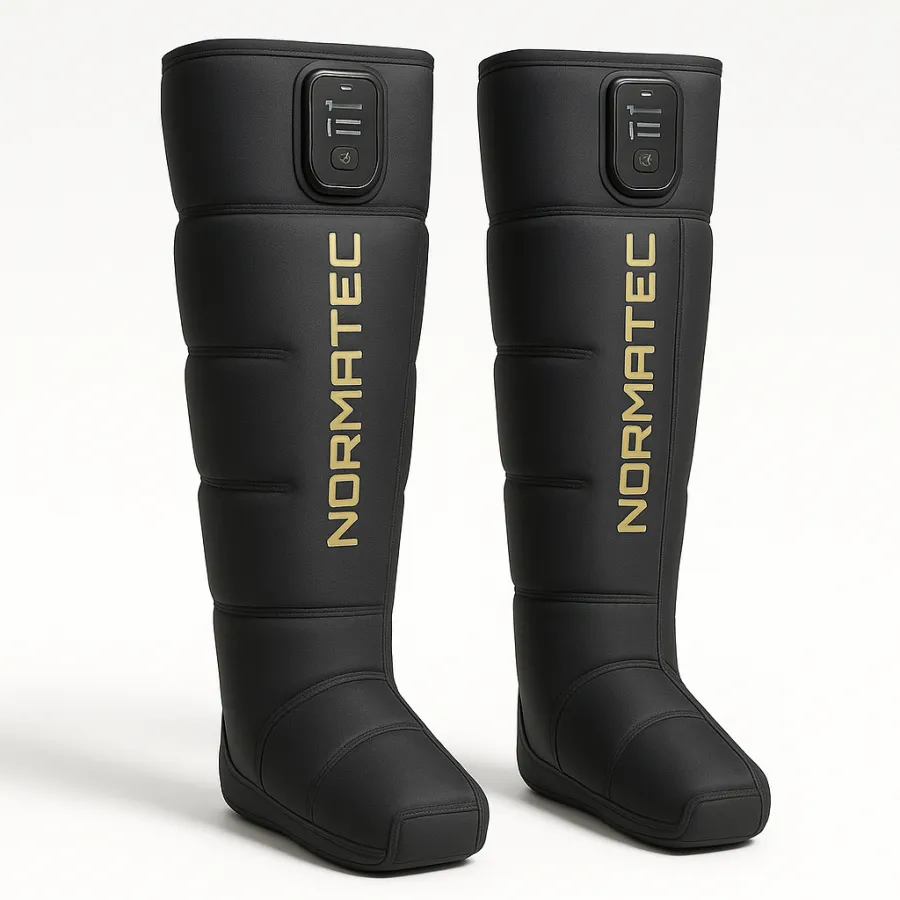
The Normatec Elite is the PRO Plus of compression boots — it takes the Normatec 3's already excellent feature set and eliminates the one remaining inconvenience: the external control unit. The Elite integrates controls directly into the boot, removes all hoses, and ships with a TSA-approved carry case. It is the fully wireless Normatec experience, and it costs accordingly at ~$999.
The underlying compression technology is identical to the Normatec 3: five overlapping zones, ZoneBoost targeting, seven pressure levels up to 110 mmHg, and Hyperice app integration. The difference is purely form factor — more portable, neater setup, more expensive. For athletes who already own a Normatec 3 and love it, the Elite is a nice upgrade but not a necessary one. For athletes buying new who travel frequently and want the best wireless experience available, it earns its price.
- Zones: 5 overlapping | Pressure: 7 levels, up to ~110 mmHg | Battery: ~3 hrs | Connection: Wireless + Hyperice app
- ✅ Full Normatec 3 performance — fully wireless
- ✅ TSA-approved carry case included
- ✅ Cleanest setup experience on the market
- ❌ $999 is a significant spend
- ❌ Over-specced for athletes who only use at home
Price: ~$999 | Available on Amazon and Hyperice.com
5. Air Relax Plus — Best Budget Entry Point
Not everyone can or should spend $700 on compression boots their first time through. The Air Relax Plus is the answer for triathletes who want to validate whether compression boots actually change their recovery before committing at the premium tier — or for those whose training budget has already been absorbed by a new wetsuit and a bike fit.
At ~$189–229, the Air Relax Plus delivers four overlapping zones, four compression levels up to 230 mmHg (higher maximum pressure than the premium brands, though athletes rarely use maximum levels), and a simple push-button control unit. No app, no Bluetooth, no ecosystem. You press a button, boots inflate, legs recover, done.
It works. The compression is effective, the build quality is reasonable for the price, and users report meaningful recovery benefits at the same level as premium products when used consistently. What you give up: precision in zone targeting, app integration, ZoneBoost-style focused treatment, and the refined design quality of Normatec and Therabody. For athletes testing the category, these tradeoffs are entirely acceptable. Upgrade later if the boots earn their place in your routine.
- Zones: 4 | Pressure: 4 levels, up to 230 mmHg | Battery: N/A (AC powered) | Connection: Manual control unit
- ✅ Fraction of premium brand price
- ✅ Effective at validating whether boots work for you
- ✅ Higher max pressure ceiling than premium brands
- ❌ AC power only — not portable
- ❌ No app, no zone targeting, basic controls
- ❌ Build quality reflects the price
Price: ~$189–229 | Available on Amazon
Which System Should You Actually Buy?
Best overall for most triathletes: Hyperice Normatec 3 Legs. The combination of five overlapping zones, ZoneBoost targeting, and proven performance across multiple generations earns the recommendation. The hose setup is a minor inconvenience. The recovery benefit is not minor.
Best if you travel for races: Therabody RecoveryAir JetBoots Prime. No hoses, no drama, packs flat. The $150 you save versus the Normatec 3 doesn't hurt either.
Best premium wireless: Normatec Elite. If you want the Normatec experience without any setup friction and budget is not an issue, this is the device.
Best to test the category: Air Relax Plus. Don't spend $700 before you know you'll use it. Buy this, use it for a month, and upgrade when you realise you've been reaching for it every day.
The Protocol That Gets Results
Owning compression boots and using them optimally are different things. Most athletes underuse them. The protocol that works:
- Post hard sessions: 20–30 minutes at medium pressure (50–75% of maximum) within 2 hours of finishing. Don't overthink the timing — just do it before bed if nothing else.
- Race week: 30–40 minutes at low-medium pressure (25–50%) in the evenings from Sunday through Thursday. Reduce to 15 minutes on Friday and nothing the day before. You're flushing without creating additional stimulus.
- Recovery weeks: Daily 20-minute sessions at whatever pressure feels best. Recovery weeks are where the adaptation happens — don't neglect the recovery tools during them.
- Do not use at maximum pressure all the time: Higher is not better. Excessive pressure can cause discomfort and isn't more effective. Start at 50%, adjust up to your personal threshold, and stay there.
The athletes who get the most out of compression boots are the ones who build it into their routine with the same discipline they bring to swim technique drills. Your body adapts to the training load you give it — but only if you give it the recovery infrastructure to do so. The boots are part of that infrastructure. Use them.


