

My first heat-training summer, I showed up to a noon track session in July convinced that fitness would carry me through anything. It didn't. I was hitting splits I'd normally hold for tempo work at what felt like a full sprint, my heart rate was pinned twenty beats above where it should've been, and I spent the cooldown lying in the shade of a bleacher genuinely unsure if I was going to be sick. Heat doesn't care how many hours you've logged. It just taxes everything harder, and the athletes who train through it well aren't tougher, they're better equipped.
That's the part nobody tells you when they say "just acclimatize." Acclimatization is real and it works, but it takes weeks, and in the meantime you still have to survive the sessions that get you there. The right gear doesn't replace heat adaptation. It buys you the ability to keep training hard enough, long enough, to actually adapt. Here's what's actually worth owning, based on what the physiology says works and what triathletes I know actually reach for.
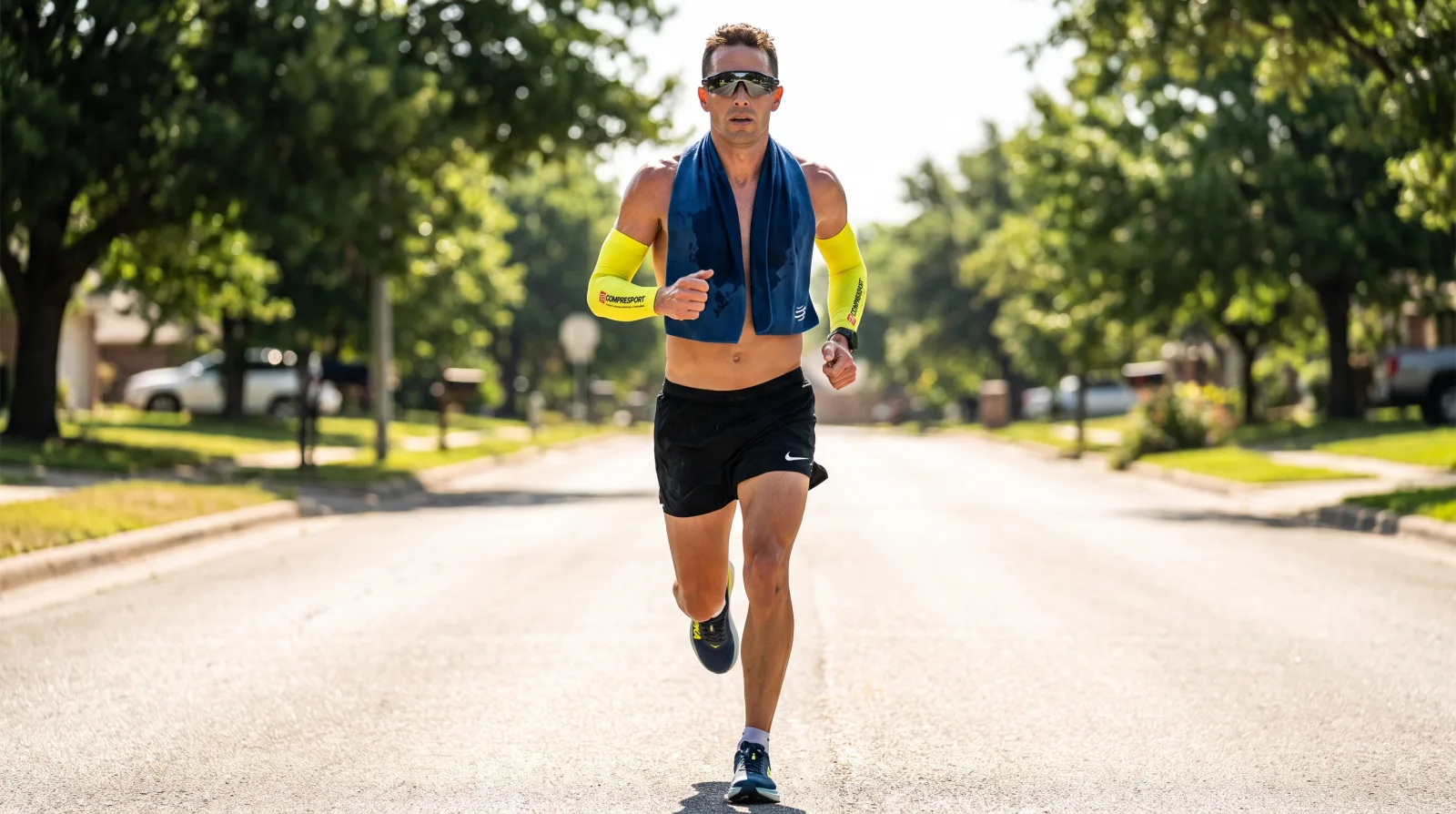
What Actually Cools You Down, Physiologically
There are three real mechanisms at play: evaporative cooling (sweat, or wet fabric, evaporating off skin and pulling heat with it), conductive cooling (direct contact with something colder than your skin, like ice), and internal cooling (lowering core temperature from the inside, mainly through ice slurry or very cold fluids). Everything on this list works through one of those three paths. Products that promise vague "cooling technology" without falling into one of these categories are usually selling marketing, not physics.
Pre-cooling before a session and cooling during a session are also different problems with different best tools. A vest packed with ice works great sitting in the shade for twenty minutes before you start. It becomes dead weight once you're twenty minutes into a run and it's warmed to skin temperature. Match the tool to the moment, not just the marketing copy on the box.
Humidity changes the math on all of this. Evaporative cooling depends on sweat or wet fabric actually being able to evaporate, and in dry heat that happens fast, which is why a soaked towel feels almost cold to the touch within a minute of putting it on. In humid conditions, the air is already saturated and evaporation slows down dramatically, so the same wet towel does less work and dries out slower, which sounds like a win until you realize it's barely cooling you at all. If you're training somewhere genuinely humid, lean harder on conductive cooling (ice, cold packs) and internal cooling (electrolytes, cold fluids) rather than expecting evaporative gear to save you the way it would in a dry desert heat.
The Gear Worth Owning
1. Frogg Toggs Chilly Pad Cooling Towel: The One Everyone Should Just Buy
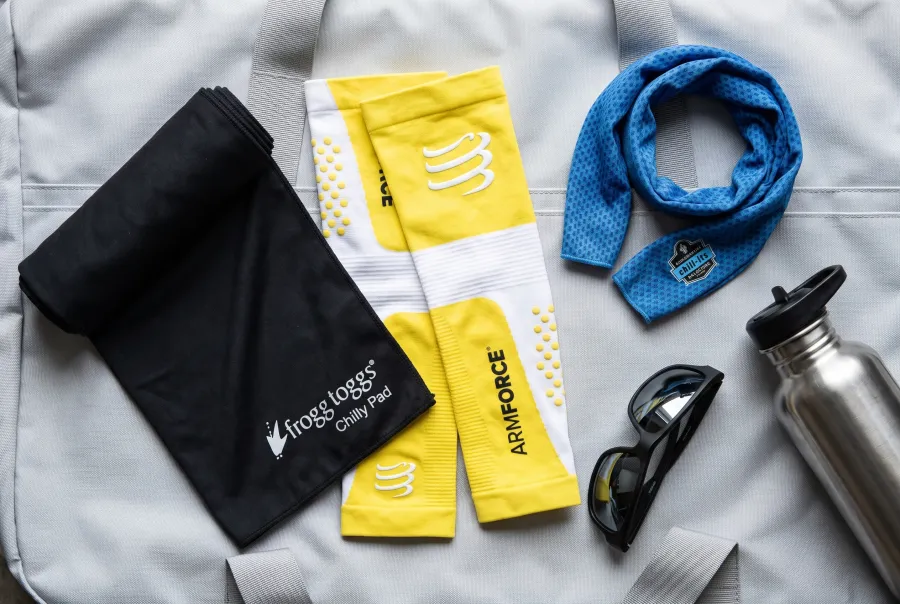
At $16.99, this is the single highest-value item any triathlete training through summer can own. It's a thin, PVA-based synthetic chamois-style material that holds far more water than it looks like it should, and stays cold-to-the-touch through evaporation for a genuinely long time once soaked. Wring it out, snap it once to shed the drip, and drape it around your neck, over your head, or across your shoulders. Re-wet it at any water fountain, hose, or aid station and it reactivates instantly.
I keep one in my gym bag, one in the car, and one in my transition bag for race mornings, because at this price there's no reason to ration them. The only real limitation is that it does eventually dry out on long sessions without access to water, which is where a neck wrap with more sustained retention earns its spot lower on this list.
- Price: $16.99 | 33" x 13" | UPF 50+
- ✅ Cheap enough to own three
- ✅ Reactivates instantly with any water source
- ❌ Needs re-wetting on runs longer than 60–90 minutes in full sun
2. Compressport ArmForce Ultralight: Best for Long Rides and Runs
Arm sleeves feel counterintuitive to anyone raised on the idea that bare skin breathes better. In direct sun, that logic is backwards. Wet fabric sustains evaporative cooling far longer than exposed, quickly-drying skin, and the Compressport ArmForce Ultralight is built specifically around that principle: a stitch-free, ultra-thin microfibre weave with light compression that keeps the fabric wicking sweat outward while shielding your arms from UV.
Soak them before you put them on for hot-weather sessions rather than waiting for sweat alone to do the job. That first few minutes of aggressive evaporative cooling matters, especially on a bike leg where you're not generating the same airflow you'd get running. The light compression is a genuine secondary benefit on long rides, not just marketing filler; my forearms feel noticeably less fatigued gripping the aero bars after four-plus hours with a pair on versus bare skin.
- Price: ~$30 | UV protection, light compression, stitch-free knit
- ✅ Sustains evaporative cooling far longer than bare skin in direct sun
- ✅ Doubles as UV protection on long exposed rides
- ❌ Some athletes find any forearm compression distracting on the run; try before race day
3. Ergodyne Chill-Its 6603 Cooling Neck Wrap: The Budget Backup
This one is almost embarrassing to recommend at $5.55, because it works better than the price suggests it should. It's a PVA evaporative band, similar chemistry to the Frogg Toggs towel but shaped specifically to wrap and stay put around the neck, rated for up to four hours of cooling relief per soak. The neck carries major blood vessels close to the surface, which makes it one of the most efficient places on your body to apply external cooling, and this wrap sits there without sliding around the way a loose towel eventually does on a run.
Buy two or three. At this price there's genuinely no argument not to, and having a spare pre-soaked in a cooler at an aid station or a support crew stop means you're never stuck with a dried-out wrap for the back half of a long session.
- Price: $5.55 | Up to 4 hours cooling per soak | UPF 50+
- ✅ Cheapest genuinely effective item on this list
- ✅ Stays put better than a draped towel
- ❌ Smaller surface area means less total cooling capacity than a full towel
4. Arctic Heat Cooling Vest: Pre-Cooling Before the Session Starts
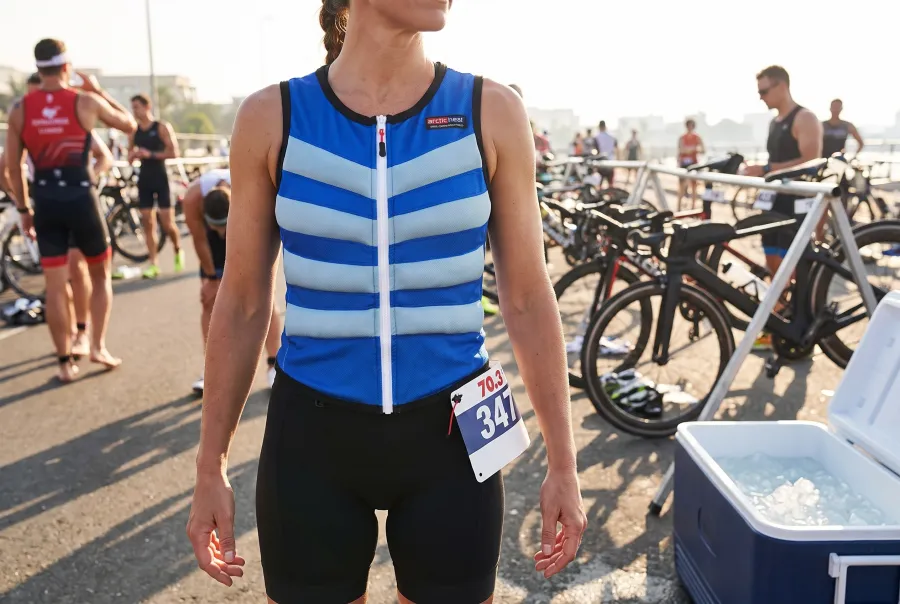
This is the specialist tool on the list, and it's specialist for a reason. The Arctic Heat vest uses gel panels that swell when soaked in water, then hold a deep chill for one to two hours once frozen or packed in an ice slurry. Wear it through warm-up and the last few minutes before a hard session or a race start, then hand it off. Research on pre-cooling backs this up consistently: dropping core temperature by even half a degree before you start delays the point at which heat becomes the limiting factor, and that effect shows up most in the back half of a run.
Where people misuse this vest is wearing it into the session itself, hoping it'll keep helping. It won't. Once the gel warms to skin temperature, the thermal gradient that made it useful disappears, and a warm, damp vest strapped to your torso just traps heat instead of shedding it. Treat this strictly as a pre-cooling tool, take it off at the start line or the first few minutes of a session, and it earns its $180 price tag. Worn the wrong way, it's an expensive way to overheat slightly slower.
- Price: $180 | Stays cold 1–2 hours when frozen | Reusable gel panels
- ✅ Meaningfully lowers core temperature before hard efforts or races
- ✅ Used by pro triathletes and cyclists at major championship events
- ❌ Expensive, and useless (or counterproductive) once it warms up mid-session
5. SaltStick FastChews: Cooling From the Inside Out
External cooling only gets you so far if your electrolyte balance is falling apart underneath it. Sweat rate climbs hard in heat, and sodium losses climb with it. SaltStick FastChews deliver 100mg of sodium, 30mg of potassium, 10mg of calcium, and 6mg of magnesium per two-tablet serving, absorbed partly through the tissue in your mouth before they even hit your stomach, which matters when your gut is already struggling to prioritize digestion over cooling and working muscle.
Half of r/triathlon treats electrolyte chews as a placebo; the other half won't train a hot long run without them. My honest read after enough heat sessions to have an opinion: they're not magic, but under-salting in heat is a real, common failure mode, and a $19.99 bottle of chews is cheap insurance against a problem that ends sessions early far more often than people realize.
- Price: $19.99 for 60 count | 100mg sodium per 2-tablet serving
- ✅ Fast absorption, easy to use mid-session with no mixing
- ✅ Genuinely addresses a real failure mode in heat training, not just a symptom
- ❌ Doesn't lower skin or core temperature directly; this is a supplement, not a cooling device
6. O2COOL Deluxe Misting Fan: Post-Session Relief That Actually Works
This one is for the fifteen minutes after you stop, not the session itself. It's a small, battery-powered handheld fan with a built-in misting bottle, and it's genuinely more effective at cooling you down post-workout than either a fan alone or water alone, because it combines airflow with evaporative cooling in one motion. Fill it, aim it at your face and neck while you're stretching or walking the cooldown, and the difference versus just standing in the shade is noticeable within a minute.
At roughly $12.99, it's not a training performance tool so much as a comfort and recovery one, but recovery quality compounds. Feeling less wrecked in the twenty minutes after a brutal heat session makes it easier to actually eat, hydrate properly, and show up for the next one.
- Price: ~$12.99 | Battery-powered, up to 1,000 mists per fill
- ✅ Combines airflow and evaporative cooling in one device
- ✅ Genuinely useful for post-session recovery, not just gimmicky
- ❌ Not something you'd use mid-run; strictly a before/after tool
How I'd Actually Build a Kit
If you're only buying one thing, buy the Frogg Toggs towel. It's the cheapest item here and covers the widest range of situations. If you're training through a genuinely brutal summer and want to do this properly, the combination that's worked best for me is arm sleeves for anything over 90 minutes outdoors, a neck wrap as backup for aid stations and long rides, the electrolyte chews for anything past an hour in real heat, and the vest reserved specifically for race mornings and the hardest scheduled sessions where pre-cooling is worth the setup.
The misting fan is the one item here that's genuinely optional. Nice to have, not going to change your training outcomes. Everything else on this list addresses a real physiological problem that heat creates, and none of it is expensive enough to justify skipping.
Worth noting by discipline: none of this matters for the swim, obviously, water does the cooling for you there. It's the bike and the run, especially a brick session stacking both back to back, where core temperature climbs unchecked and this gear actually earns its keep. If you only have budget or bag space for the bike-run portion of a session, that's where to spend it.
What Gear Can't Fix
None of this replaces actual heat acclimatization, which takes roughly ten to fourteen days of consistent exposure to start showing real adaptations in plasma volume and sweat response. Gear buys you the ability to keep showing up for those sessions without a session ending early or turning into a medical event. It doesn't shortcut the adaptation itself.
It also doesn't replace paying attention to your own body. Dizziness, confusion, or a stopped sweat response in the heat are signs to stop, not signs to reach for another cooling towel. Every product on this list is here to help you train smart in the heat, not to help you ignore it.
What's actually in your bag for the hot months? I'm curious whether the neck wrap or the arm sleeves get more real-world use once people actually own both, because on paper they solve overlapping problems and I'd guess most people end up reaching for one far more than the other.


