

You just finished a five-hour brick. Your calves have the structural integrity of overcooked pasta. Your IT band is tuned to a frequency that could shatter glass. Your glutes — well, your glutes have filed a formal complaint with HR.
This is not a problem that a foam roller and some wishful thinking can solve. This is a problem that requires serious hardware. Percussive therapy — the rhythmic hammering of a massage gun into reluctant muscle tissue — has gone from niche professional tool to standard-issue triathlete gear in the last few years, and for good reason. The science backs it up, the pros swear by it, and once you've used a quality device on your calves the night before a long run, you'll wonder how you survived without it.
We've tested and researched the field extensively to bring you the six best massage guns for triathletes in 2026. Budget picks, premium picks, travel picks — all of it covered. No nonsense.
Why Triathletes Actually Need Percussion Therapy
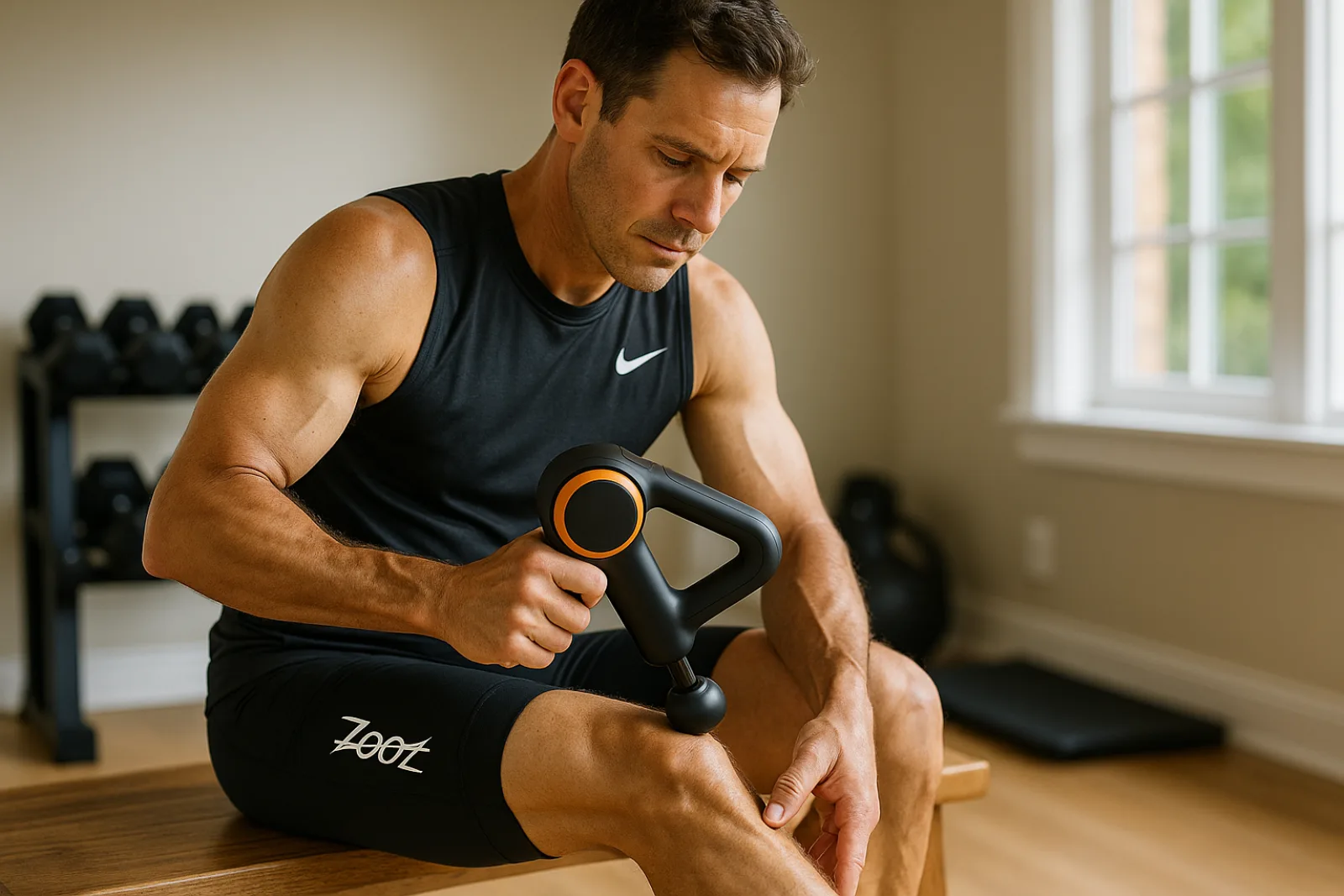
Most endurance athletes treat recovery like a suggestion. You train, you eat, you sleep, and you assume your body will just sort itself out. It will — eventually. Percussive therapy accelerates that process by mechanically stimulating blood flow to overworked tissue, breaking up fascial adhesions, reducing DOMS, and calming down the nervous system's hypersensitivity to deep-tissue pressure.
For triathletes specifically, the calves, hamstrings, hip flexors, and glutes take the most punishment. After a 90-minute open water swim, a 120km ride, and a half-marathon run, you've basically put those muscles through a wood chipper. A quality massage gun lets you address each of those muscle groups in 10–15 minutes, systematically and effectively, without needing a physio on call 24/7.
The research is solid. Studies have shown percussive therapy reduces delayed onset muscle soreness (DOMS) by up to 30% compared to passive rest, and improves range of motion in the hours following treatment. Translation: your next training session starts from a better baseline. Over a 20-week Ironman build, that compounds into meaningful performance gains.
What to Look For Before You Buy
- Amplitude (stroke depth): This is how far the head travels into the muscle — the most important spec. 12mm is adequate for general use; 16mm gets into deep tissue properly. Don't cheap out on this.
- Stall force: How much pressure you can apply before the motor stalls out. Below 30 lbs and it gives up when you actually push into a tight spot. 40–60 lbs is the range you want.
- Battery life: Anything under 2 hours per charge is annoying on a daily-use device. Look for 2.5+ hours; swappable batteries are a bonus.
- Noise: Relevant if you're using it in a hotel, early morning, or while your partner is asleep three feet away. Hypervolt wins on noise; Theragun wins on power.
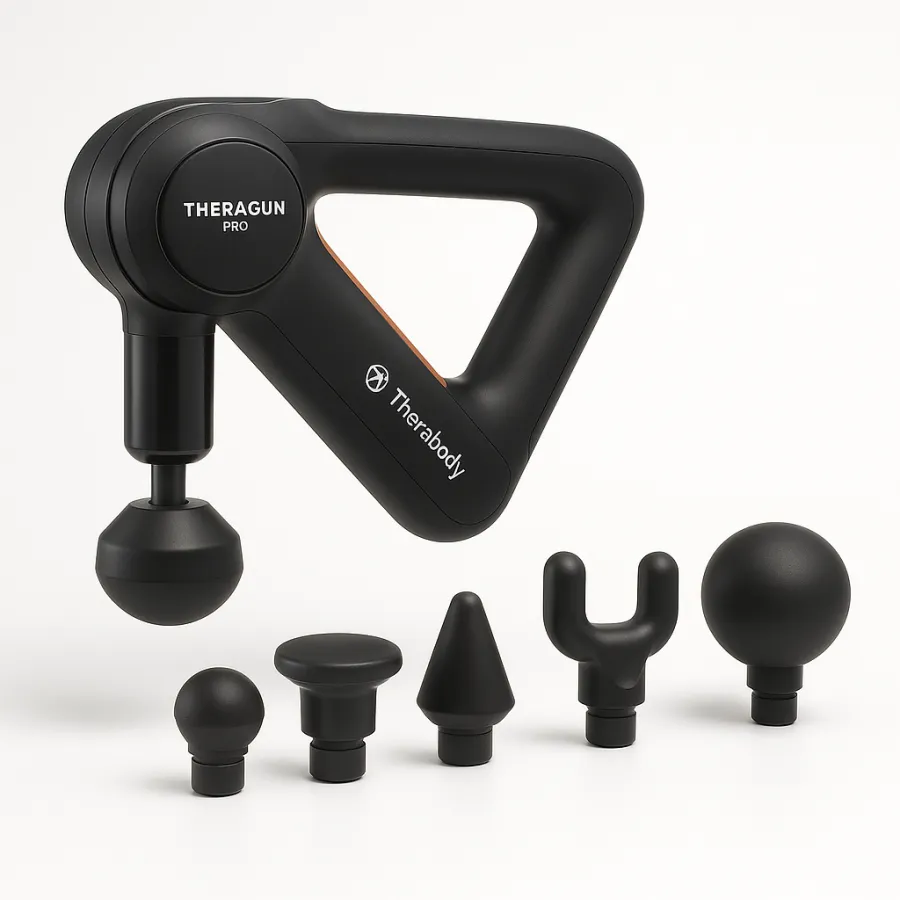
- Attachment heads: A standard ball head handles 90% of use cases. A flat head for large muscle groups, a bullet/cone for pinpoint trigger points, and a fork head for Achilles/spine work round out a complete set.
- Ergonomics: You're reaching behind your own back to hit your upper traps. If the handle design makes that awkward, you'll use it less. Theragun's rotating arm solves this; most competitors don't.
The 6 Best Massage Guns for Triathletes in 2026
1. Theragun PRO Plus (G6) — Best Overall
If you're serious about recovery and budget is not a dealbreaker, the Theragun PRO Plus is the device to own. The sixth-generation PRO is the most capable percussive therapy tool on the market by a meaningful margin — and Therabody knows it, which is why they charge accordingly.
The headline specs: 16mm amplitude, 60 lbs of stall force, and a motor that doesn't flinch when you really lean into a knotted glute. It also integrates heat and vibration therapy modes, EMG sensors that detect muscle tension and automatically adjust intensity, and Bluetooth app connectivity for guided recovery protocols. The rotating arm and multi-grip handle mean you can reach the middle of your back unassisted — a feature that sounds minor until you've actually had to use a foam roller for your thoracic spine at 6am before a swim session.
The battery situation is excellent: two swappable 150-minute batteries ship in the box, giving you 5 hours of combined runtime before anything needs charging. The included attachments cover every use case — standard ball, dampener, thumb, wedge, cone, and supersoft heads.
The downsides are real. It's expensive at ~$599. It weighs 2.6 lbs, which becomes noticeable in long sessions. And despite improvements over previous generations, it's louder than the Hypervolt lineup. None of these kill the recommendation. This is the best massage gun available in 2026 for athletes who use their recovery tools seriously.
- Amplitude: 16mm | Stall Force: 60 lbs | Battery: 150 min × 2 | Speeds: 5 (1750–2400 PPM)
- ✅ Best deep tissue penetration on the market
- ✅ Rotating arm for hard-to-reach areas
- ✅ EMG sensors auto-adjust intensity
- ✅ Heat + vibration modes built in
- ❌ Expensive (~$599)
- ❌ Heavier than competitors
Price: ~$599 | Available on Amazon and Therabody.com
2. Hyperice Hypervolt 2 Pro — Best for Daily Use
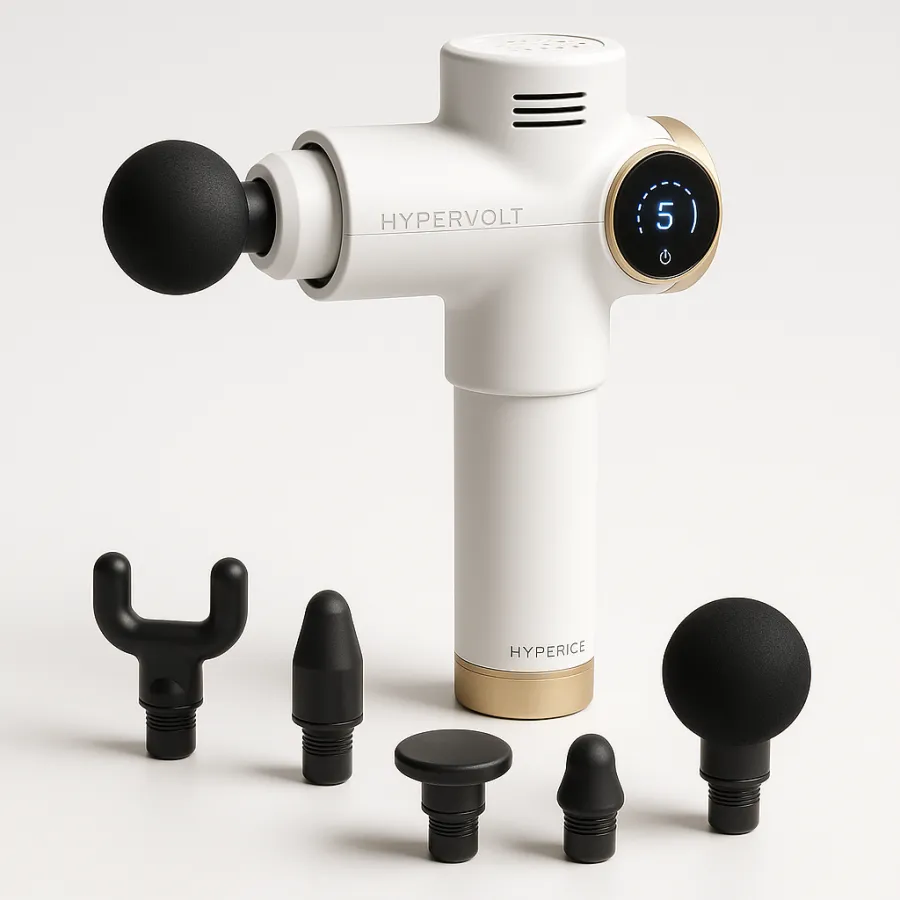
The Hypervolt 2 Pro is the massage gun most triathletes actually use every day, because it's quiet enough to not disturb anyone within 10 feet of you and powerful enough to do serious work. Where the Theragun PRO Plus is the device you pull out when you need maximum intervention, the Hypervolt 2 Pro is the one you use consistently — and consistency beats intensity in recovery just as much as it does in training.
Specs: 14mm amplitude, roughly 45 lbs of stall force, five speed settings up to 2,700 RPM, and a pressure sensor that lights up when you're applying optimal force. The digital speed dial on the back is a nice touch — no button cycling, just a dial. Five detachable head attachments ship in the box. Hyperice app connectivity enables guided routines from physios and athletes.
Battery life is solid at around 3 hours per charge on a single battery. The overall form factor is comfortable, balanced, and doesn't fatigue the hand in extended sessions. At ~$299, it occupies a price point that feels genuinely earned rather than inflated.
Where it falls short: the 14mm amplitude and ~45 lbs stall force mean it's not the right tool for your most stubborn deep-tissue problems. For a trained calf on a 30-hours-per-week athlete, it can plateau. The handle also doesn't rotate, making the mid-back harder to reach. For most age-groupers training 10–15 hours per week, it doesn't matter.
- Amplitude: 14mm | Stall Force: ~45 lbs | Battery: ~3 hrs | Speeds: 5 (1800–2700 RPM)
- ✅ Significantly quieter than Theragun
- ✅ Excellent balance and ergonomics
- ✅ Best for consistent daily use
- ❌ Less amplitude than Theragun PRO
- ❌ No rotating arm
Price: ~$299 | Available on Amazon and Hyperice.com
3. Theragun Elite — Best Mid-Range
The Theragun Elite is what happens when you want Theragun performance without the PRO Plus price tag. You give up the swappable batteries, the EMG sensors, the heat and vibration modes, and two of the attachment heads. What you keep: the 16mm amplitude and 40 lbs of stall force that make Theragun devices effective in the first place, plus the multi-grip handle and rotating arm.
For most triathletes who want Theragun-level deep tissue work without writing a $599 check, the Elite at ~$299 is the honest answer. The per-session performance is nearly identical to the PRO Plus for the muscle groups you'll actually hit most — calves, hamstrings, quads, glutes. Where the PRO Plus earns its premium is in the extras (heat, EMG, dual batteries) that only become meaningful at high training volume.
- Amplitude: 16mm | Stall Force: 40 lbs | Battery: 120 min | Speeds: 5
- ✅ Full 16mm amplitude at half the PRO Plus price
- ✅ Rotating arm included
- ✅ OLED screen with force meter
- ❌ Single battery, no heat/vibration modes
- ❌ Heavier than Hypervolt at this price
Price: ~$299 | Available on Amazon and Therabody.com
4. Ekrin Athletics B37v2 — Best Value
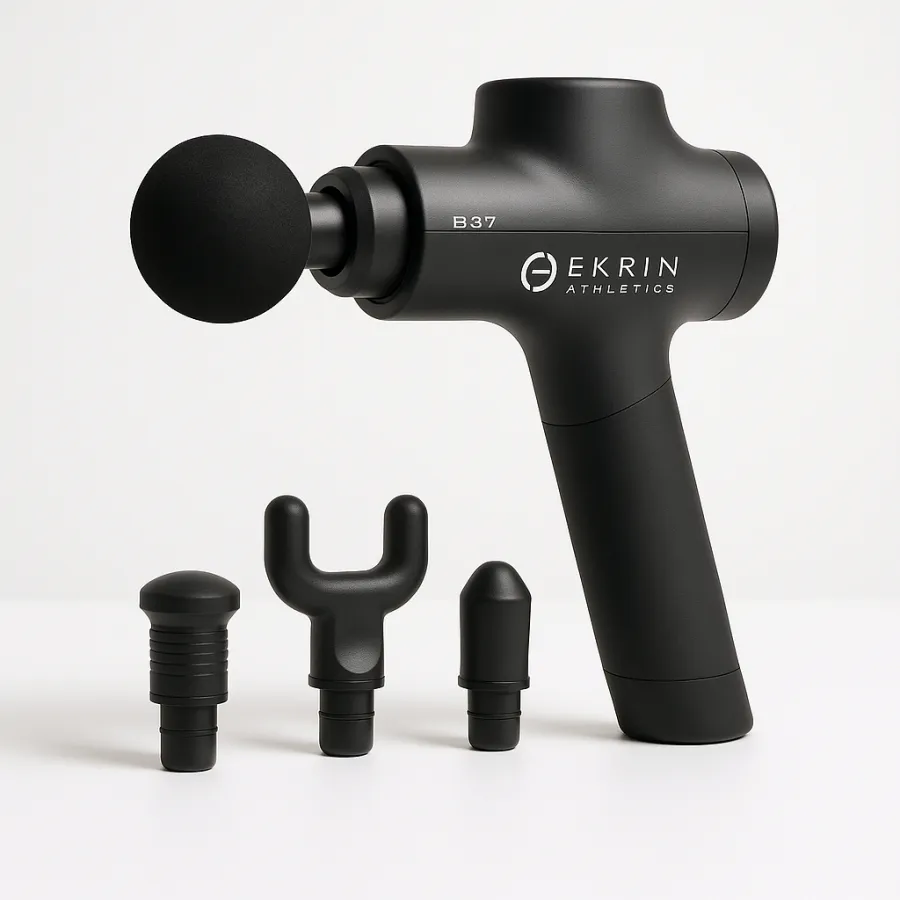
The Ekrin B37v2 is the recovery industry's best-kept secret, and triathletes who've found it tend to become obnoxiously evangelical about it. Here's why: 56 lbs of stall force (more than the Hypervolt 2 Pro), 12mm amplitude, and an 8-hour battery life — all at around $149. That battery life isn't a typo. Eight hours. You will forget to charge it and it will still be alive when you remember.
The angled handle design is different from the gun-grip style common in competitors, and it works well for reaching behind the shoulder and into the upper back. Four speeds, four attachment heads, and a 1-year warranty round out a package that genuinely overdelivers at this price point.
The tradeoff: 12mm amplitude is functional but not the 16mm you get from premium Theragun devices. For deep plantar fascia work or truly locked-up hip flexors after a 180km ride, you'll feel the difference. For everyday maintenance? Most triathletes won't notice.
- Amplitude: 12mm | Stall Force: 56 lbs | Battery: 8 hrs | Speeds: 4
- ✅ Outstanding value — serious specs at under $150
- ✅ 8-hour battery is class-leading
- ✅ 56 lbs stall force beats most mid-range competitors
- ❌ 12mm amplitude falls short of Theragun's 16mm
- ❌ Smaller brand means less physio integration/app ecosystem
Price: ~$149 | Available on Amazon and EkrinAthletics.com
5. Bob and Brad C Pro — Best Budget Pick
Bob and Brad make a name for themselves by building surprisingly capable devices at a price point that makes you skeptical before you pick one up. The C Pro at ~$89–99 includes hot and cold attachment heads — a feature you'd typically pay $300+ to access on a premium device. The cold head is useful for acute inflammation right after a race; the hot head helps warm up cold muscles before a winter brick.
The core specs are adequate for the price: 12mm amplitude, 6 speeds, 5 attachment heads. This is not a device that competes with Theragun or Hypervolt at the premium end. It is a device that does the job for a triathlete on a budget, a newer athlete who wants to see if they'll actually use it before spending $300, or anyone who wants a dedicated travel device they won't cry about if it gets lost in a race bag.
- Amplitude: 12mm | Stall Force: ~35 lbs | Battery: ~2.5 hrs | Speeds: 6
- ✅ Hot and cold heads included — unique at this price
- ✅ Excellent budget entry point
- ✅ Lightweight and travel-friendly
- ❌ Lower stall force limits deep tissue work
- ❌ App connectivity absent
Price: ~$89–99 | Available on Amazon
6. Hyperice Hypervolt Go 2 — Best for Travel
The Hypervolt Go 2 is the device you throw in your race bag and don't think about again. At 1.5 lbs and the size of a large water bottle, it fits in the front pocket of a tri bag without drama. Three speeds, two attachment heads (ball and flat), and the same quiet Hypervolt motor in a compact package.
Don't expect to hammer deep-tissue work with it — the stall force drops significantly in the compact format, and you'll feel it if you try to go hard on a locked-up calf. But for race-morning activation, pre-swim warmup on the shoulders, T2 leg flush, and travel maintenance between training sessions, this is the right tool for the job. It also costs ~$149, making it a reasonable second device for athletes who already own a full-size gun at home.
- Amplitude: 10mm | Stall Force: ~25 lbs | Battery: 3 hrs | Speeds: 3
- ✅ Ultra-portable — fits in any bag
- ✅ Quiet Hypervolt motor
- ✅ Great for travel, race morning warmup
- ❌ Limited stall force — not a deep-tissue device
- ❌ Only 2 attachment heads
Price: ~$149 | Available on Amazon and Hyperice.com

Which One Should You Actually Buy?
If you're training for a 70.3 or full Ironman and you want one device that does everything: Theragun Elite. The 16mm amplitude matters at high training volume, you get the rotating arm for self-treatment versatility, and you save $300 versus the PRO Plus without sacrificing the core performance.
If you prioritize using it consistently every day and quietness matters: Hypervolt 2 Pro. Daily use beats occasional maximum intervention for most athletes.
If you're budget-conscious and want serious specs for the money: Ekrin B37v2. Buy it, use it, tell your training partners about it when they're spending $400 more.
If you just want something for race week travel and light maintenance: Hypervolt Go 2. Lightweight, quiet, does the job.
The Protocol That Actually Works
Owning a massage gun doesn't help. Using it consistently does. The routine that works for most triathletes:
- Post hard sessions: 60–90 seconds per major muscle group (calves, hamstrings, quads, glutes), medium intensity, within 30 minutes of finishing.
- Recovery days: 90–120 seconds per group at low intensity. Focus on whatever feels restricted, not just whatever is sore.
- Pre-session: 30 seconds per group at high speed, low pressure — not to work the muscle, but to wake it up. The difference in early training session feel is real.
- Race morning: 20–30 seconds per leg group, light pressure, high speed. Think activation, not treatment.
The athletes who see the most benefit from percussion therapy are the ones who use it as systematically as they use their training plan. Your recovery is a discipline. Start treating it like one.


