
You've done the work. Months of early alarms, brick sessions, chlorine-soaked lungs, and saddle sores that would make a medieval knight wince. Now you're in the final week before race day, and your coach is telling you to back off.
So naturally, you feel terrible. Your legs are heavy. You've developed a mystery knee niggle that definitely wasn't there last Tuesday. You're convinced your entire aerobic base has evaporated. You Googled "can fitness disappear in a week" at 2 a.m.
Welcome to the taper. Welcome to the most important — and most misunderstood — phase of your entire training cycle. This complete triathlon taper protocol will walk you through the science, the distance-specific timelines, the psychological warfare of taper madness, and the exact day-by-day actions that separate athletes who peak on race morning from those who blow up before the start gun fires.
The Science of Tapering: Why Your Body Freaks Out (And Why That's Good)
A proper taper isn't rest. It's strategic recovery with maintained neuromuscular priming — and that distinction matters enormously. Research across endurance sports consistently shows a well-executed taper can improve race performance by 2–3%, with some cycling studies showing gains up to 8%. That's free speed, earned by doing less.
The mechanism: months of hard training create a mountain of accumulated fatigue that actually suppresses your peak fitness. Your aerobic engine is more powerful than it feels during training. The taper's job is to shed the fatigue while keeping the fitness, revealing the athlete you actually are rather than the tired version who crawled through your last long ride.
Volume Down, Intensity Stays
This is the rule that most athletes get half-right. Volume drops — dramatically. Intensity does not. Short, sharp efforts at or near race pace keep your neuromuscular system firing and your metabolic machinery primed. Drop both volume and intensity and you're just detraining. Keep intensity while cutting volume and you're tapering correctly.
Target volume reductions by race distance:
- Sprint: 40–50% volume reduction in the final week
- Olympic: 40–50% over 1–2 weeks
- 70.3: 50–60% over 2 weeks
- Full Ironman: 50–60% over 3 weeks
Frequency stays roughly the same — you're doing shorter sessions, not fewer days. A 20-minute swim is infinitely better than skipping swim entirely.
Taper by Distance: Your Distance-Specific Triathlon Taper Protocol
Sprint Triathlon (1 Week)
The sprint taper is sharp and decisive. Seven days out, your last hard workout is done. From there: cut volume by 40–50%, keep a few short race-pace efforts mid-week (think 4×200m at race effort, not a time trial), and cruise into race morning feeling almost suspiciously good. Don't panic. That's the point.
Olympic Distance (1–2 Weeks)
Olympic athletes often do well with a 10-day taper. Your last quality session is 10–12 days out. Week two is progressively lighter — race-pace strides, short bike efforts, easy open-water swim to confirm goggles and wetsuit. Race week itself looks like the sprint protocol: short, purposeful, and never draining.
70.3 Half-Ironman (2 Weeks)
Two weeks of graduated volume reduction. Week one drops to about 60–70% of normal volume with some sustained intensity. Week two cuts to 30–40% of normal, with only short sharpeners. Your last long run is 10–11 days out. Your last significant bike effort is 8–9 days out. From there: you're just maintaining feel and staying loose.
Full Ironman (3 Weeks)
The Ironman taper is its own beast — longer, lonelier, and more psychologically demanding. Three weeks of progressive reduction. Week three out: big volume drop begins (cut to ~70%). Week two out: moderate sessions, last brick workout. Race week: almost embarrassingly easy. You should feel like you're undertrained. You're not. Trust the process, or spend the back half of the marathon learning why you should have.

Taper Madness: Your Body Is Not Broken
At some point in your taper — probably around days 3–5 — you will become convinced something is wrong. Your left knee will develop a new click. You'll feel sluggish on what should be an easy run. You'll want to add "just one more long session" to reassure yourself. You will resist this urge, because it will destroy you.
This is taper madness, and it is physiologically real:
Why You Hurt (But Aren't Actually Hurt)
During heavy training, cortisol levels stay chronically elevated — and cortisol suppresses your ability to feel minor aches. When training volume drops, cortisol normalizes, and suddenly your body starts reporting all the little niggles it was masking for months. Nothing has changed. Your body is just finally filing its maintenance reports now that it has the bandwidth.
Why You Feel Slow and Heavy
Muscles restocking glycogen bind it with water — roughly 3 grams of water per gram of glycogen. Your legs aren't just figuratively heavier. They're literally heavier, and fuller, and loaded with fuel. This is exactly what you want going into a race. Your muscles will feel dense and strange. On race morning, they'll feel fast.
Why You Feel Anxious and Irritable
Intense training triggers consistent endorphin release. Taper cuts that tap. You're experiencing a mild chemical withdrawal from your own feel-good hormones. This is why tapered athletes are notoriously unpleasant to live with. Warn your household. It passes.
The Day-by-Day Race-Week Protocol
This is a Sunday race template. Adjust by one day for Saturday events.
Monday (6 Days Out): Last Meaningful Session
Short, purposeful. A 30–40 minute easy run with 4–5 strides. Easy spin on the bike. Maybe an open-water swim if the venue is accessible. This is your last workout that should feel like a workout. Everything else is maintenance.
- Sleep: 8+ hours, non-negotiable from here out
- Nutrition: normal eating, begin gradually shifting carb ratios higher
- Avoid: alcohol (yes, all week)
Tuesday (5 Days Out): Easy Day
20–25 minute easy swim. 30-minute easy spin. That's it. Start reviewing your race plan. Look at the course map. Know your transitions. Don't try to memorize nutrition tables you've never used — you should already know this stuff.
Wednesday (4 Days Out): Final Sharpener
Your last chance to include any brief race-pace efforts. A 20-minute run with 3×1 minute at race effort. A 30-minute bike with a few 30-second pickups. Not because you need fitness. Because your nervous system needs a reminder of what fast feels like. End the day with legs up the wall for 15 minutes. Seriously.
Thursday (3 Days Out): Travel / Prep Day
If traveling: minimize time on feet, stay hydrated obsessively, eat normally (not the mystery airport noodles). If local: check and organize all gear. This is gear-layout day — nothing new enters the rotation. Everything should be familiar, tested, and ready.
- Hydration: target pale yellow urine consistently throughout the day
- Sleep: if you're nervous, it's fine — total sleep across the week matters more than one perfect night
Friday (2 Days Out): "Feet Up Friday"
15-minute easy swim to feel the water. 15-minute easy spin to check the bike is operating correctly. Maybe a 10-minute easy jog. Done. Rest of the day: eat well (this is actually your most important carb-loading day), hydrate, do the bike check, lay out your gear. Go to bed early. You probably won't sleep great. That's normal and fine.
- Nutrition: this is prime carb-load time — rice, pasta, bread, potatoes. Keep fat and fiber low.
- Dinner: nothing exotic. Familiar food. This is not the night to try the local seafood place.
Saturday (1 Day Out): Race Eve
Short 10-minute shakeout jog, a few strides. Optional 10-minute easy swim if it settles your nerves. Then: rack your bike, check transition setup, attend the athlete briefing, eat your familiar pre-race dinner (ideally by 6–7 p.m.), get everything ready to go the night before so race morning is mechanical, not frantic.
- Dinner: 6–8 p.m., carb-forward, low fiber, nothing new
- Gear: fully laid out and ready. Race belt loaded. Nutrition on bike. Wetsuit accessible.
- Alarm: set two. Phones charged.
- Sleep: aim for 8–9 hours, expect 6–7. Fine either way.
Race Morning
Breakfast 2–3 hours before race start: familiar, carb-forward, low fiber. Toast, oatmeal, banana, sports drink — whatever you've rehearsed. Arrive at transition early. Check the bike. Walk transition. Stay warm. Do your brief warm-up. Then execute the plan you've practiced a hundred times.
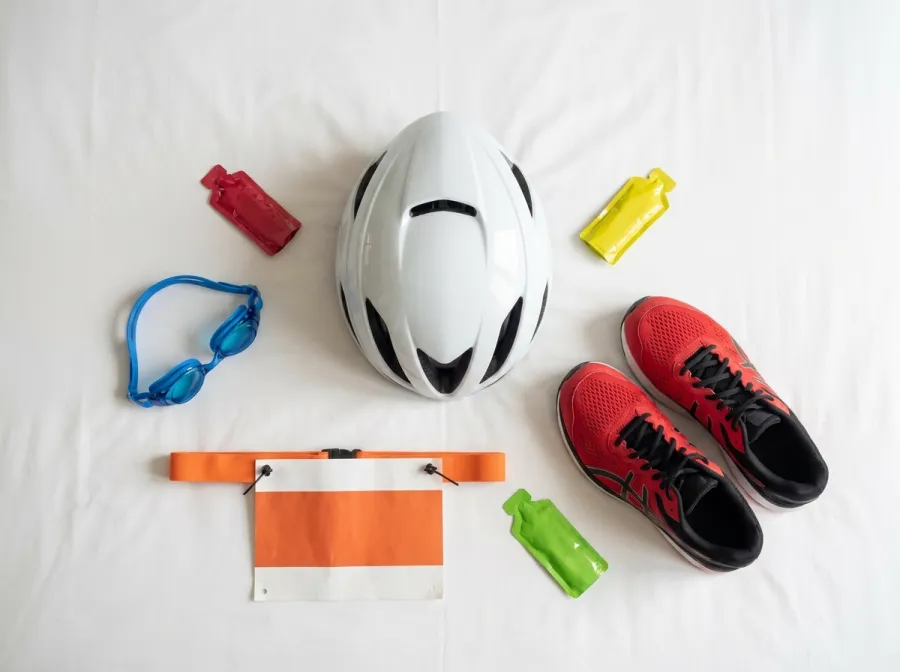
What NOT to Do Race Week: The Classic Sabotage List
Every single year, athletes who've trained intelligently for months do something profoundly self-defeating in race week. Here's the greatest hits:
1. Testing New Gear
There is a force in the universe that makes athletes want to try a brand-new wetsuit the day before an Ironman. Resist it absolutely. New saddle, new shoes, new goggles, new race suit — all banned. If you haven't trained in it, it does not race. The phrase is "nothing new on race day," but it really means nothing new in race week.
2. Doing "One More Hard Session"
You cannot get fitter in race week. Training stress has a 10–14 day lag before it converts to fitness. Any hard session you do this week will produce fatigue that shows up on race day, with zero fitness return. The athlete who does an extra hard bike Tuesday before a Sunday race is literally just making themselves slower.
3. Eating New Foods
Pre-race pasta dinner at the Italian place down the street? Potentially fine. Mystery local delicacy? Absolutely not. Your gut is not trained for novelty. The classic GI disaster story usually starts with "I just tried this one new thing." Don't be that story.
4. Going Down the YouTube Rabbit Hole
You do not need to watch six more race strategy videos the night before your race. Your strategy is set. Watching someone else's race footage at 11 p.m. the night before will not improve your performance. It will, however, keep you awake and fuel your anxiety. Close the laptop.
5. Comparing Yourself to Others at Check-In
The athlete at registration who looks like they were sculpted by Michelangelo and is wearing $12,000 in gear may or may not beat you. You have no information from how someone looks. Race your plan. The race is long enough for everyone to reveal their preparation.
6. Overhydrating
Yes, hydration matters. No, drinking a gallon of plain water the day before an event is not beneficial — it's a dilutional hyponatremia risk. Hydrate with electrolytes. Aim for pale yellow. Don't make hydration its own obsession spiral.
Race Morning Checklist
- ☐ Alarm set (two, on two devices)
- ☐ Breakfast 2–3 hours pre-race: familiar, carb-based
- ☐ Coffee if that's your routine (this is NOT the day to try your first ever espresso)
- ☐ Race numbers body-marked or race belt loaded
- ☐ Wetsuit and goggles in transition bag
- ☐ Bike tires pumped (do this morning-of at transition)
- ☐ Nutrition on bike checked and secured
- ☐ Garmin/watch charged and set to correct mode
- ☐ Sunscreen (if applicable) before wetsuit goes on
- ☐ Anti-chafe on neck/underarms/any wetsuit friction points
- ☐ Walk transition: swim in → T1 → bike out → bike in → T2 → run out
- ☐ Light warm-up: 8–10 min easy jog, a few strides
- ☐ Swim warm-up if allowed and conditions permit
- ☐ Get to start line early. Relax. You've done the work.
The Triathlon Taper Protocol Kicker: Trust What You've Built
Here's the truth about the final week: you are not going to get any fitter. But you can absolutely get faster — by arriving at the start line recovered, fueled, sharp, and uninjured. The taper is not a reward for completing your training. It's the final, critical phase of preparation.
The athletes who execute a disciplined triathlon taper protocol — who resist the urge to add one more session, who eat well and sleep long, who check their gear and walk away from the laptop — these are the ones who run strong off the bike in mile 10. They're the ones who execute their race plan instead of improvising through accumulated fatigue.
You've done the hard work. Now comes the harder work: trusting it. Back off, rest up, and show up ready to race the fitness you've actually built — not the fatigued version that's been grinding through your final training weeks.
The gun goes off. Everything you've done for the last 12 weeks is already in the bank. Go race.


