
You've made it. Two-point-four miles of open water. One hundred and twelve miles on a bike. Possibly several existential crises. And now you are standing in T2, lacing up your running shoes, and asking yourself the question that has wrecked more IRONMAN debuts than bad weather, mechanical failures, and overpriced Kona slot lotteries combined:
How fast should I run this marathon?
The honest answer is: slower than you think, smarter than you feel, and with a completely different definition of "effort" than anything your legs have experienced before. The IRONMAN marathon is not a marathon. It is a 26.2-mile negotiation with a body that has already been running for 8, 9, 10, or more hours. The rules are different. The zones feel different. And the price of getting it wrong — the infamous shuffle-walk death march from mile 18 to the finish — is paid in suffering, time, and a very awkward finisher photo.
Here is everything you actually need to know.
Why Your Legs Feel Like Concrete (And How Long That Lasts)
The first thing to understand is why running off the bike feels so dramatically worse than running fresh — and why it isn't just "being tired."
After 112 miles in the saddle, your quads, glutes, and hip flexors have been firing in a highly repetitive, constrained cycling pattern for anywhere from 5 to 7 hours. Your neuromuscular system has essentially been "programmed" for one movement. When you suddenly ask it to switch to running, there is a measurable lag — a period where your running muscles are confused, stiff, and operating at reduced efficiency. Sports scientists call this locomotor muscle fatigue and the associated neural inhibition. Athletes call it "my legs don't work anymore."
The good news: for most athletes, this adaptation period lasts roughly 1 to 3 miles. If you can get through the first mile without going out at your standalone marathon pace (more on this in a moment), your body will start to settle into something resembling a running gait. The bad news: your glycogen stores are already significantly depleted, your core temperature is elevated, and you are running a marathon. The legs do not fully come back. They just become less terrible.
The key physiological reality to bake into your pacing plan: your perceived effort will lie to you for the entire first half of the run. What feels like a comfortable jog at mile 1 is almost certainly unsustainable at mile 18. Your IRONMAN marathon is not won in the first half — but it is absolutely lost there.
The First-Mile Death Trap
Here is the single most common mistake that destroys first-time IRONMAN athletes: running the first mile at standalone marathon pace.
You feel surprisingly okay leaving T2. The transition energy is real. The crowd noise is genuinely helpful. Your Garmin is showing a pace that looks totally manageable. You think: I feel good, I'm going to bank some time early while I can.
This is the trap. This is how you end up walking from mile 18 to the finish line, doing math in your head about whether you can still make the cutoff, wishing you had listened to literally every article on the internet that told you not to do this.
The data is unambiguous. An analysis of age-group IRONMAN finishers consistently shows that athletes who run the first 13.1 miles more than 5% faster than their eventual average pace almost universally experience a dramatic slowdown in the second half. The positive-split IRONMAN marathon is not a strategy. It is a trap wearing a race number.
Your goal: even pacing or a slight negative split. The second half of your IRONMAN marathon should be the same speed as — or fractionally faster than — the first half. That is how sub-10-hour athletes race. That is how experienced age-groupers finish strong. And it requires a level of discipline in the first mile that borders on uncomfortable.

How to Calculate Your IRONMAN Marathon Pace
Forget the idea of running your "marathon pace" in an IRONMAN. Your IRONMAN marathon pace is a distinct number, calculated differently, and it will be slower than your standalone time. Here's how to get to a realistic number:
Method 1: The Standalone Marathon Adjustment
A reliable rule of thumb used by experienced coaches: add 20–40 minutes to your standalone marathon PR to get a realistic IRONMAN marathon target.
- Standalone: 3:30 → IRONMAN target: 3:50–4:10
- Standalone: 4:00 → IRONMAN target: 4:20–4:40
- Standalone: 4:30 → IRONMAN target: 4:50–5:10
The variance depends on your bike fitness (a strong cyclist burns fewer matches on the ride), your heat acclimatization, and how well you've trained bike-run bricks. Athletes with excellent run economy who also ride conservatively can sometimes land at the lower end of that range. First-timers who go hard on the bike: expect the upper end or beyond.
Method 2: The 70.3 Run Split Multiplier
If you have a recent 70.3 run split, multiply it by 2.2 to 2.4 for a realistic full IRONMAN run estimate.
- 70.3 run: 1:30 → IRONMAN run target: 3:18–3:36
- 70.3 run: 1:45 → IRONMAN run target: 3:51–4:12
- 70.3 run: 2:00 → IRONMAN run target: 4:24–4:48
This method accounts for the compounding fatigue of double the bike distance. Athletes with more long-course experience tend toward the 2.2 multiplier; beginners and anyone who overcooks the bike should plan for 2.4 or higher.
The Zone Guide: What Z2 Really Feels Like Off the Bike
Every coach on earth will tell you to "run in Zone 2" for the first half of your IRONMAN marathon. Here is the critical thing they don't always mention: Zone 2 off the bike feels significantly harder than Zone 2 fresh.
Your heart rate will be elevated from the swim and bike regardless of how easy you think you're running. If you target the same heart rate number you use in training, you may find yourself running significantly slower than expected — and that's actually correct. Your HR zones shift upward in an IRONMAN environment due to cardiac drift, heat, and cumulative fatigue. Trust effort-based feel over raw heart rate numbers in the second half of the race.
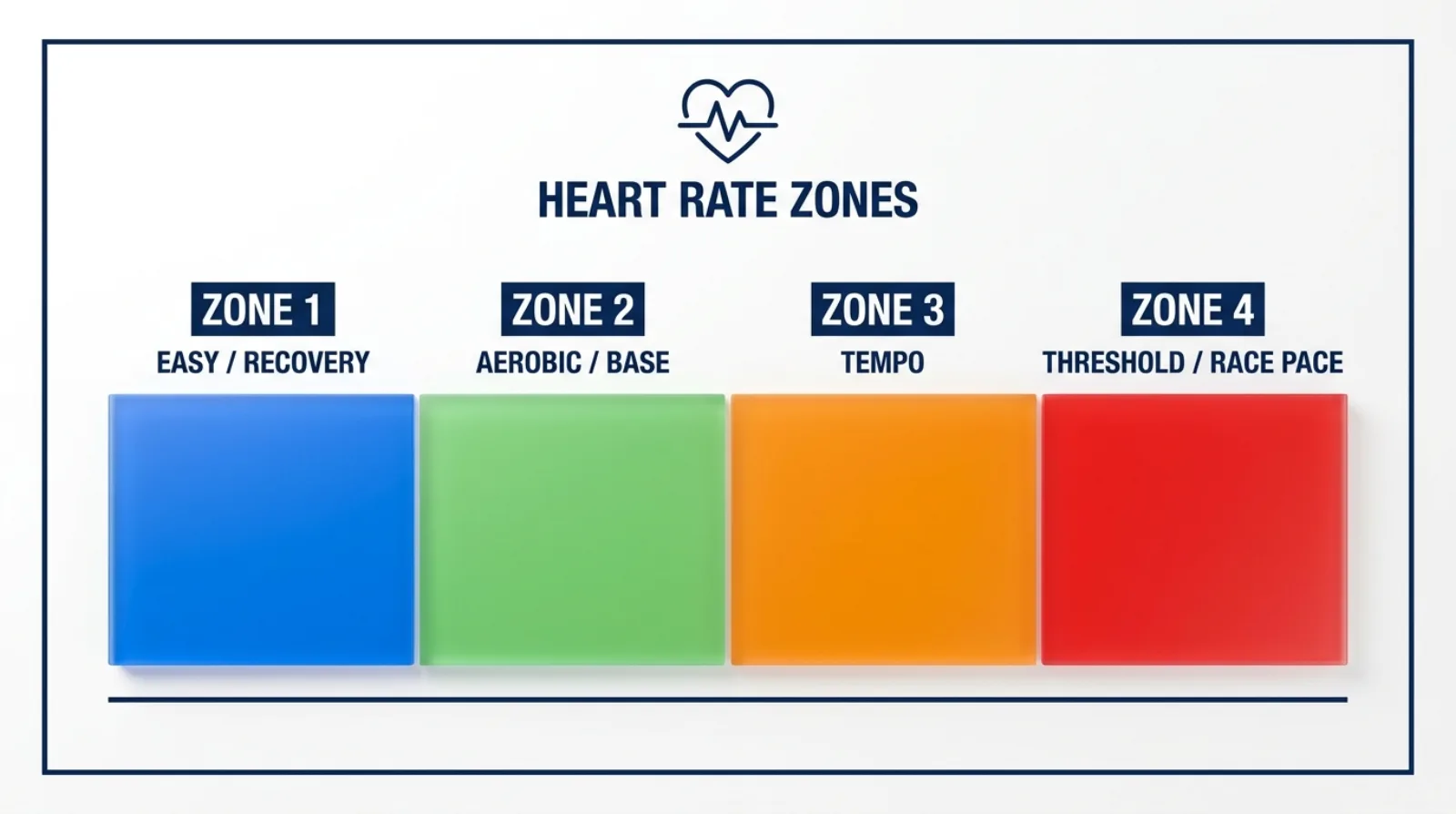
Here is a simple, practical zone guide for the IRONMAN run:
- Miles 0–6: Zone 1–2 only. Conversational pace. If you can't talk, you're going too hard. Your ego will hate this. Your finishing time will thank you.
- Miles 6–13: Settle into low Zone 2. You should be breathing rhythmically and feeling controlled. Take nutrition at every aid station.
- Miles 13–20: If you feel genuinely strong, you can allow Zone 2–3. Cautiously. This is where patience pays off — athletes who saved energy here start to pass people, not get passed.
- Miles 20–26.2: Whatever you have left. This is where you find out who you actually are. Everything is permitted.
Aid Station Strategy: Walk or Run?
Walking through aid stations is not giving up. It is racing intelligently. The walk-through-aid-stations strategy is used by elite age-groupers and professionals alike — and for good reason. In the time it takes to properly hydrate (not just spill water on yourself while sprinting past), you can consume more calories and fluids than you would fumbling on the run. A 20-second walk at 20 aid stations costs you roughly 7 minutes. Being unable to run the last 10K because you under-fueled costs you 30.
The math is not close. Walk the aid stations. Drink the cola when it appears (usually after mile 13). It contains caffeine, sugar, and something that feels like hope.
The Wall: Why It Hits at Mile 18–20
If you've bonked in a standalone marathon, you know the wall. In an IRONMAN, the wall comes earlier, hits harder, and takes longer to negotiate past. The reason is simple: by the time you're at mile 18 of the run, you've been moving for nine or ten hours. Your glycogen is depleted. Your muscles are in revolt. Your brain is writing strongly worded letters to the rest of your body.
The prevention is the same as in any long race, just more aggressive: fuel early and consistently from the very first miles of the run. A gel every 30–40 minutes starting in T2. A sip of sports drink at every aid station even when you don't feel like it. Salt. Water in addition to electrolytes. Consistent nutrition from hour one is the only reliable insurance against the mile-18 wall.
If you do hit the wall: slow down, don't stop. Walk intervals — run 4 minutes, walk 1 — burn fewer calories than running slowly and give your gut a chance to process fuel. The finish line is the only goal. Your pace is a detail.
Heat, Wind, and Course Adjustments
Your target pace from the calculator above assumes reasonable race-day conditions. If the temperature is above 80°F, add 30–60 seconds per mile to your target pace. If it's above 90°F with humidity: add a minute and a prayer. Heat is the IRONMAN's cruelest variable — it accelerates dehydration, inflates heart rate, and makes Zone 2 feel like Zone 4. Ice at aid stations goes in your hat and down your jersey. This is not optional after mile 10.
Windy run courses add 5–15 minutes to marathon times depending on severity. If you're running into a headwind, reduce effort to maintain heart rate rather than fighting to maintain pace. You'll pay for pace fights later.
The Bottom Line
Pacing the IRONMAN marathon is an act of delayed gratification practiced over the course of an entire race. The discipline you exercise in T2 — taking 15 seconds to calm down before you run — and in mile 1 — running slower than you feel capable of — pays dividends over the final 10K when you are passing people instead of shuffling past mile markers counting down by the longest tenth-miles of your life.
The IRONMAN run is not won by the fastest athletes. It is won by the ones who were patient enough, humble enough, and well-enough-fueled to run their race instead of reacting to the one happening around them. Start conservative. Build through the middle. Find out what you have at mile 20. Finish running.
"The IRONMAN marathon is a 26.2-mile negotiation with a body that's already been running for nine hours. Start the negotiation from a position of strength — not desperation."
The wall exists. The death march is real. But so is the finish line, and so is the feeling of running past it instead of walking. You've done the swim. You've done the bike. Now run smart.


