
If you have done exactly one brick workout in your triathlon training, you know The Feeling. You rack your bike, put on your running shoes with hands that are somehow also confused, take three or four running steps, and then your brain does a full system reboot because your legs have apparently been replaced overnight with two uncooperative logs made of wet sand.
Welcome to the bike-to-run transition. This is why we practice it.
Brick workouts — the term comes from various origin stories, none of them proven, the best being that your legs feel like bricks when you run off the bike — are the single training session type that separates triathletes who can race from triathletes who just complete three disciplines in the same day and hope nobody notices. If you are not doing bricks consistently, you are leaving significant performance on the table. If you are doing them but doing them wrong, you might be leaving even more.
This is the definitive guide. We are covering the physiology, every type of brick session explained with purpose, and a practical 8-week protocol. Let's start with why your legs feel the way they feel.
Why Your Legs Feel Like Concrete (The Actual Science)
The bike-to-run transition feels terrible for a confluence of physiological reasons that have nothing to do with how fit you are. Understanding them makes the solution obvious.
Neuromuscular reprogramming: During a sustained bike effort, your central nervous system optimizes firing patterns for cycling — a constrained, seated, highly repetitive rotational movement. When you dismount and start running, your nervous system has to switch to a completely different recruitment pattern. There is a measurable lag — typically 1 to 4 minutes — where your neuromuscular system is essentially confused between two modes. Running feels mechanical and labored not because you are exhausted, but because your brain and muscles haven't agreed on the new assignment yet.
Postural muscle fatigue: On a TT bike especially, your hip flexors, lower back stabilizers, and glute-hamstring posterior chain are working in a constrained position for extended periods. When you stand upright to run, muscles that have been held in shortened positions (hip flexors) and extended positions (hamstrings) suddenly need to move through full range of motion under load. The result is the characteristic heavy, stiff feeling in the first minutes of the run.
Blood redistribution: Your cardiovascular system has been efficiently routing blood to your cycling muscles. Changing to running requires redirecting blood to different muscle groups and adjusting to the vertical position after being horizontal. Heart rate often spikes in the first minutes of the run even at very easy effort, then settles.
The good news: All of this is trainable. The more frequently you practice the transition, the faster your body learns to switch modes. Elite triathletes adapt within 30–60 seconds. Well-trained age-groupers adapt within 1–2 minutes. Undertrained triathletes who never do bricks: 4–6 minutes of suffering per transition, per race. That math compounds over a season.
Brick Session Types — Every One Explained
1. The Classic Brick
Structure: Moderate-to-long bike effort → immediate run of 10–30 minutes.
Purpose: Teaches the basic transition, builds neuromuscular adaptation, trains your body to run on pre-fatigued legs.
When to use it: Year-round, as the foundation of your brick training. If you only do one type of brick, do this one. The immediate transition is the key — don't stop for 20 minutes between bike and run, that's not a brick, that's two separate workouts.
Example: 60-minute steady ride at race pace effort → 15-minute run at easy-to-moderate effort. The first 5 minutes of the run will feel bad. This is normal and the point.
2. The Race-Simulation Brick
Structure: Full race-distance bike effort → race-distance run, with race-pace targets throughout.
Purpose: The closest thing to race day you can do in training. Tests your nutrition strategy, pacing plan, and mental preparation.
When to use it: 4–6 weeks before your target race, maximum 2–3 times per season. These are demanding sessions that require full recovery time.
Example: 56-mile ride at 70.3 race effort → 13.1-mile run at target run pace. Plan your nutrition exactly as you will on race day.
3. The Run-Focused Brick
Structure: Shorter, harder bike effort → quality run session (intervals, tempo, or sustained effort).
Purpose: Trains your ability to execute quality run paces on pre-fatigued legs. This is where run fitness actually transfers to triathlon performance.
When to use it: 8–20 weeks out from your target race, during your build phase.
Example: 45-minute ride at higher-than-race intensity → 4 x 8-minute intervals at 10K pace with 90-second recovery between. The intervals will hurt more than standalone track work. That's the adaptation you're building.
4. The Reverse Brick
Structure: Run first → bike immediately after.
Purpose: Develops your ability to get into an aero position and execute power on fatigued running legs. Also excellent for identifying cycling weaknesses and for athletes who need more cycling volume without adding another standalone ride day.
When to use it: Early in a season as a general fitness builder, or during race week for maintenance work without deep training stress.
Example: 40-minute easy run → 45-minute moderate ride. Less common than the classic brick but underrated for overall adaptation.
5. The T2 Speed Drill
Structure: Short, intense bike effort → very short, very fast run (3–8 minutes).
Purpose: Trains rapid neuromuscular adaptation, practices running fast immediately off the bike, sharpens T2 speed.
When to use it: Sprint and Olympic distance athletes especially; also useful for 70.3 athletes 2–3 weeks before race day.
Example: 20-minute bike at very hard effort → 5-minute run as fast as you can go. Disgusting. Highly effective.
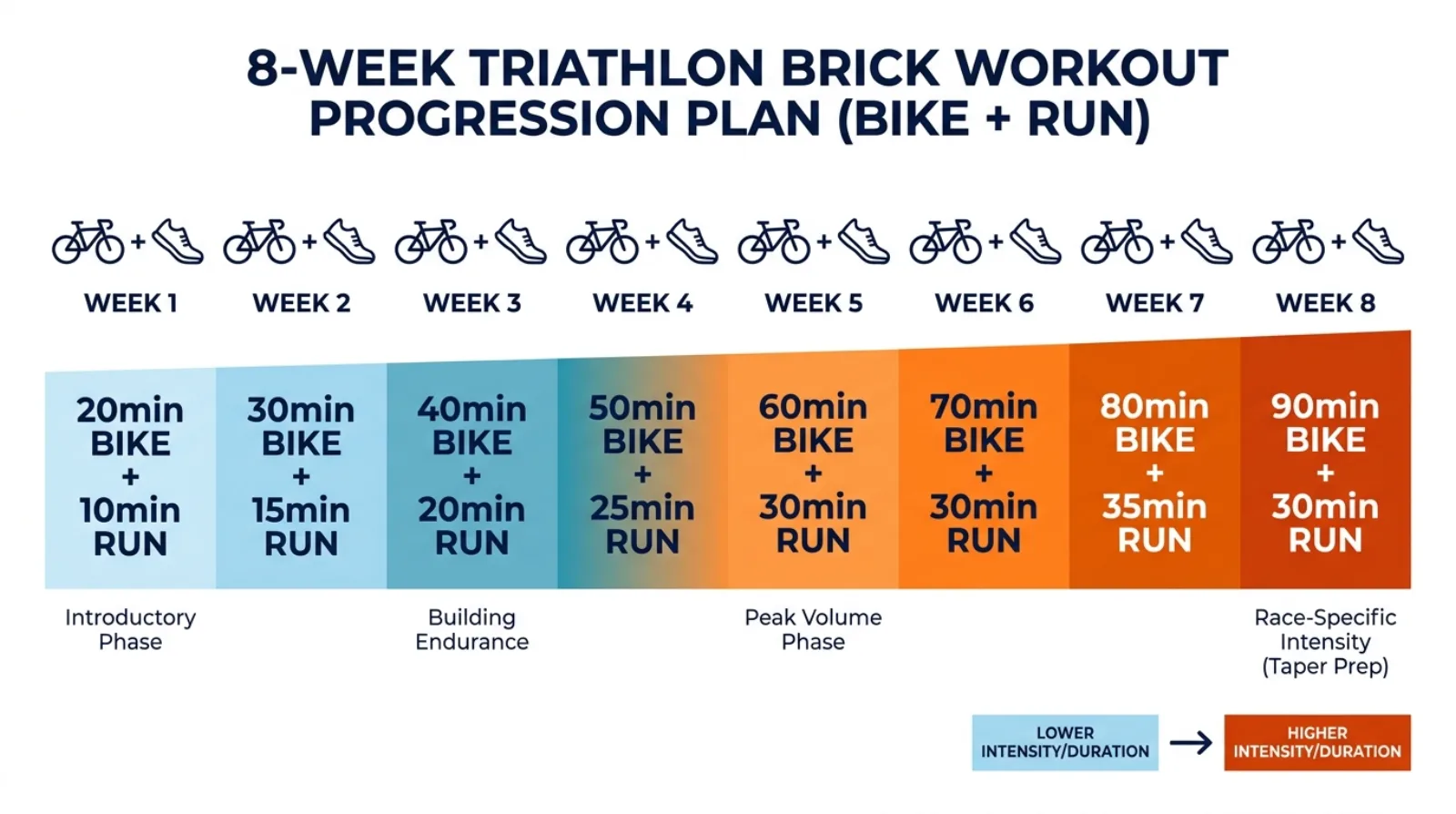
The 8-Week Brick Protocol
This protocol is designed for athletes targeting a sprint or 70.3 triathlon with 8 weeks of solid training remaining. It assumes you are already doing regular swim, bike, and run sessions and are adding structured bricks for the first time — or formalizing brick work you've been doing haphazardly.
Frequency: 1 brick per week, non-negotiable. Add a second brick per week in weeks 5–8 if your schedule and recovery support it.
- Week 1: 30-min easy bike → 10-min easy run. Goal: survive and observe. How long does the bad feeling last? Take mental notes.
- Week 2: 40-min steady bike → 15-min easy-to-moderate run. Start to notice the transition getting slightly less chaotic.
- Week 3: 50-min steady bike → 15-min moderate run. This is where most athletes start to feel the adaptation taking hold.
- Week 4: 60-min race-effort bike → 20-min run with 10 minutes at race pace. First time running at actual race effort off the bike.
- Week 5: 70-min race-effort bike → 20-min run (10 easy, 10 at race pace). Also add a short T2 drill mid-week if possible: 20min bike → 5min hard run.
- Week 6: 75-min race-effort bike → 25-min run at near-race effort throughout. This is the first genuinely hard week.
- Week 7: Race-simulation brick — full race-distance bike + run at race effort. Treat this like a B-race.
- Week 8: Race week. One short brick (40-min bike → 10-min easy run) to stay sharp. Nothing more. Taper is a strategy, not laziness.
How to Structure Bricks Within a Training Week
The most common mistake athletes make with bricks is placing them badly in the training week. A brick session is physiologically demanding — it stresses both your cardiovascular system and multiple muscle groups in sequence. Recover accordingly.
Don't do bricks the day after long runs or hard run sessions. Your run muscles are already compromised, and the brick run will either be poor quality or lead to injury. Bricks work best when you arrive fresh enough to run meaningfully after the bike.
Best placement: Saturday or Sunday, with the other day being a longer standalone ride or easy recovery session. For athletes training 5–6 days a week, a typical layout might be: Monday rest, Tuesday swim + run, Wednesday ride, Thursday swim + run, Friday easy swim, Saturday BRICK, Sunday long easy ride or swim recovery.
Don't skip the immediate transition. The physical point of a brick is specifically the transition from bike to run with no break. If you stop for 20 minutes after the bike, you have eliminated the training stimulus you came for. Rack the bike, change shoes in under 90 seconds, and start running while your legs are still in cycling mode. That discomfort you're trying to avoid is the workout.
Race-Day Takeaways from Brick Training
Everything you learn in brick training translates directly to race day. Athletes who have done consistent bricks across an 8–12 week build show up at T2 knowing exactly what the first mile will feel like. They don't panic. They don't overcorrect. They don't check their watch at mile 1 and despair. They run easy for the first 5 minutes, feel their legs come around, and then execute the run they planned.
Athletes who haven't done bricks show up at T2, feel The Feeling for the first time on race day, and react to it badly — either by slowing to a walk before they need to, or by convincing themselves they feel great and running the first mile too fast. Both are expensive mistakes.
One more thing: brick training is boring when it's going well. That is a feature, not a bug. The adaptation is happening whether or not you feel enlightened during the session. Your job is to show up, do the transition, and run the minutes. The race thanks you later.
"The brick workout is the only training session that directly simulates the specific suffering of a triathlon run. Everything else is just preparation for it."
Start with one per week. Build the habit before you build the intensity. And the next time your legs feel like concrete in the first mile of a race — remember that you've been practicing that feeling, and you know exactly how long before it gets better. That knowledge alone is worth six months of brick sessions.


