
Here is a thing that almost every training guide on the internet has in common, including most of the ones on this site: they were written with a default physiological template of a 165-pound male athlete in his early-to-mid thirties. Heart rate zones, power targets, fueling recommendations, recovery timelines — most of these are built from research conducted primarily on men, and then applied to women with a vague shrug and a "adjust as needed."
Women are now the fastest-growing demographic in triathlon. At many regional 70.3 and Olympic-distance races, women represent 40–45% of the field. And yet the training information available to them remains heavily male-centric, with the notable exceptions scattered across a handful of sports science papers that most coaches never read.
This article is about closing that gap. We're covering the real differences in female physiology that affect training, how to periodize your training around the menstrual cycle (if applicable), the specific injury risks and nutritional considerations women face, and the strength work that generic plans almost always skip. No condescension, no vague platitudes. Just the actual science and what to do with it.
Your Biggest Advantage: Women Are Built for Long Course
Let's start with something that doesn't get said nearly enough: women have a genuine physiological edge at long-distance triathlon that is not a consolation prize.
Multiple studies across endurance sports consistently show that women:
- Oxidize fat at higher rates during sustained aerobic effort, preserving glycogen stores for longer. In practical terms, this means women tend to hit the wall less catastrophically than men at the same relative effort, particularly in races lasting 5+ hours.
- Pace more conservatively and accurately — research in marathon racing shows women have smaller positive-split rates than men, meaning they are better at running a smart first half. This transfers directly to IRONMAN run execution.
- Have smaller body mass at equivalent fitness levels, which reduces the absolute energy cost of carrying body weight over a 26.2-mile run. Every pound you don't carry is work you didn't have to do.
- Thermoregulate differently — women generally begin sweating at higher temperatures than men but often handle prolonged heat exposure with lower core temperatures at equivalent effort, an advantage in hot-weather long-course racing.
The gap between elite men's and women's times shrinks as race distance increases. This is not a coincidence. It's physiology. The longer the race, the more women's metabolic profile becomes an advantage, not a deficit.
Training Around Your Menstrual Cycle
This section is for athletes who menstruate. If this isn't relevant to you, skip ahead — the rest of the article has plenty more to work with.
The menstrual cycle creates a predictable, repeating hormonal environment that measurably affects training quality, recovery capacity, and injury risk. Most generic training plans treat every week of your month identically. This is, to put it charitably, a waste of information you already have about your own body.
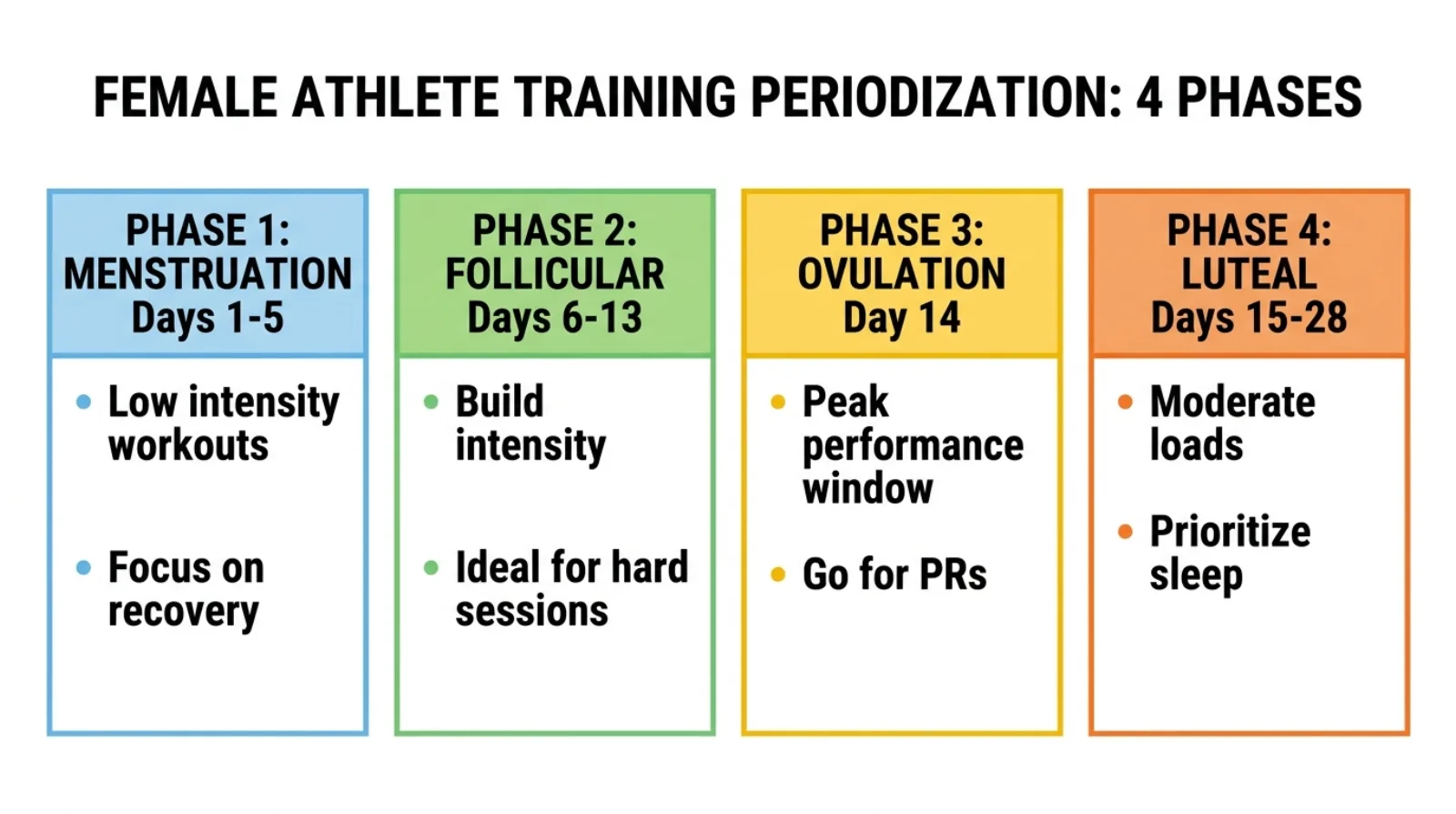
Here's how the four phases play out for a triathlete:
Phase 1: Menstruation (Days 1–5)
Estrogen and progesterone are at their lowest. Many athletes experience fatigue, cramping, and reduced motivation — but here's the important nuance: some athletes feel surprisingly strong in the first 1–2 days of their period. Listen to your body rather than forcing an arbitrary effort target. If energy is low, go easy. Do not force high-intensity sessions here. Use this phase for recovery, easy aerobic work, and mobility. Your body is doing significant physiological work — let it.
Phase 2: Follicular Phase (Days 6–13)
Rising estrogen improves neuromuscular coordination, increases insulin sensitivity, and enhances performance capacity. This is your best window for high-intensity training. Schedule your hardest sessions here — interval runs, threshold bike efforts, hard swims, brick sessions. Your body is primed for quality adaptation. Recovery is also faster in this phase than any other. Take advantage of it.
Phase 3: Ovulation (Around Day 14)
Peak estrogen creates a brief but real performance window. Many female athletes report feeling fastest and strongest in the days around ovulation. Race efforts, time trials, or peak training sessions fit well here. One important note: research shows a modestly elevated ACL tear risk in the 2–3 days before and during ovulation due to estrogen's effect on ligament laxity. Warm up thoroughly, especially before explosive movements.
Phase 4: Luteal Phase (Days 15–28)
Rising progesterone increases core body temperature (making heat sessions more demanding), reduces insulin sensitivity (affecting carbohydrate metabolism), and elevates perceived exertion at equivalent efforts. Heart rate may run 2–3 beats per minute higher at the same pace. Moderate your training load here — this doesn't mean stop training, it means stop expecting to hit follicular-phase numbers and adjusting your effort targets accordingly. Athletes who ignore this and force identical training loads in the luteal phase often report chronic fatigue, poor recovery, and increased injury frequency. That's not weakness. That's biology telling you something.
Practical application: Get a period-tracking app (Garmin, Apple Health, and dedicated apps like Whoop's cycle feature all work). Mark your cycle phases on your training calendar. Schedule your hardest weeks in the follicular phase. Schedule planned recovery weeks to overlap with your period. Most athletes who implement this see meaningful performance gains within 2–3 months — not because they're doing more work, but because they're timing the same work better.
Injury Risks Specific to Female Triathletes
Bone Stress Injuries
Female endurance athletes face significantly higher rates of bone stress reactions and stress fractures than their male counterparts, particularly in the tibia, metatarsals, and femoral neck. The primary driver is often energy availability — specifically, not eating enough to support both training demands and basic physiological function. Low energy availability suppresses estrogen, which is critical for bone density maintenance. If you are consistently fatigued, menstruating irregularly or not at all, and experiencing bone pain — these are not signs of training hard enough. They are warning signs that require medical attention.
Relative Energy Deficiency in Sport (RED-S, formerly called the "female athlete triad") is prevalent in endurance sports and frequently goes undiagnosed. If this resonates, speak to a sports medicine physician.
Iron Deficiency
Female endurance athletes lose iron both through menstrual blood loss and through the hemolytic stress of high-volume training (foot-strike hemolysis in runners being a real contributor). Iron deficiency — even at the borderline anemia level — will tank your aerobic capacity, your recovery, and your energy levels in ways that training cannot compensate for. Get a full iron panel (not just hemoglobin — specifically ask for ferritin and serum iron) at least once a year. Many sports medicine guidelines suggest female endurance athletes should have ferritin levels above 40 ng/mL for optimal performance; below 20 ng/mL and performance suffers measurably. Many labs will tell you levels above 12 are "normal." That threshold is for sedentary individuals, not athletes doing 12+ hours a week of training.
Strength Work Women Actually Need
Generic triathlon strength plans are mostly core work and some squats. Here's what female triathletes specifically benefit from that most plans underemphasize:
- Hip abductor and glute medius work. Women tend toward more valgus knee collapse under load (knee caving inward) due to wider Q-angles — a factor in IT band issues, patellofemoral pain, and hip flexor problems. Lateral band walks, clamshells, and single-leg exercises specifically targeting the glute medius correct this and directly reduce injury risk.
- Heavy lower body compound lifts. Yes, actual squats and deadlifts with meaningful weight. Estrogen's anabolic effects mean women actually respond well to strength training with heavier loads, and many female triathletes under-load their strength sessions out of concern for getting "too bulky." You will not get too bulky doing strength training while also running 30+ miles per week. What you will get is stronger, more injury-resistant legs and a better power-to-weight ratio on the bike.
- Upper body pulling and rotator cuff stability. Swimming volume in triathlon training means a lot of internal rotation work. Balance it with rows, face pulls, and external rotation exercises. Shoulder impingement is common in high-volume swimmers of any gender, but upper body proportional strength differences make it worth emphasizing for women.
- Plyometrics with proper knee tracking. Jumping exercises (box jumps, broad jumps) rebuild neuromuscular reactive strength, but watch for knee alignment under fatigue. Include single-leg work where you can monitor and correct valgus collapse.
Fueling: What Changes and What Doesn't
Women generally need fewer total calories than men due to lower average body mass, but the composition of the fuel and timing matters just as much.
Carbohydrate needs: During the luteal phase, fat oxidation increases and carbohydrate metabolism shifts slightly — some athletes find they need marginally fewer carbohydrates mid-session but more in recovery. Trial and error over multiple cycles teaches you your specific pattern.
Protein timing: Women benefit from protein distribution across meals (rather than concentrating it in one meal), particularly around training sessions. Aim for 25–35g per meal or snack, with a focus on complete protein sources. The muscle protein synthesis window post-exercise appears to be similarly important for women as for men, possibly more so given the hormonal variability affecting recovery.
Eat enough. Actually enough. Under-fueling is the single most common performance-limiting mistake female endurance athletes make. The culture around food and body weight in women's sport is genuinely harmful. Your training volume demands fuel. Eating more when you're training more is not failing at something — it is how performance physiology works. Chronically under-eating while over-training leads to RED-S, poor adaptation, chronic fatigue, and injury. The athletes who perform best in women's triathlon eat aggressively to support their work.
The Bottom Line
Triathlon built its training culture largely on data from male athletes, at a time when the women's field was a fraction of what it is today. That is changing — sports science research on female athletic populations has grown substantially in the last decade, and coaching practices are beginning to reflect it. But the literature trickles down slowly.
What you can do right now: track your cycle and align your training intensity with your hormonal phases. Get iron and ferritin checked annually. Add hip abductor work and heavy compound lifts to your strength routine. Eat enough. And stop measuring yourself against training advice written for a body that is not yours.
You are not a smaller, slower version of a male triathlete. You are a physiologically distinct athlete with specific advantages, specific vulnerabilities, and specific tools that, when used correctly, produce genuinely excellent performances. The fastest-growing demographic in triathlon deserves training advice built for them. This is a start.


