

She'd been at it for three weeks. Every session ended the same way — gasping at the 150-meter mark, grabbing the lane line, heart hammering. Her coach said the fitness was there. The form was there. She just couldn't seem to get past that wall. Then one morning she got in, pushed off, and swam 1,000 meters straight. No wall. No gasping. Just swimming. She called it the click moment — the day her brain finally stopped fighting her body.
Sports psychologists and neuroscientists have a more clinical term for it, but the phenomenon is real and well-documented. Mental blocks in endurance sports are not simply a lack of willpower or fitness. They are, in many cases, genuine neurological events — learned inhibition patterns that the brain has built to protect you from perceived danger, and which it will defend vigorously until you teach it otherwise. Understanding this changes how you train for them.
The Brain Is Not Your Coach — It's Your Overprotective Parent
In 2001, South African exercise physiologist Tim Noakes proposed the central governor model: the idea that fatigue isn't primarily a physical failure but a regulatory signal from the brain, designed to shut the body down before actual damage occurs. The brain, in this model, is constantly monitoring physiological signals and making subconscious decisions about how much effort is "safe" to sustain.
This was initially controversial, but a body of research since then has largely supported the core insight. A landmark 2012 study in the British Journal of Sports Medicine found that athletes could sustain significantly higher effort outputs when given false feedback about their performance — their muscles hadn't changed, but their central governor had been given different information. The ceiling, in other words, was being set by the brain, not the lungs or legs.
Mental blocks are an extension of this system. When a beginner swimmer hits 150 meters and panics, the brain isn't wrong to intervene — at that point in their training, heart rate is spiking, CO2 is building, and the body genuinely is approaching its current limit. The problem is that the brain learns to anticipate this response and begins triggering the shutdown signal earlier and earlier. It's protection run amok. The click moment happens when the brain finally revises its threat model and lets the body operate closer to its actual ceiling.
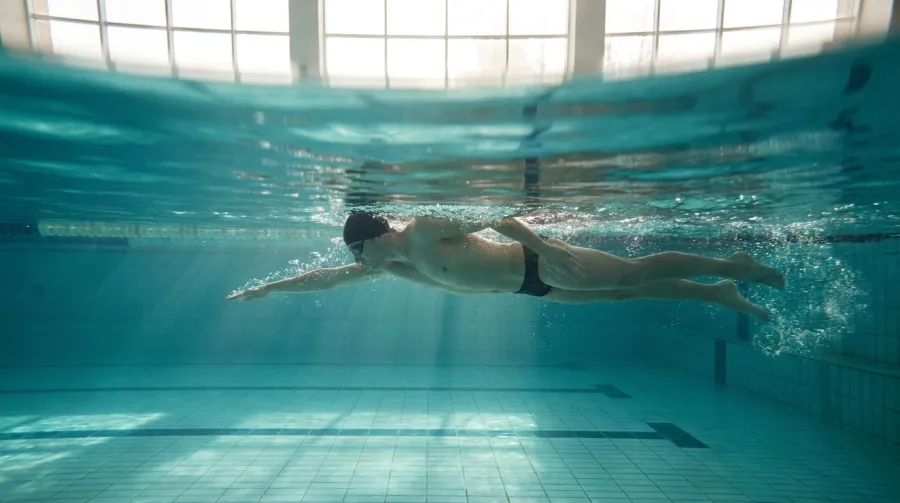
Visualization: The Evidence Is Stronger Than You Think
Mental rehearsal has moved well past motivational-poster territory. A 2016 meta-analysis published in Perspectives on Psychological Science reviewed 35 studies on motor imagery and found consistent, measurable improvements in physical performance from visualization practice — particularly in fine motor skills and novel movement patterns. For swimmers working on technique, for runners pre-programming their race-day effort, and for triathletes rehearsing transitions, this is directly applicable.
The mechanism appears to involve the same neural pathways used during actual movement. When you vividly imagine performing a skill, motor neurons fire in patterns that closely mirror execution — your brain is literally rehearsing without your body needing to be there. For athletes confronting mental blocks, this means you can practice getting past the block without the metabolic cost of a full training session.
Effective visualization for triathlon has three components. First, it must be first-person and multi-sensory — not watching yourself from outside, but experiencing the sensation of the water, the sound of your breathing, the feeling of your hands pulling through. Second, it must include the uncomfortable moments, not just the ideal ones. Visualizing yourself hitting the 150-meter mark, feeling the CO2 build, and choosing to continue is more useful than only imagining perfect, effortless swimming. Third, it must be consistent — 10 minutes before bed for two weeks produces measurably different results than an occasional five-minute session before a race.
HRV: Reading Your Readiness Before the Alarm Goes Off
Heart rate variability — the variation in time between individual heartbeats — has become one of the most reliable non-invasive indicators of nervous system readiness. A high HRV generally indicates good recovery and parasympathetic tone; a suppressed HRV often signals accumulated stress, incomplete recovery, or early-stage overtraining. For athletes working through mental blocks, HRV data adds a crucial layer: it can tell you whether a bad session was a mental barrier or your body genuinely needing more recovery.
Tools like Whoop, Garmin's Body Battery, and dedicated HRV apps (HRV4Training, Elite HRV) have made this data accessible without a lab. The practical application isn't complex: when HRV is suppressed for two or more days in a row, high-intensity training that requires mental pushes is less likely to produce breakthroughs and more likely to reinforce the shutdown pattern. Rest or easy aerobic work produces better adaptation. When HRV is elevated, that's your window for threshold sessions where a click moment is most likely to occur.
The best coaches have been using intuitive versions of this for decades — "you look tired, let's back off today." HRV monitoring just gives you the data to do it systematically when no coach is watching.

AR Race Rehearsal: The Newest Tool in the Stack
Augmented reality race simulation is the newest entrant to mental performance training, and while it's still primarily in the early-adopter / elite coaching space, it's worth knowing about. Platforms like ROUVY and Zwift have long offered video overlay cycling experiences, but 2025 and 2026 have seen a new generation of tools — including AR-equipped goggles and swim simulation systems — designed specifically to rehearse race-day environments before you arrive at them.
The psychological value is the same as visualization, but with higher fidelity: actually experiencing the visual environment of a race course your nervous system will recognize on race day. Studies on pre-competition familiarity consistently show that athletes perform better in environments they've mentally or physically rehearsed — the central governor is less likely to produce conservative threat responses in familiar territory.
You don't need a headset to apply this principle. Watching course flyover videos before a race, swimming the same open-water buoy line multiple times, running the run course the day before — all of these are lower-tech versions of the same underlying adaptation.
How to Trigger Your Own Click Moment
The research points toward a practical protocol. First, address recovery honestly — a mental block during chronic fatigue is your body being correct, not your brain being weak. Use HRV or simple sleep tracking to confirm you're training in a recovered state when you attempt breakthrough sessions.
Second, use visualization daily for two weeks before targeting a known block. First-person, multi-sensory, include the discomfort, see yourself continuing. Third, reframe the block itself — the anxious feeling at 150 meters isn't a warning that something is wrong, it's evidence that you're approaching a training threshold. That feeling is the signal that adaptation is available.
Fourth, have a single cue word. "Through" or "smooth" or whatever resonates — something you can recall in the moment to redirect attention from the shutdown signal to the task. Research on attentional focus in endurance sport consistently shows that internal focus on form or rhythm outperforms internal focus on effort or pain during hard efforts.
And then: trust the process and get in the water. The click moment doesn't announce itself in advance. You just push off one day, and somewhere around meter 400, you realize you've already gone further than the wall used to be.


