
Panama City Beach doesn't look like an Ironman town in October. It looks like a beach town that's about to get quiet for the winter, all souvenir shops and half-empty parking lots, the kind of place that peaked in July. Then race week hits in November and 3,000 athletes and their families show up and the whole Emerald Coast remembers what it's for. IRONMAN Florida has been doing this every year since 2003, which makes it the longest consecutively running Ironman event in North America. Nothing else on the calendar has that kind of institutional memory.
It's also, by reputation, one of the friendlier full-distance races you can pick for a first 140.6. Flat swim, flat bike, flat run. "PR Seekers and First-Timers alike," the race's own marketing says, and for once the marketing isn't lying. But flat isn't the same as easy, and a course with almost no hills to hide behind still finds ways to make you suffer. Here's what actually happens on November 7, leg by leg, and what nobody tells you until you've already signed the check.
The Shape of the Day
Transition opens at 4 a.m. The pros start at 5:40, age groupers five minutes later at 5:55, still dark, still cool by Florida standards. From there it's a two-lap swim, a single 112-mile bike loop out through the pine forest and back, and a two-lap marathon along Front Beach Road that ends in the middle of Pier Park's shops and restaurants. You have 17 hours total, measured from your individual start. That's generous. It's also not infinite, and the intermediate cutoffs inside that window get enforced whether you like it or not.
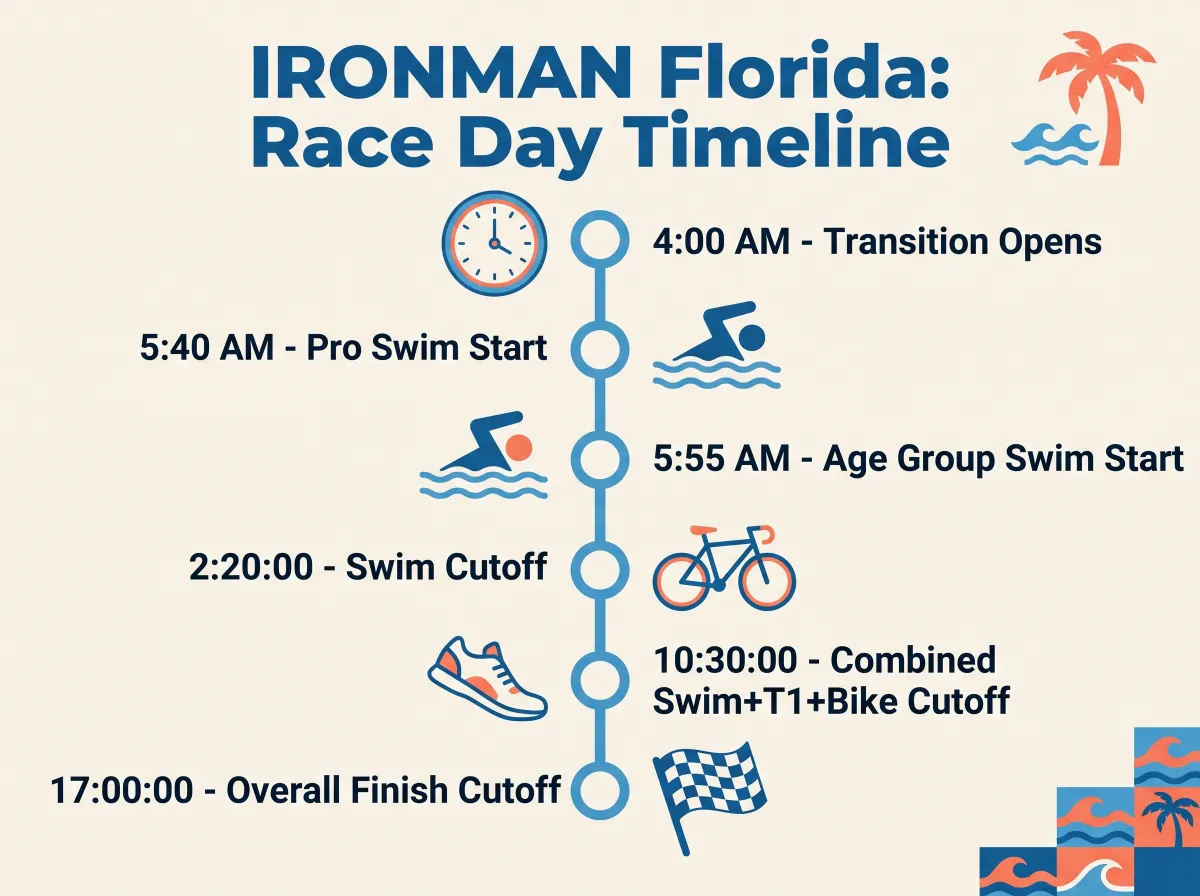
The swim cutoff is 2 hours 20 minutes. The combined swim-transition-bike cutoff is 10 hours 30 minutes. Do the subtraction and you get roughly 6.5 hours of marathon left in the tank if you're using every minute of the bike allowance, which is plenty for a walk-run finish but not a number you want to discover live, mid-race, doing math on a pool noodle brain at hour nine.
The Swim: Warm, Salty, and Not as Scary as It Looks
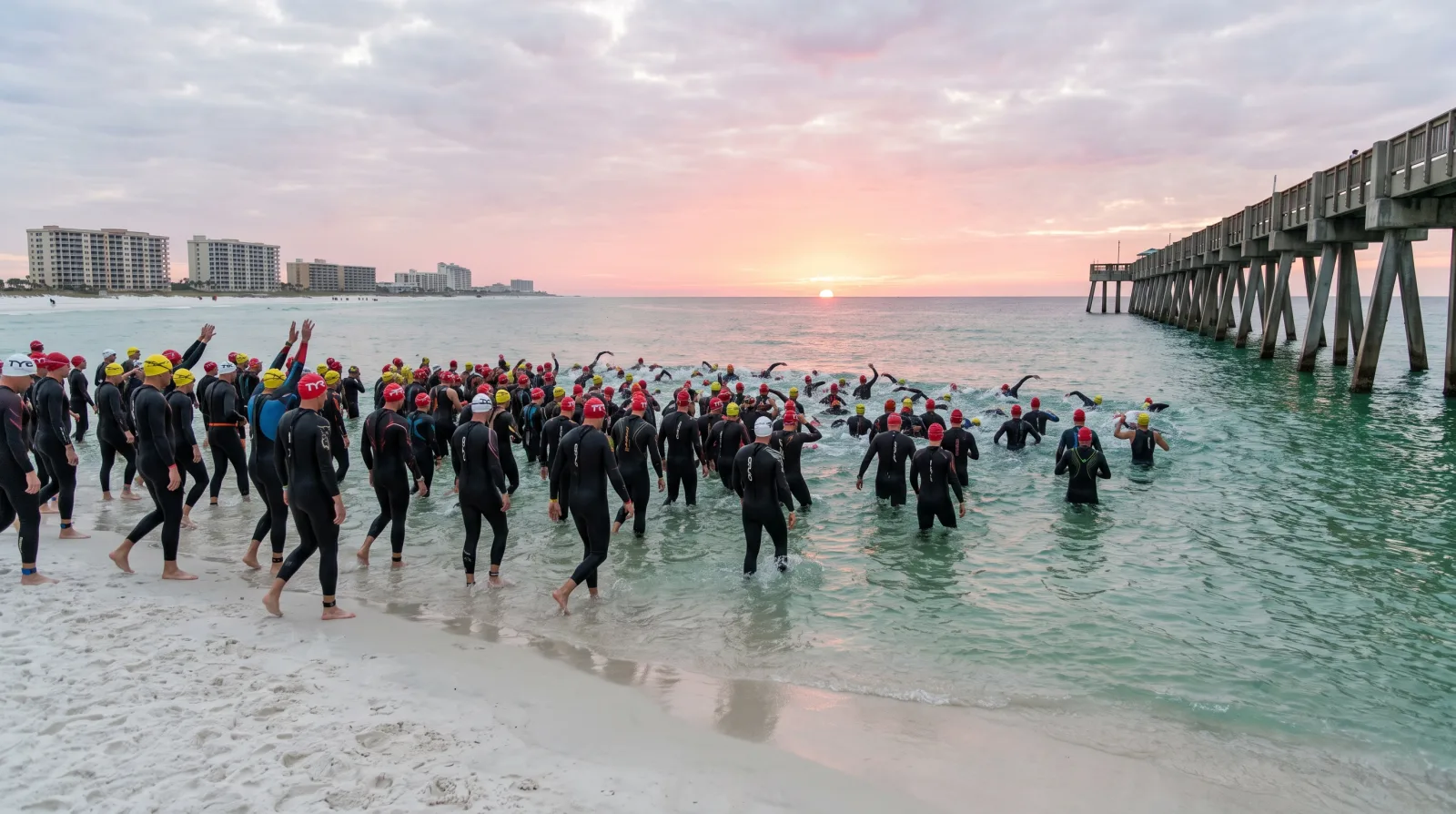
Two laps around the Russell-Fields Pier, 2.4 miles total, with a short beach run and a water station between laps. The Gulf here runs in the low 70s in early November, warm enough that plenty of people skip the wetsuit and just accept the time penalty of a swim skin, though most of the field still wears one. Visibility is genuinely good compared to a lot of Ironman swims. You can actually see the pier pilings going by underneath you, which helps more than you'd think for staying straight.
What the course description doesn't dwell on: this is open Gulf water, not a protected bay, and that means real current and the occasional rip. Race organizers run a flag system, the same one you'd see at any public beach, and on a red-flag morning the swim gets adjusted or shortened. I've swum races where a "flat, easy" ocean swim turned into a genuine fight against a lateral pull nobody warned me about, and the lesson stuck: sight off the pier structure itself, not the swimmer in front of you, because a current can walk a whole pack of bodies fifteen degrees off course without any one person noticing it happening.
Jellyfish and the occasional stingray are part of the deal in the Gulf in November, though nothing that should change your race plan. After the second lap, you run up the beach, through a freshwater shower rinse, and into transition already lighter and looking forward to dry socks. That shower matters more than it sounds. Salt water dried onto skin for 112 miles of bike friction is a recipe for chafing you'll regret by mile 60.
The Bike: One Loop, a Lot of Pine Trees, and Wind You Didn't Plan For
Unlike a lot of full-distance courses that loop you past transition two or three times, IRONMAN Florida's bike leg is a single 112-mile out-and-back-ish loop that heads north through Pine Log State Forest and along the Intracoastal Waterway before returning to Panama City Beach. That means less repetitive scenery, fewer chances for your crew to see you, and, because it's one continuous effort instead of laps you can recalibrate on, less room to course-correct a pacing mistake before it costs you.
The course is legitimately flat. Total elevation gain for the full 112 miles is minimal enough that "rolling hills" in the official course notes mostly means gentle undulations you'll clear without shifting. The catch is wind, and it's a real catch. This stretch of the Panhandle sits wide open to Gulf breezes, and the roads through the pine forest offer almost no windbreak once you're out of town. Mornings tend to be calmer; the wind typically builds as the day goes on, which means the back third of your ride, already the hardest part physiologically, often comes with a headwind tax nobody put in the brochure. Stay aero, stay patient, and don't burn matches fighting a crosswind you can't out-muscle anyway.
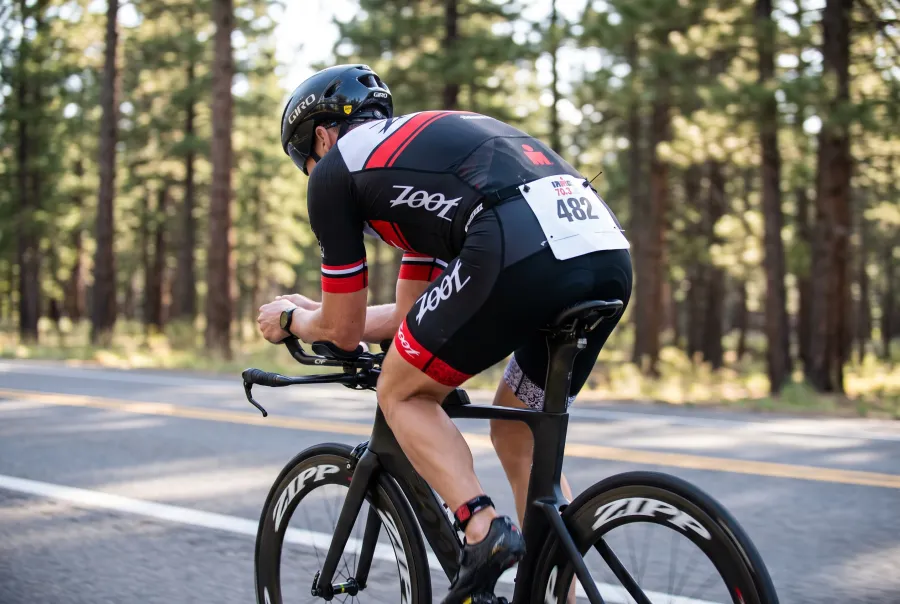
You'll spend the overwhelming majority of this ride in your aero bars, which is the whole appeal of a course like this. Nothing forces you to sit up. Aid stations are spaced at reasonable intervals along the loop, well-stocked with the standard Ironman nutrition lineup. Know your own fueling plan before you get there. A flat course tempts people into going harder than their nutrition can support, and the bonk that results doesn't care how gentle the terrain was.
The Run: Two Loops, Front Beach Road, and a Finish Line Worth the Wait
The marathon is two 13.1-mile loops, largely along Front Beach Road tracing the shoreline, and it's consistently ranked among the flattest run courses on the entire Ironman circuit. If your legs have anything left after the bike, this is where you spend it. The two-loop structure means your people get to see you at least twice, sometimes more depending on where they camp out, and the crowd density around the halfway and finish areas tends to be genuinely loud for an Ironman run course.
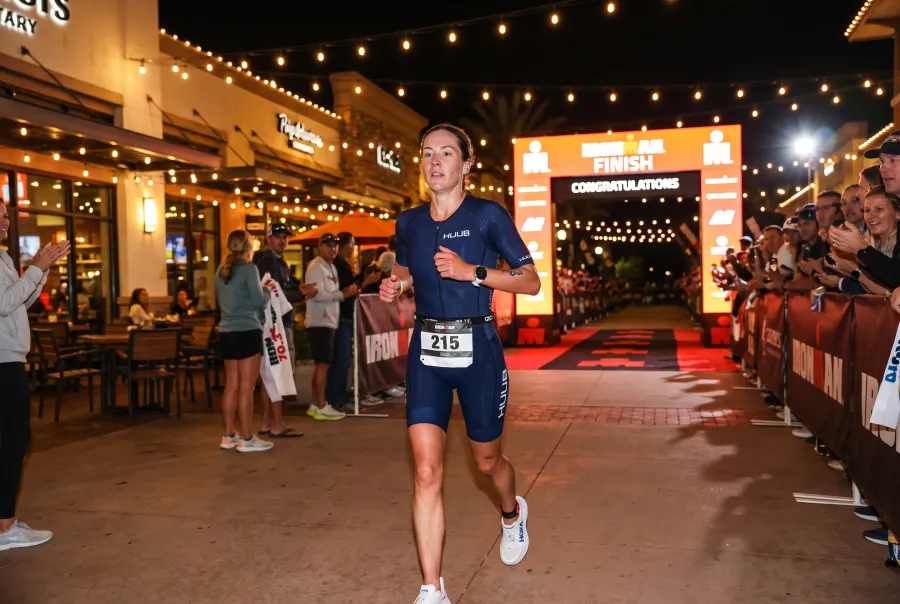
The finish itself happens inside Pier Park, weaving through the shops and restaurants that make up the town's main commercial strip. It's a strange, wonderful thing to run a marathon finish past a Chili's and a movie theater and have it feel like the biggest stage in the world, but that's exactly what it feels like at 9 p.m. when the finish line announcer calls your name and a few hundred strangers who've been drinking on a patio all day suddenly turn around to cheer for you specifically.
Weather is the wildcard here more than terrain. Early November on the Panhandle can mean genuinely warm and humid, or it can mean a cold front rolls through and you're running in a windbreaker you swore you wouldn't need. I've had both kinds of race week within a few years of each other at similar-latitude Gulf events, and the only reliable strategy is to pack for a 30-degree swing and make the call race morning, not three weeks out when you're checking the forecast for the fourth time out of nerves.
Race Week: The Logistics Nobody Reads Until It's Too Late
Check-in and timing chip pickup happen Wednesday, November 4th, from 1 to 5 p.m. at Aaron Bessant Park. There's no race-day check-in option and no exceptions for a friend picking up your packet, so build your travel around actually being in town by Wednesday afternoon, not Thursday night. The IRONMAN Village runs Thursday and Friday with the usual mix of the official store, athlete briefings, and a first-timer Q&A that's worth attending even if you think you've read every guide on the internet already, including this one.
Mandatory bike and gear check-in is Friday, November 6th, from 9 a.m. to 3 p.m. at the Pier Park West parking lot. Once your bike is racked and your gear bags are dropped, you don't touch any of it again until you're back there race morning at 4 a.m. Five color-coded bags cover the day: your morning clothes, bike gear, bike special needs, run gear, and run special needs. Pack the run bag assuming you'll finish after dark, because a large share of the field does, even on a course this fast.
Bike and gear checkout on race day runs from 5:30 p.m. to midnight, and the Hero Hour finish line party runs 10 p.m. to midnight for anyone still out on course or already celebrating. The full celebration continues Sunday morning. If you're the type who wants to be packed up and driving home the second you cross the line, this isn't that race, plan to stay through Sunday if you can, because the Panama City Beach that shows up for this event on Saturday night is a genuinely good time to be part of.
Mistakes People Make at IRONMAN Florida Specifically
- Treating "flat" as "wind-proof." The course has almost no elevation and almost no shelter. Those are two different problems and only one of them shows up in the course profile.
- Skipping the freshwater shower after the swim. Salt residue plus 112 miles of friction is how good race mornings turn into bad chafing stories by the afternoon.
- Packing for one kind of Panhandle weather. November here swings wildly. Bring options for both a humid 78°F day and a 45°F cold front, and decide morning-of.
- Not knowing your real numbers against the combined cutoff. The 10:30 swim-T1-bike cutoff is the one that actually bites people, not the headline 17 hours.
- Assuming a single-loop bike means less crew support. It does. Tell your people where to actually stand, because they won't get three chances to find you like they might elsewhere.
- Forgetting this is genuinely an evening finish for a lot of the field. Pier Park at night is part of the experience, not a consolation prize. Pack the run gear bag like you know it's coming.
None of these are unique to Ironman as a sport. They're specific to this course, this stretch of coastline, and this particular time of year, which is exactly why a generic "how to do your first Ironman" article won't save you from any of them.
Worth It?
For a first full-distance race, or a fast-focused one, yes. The course does what it promises: it gets out of your way and lets your fitness show up on the clock instead of getting eaten by a mountain pass or a technical descent. The town gets loud for you in a way that a lot of bigger, more famous venues don't bother to anymore.
If you've raced Panama City Beach before, I'd genuinely like to know how your wind luck went. Calm morning, brutal afternoon headwind on the way back from the forest, or something in between? That's the variable that seems to make or break more days here than anything else on the course map.


