

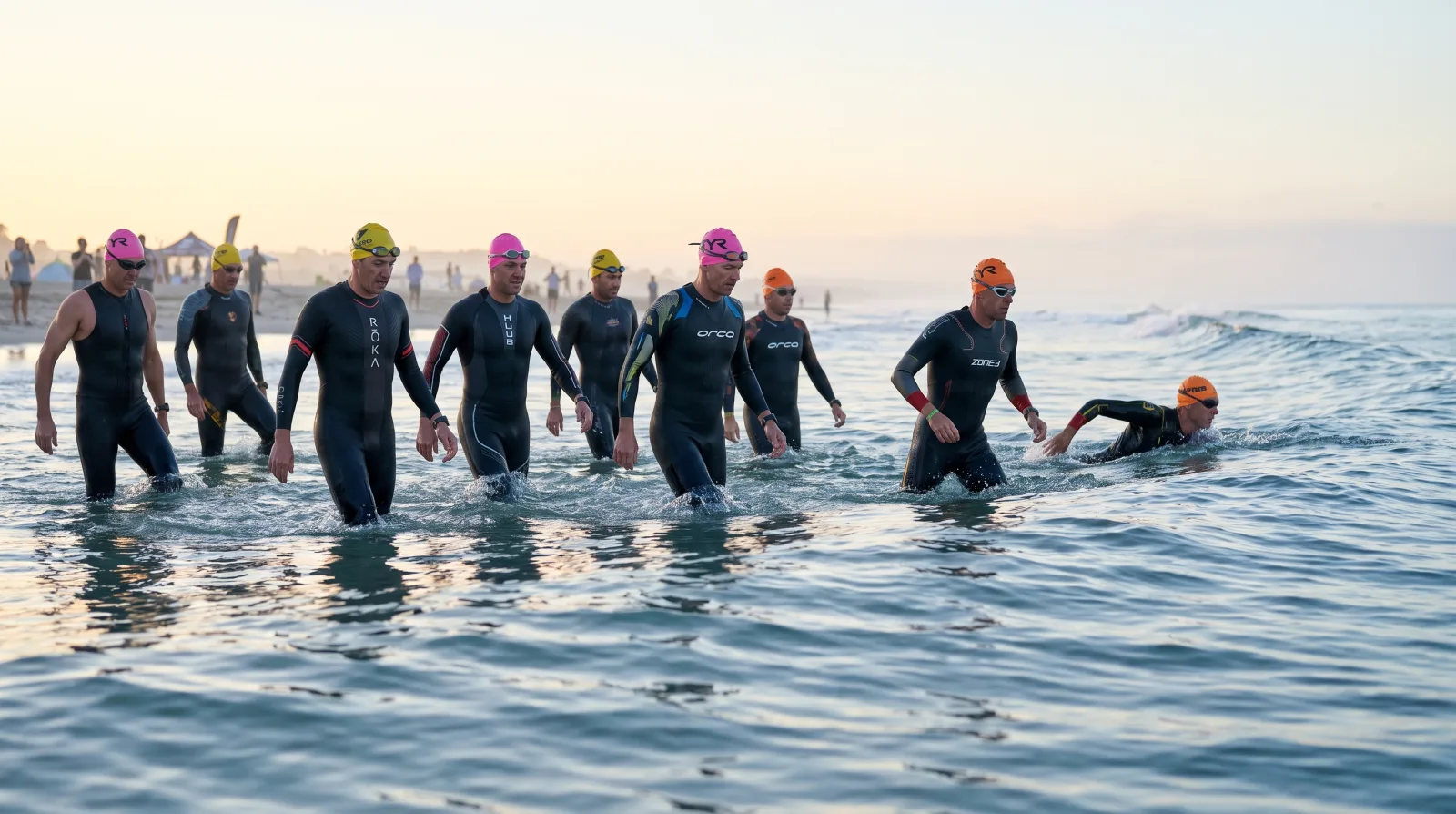
Three days ago, the largest Olympic-distance triathlon on the planet couldn't swim. Not because of weather, not because of a water-quality advisory, not because of some logistics failure in transition. Sharks showed up at Noosa, twice in two mornings, and 8,500 athletes who'd trained all year for that swim ran a 5K instead. It's the first time in the race's 43-year history that's happened.
I've swum plenty of ocean races with absolutely nothing bigger than a jellyfish in the water, and I still think about sharks every single time I put my face down and can't see the bottom. That reaction is normal. It's also, statistically, almost entirely irrational. Both of those things are true at once, and this article is about living with that contradiction instead of pretending it doesn't exist.
What Actually Happened at Noosa
Noosa Triathlon draws about 8,500 competitors every year, which makes it the biggest Olympic-distance race in the world. On the Saturday before this year's race, lifeguards spotted sharks on the swim course and organizers didn't cancel outright. They shrank the course to a 1-kilometer loop designed to keep everyone in shallower water, the kind of compromise race directors make constantly when conditions get sketchy. Then sharks showed up again at first light on Sunday, and lifeguards told organizers it wasn't safe to put anyone in the water at all.
So the race ran backwards: a 5K run first, then the usual 40K bike and 10K run. Matthew Hauser won his second straight men's title, and Natalie Van Coevorden took her first. Nobody got hurt. Nobody even got close to a shark. The whole story is really just "the swim got cancelled," which, if you've been in this sport a while, is not actually that rare a sentence. What's rare is the reason.
So How Often Does This Actually Happen?
Less than you'd think, and for a reason that surprised me when I dug into it: most "shark scares" in triathlon history turn out to be about something else entirely. Escape from Alcatraz had a real one in October 2015, when a security camera caught a great white shark attacking a seal in San Francisco Bay days before the race, with blood visible in the water near the swim course. Organizers didn't cancel. They added kayaks, briefed the field, and let the race go as planned. Fifty-nine swimmers from the Dolphin Club jumped in anyway.
Two years later, in 2017, Alcatraz's swim actually was cancelled, for the first time in recent memory at that point. The cause? A small-craft advisory from strong wind, which meant the safety boats couldn't operate. Sharks had nothing to do with it, and most headlines from that week still led with sharks anyway because that's the story people click on.
Then there's the one that should scare you the least: during a swim-course recon for Ironman 70.3 Oceanside in 2024, pro triathlete Braden Currie got surrounded by a group of sharks caught on drone footage. Turned out they were sand tiger sharks, a species that's basically harmless to humans unless directly provoked. Currie laughed it off on local radio, finished sixth that weekend, and the race never considered cancelling. That's most shark sightings at a triathlon: something gray and triangular-finned shows up on a drone feed, everyone's heart rate spikes, and then absolutely nothing happens.
The Actual Odds, Because They're Better Than You Think
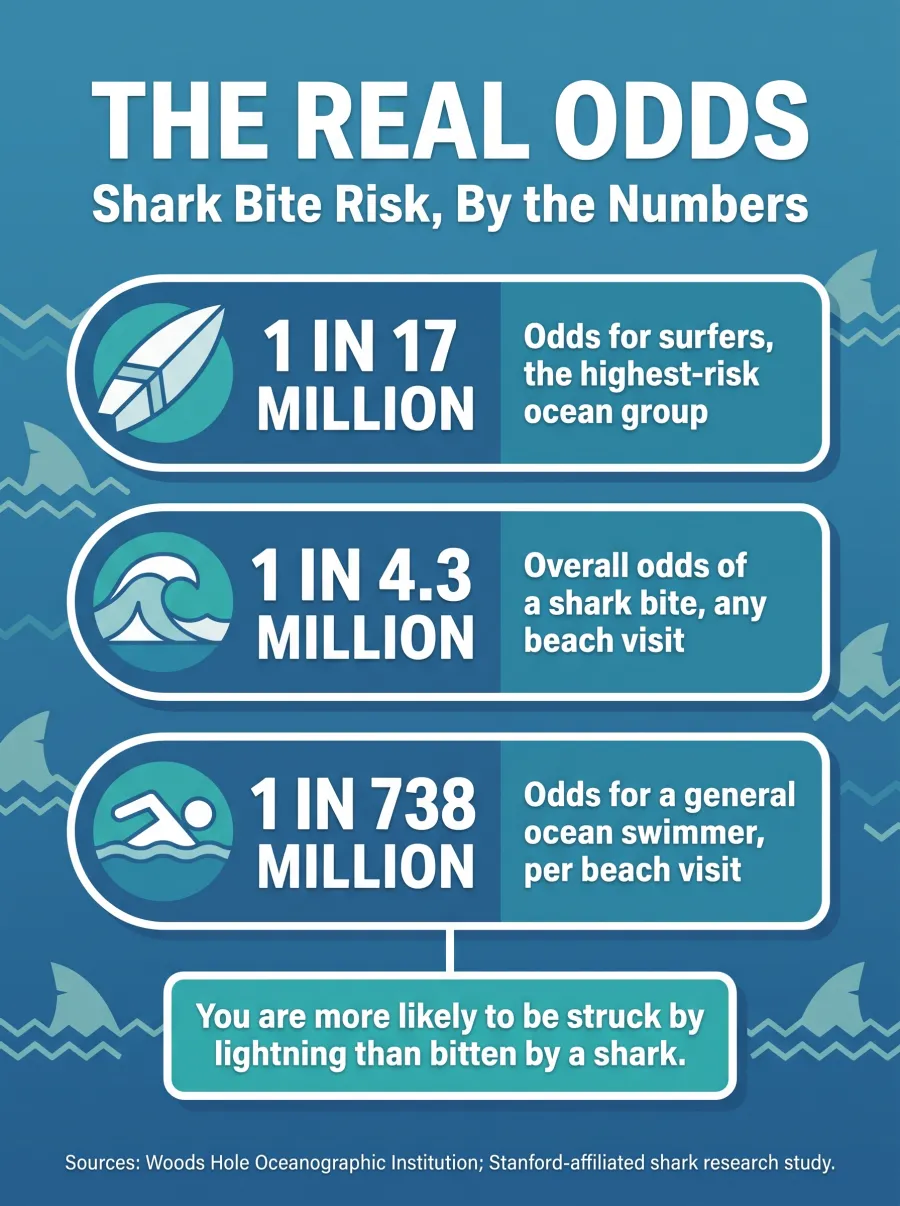
Here's where I'll admit the math is genuinely on your side. Woods Hole Oceanographic puts the odds of being bitten by a shark at roughly 1 in 4.3 million. A Stanford-led study on California surfers, the single highest-risk group in the ocean because they spend so much time sitting on boards that look like seals from below, put their odds at about 1 in 17 million. For general swimmers, the same research dropped that to roughly 1 in 738 million beach visits. You read that right: you're meaningfully more likely to get struck by lightning on your drive to the race than to have any shark interaction at all, let alone a bite.
There's one real exception worth knowing, and it's not triathlon-relevant for almost anyone reading this: a 2023 study on long-distance channel swims in Hawaii found that cookiecutter shark bites, a tiny, deep-water species most people have never heard of, happened at a measurably higher rate during swims on moonless nights. That's an edge case for marathon channel crossings, not for a race-morning swim start with a few hundred other people and a support boat every fifty meters.
What Should You Actually Do If You See a Shark Mid-Swim?
First: don't thrash. I know that's the hardest instruction anyone's ever given you, but panicked splashing and kicking is exactly the kind of high-contrast, erratic movement that gets a shark's attention in the first place, especially from below where everything you're wearing just reads as a dark silhouette anyway. Keep your stroke steady, swim a direct line toward shore or your training group, and get out calmly.
Second, and this one actually matters more than most people realize: tell somebody. Lifeguards, a dive shop, your local triathlon club's group chat, whatever reporting channel exists where you swim. Most coastal shark "sightings" that make the news started as exactly that, one person telling a lifeguard what they saw, and the system working the way it's supposed to.
Beyond that, the advice is less dramatic than you'd expect: swim with people, not alone (sharks overwhelmingly target solitary targets, and a group is also just safer for a dozen unrelated reasons). Avoid dawn and dusk if you have the choice, since that's prime hunting time for the species that actually matter to swimmers. Stay away from river mouths and areas with visible bait fish or diving birds, since that's where predators are actively feeding, not idly cruising. None of this is about living in fear. It's the same category of advice as "look both ways before crossing the street," which is to say: boring, repetitive, and the actual reason most people never have a problem.
Does Any of the Shark Gear Actually Work?
I went into this expecting to roll my eyes at the whole category, and came out more split than I thought I'd be. The data isn't close to uniform across products, so lumping "shark deterrents" into one bucket, which most marketing wants you to do, is actually the wrong way to think about this.
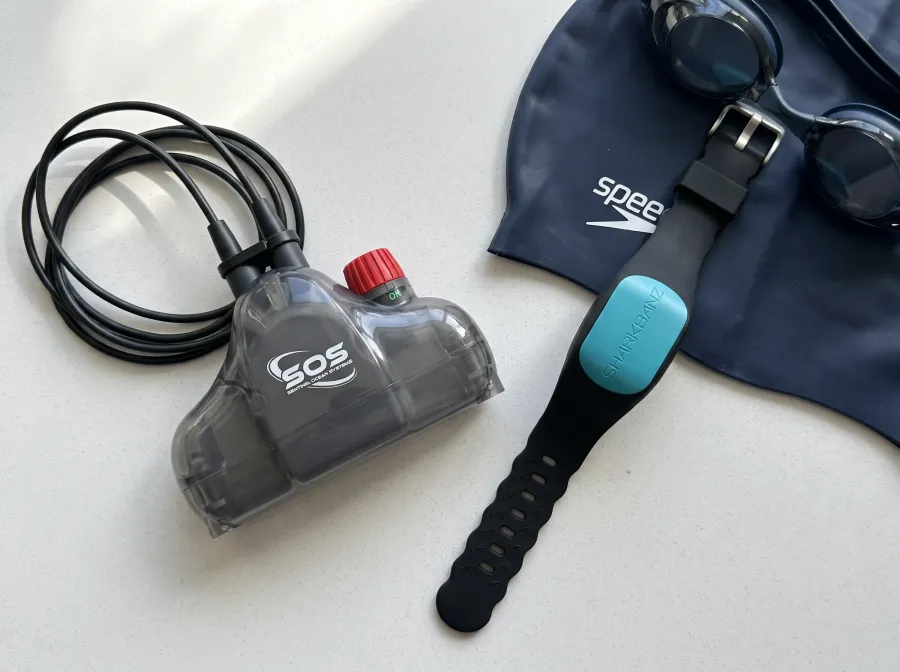
The SOS Freedom8 is the one with real independent backing. It's the current version of the Shark Shield lineage (the old Ocean Guardian FREEDOM7 got discontinued; Freedom8 is its direct replacement, same underlying electrical technology). It's an ankle-worn unit with a 2.2-meter trailing antenna that generates a pulsed electrical field roughly 6 meters across, the same core tech the Australian and US Navies use. A 2018 Flinders University field study at the Neptune Islands tested the surfboard-mounted sibling version of this same technology against wild great whites and found it cut the percentage of bait taken from 96% down to 40%, nearly doubling the distance sharks kept from the rig. That's one of the only rigorous independent field tests in this entire product category. The ankle unit runs four to five hours on a charge, is rated to 50 meters, and typically runs $600 to $650 across US retailers. That's a real range backed by a real study, not a marketing claim.
Sharkbanz 2 is the one you've probably actually seen on someone's ankle at a race, mostly because it's $138 instead of $600-plus and looks like a normal wristband. It uses permanent magnets instead of an electrical field, and that same 2018 Flinders study tested it too: no measurable effect on white shark behavior in open-water trials. Sharkbanz disputes the test conditions, arguing the bait used was more attractive than anything a real swimmer represents, and to be fair, that's not an unreasonable point. But "the only independent field study found no effect" is still the honest answer as of today, not "it probably works because it's popular."
And the one piece of gear that costs you nothing: wetsuit color. Sharks are functionally colorblind, but they see contrast and reflectivity extremely well, which is why researchers have spent decades on so-called "yum yum yellow," the bright flotation-device color that's highly visible to rescuers and, in theory, to sharks too. The honest conclusion from the actual vision research is that your standard black or navy wetsuit is already close to the lowest-contrast option you could wear. You don't need a specialty camouflage suit. Companies like SAMS have built them, with limited independent field validation so far, and I wouldn't spend the extra money until that changes.
So here's where I land, for what it's worth: if you're doing serious open-water training in a known shark area and $600-plus genuinely buys you peace of mind backed by one real study, that's a defensible purchase. If you're buying a $138 magnet band because it was on a surf shop endcap, you're paying for the feeling of doing something, not a measured reduction in risk. I'd rather you spend that money on a tow float with a whistle, which solves a problem that's actually going to happen to you.
The Risk You're Actually Ignoring
Every open-water swim I've ever done, the real hazard was never the thing with teeth. It was the guy who swam a diagonal line straight into my shoulder at the first buoy, or the current that pushed me forty meters off course until I finally sighted the shore properly. Noosa's cancellation is going to generate a thousand nervous group-chat messages this week, and maybe a few people will skip their next ocean swim over it. That's the wrong lesson. The right one is that race directors have gotten good at this exact call, Noosa proved it by shutting the swim down twice in two days rather than risk anyone, and the system worked exactly the way it's supposed to.
Would you still get in the water the morning after a sighting like that, or would you be one of the people asking for the bike-run duathlon option?


