
It's 2am. You've just paid the entry fee — somewhere in the neighborhood of $800 to your retirement fund — and now you're lying awake Googling "IRONMAN safety risks" like a perfectly rational human being. Congratulations. You've joined a long and distinguished tradition of athletes who sign up for a 140.6-mile race and then immediately begin questioning every life choice that led them here.
The fear is real and it's valid. You're about to swim 2.4 miles in open water surrounded by hundreds of people all trying to occupy the same three square feet of lake. Then you'll bike 112 miles in conditions ranging from "pleasant" to "feels like the surface of Venus." Then you'll run a marathon. Just because.
So let's actually talk about IRONMAN safety risks. Not the sanitized version, not the "you'll be fine, don't worry about it" brush-off. The honest, data-backed, slightly-dry-witted truth from someone who has done this more times than they care to admit and has personally experienced at least two of the things on this list.
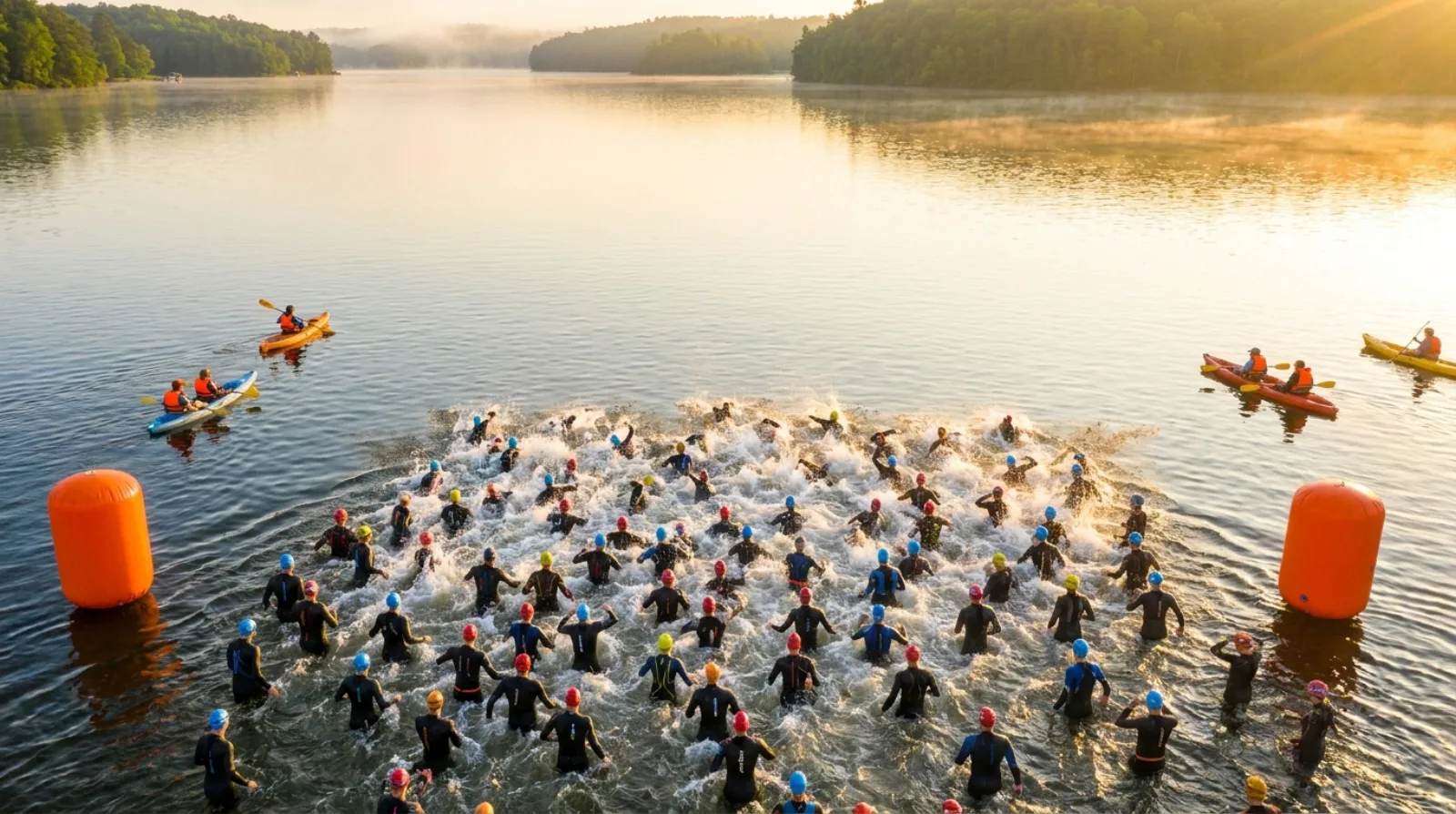
The Swim: Yes, This Is the Part Worth Taking Seriously
Let's not dance around it. The swim is where the most serious IRONMAN safety risks concentrate. Between 67% and 73% of all triathlon-related fatalities occur during the swim segment — and for full IRONMAN races, that number climbs even higher. A study analyzing IRONMAN deaths from 1986 to 2021 found that 71% of fatalities happened in the water.
The overall fatality rate across triathlons sits around 1.5 deaths per 100,000 participants. For full IRONMAN-distance events, it's higher — roughly 20–23 per 100,000 — though context matters enormously here. Most involve athletes with undetected underlying cardiac conditions, not drowning. Autopsy data shows pre-existing cardiovascular disease in roughly 44% of cases. The swim doesn't cause healthy hearts to fail; it reveals conditions that were already there.
The cold water, the mass start chaos, the sudden catecholamine surge of race morning — these are physiological stressors that can trigger cardiac arrhythmias in people who didn't know they had something to worry about. Men over 40 face a meaningfully elevated risk. The incidence for men aged 60 and older reaches approximately 18.6 per 100,000 — which is still a small absolute number, but worth knowing if you're in that demographic.
What actually reduces your swim risk:
- Get a cardiac screening before race day, especially if you're 40+, male, or have any family history of heart issues. This isn't alarmism — it's the single most evidence-backed thing you can do.
- Practice open water swimming extensively. Pool fitness and open water swimming are related but distinct skills. Panic in open water is a real phenomenon and training eliminates most of it.
- Wear your wetsuit. Buoyancy is your friend. The wetsuit is not optional vanity — it keeps you horizontal in the water and dramatically reduces fatigue.
- Know that race courses deploy kayakers, paddleboarders, and safety boats throughout the swim. There are humans actively watching you. If you need to stop and rest, you can.
- Seed yourself honestly at the start. Starting in a calmer position rather than directly behind the fast swimmers means you're not being swum over in the first 200 meters.
The Bike: Where Most Injuries Happen (But Not Most Deaths)
Here's a thing that surprises most people: the bike leg has the highest injury rate but relatively low mortality. Most bike incidents are crashes — pavement meets skin, carbon fiber meets guardrail, and nothing particularly fatal happens except to your dignity and your aero bars.
The incidence of fatal events during the bike segment is roughly 0.27 per 100,000 participants — dramatically lower than the swim. What you're more likely to encounter: road rash, collarbone fractures, the occasional dramatic tumble that you will absolutely over-describe at dinner parties for the next decade.
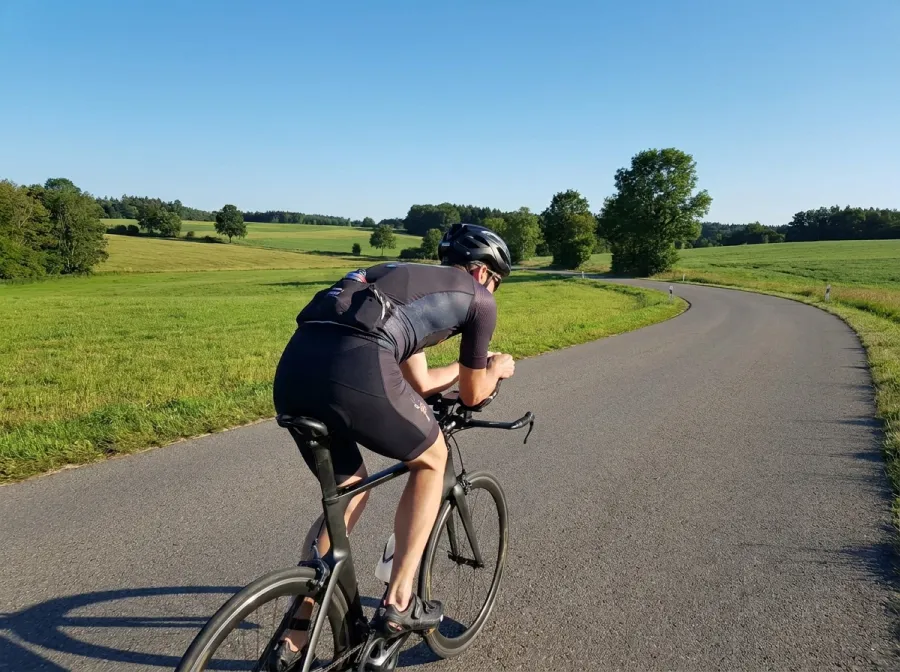
Heat is a genuine concern on the bike in warm-weather races. Core temperature management starts here, not on the run. Athletes who go out too hard on the bike — which is everyone in their first race, including you, and definitely me — arrive at T2 with a thermal debt they'll spend 26.2 miles repaying with interest.
Mitigating bike risk:
- Helmets are mandatory and non-negotiable. Wear one that actually fits.
- Get a proper bike fit. Spending 5+ hours in an aerodynamically compromised position is how you destroy your lower back and arrive at the run unable to run.
- Pre-race mechanical check. Your derailleur doesn't care that you've been training for eight months.
- Practice descending and cornering. Most crashes happen where most people don't train: at speed, on technical sections.
- Hydrate and eat on the bike even when you don't feel like it. Especially when you don't feel like it.
IRONMAN Safety Risks on the Run: Miles 18–26 Don't Play Around
The run is where the day's chickens come home to roost. Whatever sins you committed on the swim and bike — too fast, too hot, not enough sodium — the marathon will collect them, with late fees.
Exertional heat stroke (EHS) peaks during the run phase. A study of UK triathlons found that 67% of heat stroke cases occurred during the run or immediately after finishing. The run fatality incidence is approximately 0.19 per 100,000 — lower than the swim, higher than you want to think about at mile 20 when your vision is going sideways.
The good news: heat stroke is almost entirely preventable with adequate pacing and hydration strategy. The bad news: it's very hard to have adequate pacing when you've been racing for nine hours and your brain has officially left the building.
The wall — that famous moment around mile 18–20 where your body sends you a text message that simply reads "absolutely not" — is real but not dangerous. It's uncomfortable, it's demoralizing, and it will make you question everything about yourself as a human being. It won't kill you. Walk. Eat something. Keep moving. This is what the run aid stations are for.
Run safety strategy:
- Pace conservatively off the bike. Every experienced IRONMAN athlete will tell you this. You will not listen. Then you'll come back next year and tell someone else to pace conservatively off the bike.
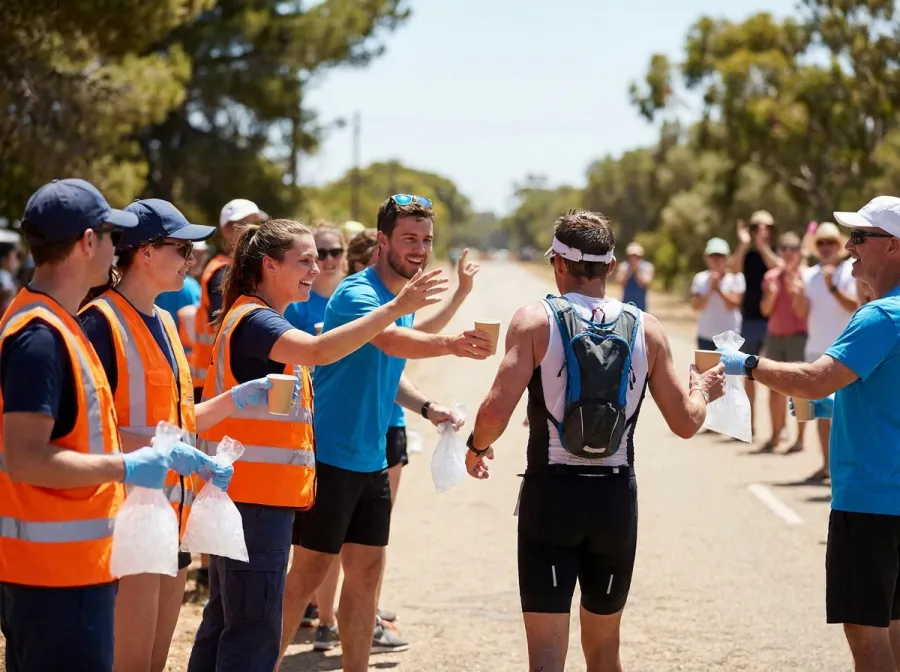
- Use every aid station. Ice in the hat, ice in the sports bra, ice down the back, ice in your socks if that's what it takes. The volunteers are there for exactly this.
- Know the signs of heat stroke: confusion, stopping sweating in hot conditions, very high body temperature. This is a medical emergency, not a "push through it" situation.
- Nutrition on the run matters even if your stomach is staging a protest. Gels, cola, chicken broth — whatever your stomach will accept.
Transitions: Chaotic But Statistically Fine
T1 and T2 are genuinely chaotic environments. You're wet, disoriented, running in bike shoes on a slippery surface while trying to locate your specific bike among several hundred identical-looking machines. Someone will definitely run their bike into your shins. You will definitely forget to put on sunscreen.
But transitions are not where people get seriously hurt. They're where people trip over their own gear bags, put their helmets on backwards (it happens), accidentally grab someone else's bike (it definitely happens), and generally move with the grace of a confused penguin. The fatality statistics for transitions are essentially unmeasurable — they're that low.
The real transition risk is operational: a poorly buckled helmet, skipped sunscreen on a seven-hour bike, forgetting to grab nutrition. These won't hurt you in the moment, but they'll make the back half of the day significantly worse.
The Weird Stuff: GI Disasters, Hypothermia, and Acts of God
Nobody talks about this in the pre-race briefing, but they should: approximately 30–40% of endurance athletes experience significant GI distress during an IRONMAN. Nausea, cramping, and the kind of urgent bathroom situations that redefine your relationship with porta-potties — these affect a meaningful portion of the field. It will not kill you. It will, however, humble you in ways that no training plan fully prepares you for.
Hypothermia is a legitimate risk in cold-water races. Water below 60°F (15°C) will cool your core faster than you expect, especially in long swim segments. Wetsuits are mandatory in most cold-water conditions, and race directors monitor water temperatures closely. If you're feeling unusually slow mentally or developing muscle cramps late in the swim, flag down a kayaker.
Lightning: yes, IRONMAN races get cancelled or delayed for lightning. Yes, this is frustrating when you've traveled three states and spent $1,200 on a hotel. No, they're not doing it to ruin your day. Lightning cancellations are rare but real, and "I trained for eight months" is not an effective argument against a thunderstorm.
The Real Answer: IRONMAN Safety Risks in Context
Here's the number that reframes everything: the overall IRONMAN fatality rate of roughly 20 per 100,000 is comparable to running a marathon (estimated 0.8–2 per 100,000) scaled for a much longer, more physiologically demanding event. For context, recreational cycling has a fatality rate of approximately 7 per 100,000 — just from riding your bike around. Skiing, tennis, swimming — all carry risks that we accept without much thought.
More to the point: the training required to get to an IRONMAN start line is probably one of the most profoundly positive things you can do for your long-term health. Cardiovascular fitness, metabolic efficiency, bone density, mental resilience — the training delivers all of it. Most people who complete an IRONMAN emerge on the other side of it healthier, better sleep, more metabolically robust than when they started.
The people who don't make it to the finish line are, in the vast majority of cases, people who had underlying conditions that weren't diagnosed. Which is exactly why the medical screening piece isn't optional. Get the ECG. Do the stress test if your doctor recommends it. Have the conversation with a sports medicine physician before race day.
And then go sign up. Because here's the other truth: the athletes I've seen at IRONMAN finish lines — people who have been on course for 13, 14, 15, 16 hours — are not people doing something reckless. They're people who spent a year learning the limits of what their bodies can do, and then pushing those limits, carefully, with support, with preparation, with a hundred trained volunteers and medical personnel watching over them every mile of the way.
The question isn't whether IRONMAN is safe. The question is whether you're going to do the work to make it as safe as it can be. Get screened. Train smart. Respect the distance. Pace the bike.
And see you at the finish line.


