
Every year, thousands of people sign up for their first triathlon. A meaningful percentage of them sign up for an Ironman. This is how to choose a triathlon race that won't break you — physically, financially, or spiritually.
Race selection is the first serious decision you make as a triathlete, and most people get it wrong because they're choosing based on inspiration rather than information. You saw someone post their Ironman medal on Instagram. Your coworker finished a 70.3. Suddenly, "I'll do that" becomes a credit card transaction, and six months later you're hobbling through mile 18 wondering where it all went sideways.
This guide is the antidote to that. We'll walk through honest self-assessment, what each race distance actually feels like from the inside, what makes a course beginner-friendly versus a survival test, the best US destination races for 2026, and how to build a season that gets smarter as you go.
How to Choose a Triathlon Race: Start With Honest Self-Assessment
Before you open a race calendar, you need a realistic snapshot of four things:
1. Your Current Fitness Base
Can you swim 500 meters without stopping? Ride a bike for 45 minutes? Run a 5K? If the answer to all three is yes, you're a sprint triathlon candidate. If one or more is a strong no, you need either more time or a shorter starting point — and both are fine. There's no shame in a super-sprint. There is significant shame in a DNF that was entirely predictable.
2. Available Training Time
Sprint triathlon training requires roughly 6–8 hours per week for 8–12 weeks. An Olympic distance needs 8–12 hours per week. A 70.3 demands 10–15 hours weekly for 16–20 weeks. A full Ironman? Clear your social calendar for 6 months and consider whether your relationships can handle it. Be honest about how many hours you actually have, not how many you intend to find.
3. Race Experience and Fear Tolerance
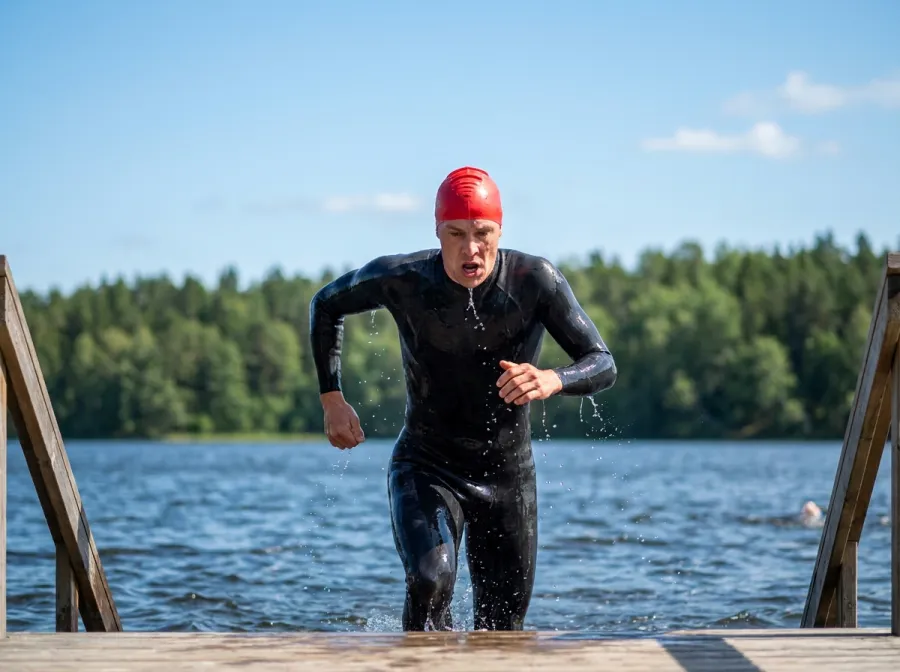
Open-water swimming terrifies a lot of otherwise capable athletes. Mass starts — where 300 people churn through the water simultaneously in what can only be described as a washing machine with legs — are disorienting even for experienced swimmers. If open water is new to you, choose a race with a pool swim option, wave starts, or a calm lake. If the word "ocean" makes you nervous, don't start with an ocean swim.
4. Budget
A local sprint race might cost $75–$150 to enter. Add a wetsuit rental, race-day nutrition, and gas to get there, and you're at $300. An Ironman registration alone runs $700–$900, plus travel, lodging, a race-legal bike, gear, and the nutrition you'll consume across 12+ hours. Budget backward from what you can actually spend.
What Each Race Distance Actually Feels Like
Race listings will give you the numbers. Here's what those numbers feel like in your body on race day.
Sprint Triathlon (750m swim / 20km bike / 5km run)
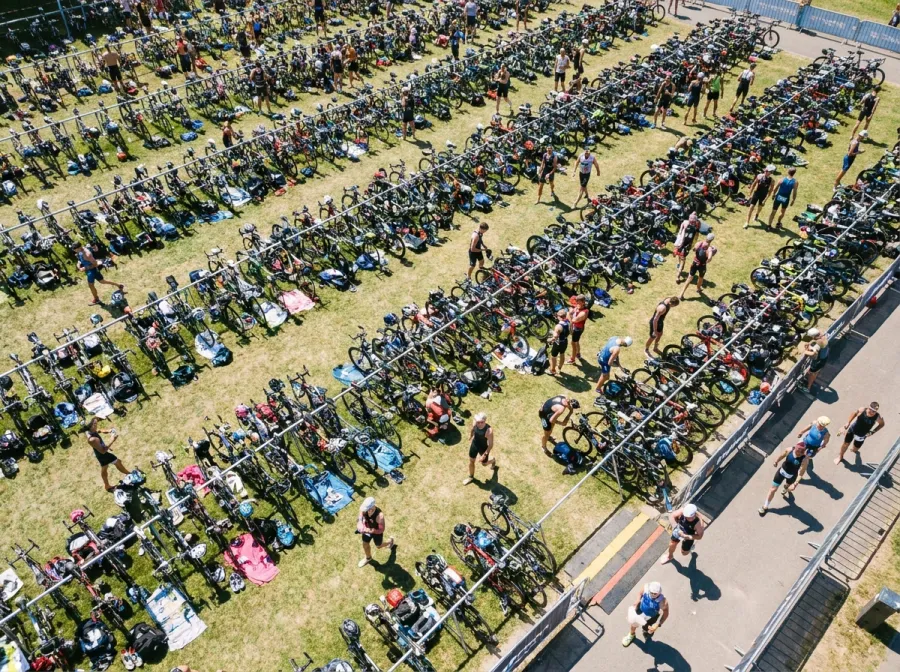
Fast, chaotic, and over before you've fully processed what's happening. Sprint races last 1–2 hours for most age-groupers. The transition areas buzz with nervous energy, the swim is crowded but short, and the run leg is where whatever you had left gets spent. It's an excellent first race because the consequences of pacing errors are minimal — you can go too hard on the bike and still survive the run. Many sprint races also have a forgiving atmosphere with volunteers who've seen every level of experience come through.
Olympic Distance (1.5km swim / 40km bike / 10km run)
This is where triathlon stops being a novelty and starts being a sport. The Olympic distance (also called International distance) takes 2–3 hours and requires genuine pacing discipline. The swim is long enough that technique matters. The bike is long enough that even small power surges cost you on the run. The 10km run at the end — on legs that just cycled 25 miles — is a different animal than a fresh 10K. Expect your first one to feel harder than you anticipated.
70.3 / Half Ironman (1.9km swim / 90km bike / 21.1km run)
The 70.3 is the distance where nutrition becomes non-negotiable. You'll be racing for 4–7 hours, which means you need a fueling strategy, not just a will to finish. The bike leg takes 2.5–3.5 hours for most athletes, and what you eat and drink on it determines whether your half-marathon run is a run or a shuffle. The 70.3 is also where race-day anxiety peaks for first-timers — the distance is large enough to feel genuinely intimidating, but short enough that nearly anyone can finish with the right preparation.
Full Ironman (3.8km swim / 180km bike / 42.2km run)
Let's be direct: the Ironman is not a beginner race, no matter what the marketing materials imply. The 140.6-mile distance takes most age-groupers 12–17 hours. You'll swim in open water for over an hour, bike for 5–7 hours, and then run a full marathon — on the same day. The psychological challenge is as significant as the physical one. If you sign up for an Ironman as your first triathlon, you will almost certainly finish, but you will also almost certainly have a significantly worse time than if you'd built up to it over a season or two. The smart athletes do a sprint, then an Olympic, then a 70.3, then an Ironman. The other athletes write Reddit posts about their DNFs.
How to Choose a Triathlon Race: Course Factors That Actually Matter
Two races at the same distance can have wildly different difficulty profiles depending on course design. Here's what to look for:
Swim Venue
Lake or reservoir = calm, predictable, wetsuit-legal in most conditions. Bay or harbor = usually calm but can have current and chop. Ocean = everything changes: surf, salt, current, swells, and the psychological weight of open horizons. For beginners, inland water is always the friendlier choice.
Bike Course Elevation
A "flat" bike course means you can hold a consistent effort and your legs will have something left for the run. A hilly course means you'll either blow up climbing or spend the entire ride braking on descents. Check Strava segments or race-provided elevation profiles before registering. Anything over 3,000 feet of gain on a 70.3 bike course is considered challenging. For full Ironman, courses like IRONMAN Florida (flat, Panama City Beach) and IRONMAN California (flat, Sacramento) are considered among the most forgiving.
Heat and Climate
Racing in Florida in July is a different experience than racing in Oregon in June. Heat slows everyone down, but it hits underprepared athletes hardest. If you're training in a cool climate and racing somewhere hot, factor in heat acclimatization. Texas in summer requires genuine respect — IRONMAN 70.3 Texas in Galveston in March is far more manageable than any summer race in the state.
Crowd Support and Race Atmosphere
This matters more than most athletes admit. A well-organized race with enthusiastic volunteers and crowds can carry you through rough patches. A small, poorly-marked race with a lonely run course does the opposite. Check reviews on sites like RaceRaves before committing.
How to Choose a Triathlon Race: Best 2026 US Destination Races by Level
With your self-assessment done and course factors in mind, here are standout 2026 options across the US:
Beginner Picks (Sprint & Olympic)
Colorado Triathlon — Boulder, CO (June 6, 2026)
Boulder Reservoir is one of the best beginner swim venues in the country: calm, flat, wetsuit-legal. The Colorado Triathlon specifically offers a "first-timers swim wave" capped at 50 athletes — a rare and genuinely welcoming touch. Sprint and Olympic distances available.
PDX Triathlon Festival — Fairview, OR (May 31, 2026)
Blue Lake Regional Park is purpose-built for accessible triathlon. The festival offers a "My 1st Tri" course alongside sprint and super sprint distances. A great way to open the season in the Pacific Northwest with a low-stakes first experience.
Supertri Long Beach — Long Beach, CA (July 19, 2026)
Sheltered ocean swim, flat course, urban energy. The Supertri format is explicitly designed for first-timers and includes sprint, super sprint, and Olympic distances. Hard to find a more beginner-friendly ocean swim setup in California.
St. Anthony's Triathlon — St. Petersburg, FL (April 24–26, 2026)
One of the oldest and most beloved triathlons in the US. St. Pete is flat, fast, and incredibly well-organized. The April timing means temperatures are manageable before the Florida summer arrives. A genuine bucket-list sprint/Olympic race for any first-timer.
Austin CapTex — Austin, TX (May 25, 2026)
Auditorium Shores in Austin is one of the best race venues in the country for atmosphere. The CapTex offers super sprint through Olympic distances, a flat course, and the kind of crowd support that makes you feel like a pro even if you're in the last wave.
Intermediate Picks (70.3 / Half Ironman)
IRONMAN 70.3 Texas — Galveston, TX (March 29, 2026)
Flat coastal swim, flat bike, flat run. This is the "PR chasers dream course" and also an ideal first 70.3 for the same reason: no surprises. The March timing keeps the heat tolerable. Widely regarded as one of the most accessible 70.3 courses in the US.
IRONMAN 70.3 Gulf Coast — Panama City Beach, FL (May 9, 2026)
Gulf swim, flat bike through Florida scenery, well-supported run. The 2026 edition shortened the swim to 1,000m due to conditions — check the current course details before registering. Still a strong first 70.3 option in a beautiful venue.
IRONMAN 70.3 Boulder — Boulder, CO (June 13, 2026)
The Rocky Mountain backdrop is spectacular. Fair warning: the bike course has rolling terrain that earns this race its "challenging but rewarding" reputation. Not the easiest 70.3 in the country, but the atmosphere and altitude make it memorable. Sells out quickly — register early.
IRONMAN 70.3 Northern California — Redding, CA (2026)
New for 2026, this course offers a scenic west coast experience with views of Mount Shasta. Worth watching for athletes who want a fresh course without the crowds of more established events.
Advanced Picks (Full Ironman)
IRONMAN Florida — Panama City Beach, FL (November 7, 2026)
Consistently ranked among the flattest and fastest courses on the Ironman circuit. If you're going long for the first time, this is where to do it. The flat run course is a genuine gift after 112 miles on the bike.
IRONMAN California — Sacramento, CA (October 18, 2026)
A downriver swim in the American and Sacramento Rivers, flat two-loop bike through farm and wine country, flat run along the river. Fast course, great spectator access, and Sacramento's race infrastructure is excellent.
IRONMAN Texas — The Woodlands, TX (April 18, 2026)
The North American Championship. More prestige, more competition, more intensity. For experienced athletes targeting a qualifier slot or a PR, this is a marquee event.
Building a Smart Multi-Race Season
Picking one race is a decision. Building a season is a strategy. The framework that works is the A/B/C race structure:
- A-Race: Your primary target. Everything in your training plan peaks for this event. Schedule 1–2 per season and protect them. Full taper (2–3 weeks for a 70.3, 3 weeks for an Ironman).
- B-Races: Moderately important. Use these to practice race-day nutrition, transitions, and pacing without a full taper. Two to four weeks before your A-Race, these are perfect fitness check-ins.
- C-Races: Just racing. Show up, go hard, see what happens. No taper, no pressure. These are the races where you find out what your training is actually doing.
A practical example for a first-time 70.3 athlete targeting IRONMAN 70.3 Texas in late March:
- January: Base building, swimming focus
- February: C-Race — local sprint (test your transitions)
- Early March: B-Race — Olympic distance (race-pace rehearsal)
- March 29: A-Race — IRONMAN 70.3 Texas
This structure gives you race experience before your A-Race, meaningful fitness data, and the psychological confidence of having done this before — at a lower-stakes level.
What to Do After Your A-Race
Post-race blues are real and predictable. You've spent months organizing your life around a singular goal, and then it's done. Many athletes respond by signing up for another race immediately, which is a fine strategy as long as you've actually recovered. A better approach:
- Take 1–2 weeks completely off. Not "easy training" — actually off. Your body and mind both need it. The fatigue from a long race runs deeper than it feels in the days immediately after.
- Reflect before you plan. What worked? What fell apart? What would you do differently? Write it down while it's fresh. This is the analysis that makes your next season better.
- Set your next goal while your motivation is still hot. Not necessarily a race date — just a direction. "I want to break 2:30 at a 70.3" or "I want to try a trail run this fall" gives you something to move toward without the pressure of a new race calendar.
- Return to training with lower stakes. Start with what sounds fun, not what's on the plan. A few weeks of unstructured movement rebuilds intrinsic motivation better than immediately resuming a rigid schedule.
The Race Selection Decision Framework
Use this checklist before clicking the registration button on any race:
✅ Race Selection Checklist
- ☐ Can I train for this distance given my current fitness and available hours? (Be honest. Round down, not up.)
- ☐ Have I swum in open water at least a few times before race day? If no, is this race pool-swim or does it have calm water conditions?
- ☐ Is the bike course appropriate for my cycling ability? Check elevation profile. Hilly > 3,000ft gain = intermediate+ only.
- ☐ What's the water temperature likely to be? Under 78°F = wetsuit legal in most races. Over 84°F = wetsuit prohibited.
- ☐ What's the weather/heat likely to be on race day? Anything over 85°F adds significant difficulty.
- ☐ Is this race a good fit for my experience level? First race should be sprint or Olympic. Full Ironman requires 70.3 experience.
- ☐ Have I read reviews from past participants? RaceRaves, r/triathlon, and race Facebook groups are good sources.
- ☐ Does this race fit my budget including travel, gear, and lodging?
- ☐ Is this my A, B, or C race? Know before you register — it determines how much you should taper.
- ☐ Do I have enough time between this race and my next A-Race? Allow 5–8 weeks between full-distance events; 2–4 weeks between short-course events.
The athletes who get the most out of triathlon are the ones who race at the right level for right now — not the level they aspire to in three years. Build smart. Race often. Progress is faster when you're not rebuilding from injury or burnout.
The sport rewards patience in a way that's almost philosophical. A sprint race well executed is worth more than a 70.3 that nearly broke you. Start where you are, not where you want to be. The finish line will still be there next season — and you'll cross it faster.


