
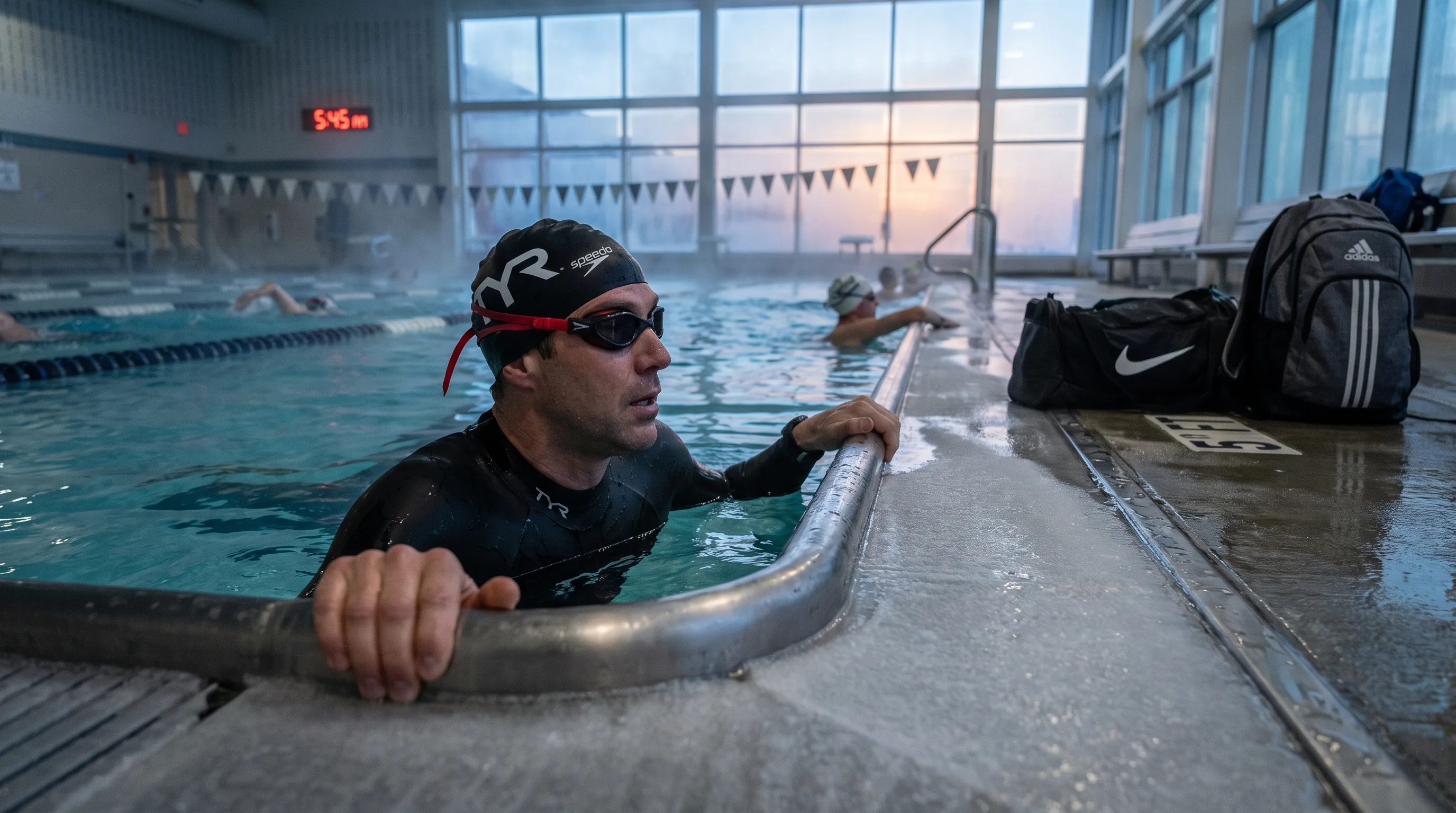
My alarm used to go off at 5:12 a.m. Not 5:00, not 5:15. 5:12, because that was the exact number of minutes I needed to get from bed to the pool deck before the lane ropes filled up with the swim team's morning practice. I'd swim for 38 minutes, towel off in the parking lot, and be at my desk by 7:40 smelling like chlorine and instant coffee. That was my "big" training day. Most weeks, my whole triathlon life fit into six or seven hours, wedged around a job, a commute, and a toddler who did not care about my race calendar.
I finished three 70.3s that way. Not fast ones. But not death marches either, and that's the part nobody tells you when you're staring at a 20-week training plan built for someone who apparently doesn't have a job.
If you've Googled "70.3 training plan" and felt your stomach drop at 14-16 hours a week, you're not broken and you're not lazy. You're just looking at a plan built for a different life than yours. Here's what actually works when six to eight hours is the ceiling, not the floor.
So How Many Hours Do You Actually Need?
Fewer than the internet wants you to believe. Matt Dixon, the coach behind Purplepatch and the author of Fast-Track Triathlete, built an entire coaching business around this exact question, and his answer is blunt: 7 to 10 hours a week for a half-distance race, 10 to 12 for a full. Dixon has said in interviews that the average Purplepatch athlete, pros excluded, trains somewhere between 10 and 11 hours a week. Some of those athletes have won their age group at 70.3 world championships. On 10 hours. Not 18.
Six to eight hours puts you slightly below Dixon's floor, which matters, but not in the way you'd think. It doesn't mean you can't finish strong. It means every single hour has to justify its existence. There's no room for a junk 45-minute jog that's too easy to build fitness and too hard to count as recovery. At low volume, that workout is just noise.
Where the Hours Should Go
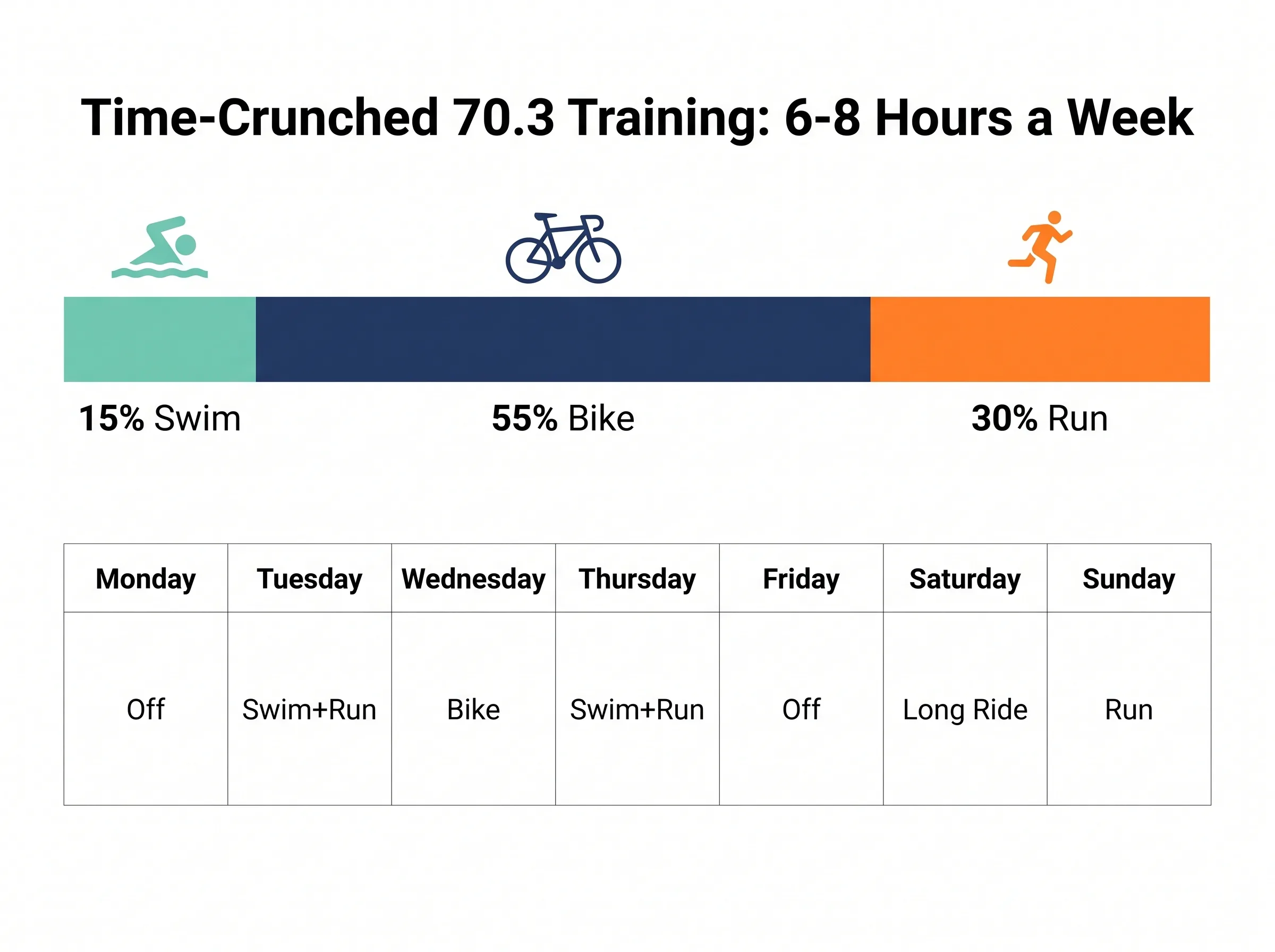
Most coaches working with time-crunched athletes land on something close to the same split: roughly 15% swim, 55% bike, 30% run. On a 7-hour week that's about an hour of swimming, just under 4 hours on the bike, and a little over 2 hours running. It looks lopsided if you're used to thinking of triathlon as three equal thirds. It isn't lopsided. It's math.
The swim is the shortest leg of your race by a wide margin (30-40 minutes of a 6-hour day, give or take) and it's also the leg where extra volume returns the least. Past a certain point, swim fitness is a technique problem, not an aerobic one. Two focused sessions a week, 45 minutes each, aimed at form rather than sets of mindless laps, will hold your swim fitness fine. I learned this the hard way after a summer of trying to swim myself into shape three times a week and watching my bike and run fitness quietly rot while I did it.
The bike and the run eat the rest of the budget because they eat the rest of the race. Bike volume builds the aerobic engine that the run leg draws on later, which is exactly why so many time-crunched athletes who cut the bike short end up walking the second half of their run. It isn't bad luck. It's an unpaid bill.
What a Real Week Looks Like
Here's a version of the week I actually ran during my second 70.3 build, at right around 7 hours:
- Monday: Off, or a 20-minute recovery jog if I felt restless.
- Tuesday: 45-min swim (technique focus) + 45-min run intervals, split around the workday.
- Wednesday: 60-75 min bike, threshold intervals on the trainer.
- Thursday: 45-min swim + 30-min easy run, both short and both non-negotiable.
- Friday: Off.
- Saturday: The long ride. 2-2.5 hours, with the last 20 minutes at race effort.
- Sunday: A 60-75 minute run, sometimes straight off the Saturday ride as a mini-brick, sometimes standalone.
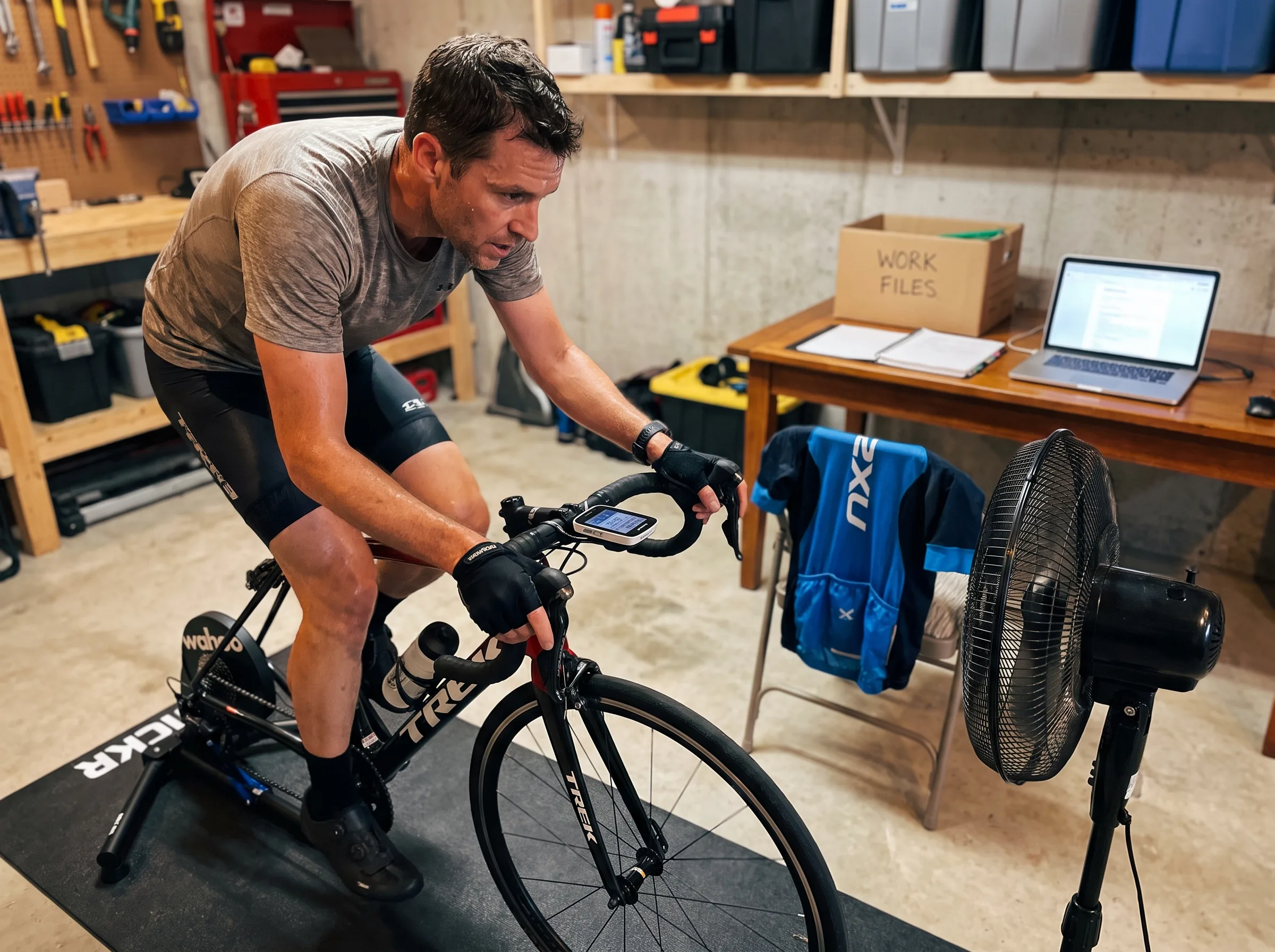
Nobody's weekend is safe from a birthday party or a work trip forever, so some weeks that Saturday ride became a Sunday ride, or a Tuesday ride, or, twice, a very sad 90-minute ride on a rain trainer in a garage that smelled like sunscreen and old bike tires. The week bent. The two anchor sessions, the long ride and the intervals, almost never got cut. Everything else was negotiable.
The One Session You Really Can't Skip
It's the long ride, and it's not close. At low weekly volume, the long ride is doing a job that would otherwise take three or four medium rides to accomplish: building the muscular endurance and fat-adaptation that let you ride 56 miles without your legs filing a complaint on the run.
You don't need it to be four hours. You need it to happen almost every week, at a duration that creeps toward 70-80% of your expected 70.3 bike split by the last month before the race. If your goal bike time is 3:15, you want to have ridden 2:15 to 2:30 continuously, more than once, before you ask your body to do 3:15 on race day with a swim already in its legs and a run still ahead of it.
Where Time-Crunched Athletes Waste the Time They Do Have
The biggest leak isn't laziness. It's decision fatigue turning into workouts that are technically completed and functionally useless.
- Swimming three times a week at moderate effort. Two focused sessions beat three tired ones. Every time.
- Running "easy" runs at a pace that's actually moderate. If you can't hold a conversation, it's not an easy run, it's a workout you didn't plan for.
- Skipping the long ride to squeeze in more short sessions. Wrong trade every time, for the reasons above.
- Treating strength training as the first thing to cut. It's usually the last thing that should go, and more on that below.
- Chasing a training plan built for 12-15 hours and quietly modifying it in your head into 7. Get a plan actually built for your hours, not a bigger plan cut down on the fly.
What Happens When Life Actually Happens
You will miss a session. Probably several. A sick kid, a deadline that eats your Tuesday evening, a flight that gets you home at midnight instead of six. I once rebuilt an entire training week around a broken dishwasher, because apparently the plumber only does mornings and mornings were supposed to be bike time. The time-crunched athletes who make it to the start line in one piece aren't the ones who never miss a workout. They're the ones who know what to cut when the week goes sideways.
Cut the swim first. It recovers fastest and costs you the least. Cut easy runs second; an easy run you skip is just an easy run you didn't need. Protect the long ride and the key run intervals as hard as you protect a work meeting with your boss, because in the currency of a 70.3 build, that's roughly what they are.
Strength Training Still Counts, Even at Six Hours
This is the one I got wrong for two full seasons. I treated the gym as the first thing to fall off the calendar whenever the week got tight, on the theory that swim-bike-run hours mattered more than anything with a barbell in it. My IT band eventually disagreed, loudly, about six weeks before a race.
Two 20-minute sessions a week, focused on hips, glutes, and single-leg stability, is enough to matter. It's not enough time to build a bodybuilder's physique and it isn't supposed to be. It's injury insurance, and for an athlete who can't afford six weeks off to let something heal, injury insurance is worth more than almost any other hour in the week.
Do You Actually Need a Coach for This?
Probably, yes, and I say that as someone who tried to DIY it for a full season first. Not because a coach knows some secret workout you couldn't find yourself. Because at six to eight hours a week, there's zero margin for wasted sessions, and a decent coach's whole job is making sure none of your hours are wasted. A generic plan downloaded off the internet doesn't know your Tuesdays are always destroyed by a recurring meeting. A coach, or even a good adaptive app, adjusts around that instead of pretending your week looks like everyone else's.
If the budget doesn't stretch to a coach, at minimum build your plan around Dixon's Fast-Track Triathlete framework or something structured in the same spirit, rather than hand-cutting a full-volume plan down to size. Cutting a 15-hour plan in half doesn't give you a good 7-hour plan. It gives you a 15-hour plan with the wheels missing. (For more on what to actually look for if you do go the coaching route, see our guide to choosing your first triathlon coach.)
Tapering When You Never Had Much Volume to Taper From
Here's the taper paradox nobody warns you about: when your peak week was already only 8 hours, cutting it by 40-50% for taper week leaves you at 4-5 hours, which can start to feel less like rest and more like you've simply stopped training. Don't panic and sneak extra sessions back in. The fatigue you're carrying into race week isn't measured in hours the way a 15-hour-a-week athlete's is, but it's real, and your body still needs the reduced load to arrive fresh. (Our full breakdown of taper week logistics, bag drop, and race morning timing lives in the race-week taper protocol, and it applies just as much at low volume as high.)
Is 6-8 Hours Really Enough?
For a strong finish, yes, with consistency doing the heavy lifting that volume can't. For a podium at your local age group awards ceremony, probably not, and that's fine, because that was never really the goal. Half of r/triathlon will tell you 6 hours is a joke and you need a coach and a power meter and 12 hours minimum. The other half is out there quietly finishing 70.3s in the 5:30-6:30 range on exactly the schedule above, working full-time jobs, showing up tired, and getting it done anyway.
What actually determines whether 6-8 hours gets you to a good finish isn't the number itself. It's whether every one of those hours is doing a job, instead of just filling a calendar square so you can tell yourself you trained today. Cut the noise, protect the long ride, and stop apologizing for having a life outside triathlon. It was never a prerequisite for finishing one.
If you're on this plan right now, in week four of a build that started with a lot of hope and is currently running on caffeine and stubbornness: what's the one workout you keep protecting no matter how bad the week gets? That's usually the tell for what your body actually needs most.


