
Ask a triathlete why they skip the weight room and you'll hear a familiar rotation of excuses: not enough time, worried about bulk, "I swim, bike, and run — that's enough." It's a reasonable-sounding set of rationalizations, and it's costing them minutes on race day. Strength training is the fourth discipline of triathlon, and it's the one most athletes systematically ignore — right up until something snaps, tears, or just stops working the way it used to.
Why Strength Training Actually Works
The science here isn't ambiguous. A 2019 review published in the Journal of Strength and Conditioning Research found that concurrent strength and endurance training significantly improves both running economy and cycling power output compared to endurance training alone. A study on long-distance triathletes showed a 7% improvement in cycling performance after 26 weeks of strength training — that's not a rounding error.
The mechanism is straightforward: when you increase your maximal strength, the relative effort of each stride or pedal stroke drops. A runner who can hip-hinge 200 lbs treats a 6-minute mile differently than one who can barely manage a bodyweight squat. You're not just getting stronger — you're getting more efficient at the loads you already handle. Ground contact time drops. Pedal force improves. Your shoulders stop collapsing in open water after the first 500 meters.
There's also the injury prevention angle, which is less glamorous but equally important. Triathletes are repetitive-motion machines. Thousands of steps, thousands of pedal revolutions, thousands of swim strokes — all on the same joints, same angles, same muscle recruitment patterns. Strength training adds structural integrity to the whole system. It fills in the weak links before they become stress fractures, IT band issues, and shoulder impingements.
The 6 Lifts With the Highest Triathlon ROI
You don't need to live in the gym. You need the right six movements, done consistently. Here they are, in order of priority:
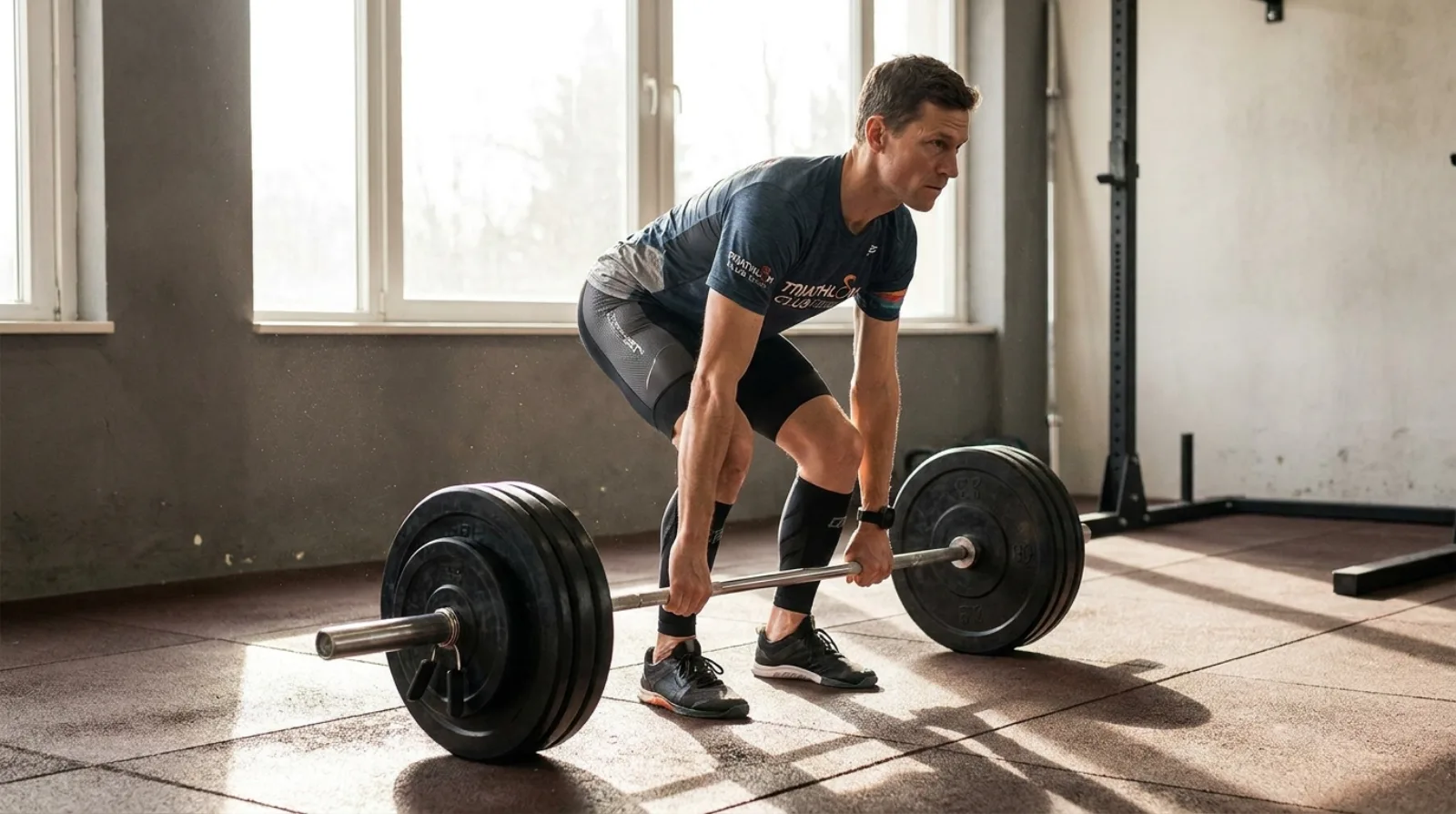
1. Romanian Deadlift (RDL)
The king of posterior chain development for endurance athletes. The RDL trains the hamstrings, glutes, and lower back through a hip hinge pattern that directly translates to running gait and cycling power. Form note: Push your hips back — don't just bend over. Maintain a neutral spine throughout, soft knee bend, bar stays close to the legs. Feel the stretch in your hamstrings at the bottom, drive through the hips at the top. Start with a weight that lets you feel the movement, not just survive it.
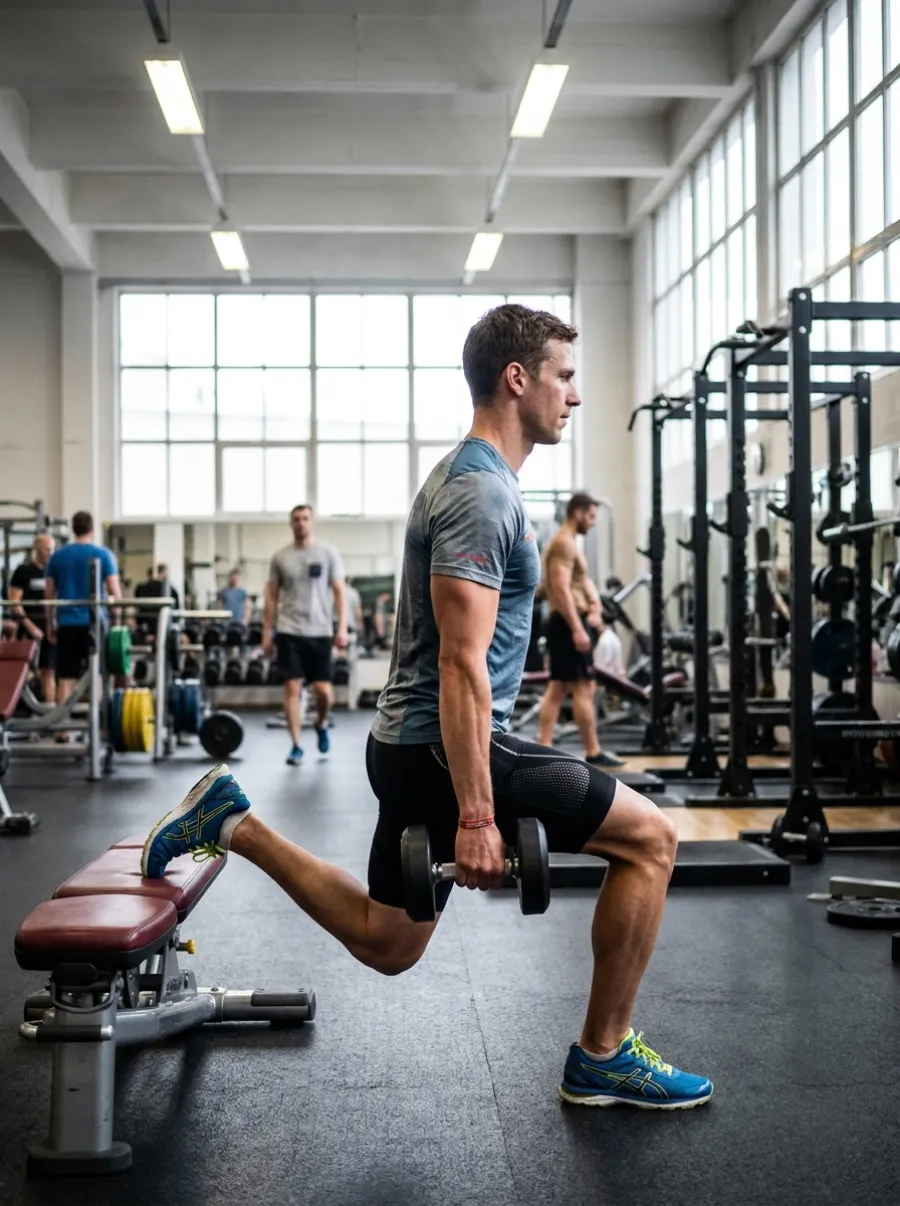
2. Bulgarian Split Squat
Single-leg training is non-negotiable for triathletes because every stride and every pedal stroke is a unilateral movement. The Bulgarian split squat — rear foot elevated on a bench, front leg doing the work — builds leg strength, hip flexor mobility, and balance simultaneously. Form note: Keep the front knee tracking over the second toe, don't let it cave inward. Torso stays upright or with a slight forward lean. Drive through the heel of the front foot to stand. This one will expose every imbalance you have, and that's the point.
3. Single-Leg Hip Thrust
Glute strength is the engine of both running and cycling, and most triathletes have glutes that are functionally checked out — tight hip flexors from sitting and cycling have trained them to be passengers. The single-leg hip thrust forces them back into the conversation. Form note: Upper back on a bench, one foot planted on the floor, drive the hips up until your body forms a straight line from shoulder to knee. Squeeze at the top. Don't hyperextend the lower back. The working glute should be burning.
4. Lat Pulldown / Pull-Up
Swimming is a pulling sport. Every freestyle stroke is a lat-dominant pull through the water, and weak lats mean a weak catch, a weak pull, and wasted energy. Lat pulldowns (or pull-ups for those who can do them with good form) directly address this. Form note: Pull to the upper chest, not behind the neck. Initiate with the lats, not the biceps — think about pulling your elbows down and back toward your hips. Avoid shrugging the shoulders up as you reach the top position.
5. Overhead Press
Upper body pressing might seem like a vanity add-on for triathletes, but the overhead press builds shoulder stability and thoracic extension that keeps you upright and pain-free on a 6-hour bike ride. It also improves the "recovery" phase of your swim stroke. Form note: Press the bar overhead in a straight line, keeping your core tight and avoiding excessive lumbar extension. At the top, shrug slightly to fully engage the serratus anterior and stabilize the shoulder blade. Don't turn it into a standing chest press.
6. Plank Variations and Dead Bug
Core stability isn't about crunches. It's about resisting movement — holding your spine in position while your limbs create force. Planks and dead bugs train exactly that. The dead bug is particularly effective because it trains the deep core to stabilize while opposing limbs move, which is precisely what happens during running. Form note: For dead bugs: lower back pressed into the floor throughout. Extend opposite arm and leg slowly, exhale on the way down, don't let the lower back arch. For planks: straight line from head to heel, no sagging hips, no piked-up rear.
How to Schedule Strength Training
Timing matters. The goal is to add strength without cratering your swim, bike, and run quality. A few rules:
- Never lift the day before a long run or long ride. The residual fatigue will compromise the quality session that actually matters most in your week.
- Lift on the same day as a hard endurance session when possible, ideally after (not before) the endurance work. This keeps recovery days as actual recovery days.
- Allow 48-72 hours between heavy lifting and your next key workout. Strength training creates muscle damage that needs time to repair.
- In-season: 1–2 sessions per week, focused on maintenance. Keep intensity moderate, volume low.
- Off-season: 2–3 sessions per week, focused on building. This is when you make real strength gains.
In-Season vs Off-Season Periodization
Periodization isn't a buzzword — it's the difference between strength training that helps and strength training that just makes you tired.
Off-Season (November–February for most athletes)
This is your window. Endurance volume is lower, race pressure is off, and you can actually afford to be sore. Start with 2-3 sets of 12-15 reps at lighter weight, focused on form and movement patterns. Progress to 3-4 sets of 8-12 reps at moderate load around weeks 5-8. By weeks 9-12, you can push toward 3-5 sets of 5-6 reps at heavier loads, building maximal strength that will underpin everything else in your season.
Pre-Season (March–April)
Start transitioning toward power and sport-specific movements. Reduce volume slightly, maintain intensity. 2 sessions per week. Add explosive elements like kettlebell swings and jump variations if appropriate for your level.
In-Season (May–October)
Maintenance mode. The goal is to preserve what you built, not accumulate more. One session per week, full-body, 2-3 sets of 6-8 reps on your key lifts. Keep weights moderate. If you're feeling run-down before a target race, this is the first thing you scale back.
The 8-Week Starter Program
If you've never done structured strength training alongside triathlon training, start here. Two sessions per week, 30-45 minutes each. This is not an advanced program — it's a foundation.
| Week | Phase | Sets × Reps | Exercises | Notes |
|---|---|---|---|---|
| 1–2 | Movement Learning | 2 × 12–15 | RDL, Goblet Squat, Plank, Dead Bug, Lat Pulldown, Push-Up | Light weight. Focus on form. Every rep should feel controlled. |
| 3–4 | Foundation | 3 × 10–12 | RDL, Bulgarian Split Squat, Hip Thrust, Lat Pulldown, Overhead Press, Dead Bug | Add load when form is solid. 60-second rest between sets. |
| 5–6 | Strength Build | 3 × 8–10 | RDL, Bulgarian Split Squat, Single-Leg Hip Thrust, Pull-Up or Lat Pulldown, Overhead Press, Plank | Increase load 5-10% from previous block. 90-second rest. |
| 7–8 | Consolidation | 3–4 × 6–8 | Same as weeks 5–6 | Push load slightly. Maintain perfect form. Assess what needs more work. |
Common Mistakes That Undermine Everything
Lifting Too Heavy, Too Soon
Ego is expensive in the weight room, and triathletes aren't immune. Many athletes come from endurance backgrounds where suffering through discomfort is a virtue — they apply that same logic to a barbell and wonder why they're hobbling through their next long run. Start lighter than you think you need to. Add load systematically. The goal is adaptation, not punishment.
Lifting the Day Before Key Sessions
A heavy leg session on Friday followed by a long run on Saturday is a recipe for either a poor run or an injury. Map your strength sessions against your weekly training plan before you start. The weight room serves the swim, bike, and run — not the other way around.
Skipping Leg Work
Some triathletes load up on upper body pushing and pulling (because swimming) and treat lower body as optional. This is backwards. Your legs carry you through 90% of the race. Romanian deadlifts, split squats, and hip thrusts are non-negotiable. If you're going to cut something from a session, cut the accessory upper body work, not the compound leg movements.
Abandoning Strength Training Mid-Season
A common pattern: athletes build a solid strength base in winter, then drop it entirely when training volume picks up in spring. Within 6-8 weeks, the gains start to erode. Maintain with one session per week and you keep most of what you built. Drop it entirely and you start over next November.
The Bottom Line
Triathlon is already a sport that demands mastery of three disciplines. Adding a fourth is genuinely inconvenient. But the athletes who show up to the start line structurally durable, with a posterior chain that works and glutes that fire, tend to have a different kind of race than those who spent every training hour in the pool, on the bike, and on the road.
The weight room won't make you slower. It won't bulk you up if you're eating like an endurance athlete. What it will do — consistently, measurably, over time — is make everything else more efficient. That's the whole job. Two sessions a week, six exercises, done with intention. It's not a big ask for what it gives back.


