
Picture this: you're 800 meters into an open-water swim, your stroke is unraveling, your sighting is off, and you have absolutely no idea how fast you're going or whether your head is doing that bobbing thing your coach keeps yelling about. You'd give anything for a split time right now. Well — welcome to 2026, where your goggles can tell you, in real time, while your face is buried in the water.
Heads-Up Display swim goggles — the kind that project live performance metrics directly onto your lens while you swim — have crossed from "interesting prototype" to "gear you can actually buy and race with." And for triathletes specifically, the implications are significant. The swim is already the discipline most athletes understand least about their own performance. HUD goggles are about to change that. Whether that's a good thing entirely depends on what you do with the data.
What HUD Swim Goggles Actually Do
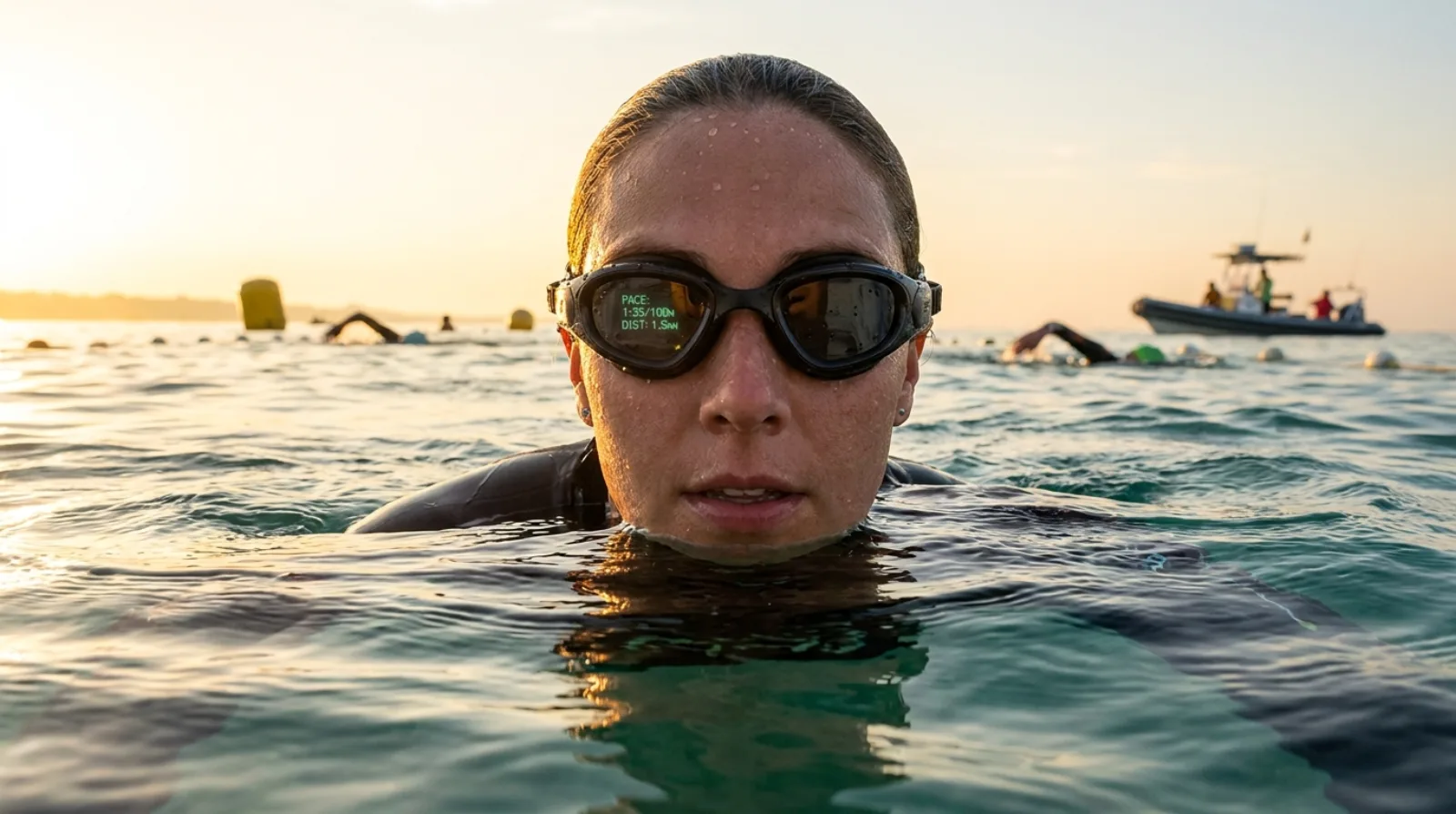
Before we get into which ones to buy, let's be clear on what this tech does — and what it doesn't. HUD swim goggles use augmented reality displays, typically via waveguide optics, to project a small data overlay onto one lens. The swimmer sees the water ahead normally, with a transparent data readout sitting in their peripheral or direct field of view. Think fighter pilot HUD, but for your 1:45/100m pace.
The metrics available vary by model, but the category leaders can show: pace per 100 meters, stroke rate (strokes per minute), stroke count per length, heart rate, distance swum, elapsed time, split times, and even head position data. In open water, some models add compass bearing and GPS-linked navigation — which, if you've ever done a race where you ended up swimming 300m extra because you can't sight to save your life, is worth its weight in gold.
The core promise is this: you get the data you'd normally need a coach on deck to provide, except it's live, it's yours, and it's in your eyeball while you swim. For triathletes who spend most of their training time swimming alone in a lane at 6am, that's genuinely useful.
The Main Players in 2026
FORM Smart Swim 2 — $199 | FORM Smart Swim 2 PRO — $299
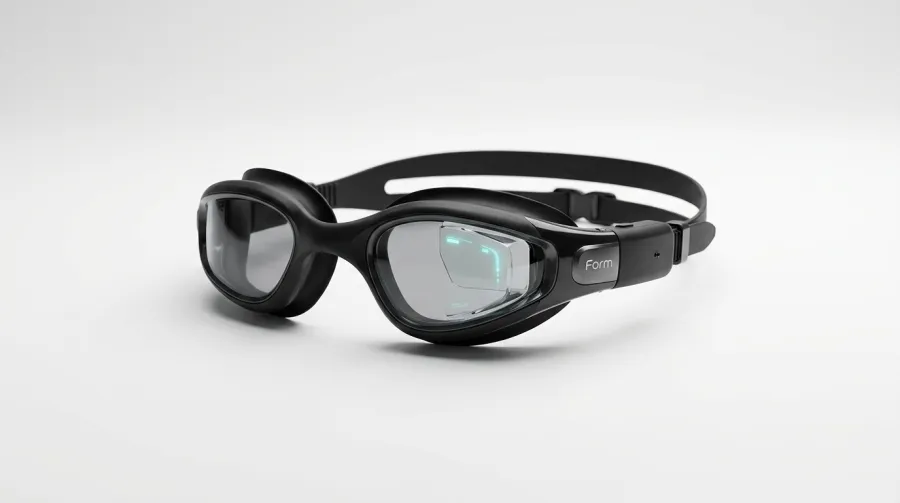
FORM has effectively owned this category since they launched their first smart goggles, and the Smart Swim 2 (released in 2024, now the market standard) is the most capable consumer HUD goggle available. The display uses patented Waveguide technology to project metrics onto the lens — it's clear, readable at a glance, and doesn't impair vision. Nine metrics are available simultaneously: time, distance, pace, stroke rate, stroke count, calories, heart rate, splits, and elapsed time.
The built-in optical heart rate monitor is a standout feature. Most swim watches struggle with heart rate in water, but the FORM goggles measure from the temple — more reliable than a wrist sensor mid-swim. Battery life is rated at 14 hours, which means you're charging this maybe once a month even if you swim every day. The smaller "tech pack" on the Smart Swim 2 (15% reduction vs. the original) improved the fit noticeably, and the goggles come with five interchangeable nose bridges.
The headline feature — and the one that makes this specifically interesting for technique-focused triathletes — is HeadCoach. This tracks head pitch (the angle your head makes looking into the water; optimal range is 30–37 degrees), peak head roll during breathing, and time-to-neutral after inhaling. Most swimmers have no idea what their head is doing underwater. Most triathletes have even less idea, because they never get coach feedback on swim form. HeadCoach gives you that feedback automatically, in post-swim analysis, with in-goggle cues during the session.
The SwimStraight digital compass is the open-water feature worth talking about. It helps you maintain bearing between sighting, which directly addresses the single most common cause of wasted swim time in triathlon. If you're swimming an extra 100 meters per race because you drift, this feature alone can justify the purchase.
The Smart Swim 2 PRO adds Corning Gorilla Glass 3 lenses, addressing the durability complaints about the standard model's plastic optics. If you're dropping $299, the scratch resistance makes it worth the premium over multiple seasons.
Caveats: FORM requires a subscription (~$12/month) to unlock HeadCoach, guided workouts, and advanced analytics. The goggles are bulkier than standard options — not uncomfortably so, but noticeably. And they won't reliably track kick sets or board work since the sensor depends on arm movement. Also: they are World Triathlon approved, so you can race in them without getting pulled aside by the officials. Worth checking.
FINIS Smart Goggles — ~$149
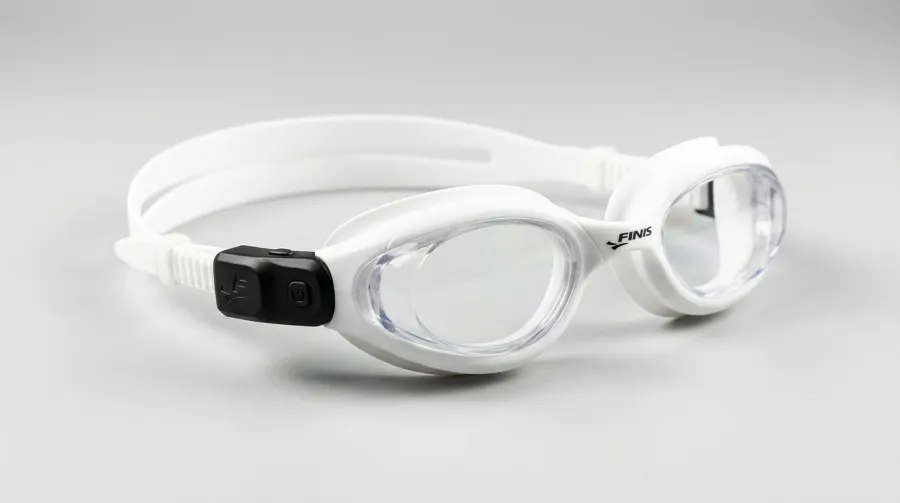
FINIS took a different design philosophy with their Smart Goggles. Instead of a central AR display, the HUD module sits to the side of the left lens — meaning you glance sideways to check metrics, rather than seeing them in your direct line of sight. The metrics available include splits, swim time, rest time, and distance. No heart rate sensor, no compass, no HeadCoach equivalent.
What the FINIS goggles get right is the business model. The Smart Coach module — the tech unit containing the HUD and sensors — is removable and transferable. When your goggle lenses scratch (and they will), you don't throw away $150 of electronics — you just clip the module onto a new pair of FINIS frames. Over a two-to-three season horizon, this makes the FINIS a smarter long-term financial bet for the athlete who goes through goggles regularly. The accompanying Ciye app provides solid post-swim analysis.
The tradeoff: the side-glance display is less intuitive than FORM's central overlay, and the metric depth is considerably shallower. If you want head position analysis and real-time heart rate, FINIS doesn't have it. If you want basic pace and split data without a subscription model, FINIS is genuinely compelling at its price point.
Holoswim 2GO — ~$119
The Holoswim 2GO is the budget entry into this category, offering a near-eye AR display and AI-driven analysis tracking stroke count, distance, pace, and SWOLF score. It's a real product and the display technology works. What it lacks is the refinement, ecosystem depth, and open-water features of the FORM goggles. For a swimmer who wants to try HUD goggles without committing $200+, the Holoswim is a reasonable gateway product. For serious triathletes doing open-water racing, it probably falls short of what you need.
The HeadCoach Question: Does Your Head Actually Need Surveillance?
The HeadCoach feature deserves its own section because it's the most misunderstood part of the FORM value proposition — and also the most genuinely useful for triathletes specifically.
Most triathletes swim with some form of inefficiency baked in that they're completely unaware of. Head carriage is one of the biggest culprits. Swimming with your head too high — looking forward rather than down — creates drag equivalent to swimming in a mild headwind for the entire duration of the swim. Breathing with too much lateral rotation, or taking too long to return your head to neutral after inhaling, fragments your stroke rhythm and kills propulsion.
HeadCoach measures all three in real time. Head pitch data tells you whether you're looking too far forward (a common wetsuit-wearing habit, because the buoyancy shifts your natural position). Peak head roll data tells you whether you're rotating too aggressively to breathe (which often correlates with shoulder tension and injury risk). Time-to-neutral tells you whether you're lingering at the breathing position and disrupting your stroke cycle.
The practical impact: athletes who use HeadCoach for six to eight weeks and actually act on the data consistently report measurable pace improvements without adding training volume. That's not a marketing claim — it's a predictable outcome of fixing inefficiencies that were previously invisible. Your goggle tan is not the real problem. But your head carriage probably is.
Who Should Actually Buy These
Not everyone. Let's be honest about that.
HUD goggles make most sense for triathletes who train alone and swim more than twice a week, athletes targeting Olympic distance or longer where swim pacing matters, swimmers working on technique who don't have regular coach access, and open-water swimmers who struggle with navigation or pacing consistency.
They make less sense if you're a strong swimmer who already has good technique feedback through a squad or coach, if you're primarily racing sprint distances where the swim is short enough that pacing feedback has minimal impact, or if you're the kind of athlete who collects data and never actually uses it to change behavior. Buying HUD goggles and ignoring the HeadCoach data is like buying a power meter and training by feel. Technically functional, but you're leaving most of the value on the table.
The honest answer on the goggle tan: it stays the same regardless of what goggles you wear. We checked.
The 2026 Horizon: What's Coming
The smart swim goggle market is in genuine growth mode. There is credible speculation — fueled by a Garmin triathlon video that eagle-eyed viewers dissected in early 2026 — that Garmin is developing its own HUD goggles with microLED projection technology. Garmin already integrates with FORM via compatible watches for GPS-linked open-water data. A first-party Garmin goggle would integrate that GPS natively into the lens, which for athletes already deep in the Garmin ecosystem would be compelling. Nothing is confirmed as of April 2026, but the competitive pressure is clearly building.
The broader trend is toward AI-driven real-time coaching — where the goggle doesn't just show you the data but actively coaches corrections during the swim. FORM's HeadCoach is the first real commercial implementation of this concept. Expect it to get significantly more sophisticated in the next hardware cycle.
The Verdict
If you're a serious triathlete who trains alone, struggles with open-water navigation, or suspects your swim form is leaking time you haven't identified — the FORM Smart Swim 2 is worth the $199 plus subscription. The combination of real-time pace data, HeadCoach technique analysis, and SwimStraight compass is a legitimate performance upgrade, not a gadget. For athletes who want to dip a toe in the category on a budget, the FINIS Smart Goggles offer real functionality at a lower price with a smarter long-term economics model.
The category is no longer experimental. The tech works. Your swim form now has nowhere to hide — which is exactly the point.


