
You've done the training. You've nailed your swim intervals. You show up on race morning, wade into the open water with 400 other neoprene-clad humans, the gun goes off — and thirty seconds into the swim, your goggles are so fogged you can barely see the hand in front of your face, let alone the first buoy. Congratulations. You've been defeated by condensation.
Foggy goggles aren't just annoying. They're legitimately dangerous in open water — you can't sight, you can't see other swimmers, and the panic that comes with zero visibility at race pace is not a small thing. And yet most triathletes treat this as an unavoidable fact of life, like chafing or port-a-potty queues, rather than something that can actually be solved.
It can be solved. Let's talk about why goggles fog and what actually works to stop it — not broscience and locker room folklore, but the real mechanics of condensation and the gear and habits that address them.
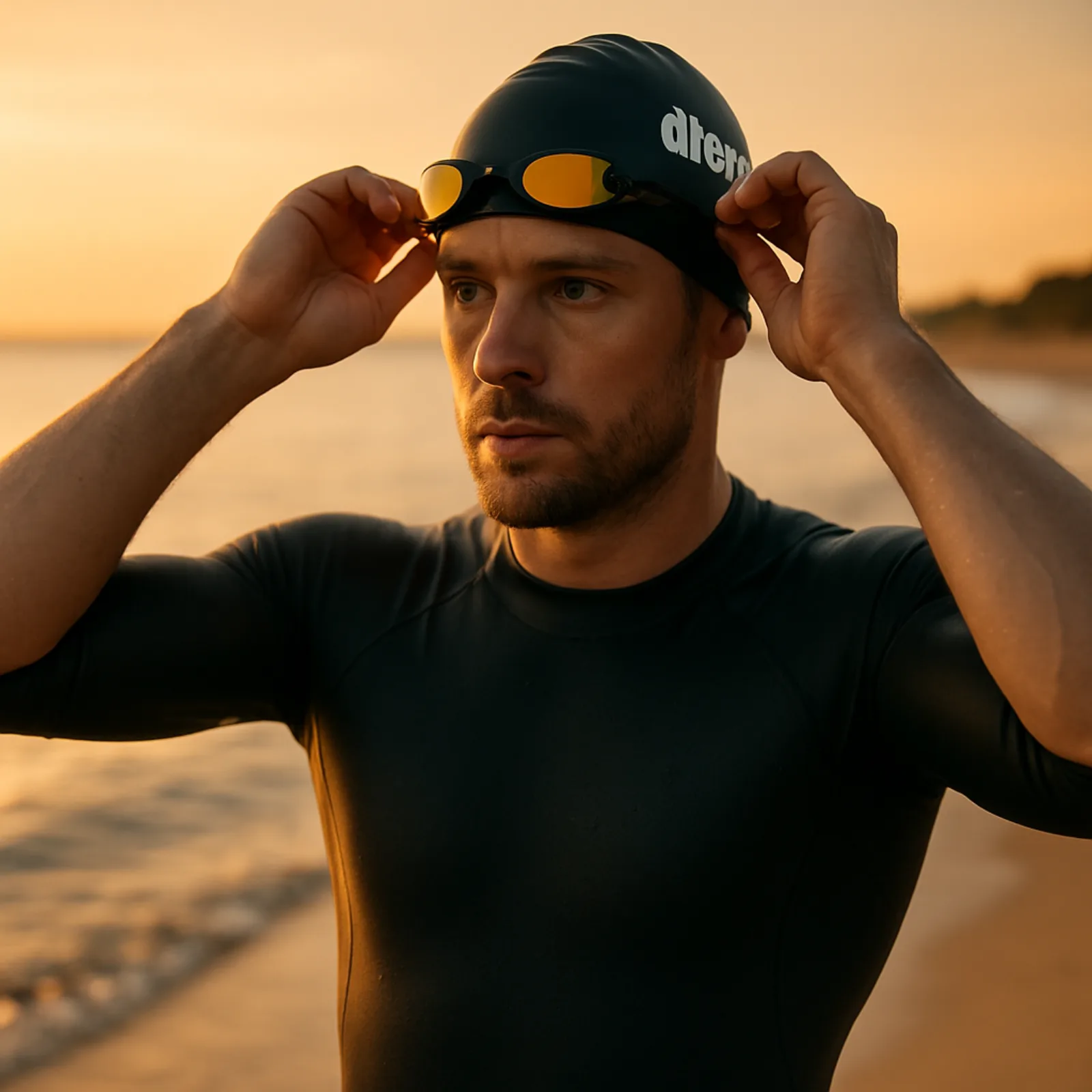
Why Goggles Actually Fog: The Real Science
Fogging is condensation. Full stop. It happens when warm, moisture-laden air trapped inside your goggles comes into contact with the cooler inner surface of the lens — the side that faces your eye. The temperature differential causes water vapor to drop out of the air and form millions of tiny water droplets on the lens surface. Those droplets scatter light and destroy your visibility.
The reason it's worse in open water than in the pool is straightforward: open water is colder. A greater temperature difference between the inside air and the lens surface means more aggressive condensation, faster. Add in the fact that your face heats up rapidly at race intensity, and you have a perfect fog machine strapped to your eyeballs.
Here's the part most people miss: new goggles from the factory have an anti-fog coating applied to the inner lens surface. This hydrophilic coating works by reducing the surface tension of water, causing condensation to spread into a thin, transparent film rather than beading up into light-scattering droplets. That's why brand-new goggles often seem miraculously fog-free — and why the same goggles fog constantly six months later.
The coating degrades. Chlorine eats it. Saltwater eats it. Your skin oils eat it. And most destructively: rubbing the inside of the lens with your finger destroys it instantly. One swipe with a finger = coating gone = permanent fog. This is the single most common and most preventable cause of chronically foggy goggles.
What Actually Works (And What Doesn't)
Let's get through the myths quickly so we can spend more time on what actually works.
Baby shampoo: This is the most common advice on triathlon forums and it's... partially true, but mostly overstated. Yes, baby shampoo is a mild surfactant that can temporarily create a thin film on the lens. But it washes off almost immediately in open water, requires careful application, and if you use too much or rinse too little, you get soapy irritant in your eyes at race pace. It's a backup option, not a strategy.
Saliva (spitting in your goggles): This works in a pinch — saliva contains surfactant proteins that temporarily coat the lens. Competitive swimmers do it between intervals in the pool. At open water race pace, it buys you maybe ten minutes before the film breaks down. Again: backup, not strategy.
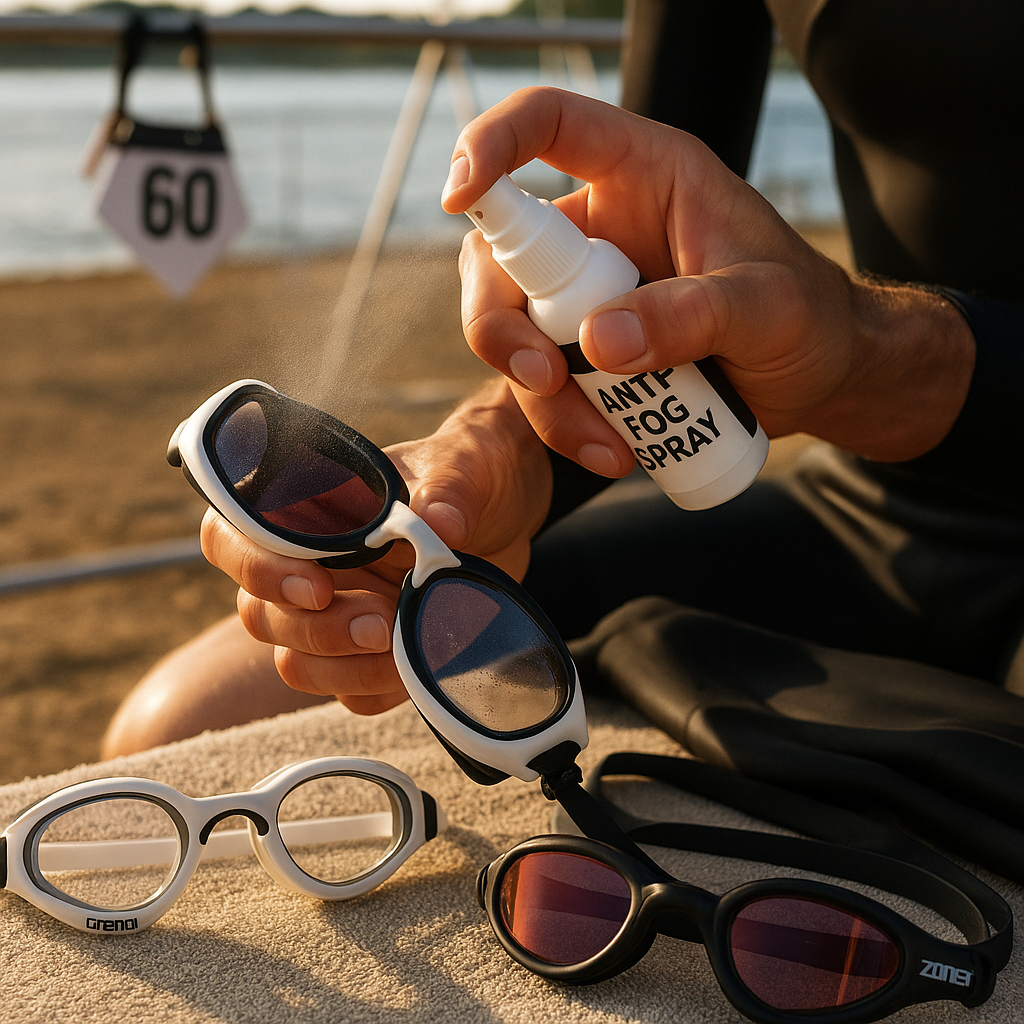
Commercial anti-fog sprays: These work significantly better than DIY options and are the correct answer when your factory coating has degraded. Quality anti-fog sprays deposit a hydrophilic surfactant layer that lasts much longer than saliva or baby shampoo. Apply to the inside lens, let it sit 30–60 seconds, then rinse lightly (not aggressively — you want some of that treatment to stay). Products like Jaws Quick Spit and TriSwim Anti-Fog are the ones most experienced triathletes reach for.
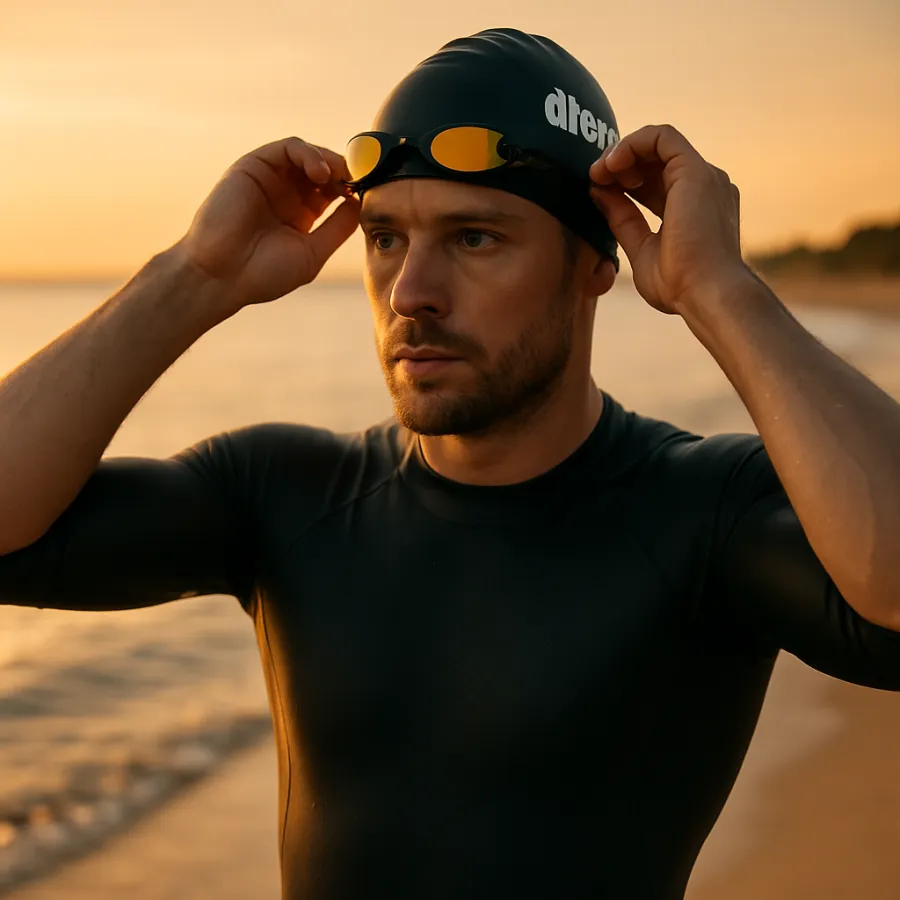
The Goggle Maintenance Protocol That Actually Preserves Anti-Fog
The single most impactful thing you can do to keep your goggles fog-free longer is never touch the inside of the lenses. This sounds obvious. It is not practiced. Watch any triathlon transition and you'll see athletes absentmindedly wiping the inside of their goggles before the swim. Every wipe is a micro-abrasion that destroys the hydrophilic coating that's protecting you from fog.
The full maintenance protocol:
- After every swim: Rinse with cool fresh water. Don't rub. Don't wipe. Just rinse and shake gently.
- Drying: Air dry only. Don't put them in a hot bag or direct sunlight — UV and heat degrade both the coating and the silicone seal.
- Storage: Keep them in their protective case between uses. The case prevents scratches that also accelerate fog.
- Never store wet inside the case: Moisture trapped inside a case creates exactly the conditions for coating degradation.
Follow this and a quality pair of goggles will stay noticeably fog-resistant for six months to a year of regular use, versus the two-to-four weeks you might get with rough handling.
The Best Fog-Resistant Goggles for Triathletes in 2026
Technique and maintenance will only get you so far. If you're buying new goggles, the anti-fog technology in the lens itself matters — a lot.
Arena Cobra Ultra Swipe is the standout for open water triathlon in 2026. The "Swipe" technology is genuinely clever: a slightly thicker anti-fog coating that can be reactivated by gently wiping the inside of the lens with your finger while still in the water. You don't destroy the coating — you redistribute it. Arena claims this can be done up to ten times before the coating is depleted. In practice, it means you can clear fogging mid-race without stopping, which is a game-changer for open water swims.
Speedo Vanquisher 3.0 uses Speedo's Anti-Fog Ultra coating, which is impregnated into the lens material during manufacturing rather than applied as a surface spray. This means it's substantially more durable than most factory coatings and doesn't rub off in the same way. At around $25, it's also one of the best value anti-fog investments on the market.
Zone3 Venator X is the go-to for athletes who prioritize peripheral vision in open water — the wide-frame design combined with solid anti-fog performance and polarized lens options makes it a complete open water package. Zone3 is quietly one of the best value premium goggle brands in triathlon.
TheMagic5 takes a completely different approach: custom-fit goggles molded to your specific face shape using a 3D scan. The theory is that a perfect seal prevents the leaks that allow warm moist air to circulate against the lens — eliminating one of the primary drivers of fogging. At $75+, it's the premium option, but the custom fit also solves the persistent leak problem that plagues athletes with asymmetrical faces.
HUUB Aphotic features photochromic lenses that automatically darken in bright conditions and lighten in overcast light — a significant advantage for races that start before dawn and finish in full sun. The anti-fog performance is solid, and the adaptability to changing light conditions is something no amount of anti-fog spray can replicate.
The Race Day Protocol: No More Foggy Starts
Here's the practical race-morning system that eliminates fogging:
- Night before: Apply commercial anti-fog spray to inside lenses, let sit 60 seconds, rinse lightly. Store in case.
- Race morning: Repeat the anti-fog application. This double-layer approach is what competitive open water swimmers do.
- At the water's edge: Dip your goggles in the race water for 15 seconds before putting them on. This equilibrates the lens temperature with the water and dramatically reduces the temperature differential that drives fogging.
- On your face: Once on, don't touch the lenses. If fogging starts mid-swim, try gently blinking rapidly and shaking your head — sometimes this redistributes the condensation film enough to restore visibility temporarily.
- If using Arena Cobra Swipe: A gentle swipe of the inside lens mid-swim will clear fog and reactivate the coating. This is legitimately magic at race pace.
Foggy goggles are a solved problem. The science is simple. The protocol takes five minutes. There is no reason to swim blind in 2026.
You've put months of swim training into your race preparation. The water temperature, the current, the guy who slaps your feet for the first 400 meters — those are variables you can't control. Your goggle fog is not. Get the right gear, treat it right, prep it correctly, and let the swim be the one part of your race where you can actually see where you're going.
Now stop wiping your lenses with your fingers. We've had a talk.


