
Let's be honest. The moment you decide to race a triathlon on a proper TT bike, something changes. You stop being someone who exercises. You become someone who is optimizing. You start using phrases like "yaw angle" and "effective frontal area" at dinner parties. Your friends get concerned. Your times get faster. Worth it.
But choosing that first tri bike — or your next upgrade — is genuinely hard. The market is crowded with machines that promise to shave watts, save minutes, and make you look impossibly fast even when you're suffering spectacularly. So why does the Cervélo P-Series Carbon TT earn our Best in Class badge? Let's dig in.
A Brief History of Cervélo and Why It Matters
Cervélo isn't a brand that stumbled into triathlon. They were founded in 1995 by two Canadian engineers — Vroomen and White — obsessed with aerodynamics at a time when most bike brands were still convinced that "lightweight" was the only metric that mattered. They've since built bikes that have won Tour de France stages, Ironman World Championships, and enough Olympic medals to wallpaper a very impressive bathroom.
The P-Series sits below the flagship P5 in Cervélo's lineup — but don't mistake "below" for "lesser." The P-Series is where Cervélo distills everything they've learned from professional racing into a package that real triathletes can actually afford and realistically ride. It's the democratization of serious aero engineering.
Frame Design & Aerodynamics: The Science Bit
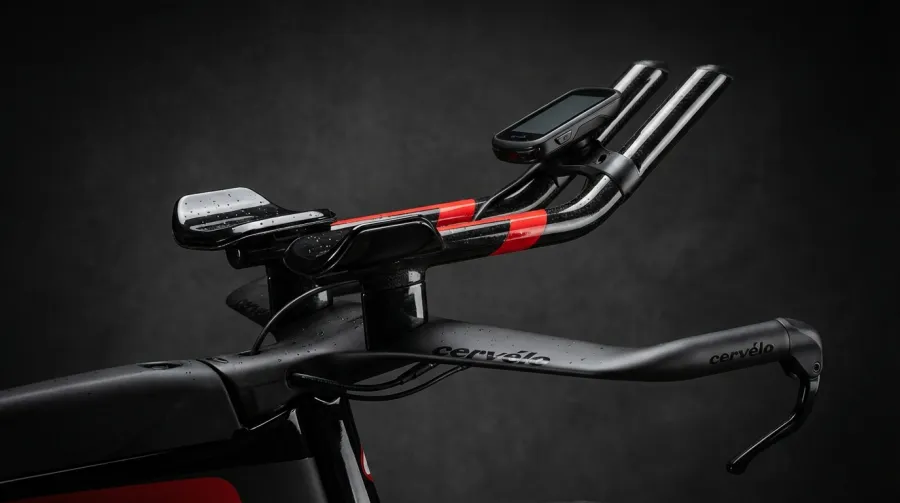
The P-Series frame is built around the same aerodynamic principles as the P5, developed using computational fluid dynamics (CFD) and wind tunnel validation. The tube shapes are custom-profiled to minimize drag across a realistic range of yaw angles — meaning the bike is fast not just in a lab with zero crosswind, but in the real world where Hawaiian trade winds are trying to remove you from the road.
The 2024/2025 update brought a measurable improvement: the new frameset is reported to be 5.9 grams faster than its predecessor (yes, grams — aero geeks measure drag in grams of force at speed). Pair it with the recommended Reserve 52/63 wheelset and 29mm Vittoria tires and you're looking at a 30-gram / 3.5-watt system improvement over the previous generation. Over 40km, 3.5 watts adds up to roughly 1–2 minutes on the bike course. That's a PR without a single extra training session.
The P-Series is also UCI legal — which matters if you race ITU events or simply like knowing your equipment passes the strictest regulatory standards in cycling. Some competitors sacrifice UCI compliance to pursue even more aggressive shapes; the P-Series doesn't need to.
Technical Specifications
| Frame | Full carbon, aero-optimized tube shapes, UCI legal |
| Fork | Cervélo all-carbon P Fork, D-shaped steerer |
| Sizes Available | 48, 51, 54, 56, 58, 61 cm |
| Tire Clearance | Up to 29mm (disc brake) |
| Brakes | Hydraulic disc (standard across all builds) |
| Drivetrain Options | Shimano 105 12-speed, Ultegra Di2 12-speed, SRAM Rival eTap AXS |
| Weight (Ultegra build) | ~9.41 kg (20 lbs 12 oz) |
| Cockpit | Standard stem interface, max stack 53mm with spacers |
| Storage | In-frame trap door (tube + tool + CO2), Smartpak 400 top-tube bento box, integrated rear hydration mount |
| Starting Price | From $3,299 (105 mechanical) to ~$7,300 (Ultegra Di2 + Reserve wheels) |
Geometry: Fit is Everything
A fast frame on a poorly fitted athlete is just expensive furniture. Cervélo knows this, and the P-Series geometry is designed for fit flexibility above almost anything else.
| Size | Stack | Reach |
|---|---|---|
| 48cm | 485mm | 381mm |
| 51cm | 506mm | 398mm |
| 54cm | 522mm | 412mm |
| 56cm | 540mm | 425mm |
| 58cm | 559mm | 437mm |
| 61cm | 587mm | 443mm |
The standard stem interface is a bigger deal than it sounds. Proprietary front ends on some competitor bikes look gorgeous and are extremely aero — until you need to swap a stem at 11 PM the night before your race in a foreign city and discover that the local bike shop has never heard of your torque specification. The P-Series uses parts your fitter, mechanic, and local shop will all recognize. Travel-friendly, too — the front end breaks down fast for a bike case.
Maximum stack of 53mm with included spacers means the bike works for athletes who need a higher position — often overlooked on aggressive TT bikes that assume everyone is a 6-foot pro with the flexibility of a competitive gymnast.
Race Day Features: Triathlon-Specific Details That Actually Matter
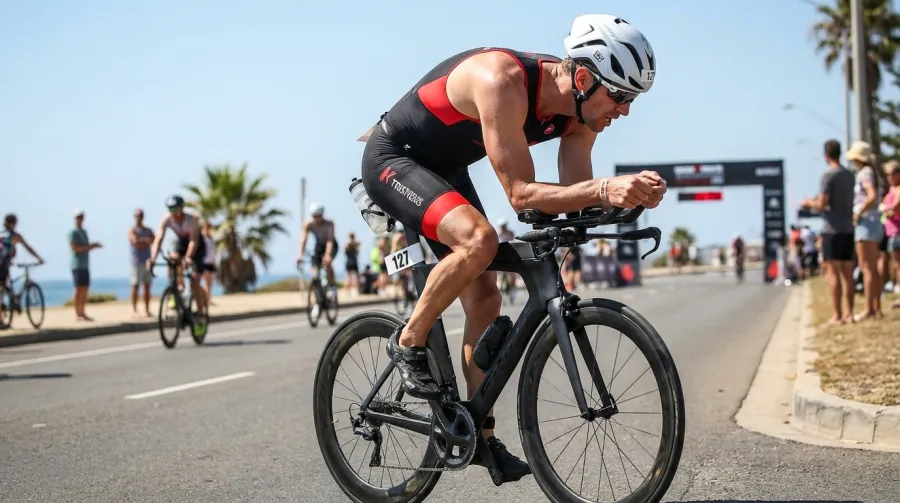
Cervélo didn't design the P-Series for a criterium. They designed it specifically for the multi-hour suffering that is triathlon, and it shows in the details:
In-Frame Storage ("The Trap Door")
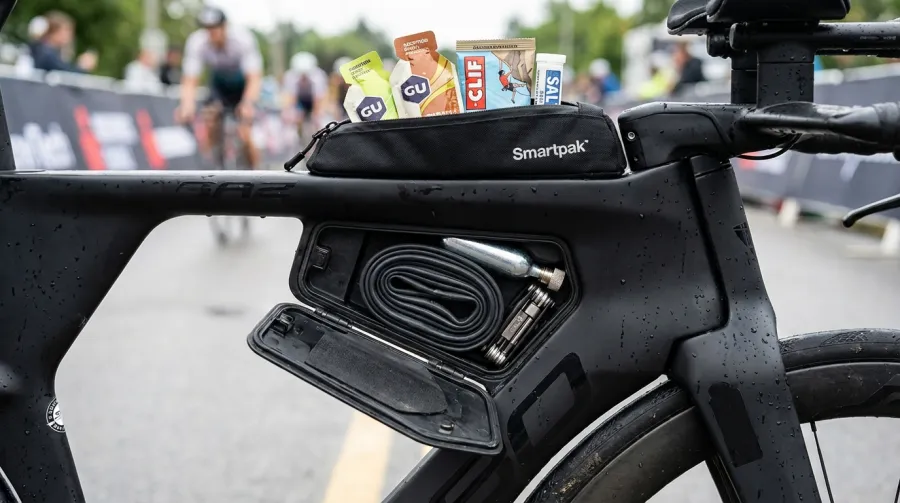
Beneath the downtube sits a hidden compartment designed to hold a spare tube, a small multi-tool, and a CO2 canister. For long-course racing, this is the difference between a mechanical ruining your day and a 4-minute inconvenience. Aero, practical, and already built in. No bolt-on bag flapping in the wind.
Smartpak 400 Top-Tube Bento Box
Every P-Series ships with an integrated top-tube nutrition compartment. Your gels, chews, and salt tabs live here, accessible without breaking aero position, without the aerodynamic horror of a sticky Velcro bag that collects road grime. It's the small things.
Rear Hydration Mount
Integrated behind-the-saddle hydration mount keeps your bottle out of the wind while making it accessible for the "reach back and grab it without crashing" manoeuvre that every triathlete perfects through trial and error (emphasis on error).
Hydraulic Disc Brakes
Standard across all builds. Consistent, powerful stopping whether your wheels are bone dry at Kona or slick with morning mist in a European 70.3. Rim brakes on a triathlon bike in 2025 is a choice you'd have to explain to your future self.
29mm Tire Clearance
Wider tires at lower pressure reduce rolling resistance and absorb road vibration — which becomes very relevant around hour 4 of an Ironman when you still have a marathon ahead of you. The P-Series accommodates 29mm, keeping the ride smooth and the legs fresher for the run.
How It Rides: The Real-World Experience
Here's where the P-Series earns its reputation. On paper, the numbers are strong. On road, it delivers something that's harder to quantify: confidence.
Multiple independent reviews from Cycling News, 220 Triathlon, and Triathlete Magazine consistently describe the handling as nimble yet stable — a combination that's harder to achieve than it sounds. TT bikes can be skittish in crosswinds, prone to washing out in corners, or so planted that they feel ponderous when you need to react. The P-Series threads this needle. It's the kind of bike that lets you focus on race execution rather than managing the machine underneath you.
The frame is genuinely stiff where it matters — the bottom bracket area transfers power efficiently, so your watts go to the road rather than flexing the frame. On climbs, it feels responsive. On flats, it locks in and pulls you forward. The hydraulic disc brakes inspire confidence on technical descents, which is worth more than watts when you're barreling downhill at 50+ km/h into a hairpin.
One honest note: the 2024 redesign removed the downtube aero bottle that previous versions offered, trading it for the in-frame storage trap door. For some athletes, particularly those racing in very hot conditions, this creates a hydration planning puzzle. The rear mount and aerobars bottle have to carry the load. It's manageable — plenty of athletes do full Ironman distances this way — but worth factoring into your race nutrition strategy.
P-Series vs. The Competition
The P-Series competes directly with the Canyon Speedmax CF and Trek Speed Concept SLR. Here's the honest breakdown:
vs. Canyon Speedmax CF
The Speedmax is aerodynamically aggressive — often UCI-illegal — and comes with integrated hydration that the P-Series currently lacks. Canyon's direct-to-consumer model means excellent specs for the money. The trade-off: proprietary everything, harder to service locally, and a front end that isn't as travel-friendly. If you live near a Canyon-friendly mechanic and never travel, it's a worthy rival. If you race internationally or value local support, the P-Series wins on practicality.
vs. Trek Speed Concept SLR
Trek's top-end Speed Concept is a genuine superbike with an IsoSpeed decoupler for road vibration and superb aerodynamics. It's also significantly more expensive at the equivalent spec level, and parts availability — while better than Canyon — still leans heavily proprietary. The P-Series at $3,299–$4,500 represents considerably better value per watt saved for the vast majority of age-groupers.
Who Is This Bike For?
- First-time TT bike buyers — the adjustability means you can dial in fit as your position evolves without needing a new bike every season.
- Age-groupers racing 70.3s and full Ironman — it's built for exactly these distances: storage, comfort, stability, and speed over long efforts.
- Athletes who travel to race — the standard front end breaks down easily and travels without drama.
- Athletes who want to upgrade over time — start with the 105 build, add Reserve carbon wheels later, upgrade to Di2 when the budget allows. The frame grows with you.
- Anyone who wants Cervélo pedigree without P5 pricing — the engineering DNA is the same. The price is not.
The Verdict
The Cervélo P-Series Carbon TT earns our Best in Class designation not because it's the most extreme bike on the market — it isn't — but because it's the most complete one in its price bracket. It's fast, adjustable, practical, stable, beautifully made, and backed by a brand with genuine aerodynamic credibility built over three decades of professional racing.
At $3,299 for the base build, it's not cheap. But when you calculate what this bike will do to your bike split — and how many seasons it will serve you — the cost-per-watt equation is hard to argue with. This is the bike you buy once and race for years. The one you talk about at those dinner parties. The one that makes your training partners ask uncomfortable questions about your equipment budget.
Get a proper bike fit first. Then get this bike. In that order. Your future self, crossing the finish line 4 minutes faster than last year, will thank you.
Triathlon Universe Rating
4.9 / 5.0
Best in Class — Mid-Range Triathlon TT Bikes


