
There's a particular kind of suffering that only long-course triathletes truly understand. It's not the swim — you got through that. It's not the bike — you survived. It's mile 16 of the marathon, when every muscle below your waist is filing a formal complaint with your brain, and you've still got 10 miles to go. In those dark moments, your running shoes become either your best friend or your worst enemy. The Hoka Carbon X3 very firmly chooses a side — and it's yours.
Hoka has spent the better part of a decade building a reputation for maximum cushioning in a world that briefly forgot that humans have nerve endings in their feet. The Carbon X3 is where that philosophy meets serious performance engineering — a shoe designed not just to protect your legs but to actively propel you forward when your body is begging you to stop. Let's look at why this is the run shoe we keep recommending to triathletes.
What Makes the Carbon X3 Different
Before we get into specs, a brief orientation: the Carbon X3 sits in Hoka's racing lineup as their road-focused endurance racer. It's not the Rocket X2 (Hoka's aggressive sprint/short-distance racer with a narrower platform). It's not a training shoe dressed up with a carbon plate. It's specifically engineered for sustained high effort over long distances — which, coincidentally, describes an Ironman run leg almost perfectly.
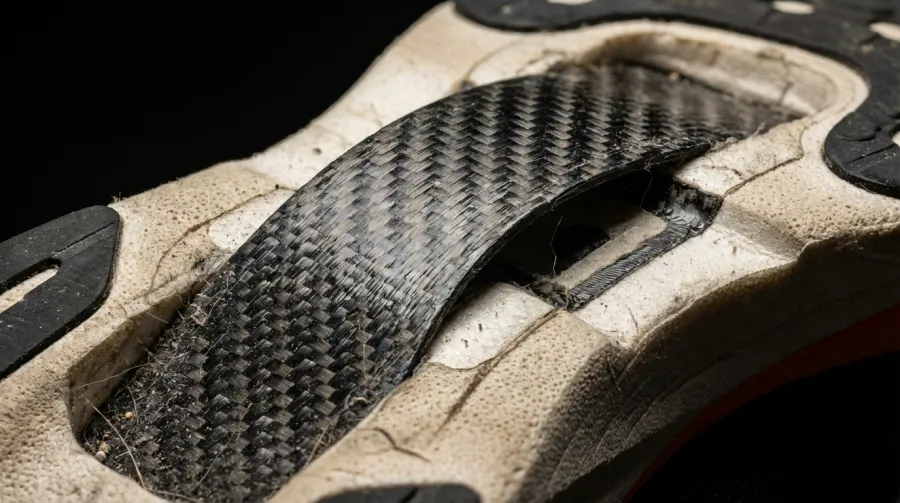
The three pillars of the Carbon X3 are: a full-length carbon fibre plate, the PROFLY X dual-layer foam midsole, and the Meta-Rocker geometry. Together, they create a shoe that feels almost mechanically assisted — like the shoe is doing a portion of the work for you, which after 112 miles on the bike, is exactly the help you need.
Technical Specifications
| Plate | Full-length carbon fibre |
| Midsole | PROFLY X dual-layer foam (soft top layer / firmer bottom layer) |
| Stack Height | 32mm heel / 27mm forefoot |
| Drop | 5mm |
| Weight | ~264g (men's US 9) / ~220g (women's US 8) |
| Upper | Engineered knit bootie construction with oversized heel tab |
| Outsole | Rubberised EVA — suitable for both training and racing |
| Platform | Wide — inherently stable design |
| Price | ~$200 |
The PROFLY X Foam: A Tale of Two Layers
Let's spend a moment with the midsole, because this is where the Carbon X3's character lives. The PROFLY X system uses two distinct foam densities stacked vertically. The top layer (closest to your foot) is softer and more compliant — it absorbs impact and provides that plush, protective feeling that Hoka is known for. The bottom layer is firmer and more responsive — it provides the stable platform from which the carbon plate can generate propulsive energy return.
The result is a shoe that somehow manages to feel both cushioned and energetic. Cushioned enough to protect quad-destroyed legs during a late-Ironman shuffle. Energetic enough to feel alive when you're actually running well. This isn't a small engineering achievement — getting these two properties to coexist in a single midsole requires careful calibration of both foam densities and the positioning of the carbon plate between them.
The Meta-Rocker: Your Built-In Running Coach
Hoka's Meta-Rocker geometry is the curved shape of the outsole that guides your foot through the gait cycle with minimal effort. Think of it like a rocking chair: the curve does the work of transitioning your weight from heel to toe so your muscles don't have to. On fresh legs, you barely notice it. On mile 18 of a marathon, with your calves cramping and your form deteriorating, it becomes a crutch in the best possible sense — the shoe keeps you moving forward even when your technique is falling apart.
The 5mm drop is interesting in context. Most maximalist shoes run higher drop (8-10mm) to work with the heel-heavy landing that high-stack shoes tend to promote. The Carbon X3's 5mm drop encourages a more midfoot strike, which is more efficient for endurance running and works better with the Meta-Rocker's forward propulsion geometry. It may take a few runs to adjust if you're coming from a higher-drop shoe, but the adaptation period is typically short.

The Triathlon-Specific Details That Matter
The Oversized Heel Tab
This seems like a minor detail. It is not a minor detail. Putting on running shoes in T2 when you're already partially hypoxic, your hands don't work quite right, and you have a full marathon ahead of you is a surprisingly difficult task. The Carbon X3's oversized heel pull tab means you can grab it with clumsy, slightly numb fingers and get the shoe on in one motion. Triathletes who've fumbled with a traditional heel for 20 seconds in T2 will appreciate this deeply.
The Bootie Upper Construction
The engineered knit bootie wraps your foot like a sock — snug, seamless, and extremely comfortable without traditional heel padding. This is excellent for triathletes who race sockless (saving seconds in T2) because the seamless interior minimises friction and hot spots. Those who race with socks will find the fit slightly roomy with a thin sock, which is fine for long-course racing where foot swelling across a full Ironman is a real consideration.
The Wide Platform
Carbon-plated shoes can be notoriously unstable — the rigidity that generates propulsion can also make lateral movements unforgiving. Hoka's wide platform counteracts this, providing a stable base that makes the shoe genuinely confidence-inspiring even when your running form isn't at its best. This is a crucial feature for long-course: when you're running your 20th mile and your form is somewhere between "deteriorating" and "controlled collapse," stability matters.
The Rubberised EVA Outsole
Unlike some race-day shoes that use ultra-aggressive outsole compounds that wear quickly during training, the Carbon X3 uses a more durable rubberised EVA that can handle regular training miles without disintegrating. This means you can — and should — run in these shoes before race day. Never, ever wear a carbon-plated shoe in a race without having substantial training miles in it first. The Carbon X3's durability makes this possible without the guilt of grinding down expensive race-only outsoles.
Carbon X3 vs. The Competition
vs. Nike Vaporfly 3
The Vaporfly is arguably faster on fresh legs for shorter distances — it's lighter, more aggressive, and the ZoomX foam is exceptionally lively. But it's less protective for long-course racing, and the narrower platform can feel unstable when fatigue affects your biomechanics. The Carbon X3 offers a better overall experience for full Ironman distances. Horses for courses: the Vaporfly for Olympic and 70.3, the Carbon X3 for Ironman.
vs. Adidas Adizero Adios Pro 3
The Adios Pro is a world-record-level marathon shoe with incredible energy return — Yomif Kejelcha wore a version of it running a 12:49 5000m. But it's also polarising: the multi-element carbon rod system and narrow fit don't work for everyone, and it offers less cushioning at the heel for heavy heel-strikers. The Carbon X3 is more universally accessible. If the Adios Pro fits you perfectly and you've run big distances in it, it may be slightly faster. If you're not sure, the Carbon X3 is the safer and often better choice.
The Real-World Test: What Triathletes Actually Experience
The consensus from the triathlon community on the Carbon X3 is remarkably consistent: it performs best in exactly the conditions where triathletes need it most. At miles 1-8 of the run, when you're still finding your run legs after the bike, the cushioning absorbs the stiffness and the Meta-Rocker keeps your cadence rolling. At miles 16-26, when everything hurts and your form is a distant memory, the stability and protection become genuinely life-saving.
The 264g weight (men's size 9) is slightly heavier than the Vaporfly or Adios Pro, but in long-course triathlon, the weight delta is almost irrelevant — you're not trying to run 4-minute miles, you're trying to keep moving efficiently for 3-5 hours. The protection and propulsion advantages far outweigh the few grams difference.
One honest caveat: the Carbon X3 runs slightly narrow in the toebox compared to what Hoka traditionally offers. If you have wider feet or tend toward foot swelling during long efforts (common in Ironman), consider going up a half size. The bootie upper has some give, but the width profile is more race-shoe than traditional Hoka.
Who Should Buy the Hoka Carbon X3
- Long-course specialists — this shoe is designed for 70.3 and full Ironman run legs, and it shows in every design decision.
- Triathletes who prioritise run-leg preservation — if you want to feel like a human being (not a shuffling zombie) through the back half of the marathon, the cushioning here is exceptional.
- Heel strikers and midfoot strikers — the 5mm drop and wide platform accommodate a range of gait patterns.
- Athletes who train in their race shoes — the rubberised EVA outsole handles regular training miles without the guilt spiral.
- Anyone who's had trouble with narrow carbon shoes — the wide platform and bootie upper offer a more accommodating fit than many competitors.
The Verdict
At ~$200, the Hoka Carbon X3 is one of the best value propositions in performance running footwear. It doesn't sacrifice protection for speed or stability for lightness. It makes a series of very smart compromises that happen to align perfectly with what a triathlete needs on the run leg: protection when you're suffering, propulsion when you're rolling, stability when your form breaks down, and a heel tab you can actually grab at 2 PM after swimming 2.4 miles and biking 112.
This is not the sexiest race shoe on the market. It won't make you look as fast as a Vaporfly at the start line. But at mile 20, when you're grinding toward the finish line and the shoe is still working for you rather than against you, you will have the last laugh. Get a proper fit, put some training miles in them, and let the Carbon X3 be your secret weapon on the run course.
Triathlon Universe Rating
4.7 / 5.0
Best Run Shoe — Long-Course Triathlon


