
Let's get one thing straight: you do not need to spend $8,000 on a carbon superbike to race triathlon. That bike exists to make you feel inadequate and separate you from your money — in that order. What you actually need is a race-ready setup that gets you to the finish line faster than you would on whatever you're riding now. And you can do that for under $1,500 without compromising on the things that actually matter.
This is a no-BS breakdown of how to build a tri bike setup on a real-world budget. Not "budget" the way cycling media uses it, where "affordable" means $4,000. Actually affordable. Let's go.
Step One: The Frame — What You're Actually Looking For
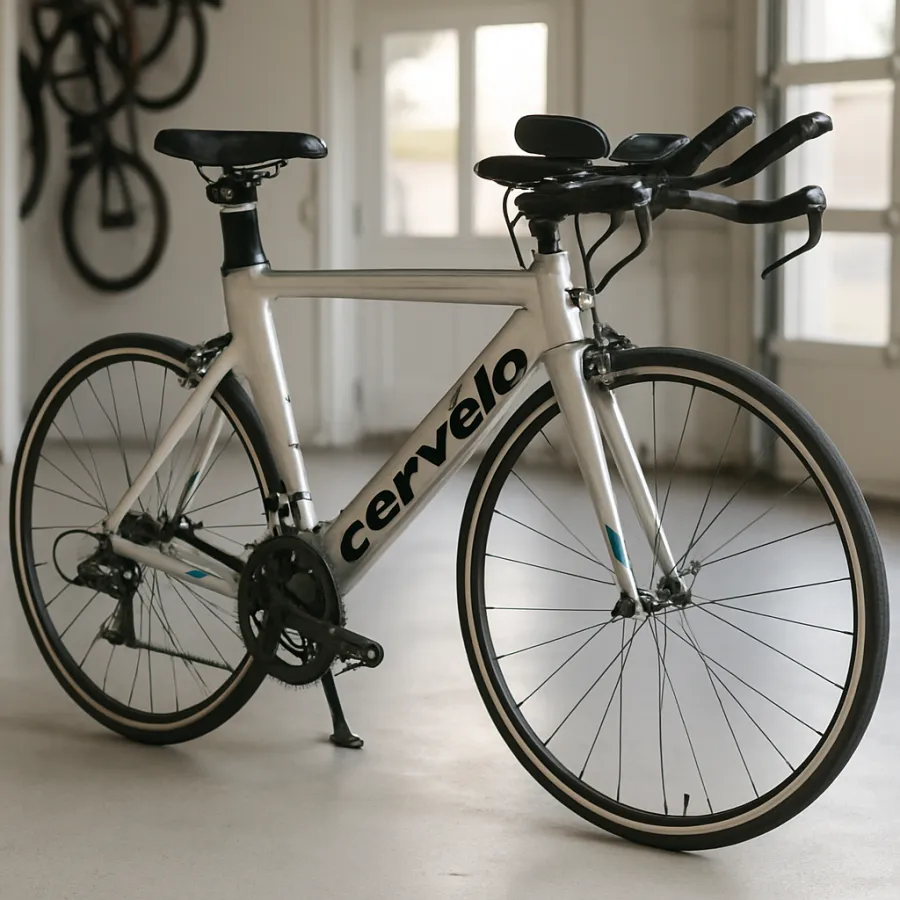
A used TT (time trial) or dedicated triathlon frame is your starting point. Here's the truth: a 5-10 year old aluminum or entry-level carbon TT frame from a reputable brand will outperform a brand new $2,000 "lifestyle" road bike in the aero position — because the geometry is purpose-built. You want a bike where you can get low, stay comfortable, and still run afterward.
What to look for in a used TT frame:
- Steep seat tube angle (76-80°): This shifts your hips forward, opening your hip flexors so you can actually run off the bike. Road bikes typically sit at 72-74°. The difference matters enormously over a 40km bike leg.
- Reputable brands: Cervélo P-series, Trek Speed Concept (older gen), Specialized Shiv (2012-2018), Giant Trinity, Cannondale Slice, Felt IA or B-series. Any of these in good used condition is a legitimate race machine.
- Aluminum is fine: Don't let carbon snobs tell you otherwise. An aluminum Cervélo P1 with a proper fit and good wheels is faster than a carbon anything ridden in a bad position.
- Check the frame carefully: Cracks around the BB shell, headtube, and seatstays. Dents in aluminum. Delamination or spider-web cracks in carbon. If it looks sketchy, walk away — there will be another one.
Budget target: $300-$600 for frame + fork (or complete bikes from $500-$900 including components)
Where to Hunt for Used Gear
You have options. Here's where the deals actually live:
- Facebook Marketplace: The best place for local deals. Search "tri bike," "TT bike," "time trial bike," and specific models. Most sellers are ex-triathletes who quit, upgraded, or need garage space. These bikes are often well-maintained and just need a clean and tune. Always check BikeIndex.org with the serial number before handing over cash.
- eBay: Wider selection, more price competition. Good for complete bikes and individual components. Use "Make Offer" aggressively. Factor shipping costs on complete bikes into your budget — they add up fast.
- BikeExchange, Pinkbike, The Paceline forum: More knowledgeable sellers who describe condition accurately. Less likely to find a steal, but also less likely to get burned by someone who doesn't know what they're selling.
- Local tri clubs and race expos: Underrated. Post in your club's Facebook group or email list. Sellers are within the community, gear is well-maintained, and they'll often negotiate because they trust the buyer.
Pro tip: Set up search alerts on Facebook Marketplace and eBay for your target bikes. Good deals move fast — the patient, persistent shopper wins.
Components: What Actually Matters vs. What's Overrated
This is where most budget builds go wrong — either over-spending on things that don't move the needle, or under-spending on things that genuinely do.
What Actually Matters
- Groupset functionality: You need gears that shift cleanly and brakes that stop you. Shimano 105 or SRAM Rival from any generation is perfectly adequate for age-group racing. A well-tuned mechanical 105 is a well-tuned mechanical 105. You do not need Di2. You do not need Dura-Ace.
- Wheels: This is where used bikes often hide the real value. A pair of Zipp 404s, Reynolds 46s, or Shimano RS81s in good condition absolutely transforms a bike's speed. Good clincher race wheels (30-50mm depth) make more difference than almost any other single upgrade — and they're available used at reasonable prices because triathletes constantly chase the next thing.
- Saddle position: More important than any component. Get a proper fit before you lock in your saddle and cockpit. A $60 used ISM saddle in the right position beats a $400 saddle 5mm off.
What's Overrated (Don't Spend Here)
- Integrated cockpits and hidden cable routing: Expensive, finicky, and they don't make you meaningfully faster than clip-on aerobars properly set up. Full integrated TT cockpits are a pain to adjust and a nightmare to service. Skip it at this budget.
- Weight: At typical age-group speeds, shaving 300 grams off your bike is worth about 60 seconds over a 40km bike leg. A proper aero position saves 5-12 minutes. Spend your money on position, not grams.
- Carbon everything: Carbon handlebars and stems are nice. They are not $400-above-aluminum-price nice. Save it for wheels where rotational mass actually matters.
- Latest groupset generation: Shimano 105 R7000 shifts beautifully, parts are everywhere, and it costs half of the R7100 Di2 series. Chasing new on a budget is how you waste your entire allocation on the drivetrain.
The Road Bike Option: Aero Bar Add-Ons
If you're not ready to buy a dedicated TT frame, clip-on aerobars on your existing road bike are a legitimate and effective alternative — especially for sprint and Olympic distance. A set of Profile Design T2+, Zipp Vuka clip-ons, or Deda Elementi Parabolica 2 bars costs $80-$150 new, fits most road handlebars, and gets you 70-80% of the aerodynamic benefit of a full TT position.
The rules for aerobars on a road bike:
- Use short extensions. Road bikes have longer reach than TT bikes — long extensions will put you in a grotesquely stretched position that will destroy your back and neck over any meaningful distance.
- Get a fit check after installation. Even 20 minutes with an experienced triathlete will catch obvious problems before they become race-day injuries.
- Practice before race day. Cornering, braking, and grabbing nutrition in aero are skills you develop over weeks, not skills you discover at kilometer 30 of your first race.
- Verify race rules. Draft-legal events and some local sprints prohibit aerobars. Read the race guide.
What NOT to Cheap Out On
Three places where being cheap actively costs you time, health, or both. Do not budge on these:
- Bike fit ($100-$200): Non-negotiable. A proper tri fit from a certified fitter determines your saddle height, setback, bar reach, and aero position in a way that maximizes power output and minimizes injury risk. A bad fit on a $10,000 bike is slower and more dangerous than a good fit on a $500 bike. Book the fit before you finalize components — saddle position affects cockpit choice significantly.
- Tires ($50-$80 per pair): The cheapest performance upgrade that exists. A Continental GP5000, Vittoria Corsa, or Schwalbe One rolls measurably faster, corners better, and punctures less than a cheap training tire. On a budget build, this is where you don't compromise.
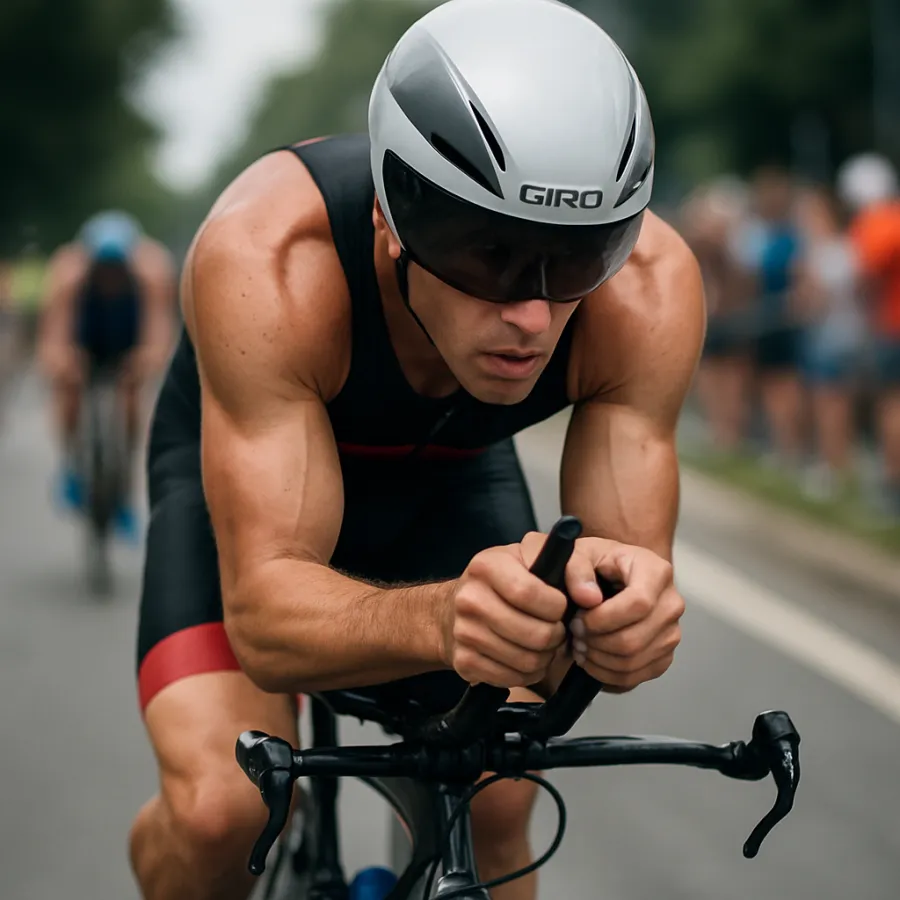
- Aero helmet ($80-$150 used): An aero helmet saves 1-2 minutes over a 40km bike leg versus a standard road helmet. It's one of the most efficient time purchases in the sport. Giro Aerohead, Kask Bambino, Specialized TT3 — all available used in great condition. Buy one.
"I spent $200 on a bike fit and $80 on a used aero helmet. My bike split dropped by nearly 4 minutes at my next race. I didn't change a single component." — Every age-grouper who finally figured this out
The $1,500 Sample Build
Here's a realistic, race-ready budget build for a patient shopper. Prices reflect used market averages in 2024-2025:
- Used Cervélo P1 or Giant Trinity complete bike (aluminum, Shimano 105): $600-$750
- Continental GP5000 tires, 25mm, pair: $80 new
- Profile Design T2+ clip-on aerobars: $90 new
- Used ISM Adamo or Cobb saddle: $60-$80
- Giro Aerohead or similar aero helmet (used): $80-$100
- Bike fit: $150-$200
- Misc (bar tape, cables, basic tune-up): $60-$80
- Total: approximately $1,120-$1,380 — leaving $120-$380 for a wheel upgrade or race nutrition
That's a legitimate race setup. Not a "one day I'll upgrade" compromise — an actual, functional, go-race-it machine built for the sport it's being used in.
The Honest Bottom Line
The triathlon industry will spend considerable effort convincing you that faster bikes make faster athletes. Sometimes that's true. But at the age-group level, the biggest time gains come from position, tires, and an aero helmet — not from dropping $6,000 on a new frameset. The athlete who shows up fit, well-fed, and properly positioned on a $700 used Cervélo will finish ahead of the athlete who shows up undertrained on a $9,000 Canyon Speedmax.
Be smart with your money. Be smart with your training. And don't let anyone at the transition area make you feel like your bike isn't worthy of the race. It is. You are. Now go prove it.


