
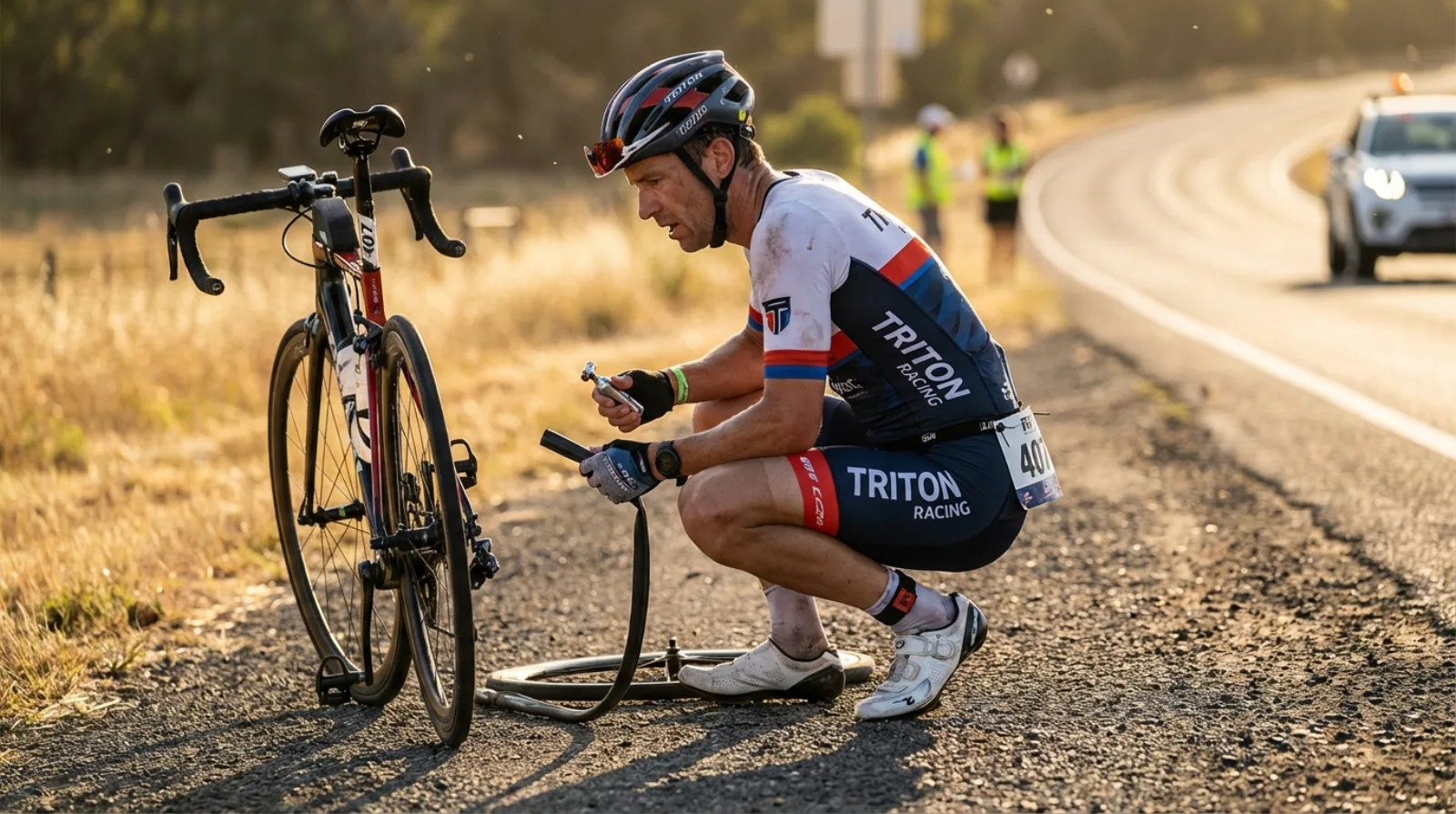
It's mile 40 of your Ironman bike leg. You've been sitting at 220 watts, your nutrition is dialed, the run is going to be your best ever — and then you hear it. That slow, unmistakable hiss. The sound of your race day dreams deflating in real time. Welcome to the flat tire experience, the one training discipline nobody wants to practice but absolutely everyone should prepare for.
Why Your Flat Repair Kit Matters More Than You Think
Here's the uncomfortable truth about flat repair kits in triathlon: most athletes spend thousands of dollars on race wheels, power meters, and aero helmets, then stuff a random CO2 cartridge and a tire lever they've never touched into their saddle bag and call it a day. This is the equivalent of training for a marathon and then deciding to run it in flip-flops.
The stakes in triathlon are uniquely unforgiving. You can't walk a flat bike to the finish line. You can't call a friend for a lift mid-race (well, you can, but your race is over). In an open-water swim you can tread water; on the run you can hobble. On the bike, a flat without the proper kit means you're done — standing on a roadside watching your race entry fee float away on the breeze.
The good news: a proper flat repair kit costs anywhere from $7 to $70. That's less than your pre-race dinner. There is absolutely no excuse not to carry the right gear.
What to Look For in a Triathlon Flat Repair Kit
Before diving into the reviews, here's what separates a great triathlon flat repair kit from a box of false hope:
- Speed: CO2 inflators are far faster than mini pumps for road tires. In a race, minutes matter.
- Tubeless vs. Tubed: If you're running tubeless tires (increasingly common in tri), you need a plug-based repair tool, not just patches and levers.
- Weight and size: Aero considerations aside, you want something that fits in a saddle bag or mounts cleanly to your frame.
- Reliability: A kit that fails when you need it is worse than no kit at all — it gives you false confidence.
- Valve compatibility: Presta is standard on tri bikes. Make sure your inflator handles it without an adapter.
1. Dynaplug Racer Pro
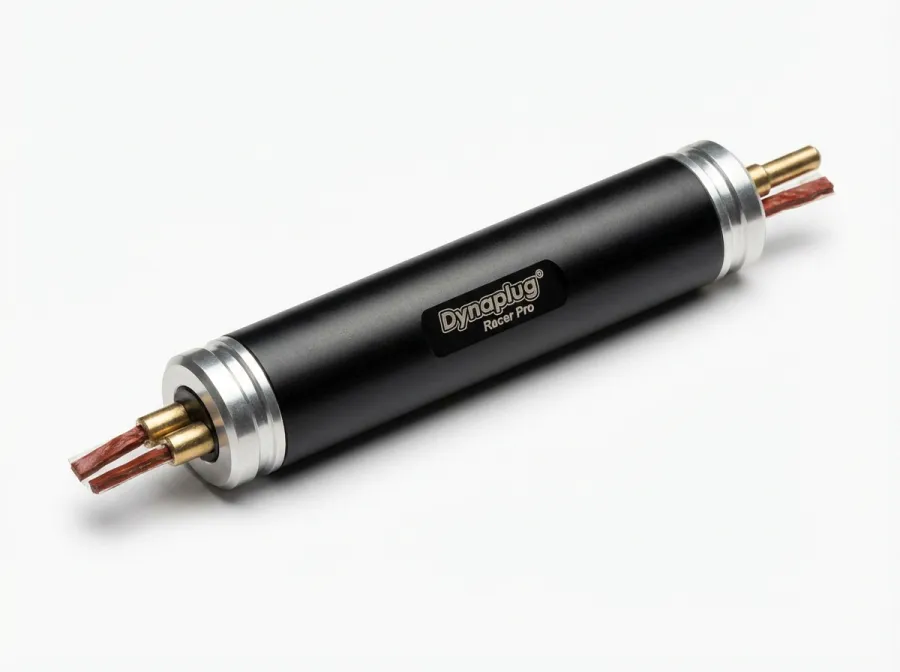
If you're running tubeless tires — and increasingly, you should be — the Dynaplug Racer Pro is the gold standard of trailside plug tools. Machined in Chico, California from 6061 billet aluminum and hardened 304 stainless steel, this thing is built like it costs twice what it does. At 4.25 inches long and 26 grams loaded, it's roughly the size of a thick pencil and lives happily in a jersey pocket or saddle bag.
What makes the Racer Pro special is its Twin Tube™ technology: the tool stores four pre-loaded plugs internally — one heavy-duty Megaplug for bigger punctures and three standard plugs for garden-variety road debris. The brass-tipped plugs are designed with a barbed end that prevents the tire's internal pressure from pushing them back out, which is a smarter design than it sounds when you're hyperventilating on a roadside at mile 40.
Using it is genuinely fast: jam the pre-loaded plug tip into the puncture, pull back the tool, and the plug stays in the tire. That's it. The sealant does the rest. Most repairs take under 60 seconds once you've practiced — and you should practice before race day, not learn the hard way while your race clock ticks.
Pros
- Best-in-class tubeless plug retention with barbed brass tips
- Twin Tube stores 4 plugs (1 Megaplug + 3 standard) in the tool body
- Ultralight at 26g, compact at 4.25 inches
- Premium CNC-machined aluminum and stainless steel construction
- Limited lifetime warranty, made in the USA
Cons
- Doesn't include a CO2 inflator — you'll still need that separately
- Tubeless-only; not useful if you run inner tubes
- Premium price point for a plug tool
Price: ~$60–$68 | Best For: Tubeless tire runners who want the fastest, most reliable plug solution available
2. Genuine Innovations Ultraflate Plus
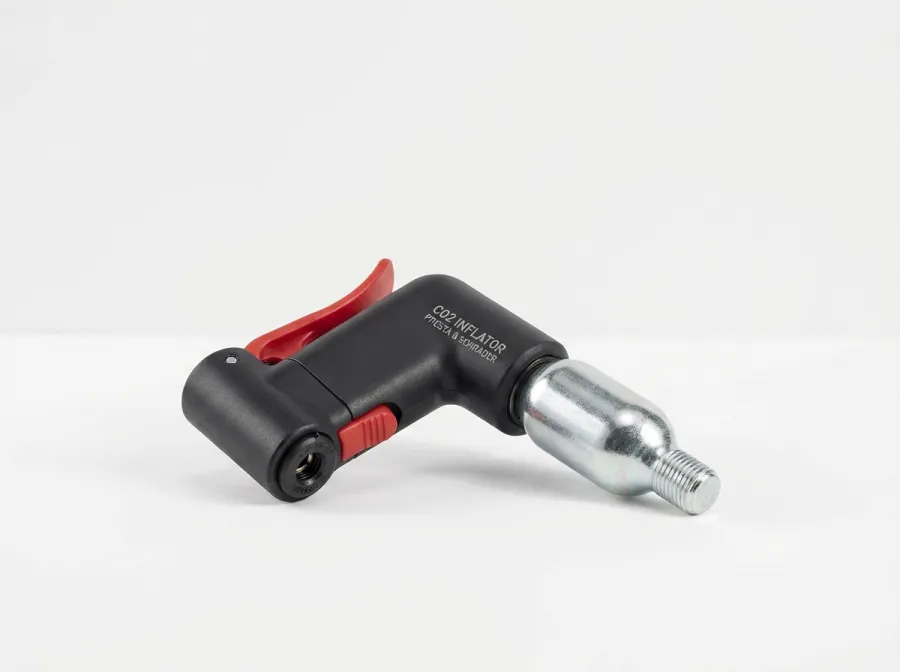
The Genuine Innovations Ultraflate Plus has been the default CO2 inflator recommendation in triathlon for years, and there's a reason it hasn't been dethroned: it's simple, it works, and it costs about as much as a post-race beer. Built with reinforced glass nylon and brass internals, it's considerably more robust than its budget price suggests.
The trigger-controlled inflation system is the standout feature here. Rather than the "jam it on and hope for the best" approach of cheaper inflators, the Ultraflate Plus lets you release CO2 in controlled bursts — critical when you're trying to hit 90 PSI without accidentally launching your tire off the rim on the roadside. A built-in trigger lock prevents accidental discharge, which saves you from the unique horror of shooting your only CO2 cartridge into the atmosphere while fumbling in transition.
Compatibility is broad: it works with 16g, 20g, and 25g threaded cartridges, as well as 20g non-threaded versions. It handles both Presta and Schrader valves. The included 20g cartridge is enough to fully inflate a standard road or tri bike tire. At around 62–72 grams without a cartridge, it adds almost nothing to your kit weight.
Pros
- Trigger-controlled CO2 release for precise inflation
- Trigger lock prevents accidental discharge
- Works with multiple cartridge sizes (16g, 20g, 25g threaded)
- Presta and Schrader valve compatible
- Excellent value for money
Cons
- No built-in pressure gauge
- Plastic body isn't as premium as aluminum alternatives
- Some reports of compatibility issues with non-Genuine Innovations 16g non-threaded cartridges
Price: ~$20–$26 | Best For: Athletes wanting a reliable, proven CO2 inflator at a budget-friendly price
3. Lezyne Pressure Drive CFH
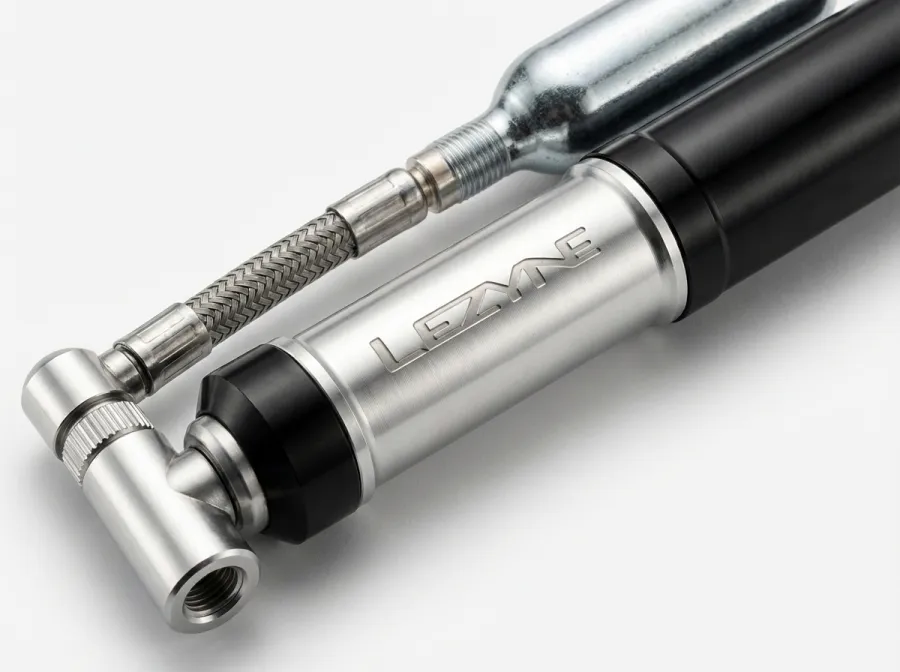
What if you blew your only CO2 cartridge seating a tubeless tire and now you're staring at a second flat with zero options? The Lezyne Pressure Drive CFH answers this existential question with characteristic efficiency: it's both a high-pressure hand pump capable of 120 PSI and a CO2 inflator, unified in a single 190mm, 108-gram package.
The CFH (Carbon Fiber Hose) designation refers to the integrated steel-braided flex hose, which is smarter than it sounds. Rather than locking directly onto a valve stem and risk snapping it off mid-inflation — a special category of race-day disaster — the hose gives you a flexible connection that protects the valve and lets you inflate at an angle. The Flip-Thread Chuck handles both Presta and Schrader, and the machined aluminum construction is Lezyne's signature: overbuilt in the best way.
At $45-55, it's not the cheapest option here, but it's the only one that gives you a meaningful backup if CO2 fails. For Ironman-distance racing in particular — where you might be 60 miles from nowhere — this dual capability is legitimate peace of mind.
Pros
- Dual function: CO2 inflator AND hand pump up to 120 PSI
- Steel-braided flex hose protects valve stems during inflation
- CNC-machined aluminum construction for durability
- Presta and Schrader compatibility
- Neoprene sleeve protects hands from CO2 freeze
Cons
- Heavier than pure CO2 inflators at 108g
- More expensive than single-function options
- No built-in pressure gauge
Price: ~$33–$55 | Best For: Long-distance athletes who want CO2 speed with a hand pump backup
4. Park Tool GP-2 Glueless Patch Kit
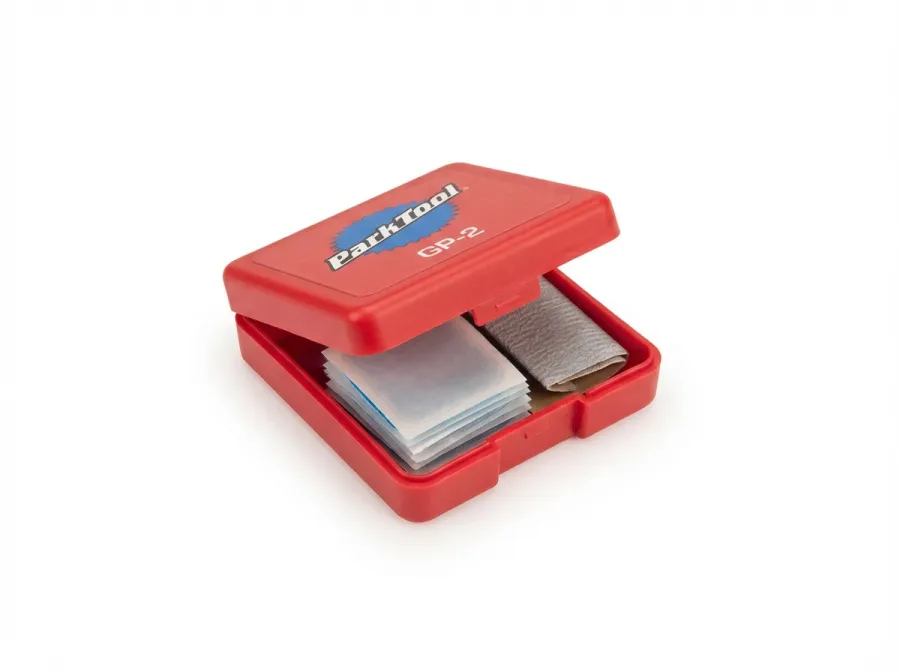
Hear us out on this one. The Park Tool GP-2 is not a glamorous piece of equipment. It's not CNC-machined in California. It doesn't have a lifetime warranty. It's a small box of pre-glued adhesive patches that costs $6.95 and weighs 5 grams. But it represents an ethos that every triathlete should embrace: belts and suspenders.
Developed in collaboration with 3M, the GP-2's self-adhesive patches are engineered to stretch and flex with the inner tube. The repair process is elementary school simple: lightly rough up the area with the included sandpaper, peel the patch, press firmly for 60 seconds. No glue, no waiting for solvents to dry, no missing steps under pressure. These won't last forever — they're a "get home" solution — but in a race context, you don't need forever. You need to finish.
At 5 grams and the size of a coin, there is genuinely no good reason not to tuck one of these into every kit bag you own. Think of it as the world's lightest backup plan. The GP-2 won't win any awards, but it will get you to the finish line when everything else has gone sideways.
Pros
- Absurdly lightweight at 5 grams — barely measurable
- No glue required, fast application under pressure
- 3M-engineered patches flex with the tube
- Six patches in a kit that fits in a coin pocket
- Price of a coffee — carry multiple kits without guilt
Cons
- Glueless patches are temporary/"get-home" solution, not permanent
- Not compatible with tubeless tires or TPU tubes
- Adhesive can degrade over time in heat
Price: ~$7 | Best For: Inner tube riders who want a featherweight emergency backup, or anyone who wants a redundant repair option
5. Blackburn Plugger Tubeless Tire Repair Kit
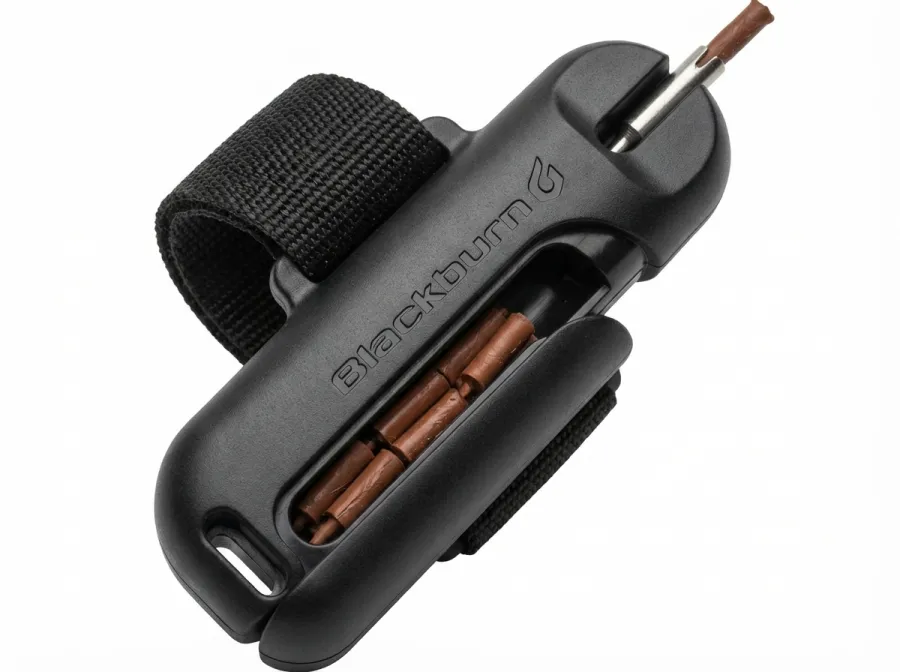
The Blackburn Plugger takes a different approach to tubeless repair tooling. Where the Dynaplug is a precision aluminum instrument, the Plugger is a purpose-built, no-nonsense tubeless plug driver that comes pre-loaded and ready to deploy. At 27 grams without the mount strap (47 grams with), it's one of the lightest dedicated plug tools available.
The design choice that sets the Plugger apart is its hollow needle — a metal tube with a diagonally cut end, rather than the fork-shaped insertion tools common elsewhere. Blackburn claims this design keeps plugs in the tire more reliably and simplifies the loading process. The handle stores up to ten spare plugs internally, which means you're carrying a meaningful repair inventory rather than the two-plug kits that leave you sweating after the first puncture.
Where the Plugger really earns its place is in mounting versatility. It can be strapped to a top tube, the seatstay, an ankle, or anywhere else on the bike frame. For triathletes who've ditched the saddle bag for aerodynamics, this frame-mount flexibility is legitimately useful. Quarter-turn release from the holster means quick access when stress levels are already elevated.
Pros
- Stores 10 spare plugs internally — more inventory than most kits
- Lightweight at 27g (without strap)
- Frame-mountable with strap — great for aero setups without saddle bags
- Quick-release holster with quarter-turn mechanism
- Hollow needle design for reliable plug retention
Cons
- Works best on mid-sized punctures; may struggle with very large gashes
- Reloading can be tricky if plug residue accumulates
- Plastic construction feels less premium than aluminum alternatives
Price: ~$25–$30 | Best For: Aero-focused athletes who need frame-mountable tubeless repair with high plug capacity
6. Crankbrothers M20 Multi-Tool
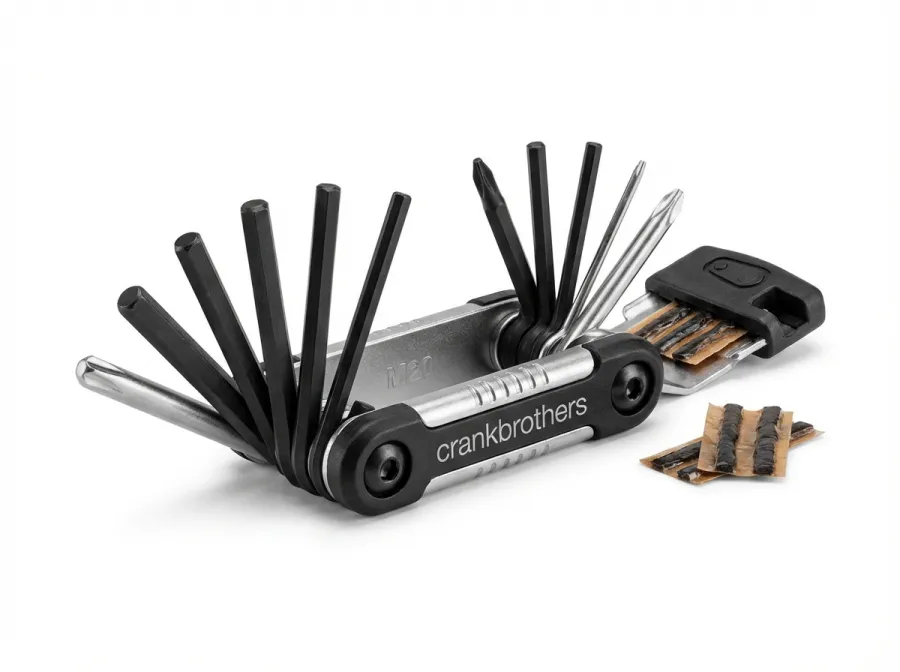
The Crankbrothers M20 makes this list on the strength of a compelling argument: why carry a dedicated plug tool AND a multi-tool when you can carry one object that does both? At 206 grams, it's not the lightest option here, but it packs 20 functions including the full hex and Torx kit you'd want for any mid-ride mechanical — plus an integrated tubeless tire plug tool pre-loaded with five plugs.
The plug tool is built into the body of the multi-tool itself and deploys cleanly. The five included plugs handle most road puncture scenarios, and the valve core removal tool means you can properly prep a tubeless repair without needing a separate instrument. The chain tool, spoke wrenches, and rotor straightening slot make this the most comprehensive single tool any triathlete can carry.
Where the M20 shines is on training rides and particularly on event days where you might be supporting a less-prepared training partner. In a race context, its weight and size push it toward the "training ride kit" category rather than the minimalist race day saddle bag — but for athletes who do their long rides with the same kit they race with, it's an efficient consolidation.
Pros
- 20 functions in one tool: full hex/Torx set, chain tool, spoke wrenches, rotor straightener
- Integrated tubeless plug tool with 5 included plugs
- Valve core removal tool included
- Crankbrothers lifetime warranty
- Consolidates multi-tool and tire repair into a single carry item
Cons
- 206 grams is significant for a race day saddle bag
- Plug capacity (5) is lower than dedicated plug tools
- Chain tool can be fiddly to use under roadside pressure
Price: ~$40–$48 | Best For: Training rides and athletes who want maximum capability in minimum carry items
7. Topeak Ninja CO2
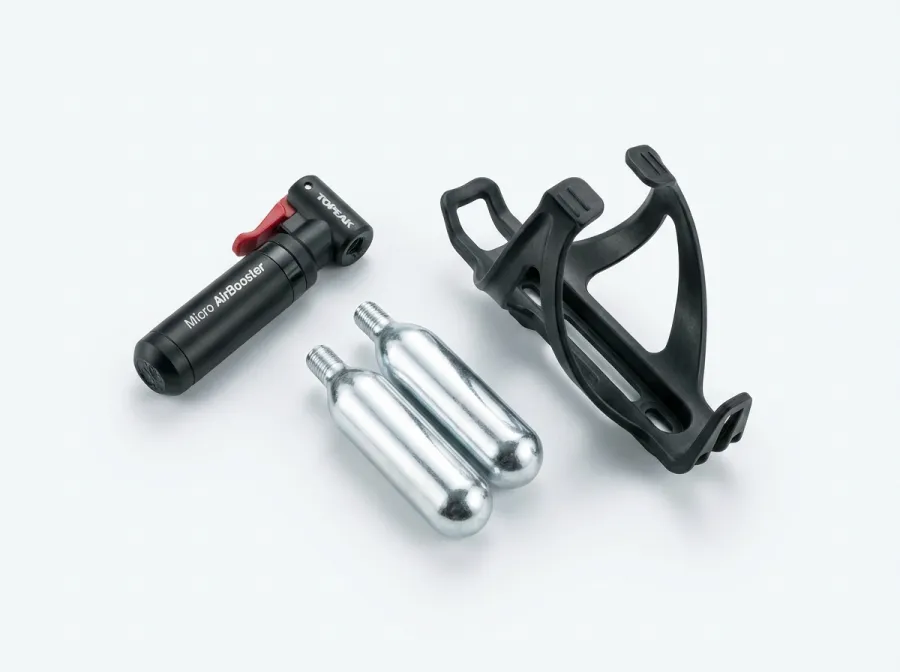
The Topeak Ninja CO2 solves a problem that's more relevant to triathletes than any other cyclists: how do you carry a flat repair kit in an aero position without a saddle bag? The answer, it turns out, is to hide everything underneath your water bottle. The Ninja CO2 mounts directly under a standard water bottle cage and conceals a Micro AirBooster CO2 inflator plus two 16g threaded cartridges in engineering-grade polymer housing.
In a race context, this is legitimately clever. Your bike stays clean and aero. Your saddle bag disappears. Your rear end stops looking like a cargo mule. The Micro AirBooster inflator uses an inline trigger-style mechanism and is compatible with both Presta and Schrader valves, with the CNC aluminum construction providing reassuring durability. Two cartridges gives you the luxury of a backup if the first one seats the tire and you need a second to top up pressure.
At 191 grams total and ~$45, it's not the most budget-conscious choice, but for triathletes who care about aero integration, it's one of very few products that actually addresses how they ride. The long mounting slots provide positioning flexibility across most standard frame setups.
Pros
- Mounts under water bottle cage — invisible aero integration
- Includes two 16g CO2 cartridges (backup built in)
- CNC-machined aluminum Micro AirBooster inflator
- Presta and Schrader compatible
- Eliminates the need for a saddle bag entirely
Cons
- Occupies one water bottle cage position — consideration for hot race days
- 191g is heavier than a minimalist CO2-only inflator
- Black plastic housing aesthetic won't win beauty contests
Price: ~$45 | Best For: Aero-obsessed triathletes who want to ditch the saddle bag and keep the bike looking race-ready
8. Silca Eolo IV CO2 Inflator
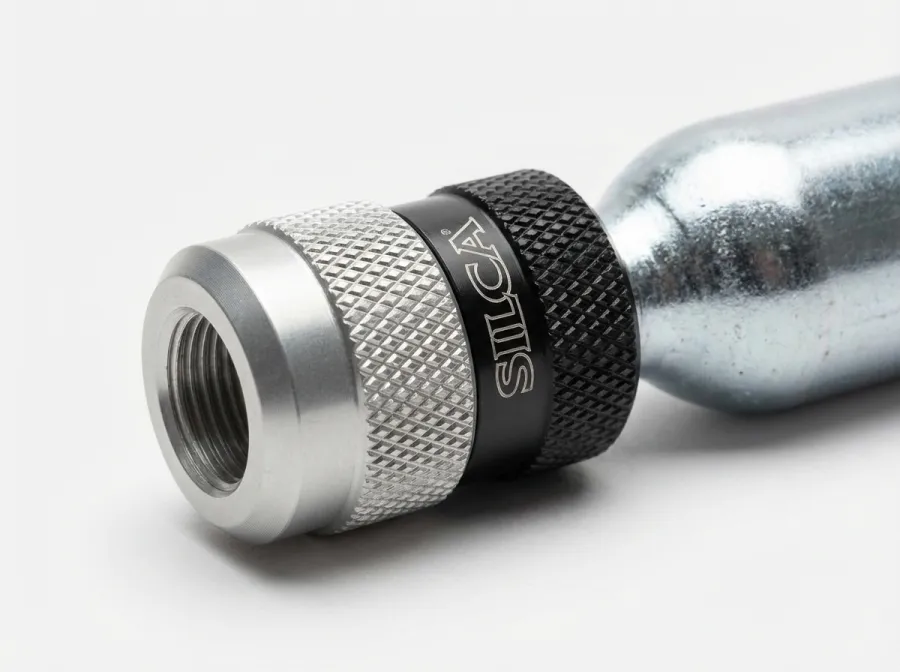
Silca is the brand that makes $400 floor pumps — and somehow justifies them, because they're built better than anything else on the market. The Eolo IV brings that philosophy to CO2 inflation in the smallest possible package: 13 grams, 30mm, zero plastic, all-aluminum construction with O-rings being the only non-metal components.
The Eolo IV's defining feature is its precision dial for flow control. Rather than an on/off gas dump, you get modulated CO2 release that lets you feel your way to the right pressure. Thread a cartridge on, press it onto the valve, and adjust the dial. It sounds simple because it is — Silca's genius is in making quality look effortless. At 13 grams, it's the lightest option in this roundup by a significant margin and will genuinely disappear in any kit bag.
The premium comes at a premium price: $26 for just the head, cartridges sold separately. And the all-metal construction means it gets very cold during use — gloves or a cloth recommended. But for the athlete who has optimized everything else and wants the finest small tool available, the Eolo IV is that thing. It's the Rapha of CO2 inflators.
Pros
- Ultralight at just 13 grams — lightest in this roundup
- Premium all-aluminum construction, no plastic degradation
- Precision dial for modulated CO2 flow control
- Extremely compact at 30mm
- Silca's legendary build quality and attention to detail
Cons
- Gets very cold during use — protect your hands
- Cartridges sold separately
- No sleeve or insulation included
- Premium price for a very small tool
Price: ~$26 (head only) | Best For: Weight-weenies and gear enthusiasts who want the best possible CO2 inflator in the smallest, lightest form factor
Quick Comparison: At a Glance
| Kit | Type | Weight | Price | Best For |
|---|---|---|---|---|
| Dynaplug Racer Pro | Tubeless plug | 26g | ~$62 | Tubeless riders |
| Genuine Innovations Ultraflate Plus | CO2 inflator | 62–72g | ~$22 | Budget-conscious |
| Lezyne Pressure Drive CFH | Pump + CO2 | 108g | ~$45 | Long-distance backup |
| Park Tool GP-2 | Patch kit | 5g | ~$7 | Ultra-light backup |
| Blackburn Plugger | Tubeless plug | 27g | ~$27 | Aero frame mount |
| Crankbrothers M20 | Multi-tool + plug | 206g | ~$44 | Training rides |
| Topeak Ninja CO2 | CO2 + cage mount | 191g | ~$45 | Aero integration |
| Silca Eolo IV | CO2 inflator | 13g | ~$26 | Premium/ultralight |
The Verdict
The right flat repair kit isn't one kit — it's a system. Our top recommendation for most triathletes is a two-part setup: pair the Dynaplug Racer Pro (if you're tubeless) or a quality plug kit with either the Genuine Innovations Ultraflate Plus for budget-conscious athletes or the Silca Eolo IV for those who've already spent the money on a nice bike and want the best of everything. Tuck a Park Tool GP-2 in there as a 5-gram, $7 insurance policy. Done.
If you're chasing pure aero integration, the Topeak Ninja CO2 is the cleanest solution available. If you want one object to rule them all on a training ride, the Crankbrothers M20 will handle flats, mechanicals, and most anything else the road throws at you.
Whatever you choose, practice with it before race day. Know which direction to turn the Dynaplug. Know how to trigger the Ultraflate without dumping the whole cartridge. Know how to seat a tubeless tire with CO2. Because at mile 40 of your next race, with your heart rate spiking and your race clock ticking and a car approaching at 60 mph, you do not want to be reading the instructions for the first time.
Prepare now. Fix fast. Finish.


