
You're registered for your first 70.3. You're googling "do I need a tri bike" at 11pm and falling down a Reddit rabbit hole that ends with someone telling you to spend $8,000 on a Cervélo P5 before you've even figured out transition. Close that tab. We need to talk.
Here's the honest answer nobody on the forums will give you: for your first half-iron distance race, a road bike will not ruin your day. Your fitness will. Your pacing will. Forgetting sunscreen will. But the bike? That's the least of your problems — and this guide is going to prove it.
What Actually Wins a 70.3 (It's Not the Bike)
Triathlon has a unique culture of gear obsession that borders on religion. Step into any beginner group and someone will mention their aerobars before they mention their training plan. It's endearing. It's also completely backwards.
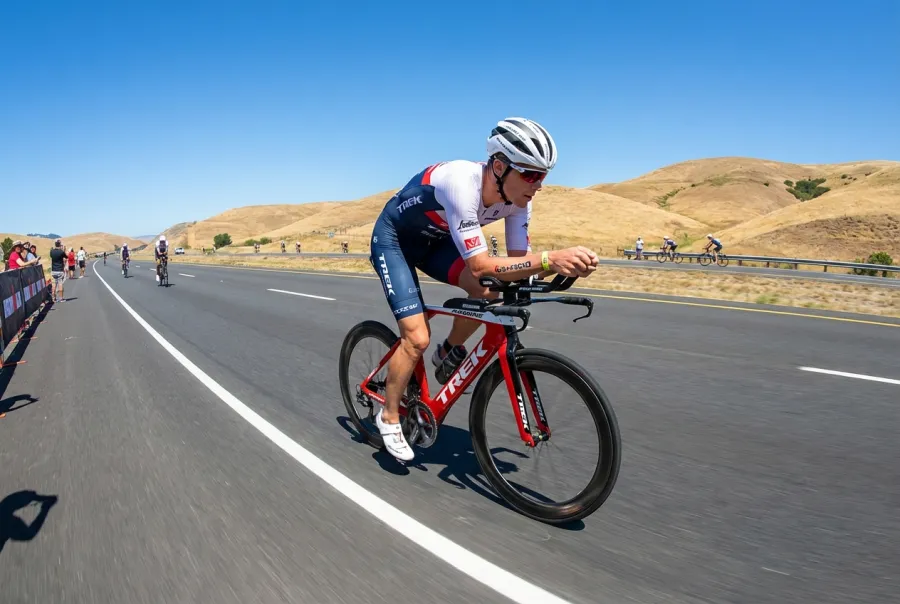
The dirty secret of first-time 70.3 racing: the difference between a $1,200 Trek Domane AL road bike and a $5,000 Canyon Speedmax CF SL aero bike is maybe 3-5 minutes over 56 miles for a beginner athlete. Meanwhile, the difference between proper pacing and going out too hard on the bike is 30-45 minutes — assuming you even make it to the finish line.
- Aerodynamics matter more at speed: The aero gains of a tri bike are significant — but mostly above 20-22mph. Most first-timers ride the 70.3 bike leg at 16-18mph average. At that speed, you're leaving seconds per mile on the table, not minutes.
- Position beats equipment: A poorly fit tri bike will destroy you. A well-fit road bike with clip-on aerobars ($80-150 on Amazon) gets you 80% of the aero benefit.
- Fresh legs for the run matter more than everything: If riding in an aggressive tri position you're not adapted to wrecks your lower back and quads, you'll walk the half marathon. Ask me how I know.
The Case FOR a Tri Bike (Eventually)
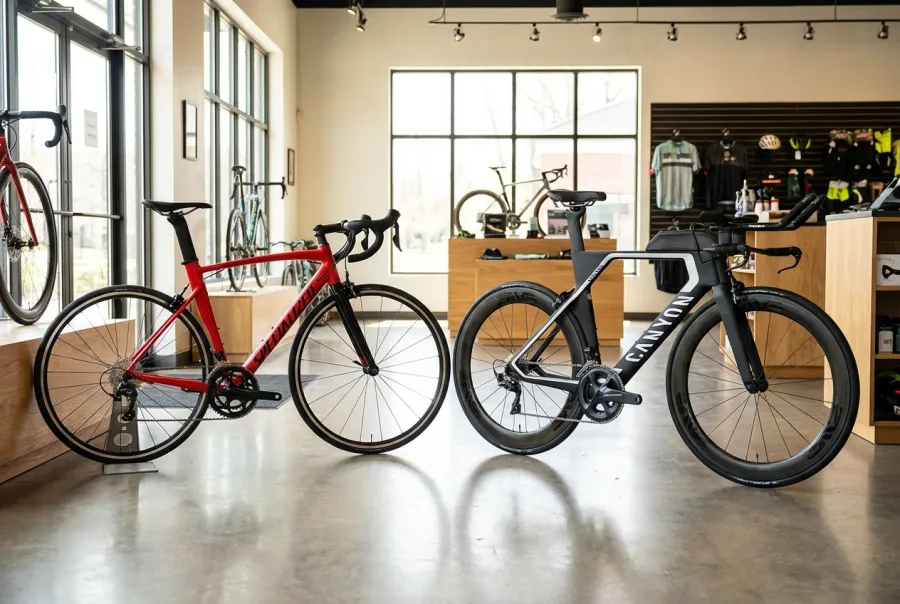
Let's be clear — tri bikes are not gear snobbery for nothing. They exist because purpose-built equipment works. A Specialized Shiv or Canyon Speedmax is engineered from the ground up for the aero position, with geometry that puts you in an aggressive forward position to offload your quads, preserve your hamstrings, and arrive at T2 with something left in the tank.
The integrated storage, the weight distribution, the hydraulic lines tucked inside carbon tubes — it's genuinely impressive engineering. If you're racing seriously, training consistently over 12-15 hours per week, and planning to do multiple iron-distance events, yes, a tri bike is worth it.
But here's the thing: you're not that person yet. And that's completely fine. You're the person who needs to finish their first 70.3 without a breakdown (mechanical or emotional). Learn the sport first. Buy the tool later.
The Beginner Gear Priority List (Actually Ranked)
If you're going to spend money, here's where it buys you the most time and suffering reduction — in order:
- 1. Bike fit ($150-300): Non-negotiable. A proper fit at a local shop will do more for your race than any equipment upgrade. Ask specifically for a "triathlon fit" if you're racing with aerobars.
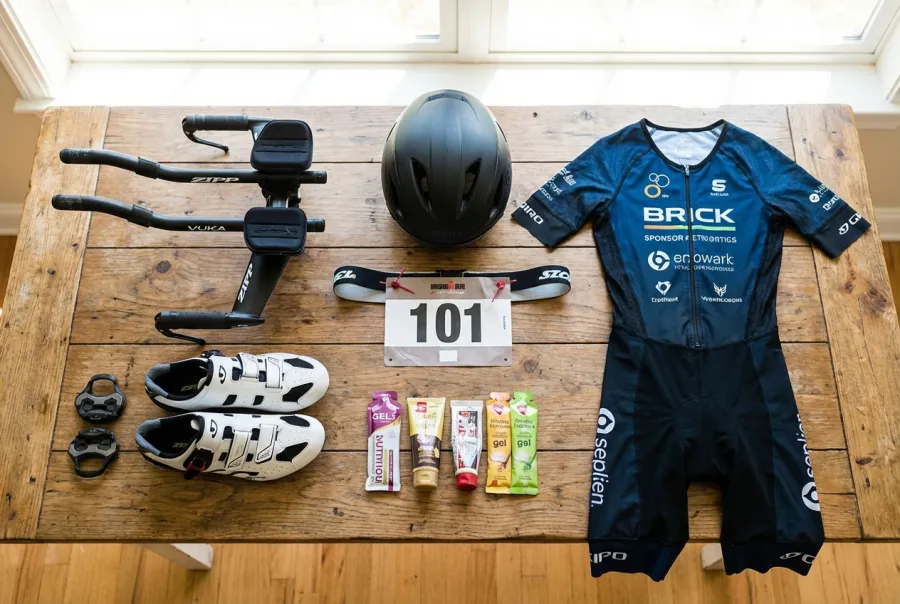
- 2. Clip-on aerobars ($80-150): Profile Design T2+ or Zipp Vuka Clip. Compatible with most road bikes. Gives you the aero tuck without the $4,000 frame.
- 3. Race wheels ($300-600 used): A set of used Zipp 303s or Boyd Cycling wheels will save more time than a new frame. Rotating mass matters. Deep section carbon saves watts.
- 4. A helmet that doesn't look like a mushroom ($80-150): An aero helmet makes a meaningful difference. Giro Agilis MIPS or Specialized Propero are solid entry-level choices. You don't need a full Kask Bambino TT helmet yet.
- 5. Tri suit ($100-200): One-piece, worn the whole race, no chamois padding (that's a nightmare on the run). Pearl Izumi or Castelli make excellent entry-level options.
- 6. Your actual bike — last: If your road bike is mechanically sound and properly fit, it'll get you across the finish line. Spend money there only after you've ticked the boxes above.
Road Bike vs Tri Bike: The Real Numbers
Let's stop talking theory and get concrete. Here's what research and real-world racing data show for an average age-group triathlete at 70.3 pace:
- Aero position savings (road bike + aerobars vs. no aerobars): ~60-90 watts savings at 18mph. That's roughly 3-5 minutes over 56 miles.
- Dedicated tri bike vs. road bike with aerobars: Additional 30-60 watts. Another 1.5-3 minutes over 56 miles.
- A botched run because your back was destroyed: 10-30 minutes of pain you can't buy your way out of.
The math is simple. The risk/reward of spending $5,000-10,000 on a Cervélo P-Series or Trek Speed Concept before your first race does not pencil out. Not when proper training, a bike fit, and some inexpensive upgrades get you 90% of the benefit.
"The fastest bike in the race is the one you know how to ride. Everything else is just receipts."
What to Actually Buy If You're Starting Fresh
If you don't own a bike yet and you're committed to triathlon, here's the honest breakdown by budget:
- Under $1,000: Used road or hybrid bike from Facebook Marketplace + clip-on aerobars. Ride it for one season. This is the move.
- $1,000-$2,500: New entry-level road bike like the Trek Domane AL 2, Specialized Allez, or Canyon Endurace AL 6. Add aerobars. Race two seasons. Decide if you're serious.
- $2,500-$5,000: Used mid-range tri bike (Canyon Speedmax CF, Felt IA, older Cervélo P3) from a tri shop or eBay. At this point you've already confirmed you love the sport.
- $5,000+: You don't need my advice anymore. You're already on the forums arguing about watt-per-dollar ratios at 2am.
The One Thing That Matters Most
You registered for a 70.3. That took guts. Most people think about doing a triathlon. You actually signed up for one. That alone puts you in a different category.
But here's what David Goggins would tell you if he cared about aerodynamics: the bike doesn't suffer. You do. And your ability to suffer — to push through the brick legs, the mental wall at mile 10 of the run, the moment at mile 45 of the bike when every part of your body is asking why — that's built in training, not in a bike shop.
Ride what you have. Train consistently. Get a proper fit. Show up at the start line knowing you put in the work. The finish line tastes the same regardless of what's parked in T2.
Now get off the forums and go ride your bike.


