
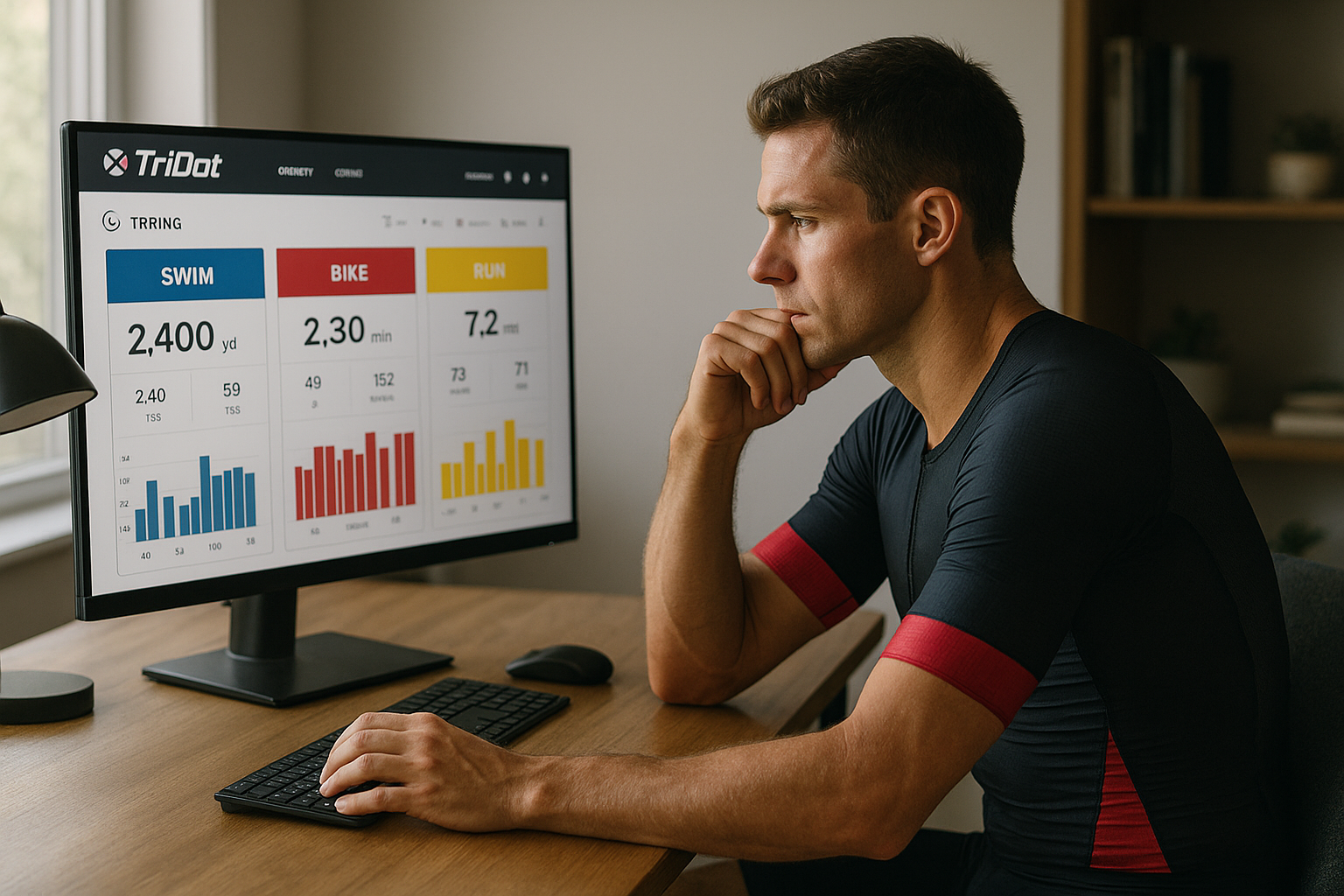
T2 might be a bloodbath, but at least it's a fair one. Every athlete in that transition zone is dealing with the same cooked legs, the same fumbling fingers, the same desperate search for their run hat. What's not the same anymore is how they got to race day — because a growing number of triathletes are showing up to the start line trained not by a human coach, but by an algorithm. And honestly? Some of them are getting faster.
AI coaching platforms have exploded in 2026. TriDot, Athletica, Humango, AI Endurance — the choices are dizzying, the marketing is breathless, and your human coach is quietly side-eyeing every sponsored post. But underneath the Silicon Valley sheen, there are real questions worth asking: Do these platforms actually make you faster? Are they worth the subscription fee? And is there anything a machine genuinely can't do that a human coach can? We went deep on all of it.
Why AI Coaching Is Having Its Moment
Let's start with the obvious: hiring a quality human triathlon coach costs real money. We're talking $150–$400 per month for anyone worth their salt, often with waitlists. AI platforms, by contrast, run $20–$50/month and are available at 11pm when you're plotting your next training block instead of sleeping like a sensible person.
But cost alone doesn't explain the surge. The more compelling reason is that AI coaching platforms have gotten genuinely, impressively good at the thing humans find most tedious: data processing. Modern AI training tools ingest your Garmin data, your HRV readings, your sleep scores, your completed workouts, your missed sessions, and your rate of perceived exertion — and they use all of it to adjust your plan in real time. If you came home from work destroyed on Tuesday and skipped your tempo run, the platform knows, and it adjusts. If you crushed your FTP test by 15 watts, it knows that too.
No human coach is staring at your wearable data at 2am. The algorithm is.
The Contenders: A Breakdown of the Big Platforms
TriDot: The Race Prediction Specialist
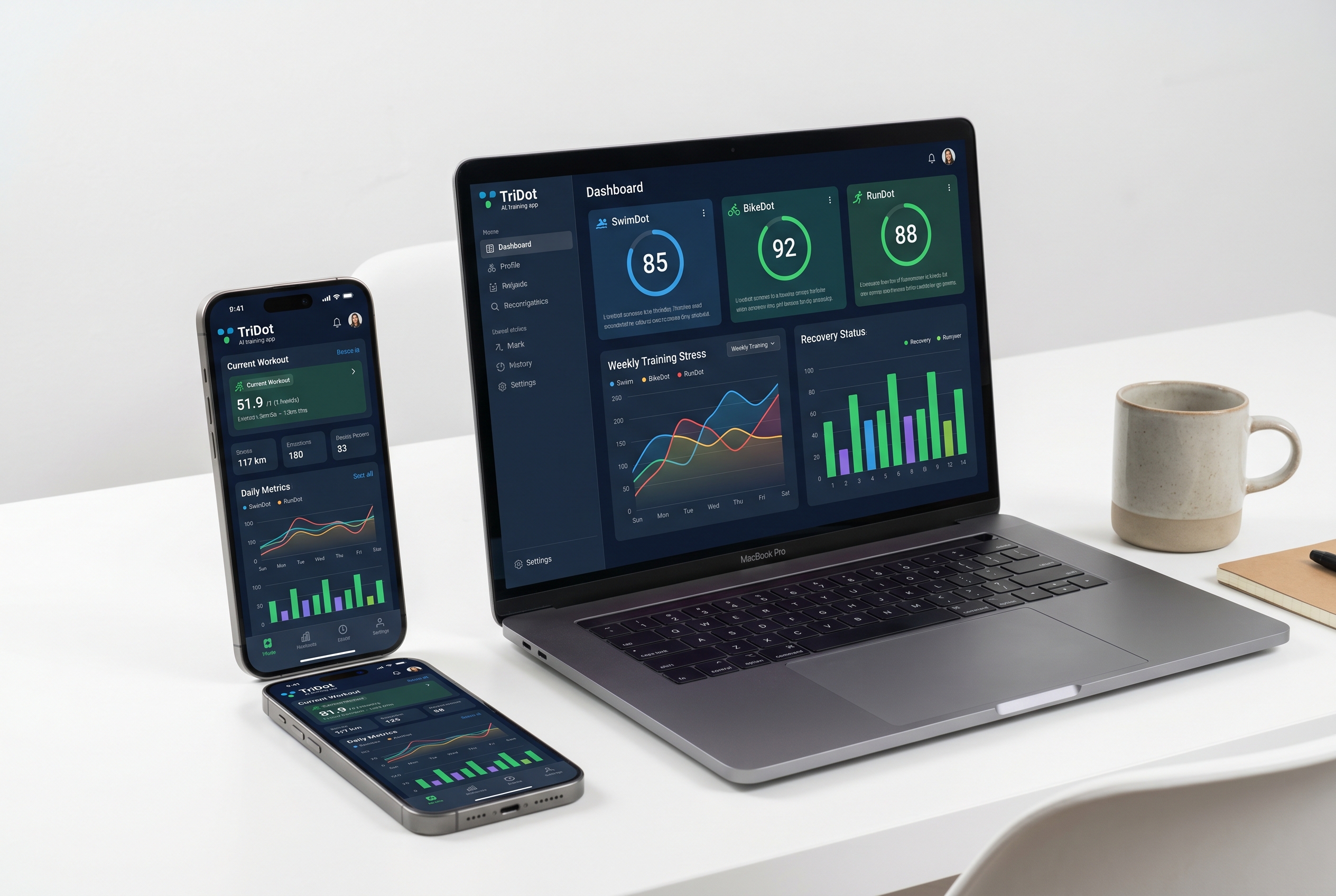
TriDot built its reputation on one thing: scarily accurate race time predictions. Feed it your training history and it will tell you — often within a few minutes — what you'll finish in at your target race. For data nerds who want receipts, this is catnip.
Beyond predictions, TriDot's philosophy centers on what it calls the "minimum effective dose" — essentially, how little training can you do and still hit your goal? For athletes juggling careers, families, and the rest of the chaos that is adult life, this is genuinely appealing. The platform adapts daily: miss a session, it adjusts. Crush one, it pushes harder. It integrates deeply with Garmin devices and even offers an optional Physiogenomix™ feature that tailors your plan to your actual genetic profile — including aerobic potential, recovery rate, and injury predisposition.
The downsides are real. TriDot is not cheap (highest subscription cost in the market). The interface is dense and terminology-heavy, which can be overwhelming for newer athletes. Some users find swimming sessions overly complicated, and a few report the running volume feels low for those chasing strong run legs off the bike. If you're not a Garmin user, you'll also feel the friction.
Best for: Data-driven athletes who want precision, accurate race predictions, and efficient time-in-training.
Athletica: Academic Rigor Meets Real-World Training
Athletica was founded by exercise physiologists and is built on peer-reviewed research. If TriDot is the Wall Street quant of triathlon coaching, Athletica is the sports science PhD who's also done a few Ironmans and actually understands what happens when your glycogen hits zero at mile 18.
The platform excels at periodization — structuring your training phases to build fitness systematically without digging yourself into a fatigue hole. It considers your entire training history, not just recent sessions, which helps it avoid the boom-and-bust patterns that plague a lot of self-coached athletes. During interval sessions, it adjusts your target power or pace in real time based on how you're actually performing — so if you're fading on rep four of six, the AI knows and recalibrates the target, ensuring you hit the intended training stimulus without overcooking yourself.
Where Athletica sometimes draws criticism is its conservatism. The AI errs hard on the side of caution, which is genuinely valuable for longevity but can feel frustrating if you're used to high-volume training and want to hammer. The platform also needs quality input data — particularly HRV readings — to work optimally. Feed it garbage data and it will make garbage decisions, just very confidently.
Best for: Athletes who want science-backed training, injury prevention as a priority, and are willing to invest in good HRV monitoring.
Humango: The Budget-Friendly Contender
Humango delivers genuine AI coaching intelligence at a significantly lower price point. It learns from your session feedback — rate a workout "too easy" and it immediately recalibrates. It's not as deep in its data analysis as TriDot or Athletica, but for athletes who want adaptive training without the premium price tag, it's a serious option that shouldn't be dismissed.
What AI Does Genuinely Well
- Real-time plan adaptation: No human coach is adjusting your Thursday workout based on Wednesday's HRV score at 5am. AI does this automatically.
- Unbiased data processing: The algorithm doesn't care that you had a bad week. It reads the numbers and responds accordingly, without emotional noise.
- Availability: 11pm training questions, 6am workout confirmation, race-week anxiety spirals — the platform is always there.
- Cost and accessibility: Quality structured training at $20–$50/month removes a significant barrier for athletes who can't afford private coaching.
- Volume management: AI platforms are particularly good at managing training load across a full season without overcooking the athlete — which is honestly where a lot of self-coached triathletes go wrong.
What AI Still Can't Do (And This Matters)
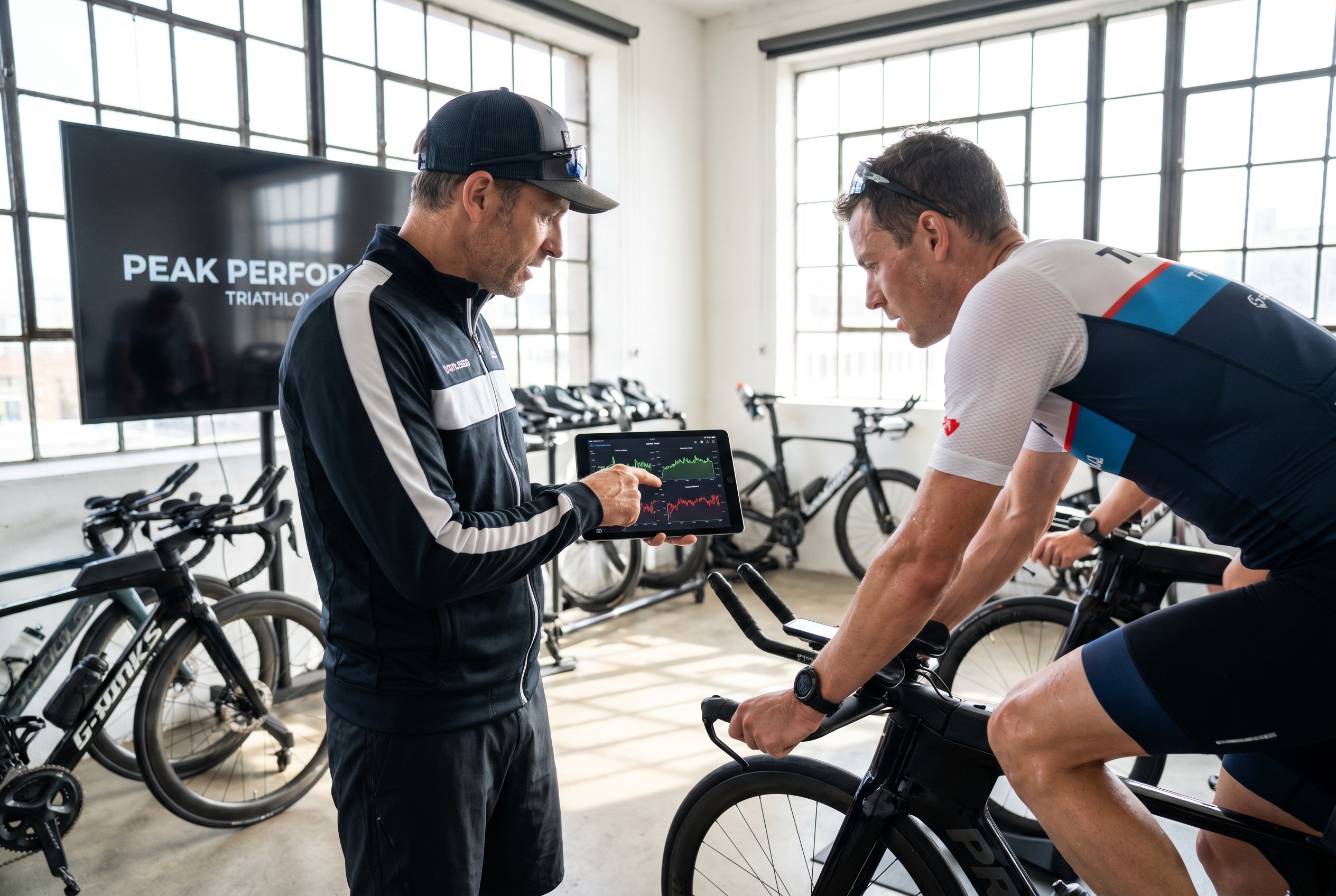
Here's where we pump the brakes on the hype, because this is important. AI coaching in 2026 is impressive, but it is not magic, and it is not a complete replacement for a thoughtful human coach. The gaps are specific and they matter.
Life Context and Judgment
A human coach knows that your training has been off because your mom is in the hospital, your marriage is going through a rough patch, and you're not sleeping. They adjust accordingly — not just the numbers, but the conversation. They tell you to ease off not because the data says so, but because they know you as a person and they can see what's actually happening. An AI sees elevated resting heart rate and lower HRV. A good human coach sees a human being having a hard time.
Technical Feedback on Form
No AI platform can watch your swim stroke and tell you that your left hand is entering crossed over your centerline and killing your pull efficiency. No algorithm can observe your run gait and identify that your heel striking pattern is loading your IT band in a way that's going to end badly in six weeks. Human coaches — especially experienced ones — catch things in real life that no sensor can currently capture.
Race Day Strategy and Adaptability
Race day is chaotic. The swim is rough, the wind is unpredictable, your nutrition plan fell apart at mile 40, and you're trying to decide whether to push or hold on the final bike climb. A human coach who knows your race history, your mental patterns, your tendency to blow up when you're excited — that experience is still worth something. AI gives you a pacing plan. A human gives you a framework for when the plan falls apart.
Psychological Support and Accountability
There's something about a real human knowing you skipped your long run on Saturday that creates a different kind of accountability than an app notification. Human coaches build relationships. They push you, believe in you, and occasionally tell you hard truths that an algorithm would never deliver. The emotional dimension of coaching is not a soft extra — for many athletes, it's the whole game.
"AI is something to consult and learn from, not follow blindly. It's a powerful assistant coach — but the bigger picture still needs a human to put it together." — Lionel Sanders, professional triathlete
The Hybrid Model: Where This Is All Heading
The most interesting development in 2026 isn't AI versus human coaching — it's the emergence of the hybrid model, and the data suggests this is where the performance ceiling actually sits. In this approach, an AI platform handles the data-intensive grind: tracking metrics, adjusting training loads, flagging recovery needs, and optimizing weekly periodization. The human coach operates at a higher level: strategy, psychology, technical feedback, life context, and the kind of relationship that actually sustains an athlete through a multi-year development arc.
Think of it like this: the AI is the world's most diligent training assistant, available 24/7, never in a bad mood, immune to confirmation bias. The human coach is the experienced athlete whisperer who synthesizes all that data into something meaningful and adapts it to the actual human being in front of them. Together, they're formidable. Separately, each has real limitations.
Several elite age-group and professional athletes are now operating this way — using TriDot or Athletica to manage day-to-day training load while working with a human coach on form, race strategy, and mental preparation. The cost is higher than either option alone, but for athletes serious about their performance ceiling, the combination appears to be the current best practice.
So — Should You Switch to AI Coaching?
Here's the honest answer, stripped of both hype and fear: it depends on what you're missing.
If you're self-coached and winging your training based on whatever plan you found on Reddit three years ago, an AI platform will almost certainly make you faster. The structure, the adaptation, the data-driven load management — all of it is better than most athletes' current approach. TriDot or Athletica will give you a legitimate, periodized training program that responds to your actual fitness. At $30/month, that's an extraordinary value.
If you already have a good human coach who knows your history, understands your life, can watch your form, and has built a real coaching relationship with you — don't blow that up for a subscription app. The things that coach provides are real, valuable, and genuinely hard to replicate algorithmically. An AI tool might be a useful supplement; it's not a straight upgrade.
If you're somewhere in between — self-coached but curious, or working with a coach who mostly just sends you a plan and doesn't provide much real-time feedback — the hybrid model is worth serious consideration. Use the AI for daily structure and load management. Use a human for the work the algorithm can't do.
The Bottom Line
AI coaching platforms in 2026 are legitimately impressive. They are not gimmicks. They are not going away. They are making real athletes meaningfully faster, and they are doing it at a price point that democratizes quality training advice in a way the sport has never seen before. That is unambiguously good.
But they are tools. Sophisticated, data-rich, genuinely useful tools — that still cannot look you in the eye after a rough race and tell you exactly what you need to hear. Your human coach — if you have a great one — does something an algorithm still can't. Don't forget that while you're browsing subscription plans.
Now log your workout. The algorithm is waiting.


