
You spent $800 on a road bike. You signed up for a sprint tri on a whim. Now you're deep in a Reddit rabbit hole at midnight wondering if you just made a catastrophic financial mistake. You didn't. Breathe.
Yes, you can absolutely use your road bike for a triathlon. And not just "survive" a triathlon — you can actually race it, have a great time, and cross the finish line feeling like the athlete you're becoming. The road bike is not the barrier. Your willingness to suffer is.
That said, there are smart ways to set up your road bike for tri, and a few things you genuinely need to understand before race day. Let's break it all down — no fluff, no gear-shaming, just the facts.
The Short Answer: Road Bikes Are Perfectly Legal (and Common)
In non-drafting triathlon events — which is virtually every age-group race from sprint to Ironman — road bikes are explicitly allowed. There is no rule that says you need a time trial (TT) bike. You will see road bikes at every single race, from local sprint events all the way to Ironman. Nobody is going to pull you from the course for riding a Trek Domane.
In fact, in draft-legal formats (common in elite-level short-course racing and some youth events), road bikes with standard drop handlebars are often required — and clip-on aerobars are banned. So ironically, there are contexts where the road bike is the faster-legal choice.
For the vast majority of age-groupers reading this: race your road bike. It's legal, it's fine, and it's a completely legitimate choice.
What You're Actually Giving Up vs. a TT Bike
Here's where we get real. A TT (time trial) bike is purpose-built for one thing: going fast in a straight line with no drafting. It achieves this through two main advantages:
- Steeper seat tube angle (76–82°) — This shifts your hips forward, opening up the hip flexors so you can sustain a powerful output without torching the muscles you need for the run.
- Lower, more aggressive aero position — Integrated aerobars put you flat and tucked, dramatically reducing your frontal area and cutting drag.
The aerodynamic advantage is real. At 25 km/h (a typical age-group pace), you create significantly more drag than a pro at 45 km/h — and saving drag at slower speeds actually produces a larger time benefit. A proper TT position can save 5–12 minutes over a 40km bike leg depending on your fitness and the course.
But here's the catch: that advantage only exists if you can actually hold the position for the entire ride — and then run off the bike. Plenty of athletes on $10,000 tri bikes spend the last 30km sitting up because their hip flexors are screaming. If that's you, your aero position is costing you time, not saving it.
Your road bike, ridden well, is a perfectly competitive machine — especially for sprint and Olympic distances where the bike leg is shorter and position time is limited.
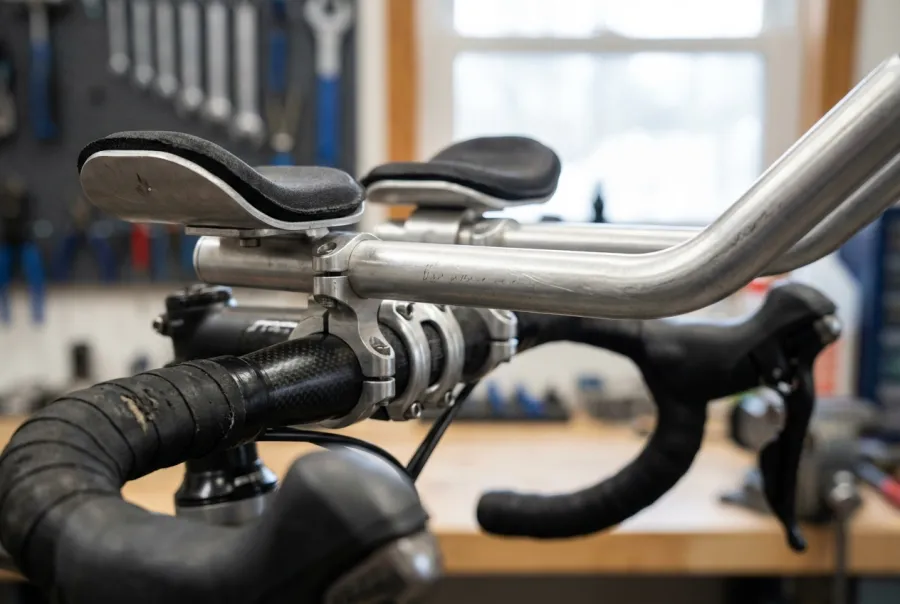
The One Upgrade That Actually Matters: Clip-On Aerobars
If you do one thing to your road bike before your triathlon, make it this: add clip-on aerobars. Also called "tri bars" or "aero extensions," these bolt onto your existing handlebar and give you a pair of padded elbow rests with forward-extending bars, allowing you to adopt a lower, more aerodynamic riding position.
The cost: $75–$150 for a solid pair. The impact: substantial. Here's what you need to know:
- Use short clip-ons, not full-length traditional aerobars. Road bike geometry has a longer reach than a TT bike, so long aerobars will put you in a grotesquely stretched position that will destroy your back and neck over a long ride.
- Get a basic fit check after installation. Even 15 minutes with a knowledgeable fitter or experienced triathlete will tell you if your position is workable or a recipe for injury.
- Practice before race day. Riding in aero on a trainer or quiet road is very different from riding in aero while fatigued, handling water bottles, or navigating a turn. Do not try this for the first time on race morning.
- Check the rules. Most non-drafting amateur races allow aerobars. Some sprint and Olympic-distance events that run in draft-legal format do not. Read the race guide.
"The best aero position is the one you can hold for the entire ride and still run a decent split off the bike. Aerobars on a road bike, set up properly, can get you 80% of the way there for 10% of the cost of a TT bike."
Road Bike Setup Tips for Triathlon
Beyond aerobars, a few other adjustments can make your road bike more tri-friendly:
- Saddle position: If you're adding aerobars, consider sliding your saddle forward a centimeter or two to partially mimic the steeper effective seat angle of a TT bike. This helps with hip angle in aero. Don't overdo it — a proper fit is the right answer here.
- Hydration: A behind-the-saddle bottle cage or a between-the-aerobars bottle holder keeps you fueled without breaking your aero position every time you reach for a drink. On road bikes, BTA (behind-the-aerobars) mounting can be tricky — a simple saddle-mount system works well.
- Tires: If you're still on knobbies or heavy training tires, swap to a decent road tire. 25mm clinchers at proper inflation (80–90 PSI) roll faster and are more puncture-resistant than you might think.
- Gearing: Road bikes typically have more gear range than TT bikes, which is actually an advantage on hilly courses. Don't fight the terrain — use your gears.
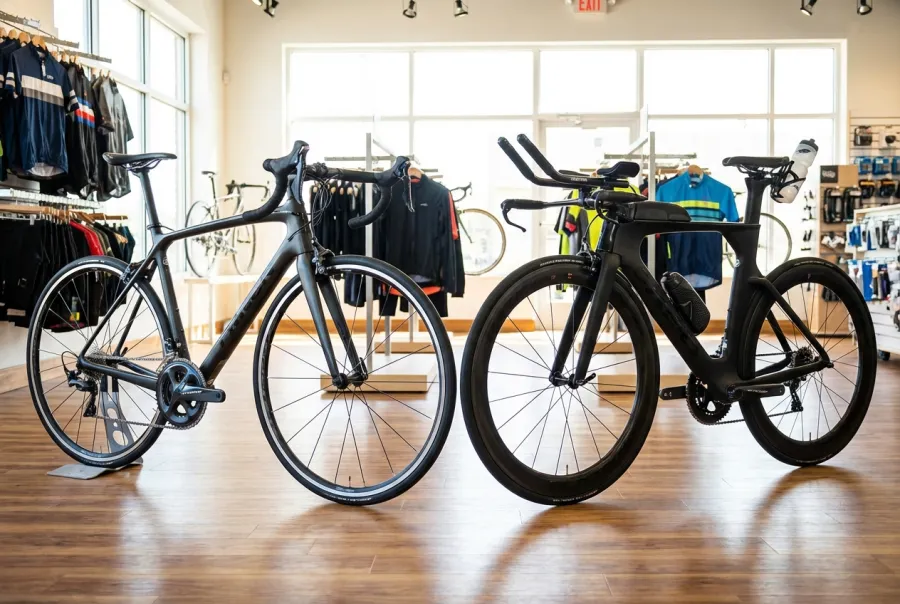
When Does It Make Sense to Upgrade to a TT Bike?
Honest answer: when you've done enough races to know you're serious, and when your fitness and position have maxed out what your road bike can offer. That's usually not your first triathlon. It might not even be your fifth.
Consider a TT bike when:
- You're racing predominantly non-drafting events at Olympic distance or longer
- You've dialed in your aero position on your road bike and want the next level of optimization
- You've gotten a proper bike fit and know your ideal geometry
- You have the budget for it without compromising your nutrition, coaching, or race entry fees
A used TT bike in good condition starts around $1,500–$2,500. A quality new entry-level tri bike runs $3,000–$5,000. This is not a panic purchase — it's a considered investment once you know the sport is yours.
Stop Worrying, Start Racing
The triathlon community is more welcoming than the gear obsession online might suggest. Nobody at the transition area is judging your bike. They're too busy worrying about their own race. What they will remember is how you carried yourself — how you pushed through the hard miles, how you ran when your legs were screaming, how you crossed that finish line.
Your road bike got you interested in this sport. Now let it get you to the start line. That is a worthy beginning.
The bike matters less than the engine. You are the engine. Now go build it.


