
You've signed up for a triathlon. Maybe it was a dare, a bucket-list impulse, or a casual "how hard can it be?" moment of temporary insanity at 11pm. However you got here — welcome. You are going to do this.
But right now you're probably sitting there with a gut full of anxiety, convinced you're not fit enough, not fast enough, and absolutely not experienced enough to show up at a start line with people who look like they've been training since the womb. Here's the truth: every single one of them started exactly where you are. The only difference is they went anyway.
This guide is not about peak performance or podium finishes. It's about getting you to the start line, through the swim, onto the bike, across the run, and past the finish line in one piece — preferably smiling. Let's do it.
First: What Actually Is a Sprint Triathlon?
If this is your first race, start with a sprint. A standard sprint triathlon looks like this:
- Swim: 750 meters (~0.5 miles) — typically in open water (lake, bay, ocean)
- Bike: 20 kilometers (~12.4 miles)
- Run: 5 kilometers (~3.1 miles)
Total finish time for a true beginner: 1:30–2:30 depending on fitness. That's it. It's not an Ironman. It's a completely achievable athletic challenge for someone in average health who has been training consistently for 8–12 weeks.
Some events run "super sprint" formats that are even shorter. If that's on the menu near you, it's a perfect first race. No shame in starting small — it's still a triathlon.
The 12-Week Couch-to-Sprint Framework
You don't need a coach, a training plan from a $200/month app, or a Garmin that costs more than your bike. You need consistency in three disciplines and enough weeks to build base fitness. Here's the skeleton:
Weeks 1–4: Learn to survive each discipline independently. Swim 2x/week (even if it's ugly). Bike 2x/week (20–40 minutes each). Run 2–3x/week (walk/run intervals are fine). Don't worry about speed. Just show up and finish the session.
Weeks 5–8: Start building duration. Swim sessions hit 400–600m straight. Bike rides push 45–60 minutes. Runs extend to 30–40 minutes without stopping. Add your first brick workout (bike immediately followed by run) in week 6 — even 15min bike + 10min run counts. The brick is crucial. Running off the bike feels like your legs have been replaced with wet sand. You need to know this before race day.
Weeks 9–11: Race-specific prep. Hit at least one 700m swim. Do two brick workouts. Practice transitions. Know your gear, know your nutrition, do a full rehearsal of race morning in your head (and ideally on paper).
Week 12: Taper. Cut volume by 40–50%. Sleep. Eat well. Don't try anything new. Your fitness is locked in — you're just letting your body recover to peak on race day.
The Swim: The Leg That Scares Everyone (And Shouldn't)
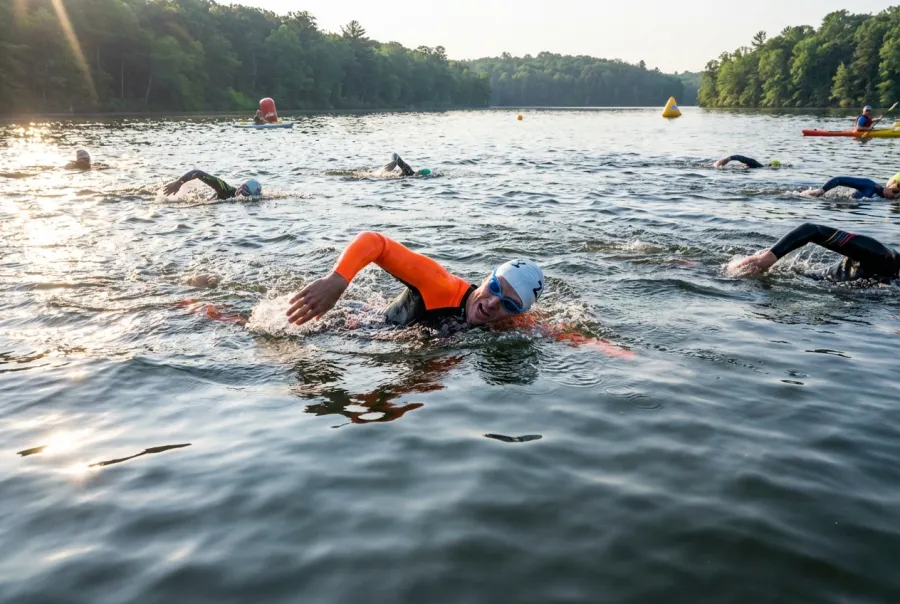
Let's address the thing keeping you up at night. The swim is almost always the shortest leg of a sprint triathlon — usually 12–25 minutes — yet it's the number one source of pre-race terror for first-timers. Here's why you're going to be fine:
You are not going to drown. Every race has kayakers, lifeguards, and safety boats stationed throughout the swim course. You are allowed to stop and rest on a kayak. You are allowed to roll onto your back and float. You are allowed to switch to breaststroke, sidestroke, or whatever keeps you moving forward. The only disqualification is grabbing the kayak for forward propulsion — floating on it to catch your breath is perfectly legal.
Wear a wetsuit if the water temperature allows it. Wetsuits are buoyant. They will hold you up. An athlete who would struggle in a pool will float like a cork in a wetsuit. Check your race's water temperature rules — most races allow wetsuits under 78°F (25.6°C), and many require them below 60°F (15.6°C). Rent one for your first race if you don't want to buy.
Seed yourself at the back or side of the wave. The washing machine chaos of a mass swim start is real. If you start at the front, you will be swum over by people faster than you. Start at the back or far outside, let the pack thin out, then settle into your rhythm. It's quieter back there. You'll thank yourself.
Sighting matters more than speed. Every 6–8 strokes, lift your head and find the next buoy. Open water has no lane lines and no black stripe to follow. Athletes who don't sight regularly swim 900 meters instead of 750. Pick a buoy, aim at it, swim, sight, repeat.
Expect to swallow some water, breathe some panic, feel some chaos. This is normal. Your heart rate will spike at the start. Your breathing will feel out of control for the first 50–100 meters. This is not an emergency. Keep moving. It will settle. Every experienced triathlete knows this feeling. You breathe through it — literally.
Transition: The "Fourth Discipline" Nobody Warns You About
Transition (T1 = swim-to-bike, T2 = bike-to-run) is often called the fourth discipline of triathlon, and for good reason: a slow transition can cost you more time than a slow swim. More importantly, a chaotic or confused transition can turn an otherwise good race day into a nightmare.
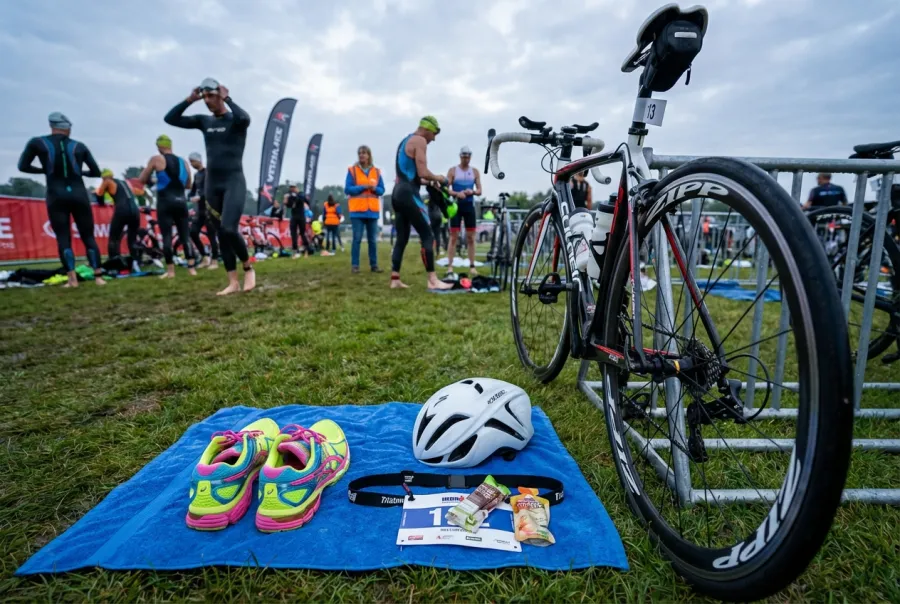
Walk through your transition setup the night before in your living room. Literally. Lay out your gear in the order you need it, put on your wetsuit, "swim" across your floor, and practice removing it, putting on your helmet, clipping your shoes, and running to your imaginary bike. It sounds ridiculous. It works.
Your T1 checklist (swim → bike):
- Run out of water to transition area (jog, don't sprint)
- Pull wetsuit top down to waist as you run
- Rack your bike spot memorized — count racks from the entrance
- Sit if needed, remove wetsuit fully
- Helmet on and buckled before you touch the bike (mandatory rule)
- Sunglasses on (optional but smart)
- Shoes on (or clip into already-mounted bike shoes)
- Grab bike at seat, walk to mount line, then ride
Your T2 checklist (bike → run):
- Unclip shoes before dismount line if using clip-in pedals
- Walk/jog bike to rack
- Helmet off after racking bike
- Race belt on (number facing front for the run)
- Running shoes on
- Go
One more thing: know where transition exits are. T1 exit (to bike course) and T2 exit (to run course) are often different gates. Walk the transition area at registration the day before and physically walk the route from swim exit → your rack → bike mount line → bike dismount line → your rack → run exit. This 10-minute walk will save you 3 minutes on race day.
The Bike: Pace Like You Have a Run Coming (Because You Do)
The bike leg will feel easy. Dangerously easy. Your legs will feel fresh coming off the swim (relatively), the road will be smooth, your speed will feel exhilarating, and every instinct will tell you to push harder. Do not listen.
The most common mistake among first-time triathletes is blowing up on the bike and arriving at T2 with legs that simply refuse to run. The bike is where races are won, but it's also where first-timers go to die — not by going too slow, but by going too hard.
For your first sprint, aim for a perceived effort of about 6–7 out of 10. You should be able to speak in short sentences. Your legs should feel like they're working but not maxed out. You're banking energy for the run.
On bike gear for beginners: use whatever bike you have. Road bike, hybrid, mountain bike (yes, seriously — for a sprint, it's fine). If you have clip-in pedals, practice getting in and out of them before race day. Crashing at the mount line because you forgot to clip out is a time-honored triathlon tradition that nobody wants to repeat.
Hydrate on the bike. For a sprint distance, you probably need one 500–750ml bottle. Drink before you're thirsty, because by the time you feel thirsty in a race, you're already behind. If the course has aid stations with water on the bike, use them even if you brought your own.
The Run: Where Beginners Either Survive or Crater
You step off your bike and your legs will feel like someone replaced your bones with overcooked noodles. Your brain says run; your legs send back a very different message. This is called "brick legs" and it is 100% normal, 100% temporary, and 100% going to happen to everyone around you too.
The fix: brick workouts in training (bike → run, even just 10 minutes of running) teach your body to convert from cycling muscle recruitment to running recruitment. Do at least two before race day and brick legs will feel manageable.
The 5km run in a sprint is your victory lap. After 45–90 minutes of racing, you have 5 kilometers standing between you and the finish line. Walk if you need to. Run when you can. Mix it if necessary. The goal is forward motion.
One pacing tip: start the run slower than feels right. The adrenaline of transition makes the first 400m feel effortless. You'll pay for that with a wall at the 2km mark if you go out too hot. Settle into a rhythm, breathe, and tick off the kilometers.
Race Day Packing List (Don't Miss These)
Nothing derails a first triathlon like forgetting something essential. Pack the night before:
- ✅ Wetsuit (if required or allowed)
- ✅ Goggles (bring a backup pair)
- ✅ Swim cap (race will usually provide one)
- ✅ Tri suit or bike shorts + top
- ✅ Helmet (non-negotiable)
- ✅ Bike shoes or regular athletic shoes for pedals
- ✅ Running shoes
- ✅ Race belt with your bib number
- ✅ Sunglasses
- ✅ Sunscreen (apply before the wetsuit)
- ✅ Water bottles pre-filled on bike
- ✅ Nutrition (gel or chews if race is over 60min)
- ✅ Body Glide or anti-chafe balm (wetsuit neck, thighs)
- ✅ Timing chip (comes in race bag — strap to ankle)
- ✅ ID and race registration confirmation
One thing many first-timers forget: put your race number on your bike helmet if required by your race (some events require it, check your race guide). And attach your bib to your race belt before you get to transition — fidgeting with safety pins at 6am with cold hands is nobody's idea of a good start.
The Morning Of: What to Do (and What Not to Do)
Wake up early. Earlier than you think. Transition setup takes longer than it looks on YouTube, parking is chaos at most race venues, and you want 20–30 minutes of calm before your wave starts — not 2 minutes of desperate sprinting.
Eat breakfast 2–3 hours before your start time. Something familiar, carb-based, not excessive. Oatmeal, toast, banana, bagel. Not the massive pancake stack you've been fantasizing about. Your stomach will thank you mid-swim.
Warm up lightly if time allows. A 5-10 minute easy jog, some arm circles, maybe a short swim warm-up if the venue offers one. Getting your heart rate up before the gun goes off takes the shock out of the swim start.
Talk to someone. Find another first-timer, a volunteer, anyone. Race morning nerves are infectious in the best possible way when shared. You're about to do something most people only think about. That deserves a moment of acknowledgment.
The Finish Line: What Nobody Tells You
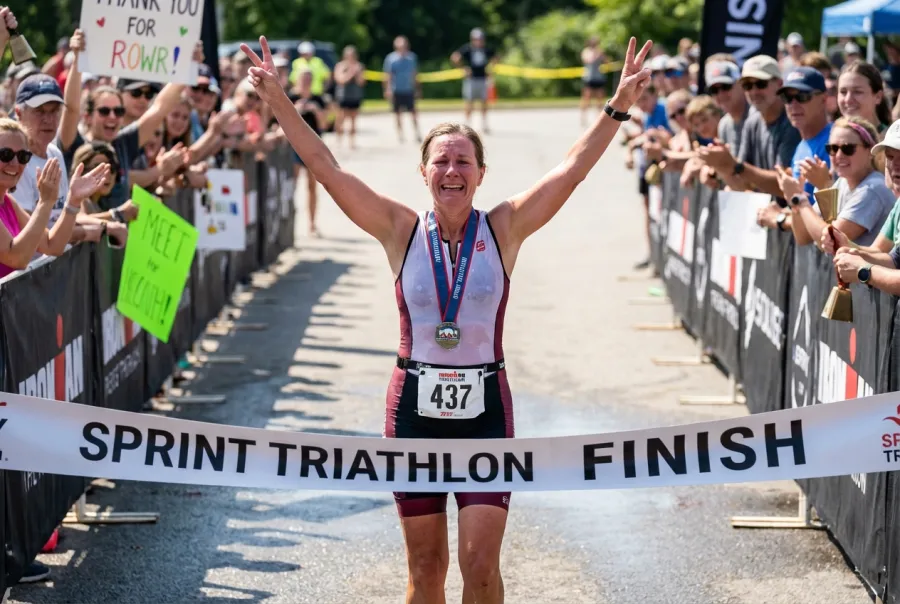
Here's what nobody warns first-timers about: the finish line will make you cry. Or laugh. Or both simultaneously. Not from pain — from relief, pride, and the overwhelming realization that you just did something you weren't sure you could do.
You will cross that line and immediately want to do another one. This is documented, universal, and inevitable. The "post-triathlon tax" is already signing up for the next race before your medal is cold. Budget accordingly.
But first: stop. Breathe. Look back at where you started — in terms of the course, and in terms of who you were 12 weeks ago on the couch. You are now a triathlete. Not a "beginner triathlete" or an "almost triathlete" or a "someday triathlete." A triathlete. Full stop.
The One Thing That Actually Matters
Every training plan, pacing strategy, transition tip, and gear recommendation in this guide is secondary to one thing: showing up.
The people who fail at their first triathlon aren't the ones who go too slow, forget Body Glide, or walk the entire run. They're the ones who talk themselves out of signing up, or sign up and talk themselves out of starting, or start training and stop at week 4 when life gets hard.
You've already done the hardest part by deciding to do this. Everything from here is just execution. Trust your training — even if it felt inadequate. Trust your body — even when it sends distress signals. And trust the process: thousands of people cross their first triathlon finish line every single weekend. You're next.
See you at the start line. You belong there.


