
10 Things Every Triathlete Wishes They Knew Before Their First Race (Told By People Who Learned the Hard Way): First Triathlon Tips That Actually Matter
So you signed up for a triathlon. Maybe it was a dare. Maybe you saw someone crossing a finish line and thought I could do that. Maybe you just needed something to aim at. Whatever the reason, you are now lying awake at 11pm staring at the ceiling, running through a mental list of all the ways this could go sideways, and wondering if it is too late to quietly un-register and pretend this never happened. These first triathlon tips are for you.
Here is the truth: the gap between a miserable, chaotic, what-have-I-done slog and the best day you have had in years is not fitness. It is information. The athletes who show up prepared — not just trained, but genuinely prepared — have a completely different race than the ones who winged it. They smile through the hard parts. They know what to expect. They finish with something to prove and a story to tell. The ones who didn’t do their homework spend the whole run leg wondering why their legs feel like someone replaced them with wet cement, and whether the chafing on their neck is going to require a medical tent visit.
This article is the briefing you deserved when you hit that register button. Ten things. All real. All sourced from people who learned them the hard way so you don’t have to. Read it. Take notes. Sleep better tonight.
1. First Triathlon Tips Start Here: Bodyglide Is Not Optional
Let us start with the most unglamorous entry on this list, because it will ruin your day faster than any training gap will. Chafing in a triathlon is not like the mild irritation you might get on a long run. Triathlon chafing is a sustained, multi-hour assault on specific parts of your body that you will not stop thinking about until you are standing in the shower making sounds you would rather no one hear.
The wetsuit neck is ground zero. That rubber collar sits directly on your skin and moves with every stroke for anywhere from ten minutes to over an hour depending on your swim distance. Without anti-chafe balm applied liberally to your entire neck and the top of your collarbone before you zip up, you will finish the swim with a raw ring around your throat that looks and feels like a rope burn. Apply Bodyglide, Aquaphor, or petroleum jelly to the neck, the inside of your arms where the wetsuit seams make contact, and your inner thighs.
Men: your nipples. This is not a joke. Long bike and run legs with a damp tri suit rubbing against your chest is a recipe for visible bloodstains and pain that will make you walk the final mile not because your legs gave out but because every arm swing is agony. Bodyglide them. Or tape them. Both if you are doing an Olympic or longer. This is accepted triathlon knowledge and not a thing anyone finds weird.
The general rule: anywhere a seam meets skin, anywhere rubber meets skin, and anywhere fabric meets wet skin for longer than twenty minutes — apply something. Do it at home during your gear check the night before, then apply again at the race site. It takes three minutes and prevents hours of regret.
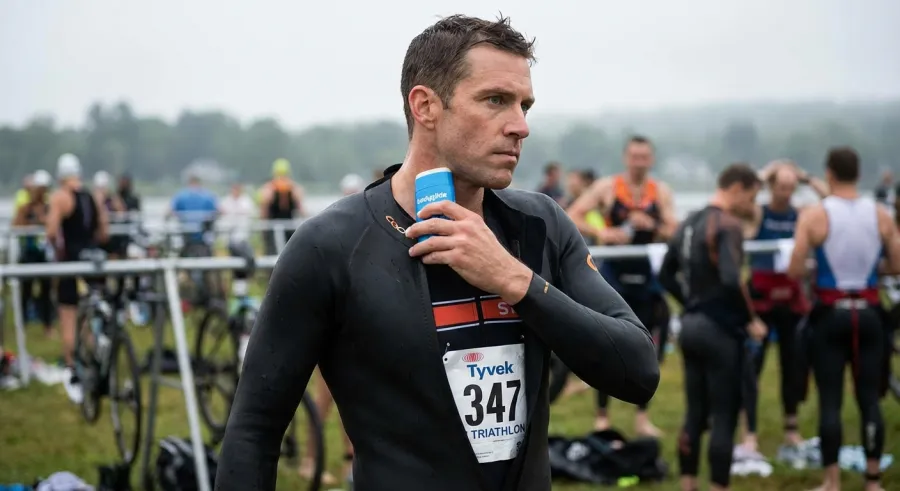
The athlete who skips this step and the athlete who follows it finish with the same time, but only one of them is smiling in the finisher photo.
2. Your First Open Water Swim in a Wetsuit Will Feel Like a Panic Attack, and That Is Completely Normal
You have swum in a pool. You know you can swim. You get in the water on race morning, put your face in, take your first stroke, and immediately feel like you cannot breathe. Your chest is tight. The water is dark. You cannot see your hands. Someone is swimming over your legs. This is not a medical emergency. This is Tuesday in triathlon.
Wetsuits compress your chest. A wetsuit that fits correctly — meaning snugly — will feel noticeably restrictive when you first put it on and get horizontal in the water. Your breathing pattern changes. Most athletes need three to five minutes to acclimate to this sensation, and if you jump straight into race pace, you will hyperventilate before you find your rhythm. The fix: get in the water before the start, swim easy for a few minutes, and let your body adjust. This alone eliminates most first-race swim panics.
Cold water shock is a separate but related phenomenon. Water below about 70 degrees Fahrenheit triggers an involuntary gasping reflex. Your body redirects blood away from your extremities. Your breathing becomes rapid and shallow. This passes within sixty to ninety seconds, but if you do not expect it, it feels like something is seriously wrong. Expect it. Breathe through it. It passes.
If you do find yourself overwhelmed mid-swim — and some first-timers do, and there is zero shame in it — do these things in order: roll onto your back, which immediately removes the compression of the water against your chest. Take three slow, deliberate breaths. Find the nearest safety kayak or paddleboard — there will be one close by — and rest a hand on it. You are allowed to hold onto a kayak without being disqualified. You just cannot be towed forward. Rest as long as you need, then keep swimming. Every safety officer at every triathlon has seen this a hundred times. No one is judging you. The only thing that disqualifies you is quitting.
The murky water is not trying to intimidate you. It just does not have a filter budget.
3. Practice Your Transitions Before Race Day. In Your Driveway. With a Timer.
Here is something no one tells you: transition is the fourth discipline. There is a reason experienced triathletes talk about T1 and T2 as seriously as they talk about swim splits and run pace. A chaotic transition does not just cost you time — it costs you mental energy, momentum, and occasionally your race number, which you left on the towel.
Mental rehearsal is not enough. You can picture yourself flowing smoothly from wetsuit to bike shoes to helmet a hundred times, and then on race day, under stress, with wet hands, your fingers fumbling at a buckle you have never actually fumbled at before, all of that mental preparation evaporates. Physical rehearsal is different. Muscle memory is built with repetition, not imagination.
Set up your transition area in your driveway or garage exactly as it will be on race day. Towel down, bike racked, helmet open, shoes positioned. Run a fake swim by jogging up to your transition spot wet from a shower if you want the full experience. Practice removing your wetsuit — which takes longer than you think when your hands are cold and the rubber is clinging. Strap on your helmet. Clip your shoes. Walk your bike to the end of the driveway. Come back and do the T2 sequence: rack the bike, swap shoes, clip on your race belt, go. Run it ten times. Time it. Cut two seconds off each run. You are not training fitness; you are training a procedure, and procedures get faster with reps.
Race-day transition areas are loud, crowded, and disorienting in ways you cannot replicate at home. Knowing your sequence cold means you can execute it on autopilot while everything around you is chaos. That is the whole point.
The athlete who practiced T2 in their driveway ten times will beat the athlete with better fitness. This has been proven empirically at every sprint triathlon in recorded history.
4. Brick Workouts Are Not Optional and Your Legs Will Lie to You Leaving T2
A brick workout is any session where you bike and then immediately run. The name reportedly comes from the feeling in your legs when you do it for the first time: like running on bricks. That is accurate. The sensation is genuinely alarming — heavy, uncoordinated, and deeply unfamiliar — because cycling and running recruit your muscles differently, and the sudden switch causes a neurological and circulatory adjustment that your body needs to learn how to handle.
If you have never done a brick workout, your legs off the bike will feel like they belong to someone else. Your quads will be loaded and tight from the cycling position. Your running gait will be choppy. You will feel slower than you are and question whether something is wrong with you. Nothing is wrong with you. Your body is just recalibrating. But here is the thing: if you have done ten brick workouts in training, that feeling is familiar. You know it passes after two or three minutes. You run through it. If you have never experienced it before, you slow down, you panic slightly, and you lose two minutes figuring out what is happening.
Add one brick workout per week to your training plan starting four to six weeks before race day. They do not have to be long: thirty minutes on the bike followed by ten minutes of running is enough to train the adaptation. By race day, the transition from bike to run legs should feel uncomfortable but manageable — not like a physiological betrayal.
One specific tip from every experienced triathlete who has ever given advice at a finish-line pizza table: walk the first thirty seconds out of T2. Not jog. Walk. Let your legs reset. Shake them out. It feels wrong to walk when you are racing, but athletes who sprint out of T2 on jelly legs often spend the next mile paying for it. Thirty seconds of walking costs you nothing. Blowing up at mile two costs you everything.
Your legs off the bike are not broken. They are just recalibrating. Give them thirty seconds and do not make any decisions about your race during that window.
5. The Race Expo Is a Trap
Every triathlon comes with a pre-race expo. Vendors, gear, nutrition samples, the latest in aerodynamic sock technology. It is exciting. Everything looks useful. You have been training for months and you are dialed in and ready and then you walk past a booth selling goggles and think, you know, mine have been fogging a little lately.
Do not buy the goggles. Do not buy anything you are going to use tomorrow that you have not used before. This is the single most violated rule in beginner triathlon and also the one with the most reliable consequences. New goggles that fog. New nutrition gels that disagree with your stomach at mile three of the bike. New bike shorts that chafe in ways your old ones never did. New running shoes that felt incredible in the parking lot and feel like medieval devices by mile one of the run. The expo is full of people who learned this lesson so recently it still stings.
Nothing new on race day is not a suggestion. It is a law of physics. Your body has been trained on specific gear, specific nutrition, specific everything. Race day is not the day to introduce variables. The expo is for looking, learning, and maybe picking up a post-race souvenir. Browse freely. Buy after the race.
The athlete who bought new goggles at the expo and discovered they leaked on the swim start is a story told at every finish-line pizza table in the country. Don’t be the story.
Expo goggles have a gravitational pull that defies reason. Acknowledge it. Resist it. Walk away.
6. Know the USAT Rules Before You Get There
USA Triathlon sanctions most races in the United States, and their rulebook is not optional background reading — it is the difference between finishing and getting a penalty card. The rules exist for safety and fairness, and officials enforce them. Ignorance is not a defense. "I didn’t know" is the thing every penalized athlete says right before they sit in the penalty box for four minutes.
The most commonly violated rules by first-timers, in rough order of frequency:
Helmet on before touching the bike. Your helmet must be buckled before you unrack your bike in T1, and it must stay on until after you rack your bike in T2. Not before you mount. Before you touch it. Many beginners put the helmet on but don’t buckle it until they’re at the mount line. That’s a violation. Strap first, then unrack.
No headphones. USAT prohibits wearing or carrying headphones, earbuds, or personal audio devices during the race. This includes bone conduction headphones. If an official sees them in your ears, you get a penalty. Train without them for at least your long sessions so race day doesn’t feel strange.
Drafting on the bike. Most age-group races are non-draft legal, meaning you must maintain at least three bike lengths (roughly ten meters) between your front wheel and the rear wheel of the cyclist ahead of you. If you enter their draft zone, you have fifteen to twenty seconds to complete the pass. If you don’t, you’re drafting. Penalties are two minutes for Olympic distance and one minute for sprint.
Passing on the left only. You must pass on the left. Passing on the right is a violation. This also means you should ride to the right side of the lane unless actively passing.
Nudity in transition. You must be covered while in the transition area. Changing clothes is fine, but flashing the field while doing so is a penalty. A tri suit solves this entirely — swim, bike, and run in one garment, no changes required.
The rulebook is sixteen pages. Read it once. Your four-minute penalty box time could have been a PR.
7. Nutrition Starts Earlier Than You Think, and the Bonk Is Not a Metaphor
Triathlon nutrition is one of those topics that sounds optional until the moment it isn’t. The bonk — hitting the wall, glycogen depletion, whatever you want to call it — is not a metaphor for feeling tired. It is a physiological event. Your blood sugar crashes, your muscles run out of available fuel, your pace drops off a cliff, and your mental clarity goes with it. Glycogen depletion shows up as a sudden, irreversible collapse: you are moving fine, and then you are not, and there is no fixing it in the moment. You can only eat your way out of it slowly while everyone passes you.
The basic fueling timeline: for a sprint triathlon (typically 45 minutes to 90 minutes total), most athletes can get through on pre-race nutrition and bike fluids alone — but that assumes you ate a proper breakfast and started drinking early on the bike. For an Olympic distance race (two to three hours), you need to be eating and drinking on the bike from the first fifteen minutes, not when you feel hungry. By the time hunger signals arrive, you are already behind.
The common beginner mistake is waiting to feel hungry before eating, which in a race context means you are waiting until you are already depleted. Eat a gel or chew every thirty to forty minutes on the bike regardless of how you feel. Drink to thirst but have a minimum floor: at least one bottle per hour, more in heat. If your race has an aid station on the run, take something from it even if you feel fine. The run is where undercooked nutrition catches you.
Practice your race-day nutrition in training. Every gel, chew, or drink you plan to use on race day should have been used on a long training ride first. Discover which brands agree with your stomach on a Tuesday. Not at mile eight of the bike leg with fourteen miles still to go.
The bonk will introduce itself exactly once. After that, you will be religious about eating on the bike for the rest of your triathlon career.
8. Triathlon Is Expensive and There Is a Gear Treadmill Waiting for You
Let’s be honest about what this costs, because “just one sprint tri” is a financial trajectory, not a single transaction. Here is an honest accounting of what race one typically runs:
Race registration: $80–$150 for a sprint, more for Olympic. USAT one-day license: $13–$18 on top of that. Wetsuit: $200–$400 for a beginner-level option (rental is available for around $50 if you want to test the waters, figuratively and literally). Helmet: $50–$150 for a road helmet that meets CPSC standards. Bike shoes and pedals: $100–$300 combined, though many beginners do race one in running shoes. Goggles: $20–$40. Tri suit: $50–$130. Race belt: $10–$20. GPS watch: $200–$400 if you don’t already have one.
That is a realistic first-race total of $800 to $1,500 before you account for training costs, travel, or the bike itself — which can range from the road bike you already own to an entry-level triathlon-specific setup starting around $2,300. For race one, the bike you have is the bike you use. Do not buy a triathlon bike for your first sprint tri.
Here is the warning delivered with full affection: “just one sprint” tends to become three races by fall, a new saddle by winter, a bike fit by January, and a detailed spreadsheet of carbon wheel options by March. The gear treadmill in triathlon is real, it is fast, and it is waiting for you at the finish line with a brochure. Carbon wheels are somewhere around year two. You have been warned. You will ignore this warning. That is also fine.
For race one, keep it simple. Borrow what you can. Buy the consumables and the safety-required items. Everything else can wait until you know you are coming back for more.
The carbon wheel rabbit hole has a very wide entrance and no visible bottom. Just so you know where you are headed.
9. The Community at the Finish Line Is Unlike Anything in Most Other Sports
Triathlon has a reputation for being an individual, somewhat solitary sport. That reputation evaporates entirely on race day. What you will find at any triathlon — from a local sprint to a full Ironman — is one of the most genuinely supportive athletic environments you will ever stand in.
Age-groupers cheer for each other. Not performatively — actually, loudly, sincerely. The fifty-year-old who just finished will stand at the run-in and shout encouragement at complete strangers for an hour. The volunteers have usually done the race themselves and know exactly what you are going through. The athlete who finishes last — which someone always does — gets the loudest crowd of the day, because everyone who has finished is still there waiting and they all know what that last mile feels like.
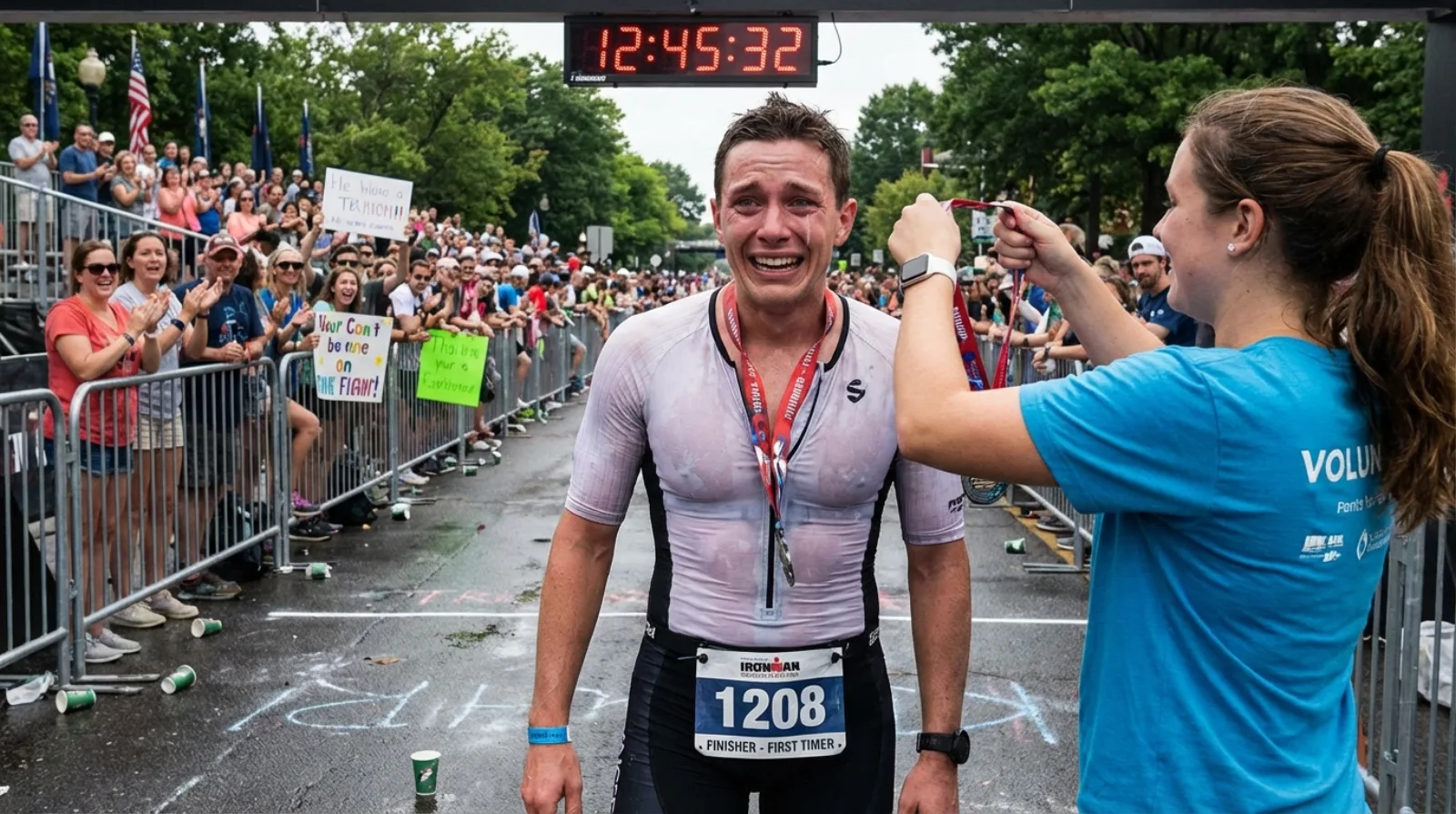
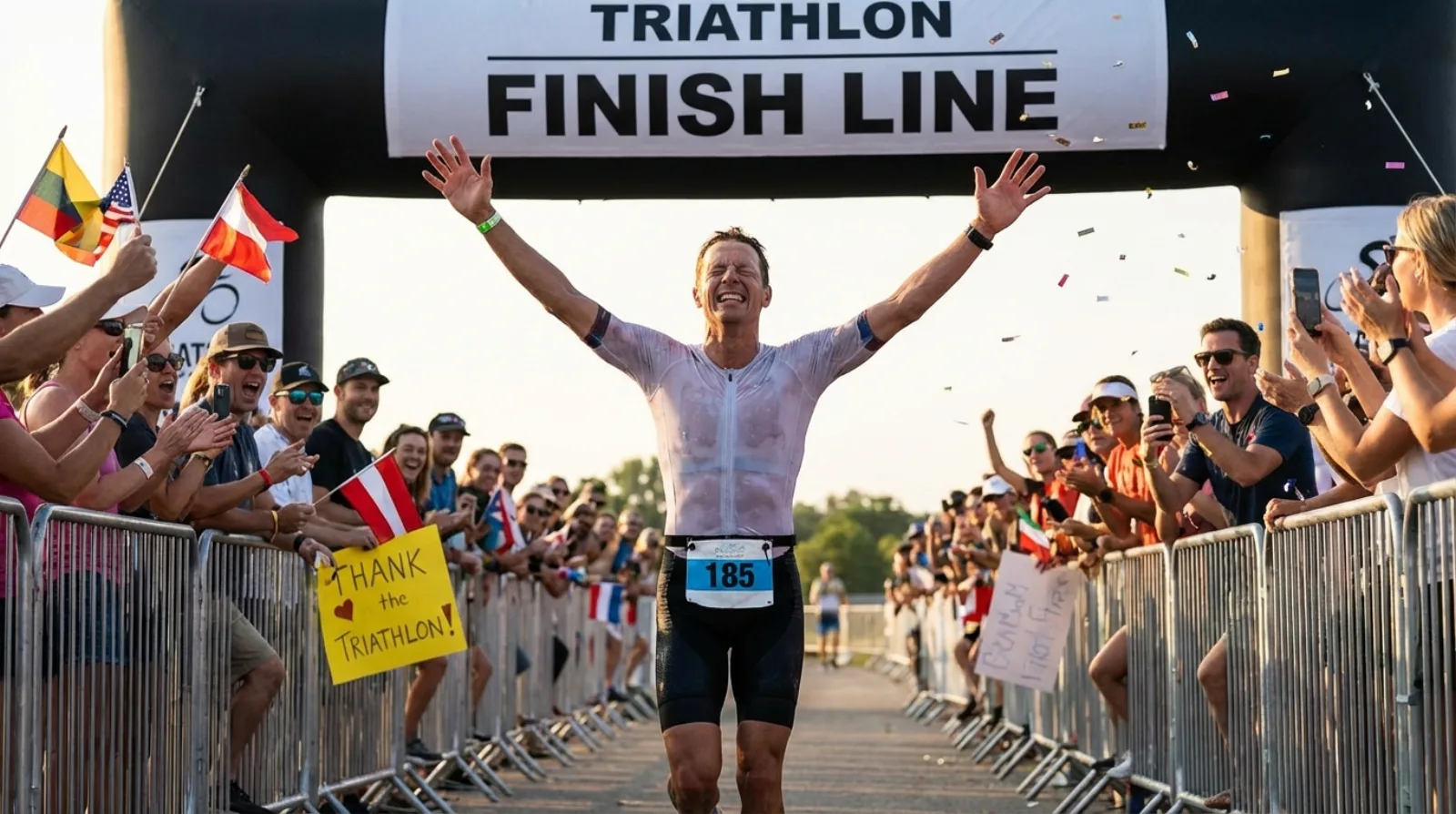
Something specific happens at a triathlon finish line that is hard to describe to someone who hasn’t stood there. You have swum, you have ridden, you have run, and you are about to cross a line that was abstract for months and is now thirty feet in front of you. The crowd noise changes. The announcer says your name. And something shifts in your chest that is not quite pride and not quite relief and not quite joy but is all three of them at once, hitting simultaneously, and it surprises you even though you knew it was coming.
That moment is real. It is not a cliché. It does not diminish with repetition — ask any ten-year triathlon veteran if they still feel it at every finish line and watch their face.
You will stand at that finish line and cheer for people you have never met, and it will feel completely natural. This is what the sport does to people.
10. You Will Sign Up for Another One Before the Finish Line Medal Is Around Your Neck
This is both a warning and a celebration. Every year, thousands of athletes enter their first triathlon saying “I just want to finish” and exit the finish chute reaching for their phone to find the next race. It happens before the adrenaline fades, before the soreness sets in, before the chips and chocolate milk at the finish tent are gone. It is the most predictable thing in the sport.
You will probably want to go longer. Sprints become Olympics. Olympics become half-Ironmans. There is a specific madness that develops somewhere between the swim exit and the run finish that makes each previous distance feel like it was just preparation for the next one. This is normal. This is triathlon.
Go ahead and let it happen. But let race one be race one first. Do not spend your first finish-line moment already planning your next race so hard that you forget to feel this one. Stand there. Look around. Take stock of what you just did. You swam in open water, you rode a bike hard, and you ran when your legs were already spent. You did all three without stopping. Whatever your time was, whatever went wrong, whatever you would do differently: you finished a triathlon. That is yours.
The second race is already loading. Let yourself finish the first one before you hit start.
Go Do the Thing
Here is your final briefing. Apply the Bodyglide the night before. Practice your transitions this week in the driveway until they are automatic. Do at least two more brick workouts before race day. Eat something on the bike from the first fifteen minutes and do not wait to feel hungry. Know the helmet rule cold. Leave the expo without buying anything new. And when the swim starts and your chest tightens, roll on your back, take a breath, and remember that every person in the water next to you felt exactly this way their first time.
The training is mostly done. The fitness is there. What separates a great race from a chaotic one now is preparation, and you just got a semester’s worth of it in fifteen minutes of reading. You are more ready than you feel. You are always more ready than you feel.
Go race it. Your first finish line is waiting. Make the preparation count. Your future self will thank you at mile one of the run when the legs come back and you realize you actually know what you are doing.


