
The Open Water Swim Is Lying to You: How to Silence the Triathlon Open Water Swim Fear and Actually Race
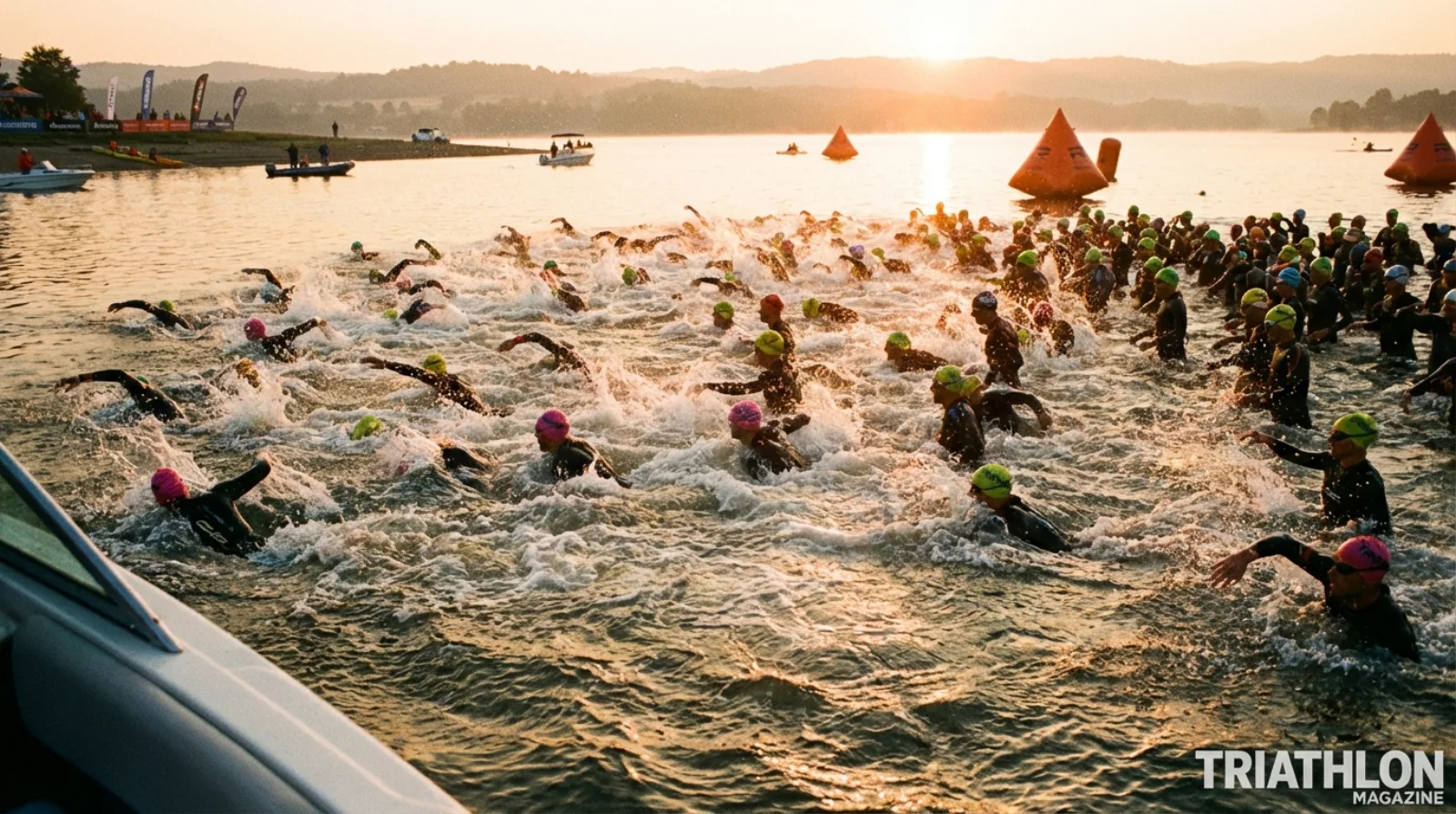
You are fifty meters in. The gun went off ninety seconds ago and already someone has elbowed you in the jaw, your goggles are half-flooded, and your wetsuit feels like it has decided to throttle you. The water is the color of old tea. You cannot see the bottom. You cannot see your hands. Your breathing, which was supposed to be rhythmic and controlled, has abandoned all pretense of rhythm and is now a series of panicked gasps that are bringing in about one part air to three parts lake water. Your heart rate is somewhere north of 180 and climbing. You had a plan for this swim. You trained for this swim. And right now your lizard brain is overriding every byte of that training and screaming one single word: out.
This is triathlon open water swim fear at its rawest. And if you have felt it, you are not weak, not unprepared, and not alone. Survey any group of triathletes and you will find that the swim produces more pre-race dread, more mid-race panic exits, and more post-race PTSD stories than the bike and run combined. People who can hold a 1:35/100m in the pool have abandoned races at 200m of open water. Experienced athletes with dozens of events under their belts have stopped mid-lake, rolled onto their backs, and been rescued by kayak. This happens to good swimmers. This happens to fast swimmers. The open water is a different environment and your nervous system has opinions about it.
This article is not a pep talk. It is not going to tell you to just relax and enjoy it. It is going to explain exactly what is happening to your body and brain when open water panic hits, help you identify your specific trigger, and give you a six-week protocol to systematically dismantle the fear before your next race. Let us get into it.
Why the Open Water Swim Actually IS Harder Than the Pool (And Why That Matters)
The first thing to understand is that your fear response in open water is not irrational. It is your nervous system doing exactly what it evolved to do, presented with stimuli it was never designed for. The pool is a controlled, familiar environment: marked lanes, clear water, walls to grab, a shallow end, lifeguards, no surprises. Open water is the opposite of all of that, and your body knows it from the moment you hit the surface.
The mammalian dive reflex fires the instant cold water touches your face. Your trigeminal nerve signals the vagus nerve, triggering bradycardia (slowed heart rate) and peripheral vasoconstriction (blood pulled from limbs to core). Simultaneously, your muscles demand elevated heart rate and blood flow for the effort of swimming. These two signals conflict directly, and the result is that war-in-the-chest sensation that feels like cardiac arrest even when your heart is perfectly healthy. Cold water shock compounds this: sudden immersion below roughly 70 degrees Fahrenheit triggers an involuntary gasp reflex, elevated blood pressure, and the beginning of hyperventilation. If you gasp mid-stroke, you inhale lake water. The panic spiral ignites.
Add a wetsuit to the mix and you have a third stressor. A properly fitting wetsuit is tight across the chest by design, but that compression restricts breathing depth and creates a sensation of constriction that your anxiety amplifies into suffocation. The collar pressing on carotid arteries can trigger the carotid sinus reflex, further influencing heart rate. None of this is dangerous on its own to a healthy person, but stacked together at a mass start at 6am in 65-degree water with two hundred people churning around you, it is a formidable physiological challenge.
Here is the sobering statistic that validates the seriousness of this leg: studies covering over nine million triathlon participants found that approximately two-thirds of all race-related sudden cardiac arrests and deaths occur during the swim. Of 135 cardiac events recorded between 1985 and 2016, 90 happened in the water. The swim is the shortest leg by time and by far the most dangerous by outcome. The primary causes appear to be undiagnosed cardiovascular disease triggered by the adrenaline and physiological stress of the mass start, but panic-induced arrhythmia and swimming-induced pulmonary edema are also implicated. This is not stated to frighten you further. It is stated because understanding the real risk helps you build a real response: your nervous system is not overreacting to nothing. It is responding to genuine challenge. The goal is to train it a smarter response, not silence it entirely.
Identify Your Specific Triathlon Open Water Swim Fear Trigger
Generic advice like "just get more comfortable in open water" is useless because open water swim fear is not one thing. It is a family of distinct triggers, each with its own mechanism and its own fix. Identify yours first.
Murky Water and Visibility Loss. You cannot see your hands at arm's length. Your goggles show nothing but dark green. This is primarily a psychological trigger: the brain interprets inability to see as inability to assess threat, which activates the threat response. The fix is deliberate exposure. In the pool, practice swimming with your eyes closed for 10-second intervals. Then 20. Then full laps. Get comfortable navigating without visual input. Your body knows how to swim. Your visual cortex does not need to supervise it.
Wetsuit Claustrophobia and Chest Compression. If your panic centers on the tight-wrapped feeling of the suit rather than the water itself, your fix starts at home. Wear your wetsuit around the house for 20-30 minutes. Wear it doing light exercise. Wear it in a warm pool and swim easy for 20 minutes. Progressive exposure to the compression sensation with zero other stressors lets your nervous system reclassify "tight suit" from threat to neutral. Also check the fit: a collar that sits too high on your neck is a legitimate mechanical problem, not just anxiety.
Cold Water Shock and Breathing Loss. The involuntary gasp and hyperventilation response to cold immersion is reflexive, not voluntary, which means you cannot think your way out of it in the moment. The only fix is pre-race acclimation. Get in the water 10-15 minutes before your wave start. Splash water on your face, neck, and wrists first. Submerge slowly. Bob and breathe for two minutes before you swim a stroke. Your body needs 90-120 seconds to begin thermal adjustment; give it that time before the gun goes off.
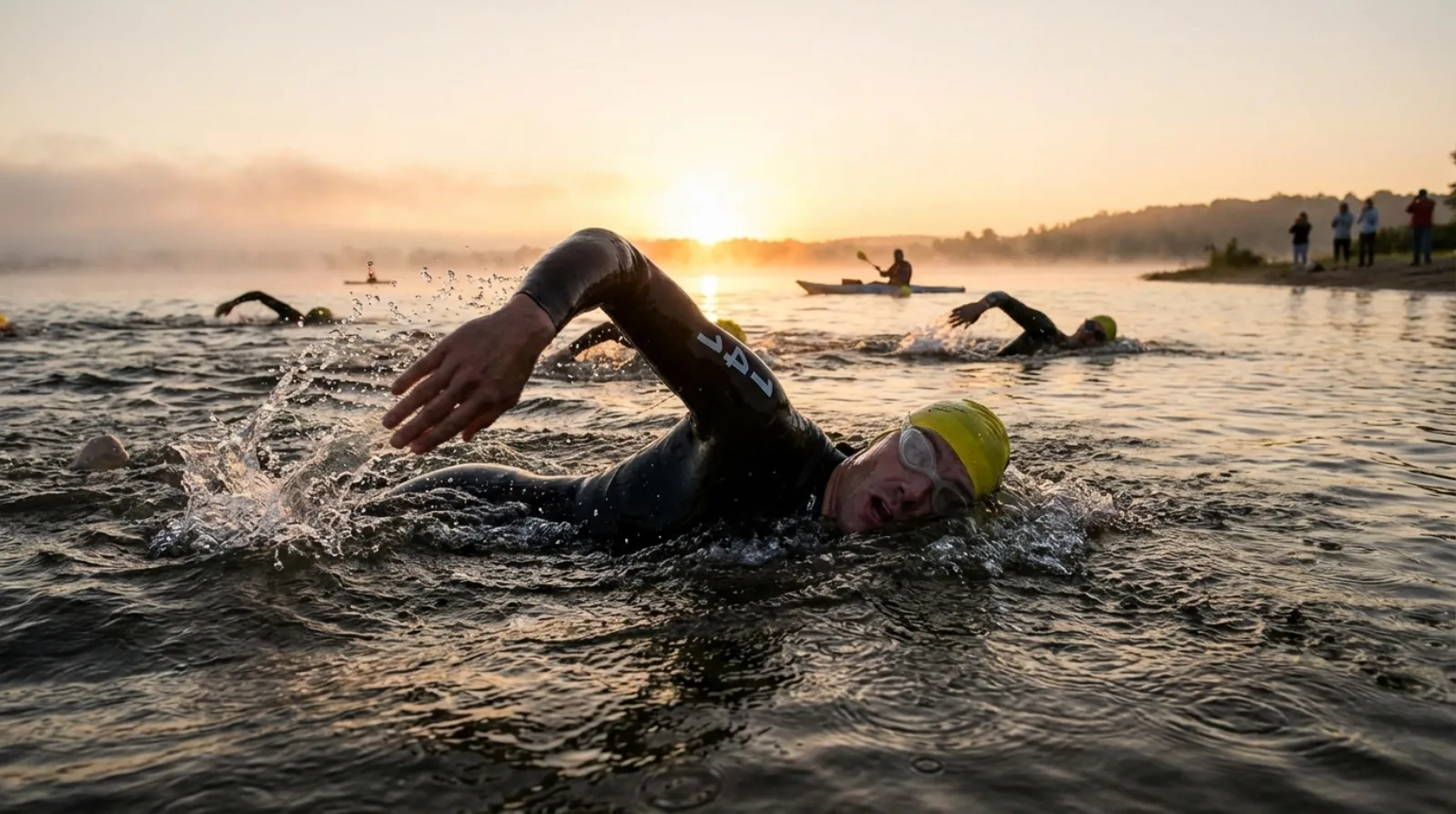
Mass Start Physical Contact and Chaos. Arms, legs, feet in your face, someone swimming directly over you, elbows at head height: the mass start is a controlled riot for the first 200 meters. If this is your trigger, practice close-contact swimming. Do it intentionally in training: swim in a lane with two or three other people deliberately making contact. Have a friend swim across your path. Swim in open water group sessions where the chaos is real but the stakes are low. Desensitization requires exposure, and you cannot desensitize to contact you have never experienced in a low-threat context.
Disorientation and Sighting Failure. You come up for air, look for the buoy, cannot find it, and suddenly have no idea which direction is forward. This is a skills gap, not a fear disorder. Fix it with deliberate sighting practice: in the pool, pick a target at the far end, and practice lifting your eyes just above the waterline mid-stroke to find it without breaking your rhythm. In open water, practice sighting every six strokes regardless of how well you can see, so the motion becomes automatic and not a signal of distress.
Deep Water Vertigo. The unmoored sensation of floating over fifty feet of nothing can trigger genuine vertigo responses in some swimmers. The fix is gradual exposure to depth: start your open water practice in shallower sections and gradually move to deeper water over multiple sessions. Also practice floating and treading water in deep water until the sensation shifts from threat to simply "this is a thing I know how to do."
General Pre-Race Panic Spiral. Sometimes the trigger is not any one specific thing but a generalized anxiety that begins the night before and crescendos at the water's edge. This responds best to the combination of the mental protocols in the section below and the physical acclimation described throughout this article. The spiral feeds on the unknown. Every piece of preparation narrows the unknown.
The 6-Week Open Water Confidence Protocol
This protocol runs six weeks and uses progressive desensitization: starting in controlled environments and systematically introducing the variables that trigger your fear, one at a time, until none of them are novel on race day. Do not skip phases. The sequence matters.
Week 1: Pool Foundation and Wetsuit Acclimation. Every swim this week is in the pool. Session A: 30 minutes of technique work with deliberate focus on long, slow exhales underwater. Your nervous system's panic response is partly driven by CO2 buildup from inadequate exhalation; fix the breathing and you fix a third of the problem. Session B: wear your wetsuit in the pool for a full 30-minute session. Swim easy. Get used to the buoyancy and compression in a zero-threat environment. Session C: eyes-closed swimming. Swim 10m with eyes closed, stop, orient, repeat. Build to 25m eyes closed by end of week. Mental cue this week: "My breathing is the dial. I control the dial."
Week 2: Pool Simulation — Contact and Intensity. Session A: recruit 2-3 training partners and swim in a single lane making deliberate contact. Practice being bumped, having someone's hand on your foot, swimming in a tight pack. Session B: high-intensity intervals (8 x 100m at race pace or faster) immediately followed by controlled breathing recovery. You want your nervous system to learn that elevated heart rate does not mean panic; it means you are working. Session C: more eyes-closed work, now with directional changes. Mental cue: "Contact is information, not threat."
Week 3: First Open Water Exposure. Choose calm, clear water if available. Swim with a friend or group. Session A: simply enter the water, float, breathe for 5 minutes before swimming. Then swim 400m easy with frequent sighting practice. Session B: repeat with wetsuit. Session C: add 1-2 minutes of cold water acclimation before swimming (splash face, submerge slowly). Log how long it takes your breathing to settle after entry. Track this number; it will improve. Mental cue: "The water is holding me up."
Week 4: Open Water Volume and Discomfort Tolerance. Two open water sessions and one pool session this week. Open water sessions build to 800-1200m. Practice starting each session with a controlled fast 100m to simulate race-pace effort, then settling into your sustainable pace. Session C (pool): high-intensity intervals again. By now your body is learning to separate "hard effort" from "panic." Mental cue: "I have been here before. I know what this is."
Week 5: Race Simulation. Find an open water group swim or organize one. Practice mass start: everyone starts together, same spot, on a signal. Swim at race effort for the first 200m before settling. Practice sighting to actual buoys or marked targets. Practice the breathing reset: when your breathing goes ragged, exhale fully, then take three slow strokes before resuming race pace. This reset will save you on race day. Mental cue: "First 200m is always the worst part. I just have to get through 200m."
Week 6: Taper and Mental Consolidation. Reduce volume by 30-40%. One short open water swim (400-600m easy) to stay familiar. One pool session for technique reinforcement. Spend time on visualization (see the mental game section). By the end of week 6, open water should feel like a place you have been many times, not a place you are visiting for the first time at race start. Mental cue: "This is my race. I am ready."
Race Day Swim Strategy for the Nervous Athlete
Preparation covered, now execution. Race day has its own psychology and its own tactics, and for the athlete managing open water anxiety, both matter.
Get in the water before the gun. If your race allows a warm-up swim, take it. Even five minutes of easy swimming before your wave start will trigger the cold water shock response and let it pass before the race begins. You want your first cold-water gasp to happen in a low-stakes moment, not at the sound of the horn. If a warm-up swim is not allowed, at minimum splash water on your face, wrists, and neck, and pour water down the back of your wetsuit collar. Give your body a head start on thermal adjustment.
Start back and wide. This is strategy, not cowardice. The front and center of a mass start is where the fastest swimmers are, and also where the contact and chaos are densest. Starting at the back or on the wide outside edge of your wave costs you perhaps 20-30 seconds over the swim in exchange for dramatically reduced contact, more space to settle your breathing, and the ability to find your rhythm before the pack compresses around you. For a nervous swimmer, that trade is worth ten times its cost in time.
Manage the first 200 meters like a project. This is the hardest stretch. Your heart rate is spiking, the pack is churning, cold water shock may be peaking. Do not try to race these 200 meters. Swim controlled, count your strokes, focus on exhaling fully. Remind yourself that discomfort peaks here and will diminish. At around the 200m mark, most fields spread out, contact decreases, and the chaos settles into something manageable. You just have to get there.
The breathing reset. If your breathing becomes ragged mid-race, use this: exhale fully and slowly three times in a row, even if you have to slow your stroke to do it. This flushes CO2, resets the breathing rhythm, and interrupts the panic feedback loop. It costs four to five seconds. It prevents a DNF. Use it without shame.
Sight every 6-8 strokes. Consistent sighting prevents the disorientation that feeds panic. Lift eyes just above the waterline, find the next buoy, put your head back down. If you cannot spot the buoy, sight to a landmark on shore instead. Keep it mechanical and regular, not reactive and frantic.
Use the safety infrastructure. Kayaks and paddleboards exist on the course for you. If you need to stop, grab a kayak, breathe for 20 seconds, and keep going. USAT rules allow you to rest on a floating object as long as you do not use it to make forward progress. Resting is not quitting. And on the subject of what might be lurking beneath you in that lake: nothing. No one has ever been eaten by anything during a triathlon swim, despite what the lizard brain insists at 6am on race morning.
The Mental Game: Building a Cocoon of Calm Around Your Open Water Swim Fear
Physical preparation solves the physiological problem. Mental preparation solves the psychological one. You need both, and the mental work begins weeks before you reach the water's edge.
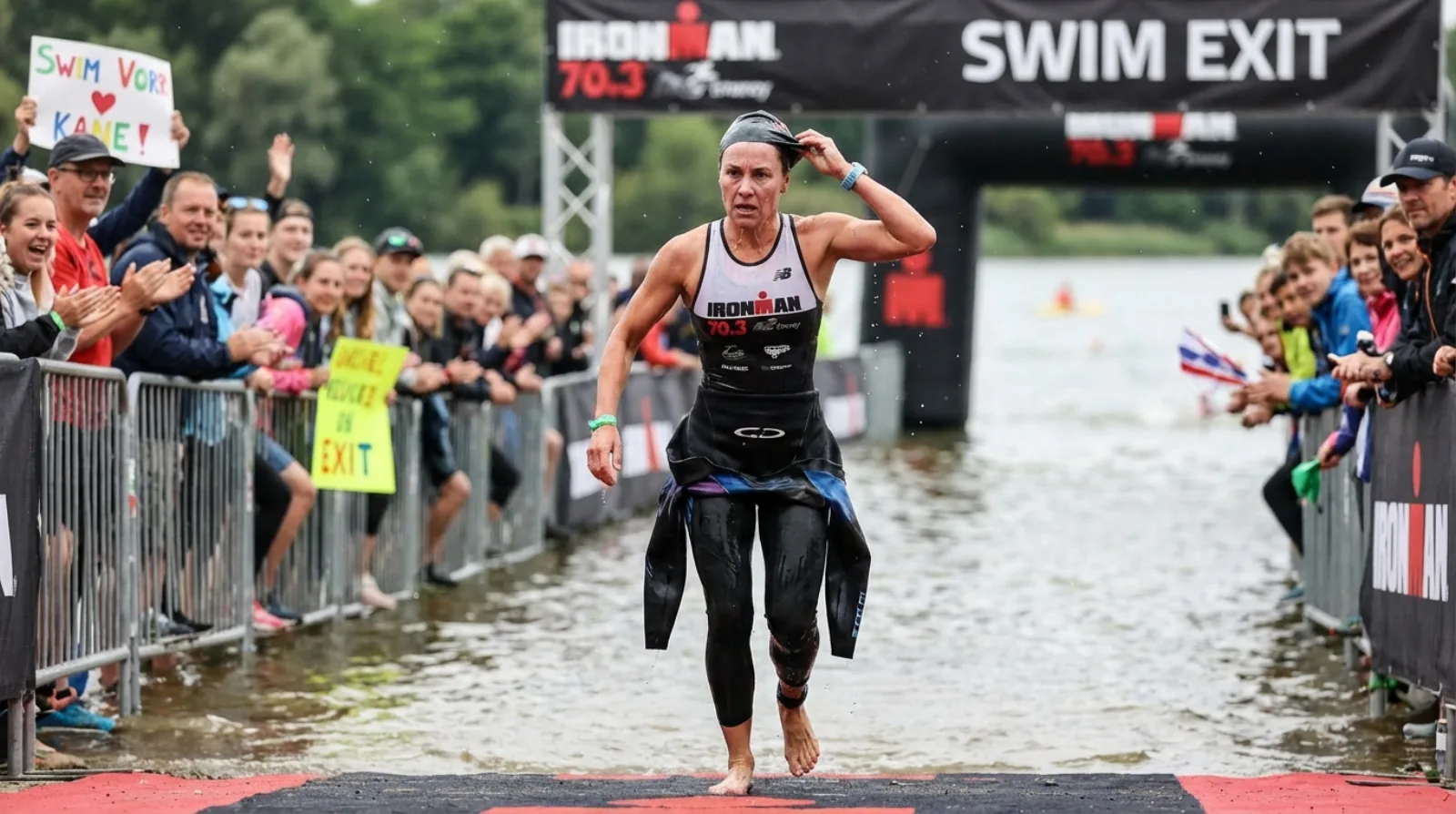
Visualization. Three to four weeks out from your race, begin a daily visualization practice. Find a quiet space, close your eyes, and run a full-color mental film of your swim. See yourself entering the water calmly. Feel the wetsuit compression and categorize it as neutral. See the murky water and feel curious rather than threatened. Watch yourself sight to the first buoy, find it, settle into your stroke. Experience the contact at the mass start and navigate it smoothly. Feel your breathing stabilize at 200m. See yourself reaching the swim exit. Make the film detailed and sensory: the smell of the water, the sound of splashing, the weight of goggles on your face. Run this film once a day for 10-15 minutes. Your brain is not great at distinguishing rehearsal from experience; use that to your advantage.
Build your mantra. Choose a short phrase that you will repeat when panic starts to rise. It should be present-tense, action-oriented, and specific to you. Something like: "Exhale, sight, move forward" or "Smooth and steady, I've done this" or simply "One stroke at a time." Whatever you choose, rehearse it alongside your visualization so it becomes a conditioned response: when you feel the panic beginning, the mantra fires automatically and gives your conscious mind something to hold onto while the autonomic storm passes.
Control what you can control before entry. On race morning, protect your mental state like an asset. Eat your planned breakfast. Arrive early enough to set up without rushing. Walk the water's edge and look at it like something familiar. Practice box breathing at transition: four counts in, four counts hold, four counts out, four counts hold. Repeat for three minutes. This activates the parasympathetic nervous system and counters the adrenaline spike of race morning. By the time your wave is called, you want to be calm and ready, not already burning through your stress budget before the gun fires.
Reframe the swim itself. The open water swim is, objectively, the most removed from traffic, noise, and distraction of the three legs. There are no cars, no sharp turns at speed, no risk of overheating on pavement. For twenty minutes, you are alone with the water and your own breathing. Some of the best athletes in the sport have learned to find the open water swim genuinely peaceful once the first 200 meters pass. That is not an innate personality trait. It is a trained response, built through the protocol above.
Go Toward the Water
Here is the honest part: your first few open water swims, even after doing this protocol, will still be uncomfortable. That is not a sign that something is wrong. That is the signature of a real challenge being met by an undertrained nervous system that is currently getting trained. The discomfort will diminish with each session in a way that is measurable and predictable, because this is not a character flaw you are fighting. It is a physiological response you are conditioning.
The athletes who conquer triathlon open water swim fear are not the ones who were never afraid. They are the ones who showed up to the lake six weeks in a row, got in, felt the fear, swam anyway, and did it again the following week. The fear did not disappear for most of them. It became manageable, then familiar, then small. A thing that lives in the corner of the swim rather than consuming the whole of it.
You do not need to love the open water swim to race it well. You need to be more prepared than you are afraid. Do the protocol. Get in the water. One stroke at a time.


