
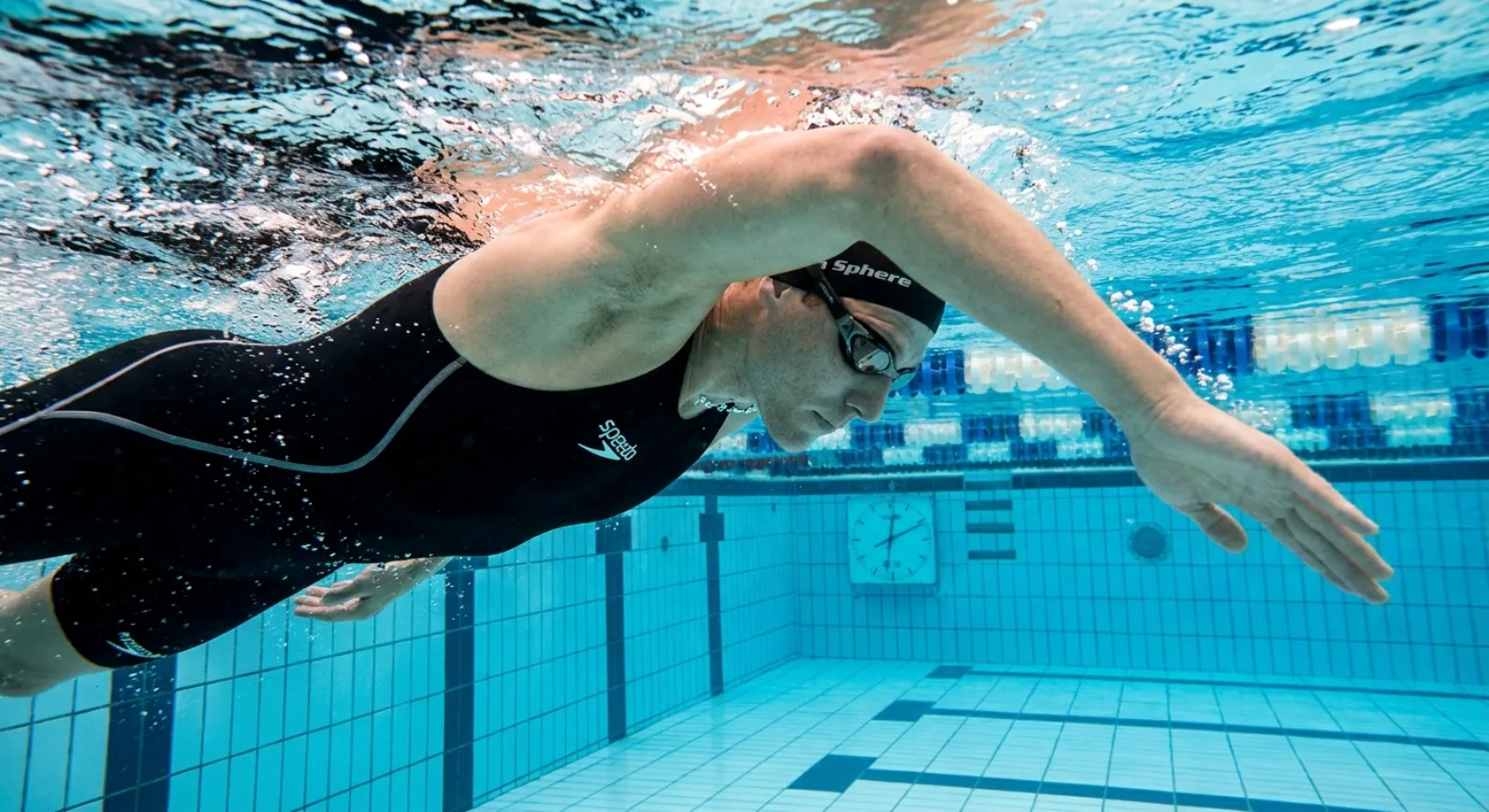
Fix Your Freestyle in 6 Weeks: The Swim Technique Breakdown That Will Actually Make You Faster
You have done the swim training. You put in the yards. You show up to masters swim when you can and you grind out the sets with everyone else. But your 750m open water time has not moved in two years. Your pool pace is the same as it was last season. You are not getting slower — which you tell yourself is a win — but you are absolutely not getting faster, and you cannot figure out why.
Here is the answer: your catch is broken. Not your fitness. Not your lung capacity. Not your mental toughness in the water. Your catch. That moment when your hand enters the water and you set up to pull — that is where 80 percent of your propulsion either comes from or gets thrown away. And if you are like most self-coached triathletes, you are throwing it away on every single stroke because no one ever taught you what a real catch looks like, and years of bad muscle memory have locked the wrong pattern in place so completely that you no longer notice it.
This is the article I wish someone had handed me three years before I actually got faster in the water. Six weeks, a specific drill sequence, and the mechanical understanding to know what you are actually trying to build. Let us get into it.
Why Triathletes Stay Slow: The Diagnosis
Watch a slow triathlete swim and you will see variations of the same three errors: the dropped elbow catch, insufficient body rotation, and a head position that creates frontal drag. Of the three, the dropped elbow catch is the original sin. It happens when your arm enters the water and your elbow drops below your wrist as you begin pulling. Instead of your forearm and hand working together as a paddle against the water, only your palm is engaged — and you are pushing down on the water rather than pulling back through it. You are generating lift for maybe 5 percent of your stroke and forward propulsion for almost none.
The worst part about a broken catch is that it feels fine. Proprioception does not tell you your elbow is low because your brain has been mapping this motion as "swimming" for years. You have to interrupt the loop, build a new motor pattern from scratch, and then gradually replace the old stroke with the new one under increasingly race-like conditions. That is exactly what this 6-week plan does.
A brief note on fitness before we go further: more yardage with bad technique does not make you faster. It makes you more efficient at the wrong pattern. If you have been swimming 3x per week for two years and your pace has not improved, the answer is not a fourth swim session. The answer is targeted technical work, then rebuilding your swimming on top of the new foundation. Counterintuitive but true: during the first two weeks of this program, your times will likely get slower as you disrupt the old pattern. By week five they will come back and then some.
The Four Mechanics That Actually Matter
1. The High-Elbow Catch: Everything Starts Here
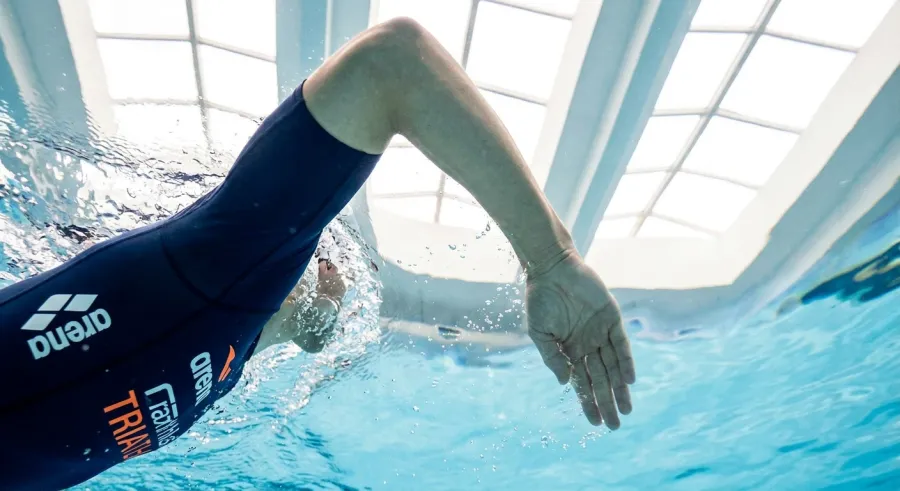
The high-elbow catch means your elbow stays high and outside your hand as your arm extends forward in the water and begins the pull phase. Imagine your forearm and hand as a single vertical paddle: the elbow points toward the side wall, the hand points toward the pool floor, and the entire surface area from fingertips to elbow is engaged against the water. You are not pushing down — you are pressing back, driving yourself forward.
To feel this for the first time, try it standing on land: extend one arm forward, palm down. Now point your fingers straight at the floor while keeping your elbow level with your shoulder. That angle — elbow high, hand down — is the catch position. It requires external shoulder rotation and a degree of flexibility in the shoulder that most desk workers do not have at first. Build it gradually. Do not crank your shoulder into pain chasing the position; the mobility will come as you drill it.
The catch initiates at the moment of arm extension, before you begin pulling. Think of it as setting up the pull rather than being part of the pull. Hand enters the water thumb-side slightly down, extends forward to near full arm length, then the elbow lifts and the hand drops as you begin pulling back. The early vertical forearm — EVF — is the technical term used by coaches. Getting your forearm vertical early in the pull cycle is how elite swimmers generate so much power per stroke while keeping stroke rate manageable.
2. Body Rotation and Hip-Driven Propulsion
Freestyle is not a flat stroke. Your body should rotate 40 to 50 degrees side to side on each stroke cycle — driven by your hips, not your shoulders. Think of it as a rotation around a central axis that runs from the crown of your head through your spine. When your right arm pulls, your right hip drives down and your left hip comes up, powering the rotation through your core. Your shoulders follow your hips, not the other way around.
Proper rotation does two things: it engages larger muscle groups (your lats and core rather than just your shoulders and arms), which delays fatigue significantly over a 1500m swim, and it allows your recovering arm to enter the water at a longer extension, increasing your effective stroke length without overreaching. Flat swimmers — and most triathletes swim flat — are doing shoulder-only freestyle that looks fine for a 100m sprint and falls apart over longer distances.
The key cue is "drive from the hip." When your right hand enters the water, your right hip should simultaneously push down and back, initiating the rotation. If your shoulders are moving but your hips are quiet, you are rotating from the wrong end.
3. Bilateral Breathing and Breathing Rhythm
Breathing to both sides — bilateral breathing — is not just an aesthetic preference. It ensures your stroke is symmetrical and forces you to develop equal rotation on both sides. Most athletes have a strong side and a weak side; bilateral breathing exposes the asymmetry and gradually fixes it. For triathlon specifically, it is also tactically useful: you can choose to breathe away from chop, toward buoys, or toward competitors without being locked into one side.
The standard bilateral pattern is breathe every three strokes: right, left, right — breathe left; left, right, left — breathe right. Some athletes use a 3-3-5 pattern (breathe every three for a while, then every five). What matters more than the exact pattern is the timing: you breathe during the high-rotation phase of the opposite arm's entry. Your face rotates with your body, not independently. The common mistake is lifting the head to breathe rather than rotating it — which breaks your neck alignment and creates drag.
4. Head Position and Drag Reduction
Your head position determines your body angle in the water, and your body angle determines how much drag you create. The target is eyes looking slightly forward and down — roughly at a 45-degree angle toward the pool floor — with the waterline crossing just above your goggles when you are at full extension. This keeps your hips high and your body nearly horizontal.
Looking forward creates the classic "downhill position" problem: your head goes up, your hips drop, and you are essentially swimming uphill on every stroke. This is extremely common in new swimmers and in triathletes who are anxious about navigation. The answer in the pool is to trust the black line on the bottom. In open water, it is to use discrete sighting movements — quick head lifts every 6-8 strokes — rather than habitually swimming with a raised head.
The 6-Week Drill Progression
This program runs three swim sessions per week. The sessions are structured: a warm-up, a drill block (the majority of the session), a short integration set, and a cool-down. Do not skip the drill block to swim more yards. The drill block is the work.
Weeks 1–2: Isolate the Catch
The first two weeks are entirely about the catch. You are going to break your stroke down and rebuild only the catch position. Everything else is secondary. You will feel slow. That is correct.
Fingertip Drag Drill. During the recovery phase of each stroke, drag your fingertips along the water's surface from hip to entry point. This anchors your elbow high during recovery and gives you immediate tactile feedback on elbow position. Swim 4–6 x 50m focusing exclusively on keeping fingertips touching the surface throughout recovery. Rest 20 seconds between reps.
Catch-Up Drill. Both arms remain extended forward until the recovering arm fully "catches up" and touches the leading hand before the pull begins. This slows the stroke down and forces you to feel the catch setup with each arm before committing to the pull. It exaggerates the extension and gives you time to set the elbow position. Swim 6 x 50m with 20 seconds rest. Your distance-per-stroke will likely increase noticeably with this drill — that is the efficiency you are building.
Fist Drill. Close both hands into fists and swim normally. Without your palm to rely on, you are forced to use your forearm as the primary propulsive surface — which is exactly the forearm engagement you want in the high-elbow catch. The moment you open your fists again, the water pressure against your palm feels amplified. Alternate: 25m fists, 25m open hands, 4–6 reps. Note how your stroke changes when you return to open hands. Chase that feeling.
Integration set, Weeks 1–2: 4 x 100m at easy-moderate effort, focusing on transferring the catch position from the drills into continuous swimming. Count your strokes per length. Track this number.
Weeks 3–4: Add Rotation and Rhythm
The catch is starting to feel more natural. Now you add rotation and connect the hips to the stroke. The goal is to feel the rotation driving the catch — when your hip drives, your catch arm sets, and then your pull is powered by your whole body rather than just your arm.
Side-Kick Drill. Kick on your side with your lower arm extended forward and your top arm resting against your body. Hold this position for 6 kicks, then take one full stroke cycle and switch sides. This trains the hip-drive rotation directly: you have to use your hip to roll from one side to the other, and you feel the connection between hip position and arm extension. Swim 4 x 75m, alternating sides on each stroke. This is the most important drill in the sequence for body rotation — do not rush it.
6-1-6 Drill (variation on side-kick). Six kicks on your side, one stroke, six kicks on the new side. This is slower and more deliberate than continuous swimming and that is the point. You are ingraining the rotation pattern and learning to pause at full extension. Swim 4 x 50m with 30 seconds rest.
Bilateral breathing integration. If you are a one-side breather, weeks 3–4 are when you begin training the other side. Start with every-five-strokes breathing: breathe right, five strokes, breathe left, five strokes. It will feel awkward and your off-side breath will be ragged. That is fine. You are building the motor pattern. Do one entire session per week with enforced bilateral breathing, even if it means slowing way down.
Integration set, Weeks 3–4: 6 x 100m with the last 25m of each rep as all-out effort to begin building the connection between technique and speed. The point is to feel whether your catch holds up under mild intensity. It probably will not at first. That is valuable information.
Weeks 5–6: Build Tempo and Transfer to Pace
The mechanics are in place. Now you build stroke rate and practice holding good technique at race effort and above. This is where the work from weeks 1–4 pays off.
Tempo Trainer work. If you have a Finis Tempo Trainer or similar metronome device, set it to your current comfortable stroke rate and swim 200m. Increase by two beats per minute and swim another 200m. Continue until you feel your catch breaking down, then back off one step. That is your current technical ceiling — your maximum stroke rate at which good mechanics hold. This number will increase over the coming weeks.
Descending 200s. Swim 4 x 200m with each rep 3–5 seconds faster than the previous. On the final rep you should be at or near threshold effort. This trains you to maintain catch integrity under fatigue — the condition you will face in every race.
Broken swims. Swim 400m broken as 25m on, 5-second pause, 25m on. The pause allows you to reset your body position and mentally reinforce the catch setup before each rep. This is a classic drill for building clean technique at near-continuous pace without the mental drift that happens over longer swims.
Open-water simulation set: 2 x 500m continuous with sighting every 8 strokes (pick a target at the end of the pool and sight to it). Practice the bilateral breathing pattern at race effort. This is your test set for week 6 — if you can hold your stroke count from week 1 (or better, reduce it) at a noticeably faster pace, the program has worked.
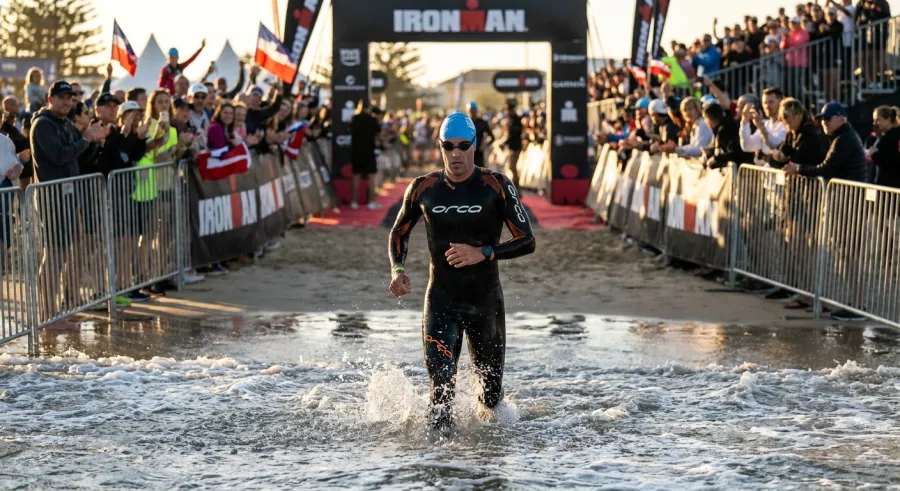
Race-Day Transfer: Taking Pool Gains to Open Water
Pool drills in a lane are not the same as a 1500m open water swim at T1. The transfer requires deliberate bridging, and most athletes skip this step entirely — which is why their pool times improve but their race times do not.
Start with acclimation, not chaos. Get in the water before your wave. Even five minutes of easy swimming will let cold shock pass before the gun. If you enter cold water at race start and spend your first 90 seconds fighting the involuntary gasp reflex and elevated heart rate, your beautifully drilled catch is the first thing to go. Pre-race swim is not optional; it is technical preparation.
Survive the first 200 meters. The mass start is not the place to execute perfect mechanics. It is the place to not drown. Breathe, stay calm, let the pack spread out. At around 200–300m, the chaos subsides and you will have space. That is when you switch on the catch — consciously: take three strokes, feel the elbow position, feel the hip drive, settle into your rhythm. Do not try to race technique from stroke one.
Use a stroke-count anchor. Know your stroke count per 25m from the pool. In open water, periodically count strokes over 10–15 seconds. If you are noticeably above your pool count, your stroke has broken down — probably the rotation has gone flat, which kills your catch leverage. The fix is three controlled strokes with exaggerated hip drive, then return to pace. This cue is more useful than any pace target in rough water.
Sighting rhythm is part of your stroke rhythm. In the pool you practiced sighting every 6–8 strokes. Keep that same rhythm in open water, regardless of how well you can see. Sighting less frequently leads to navigation errors and panicked re-sighting that disrupts your stroke far more than a regular, mechanical head lift every 8 strokes would. Make it automatic, not reactive.
Wetsuits change your catch — adjust for it. A wetsuit adds buoyancy and changes the feel of your arm extension. Many swimmers find the wetsuit makes their arms feel higher in the water, which can disrupt the catch setup. In the 3–4 weeks before your target race, get at least two open water sessions in your race wetsuit so the feel is not novel on race morning.
The fitness will follow. A cleaner stroke means more distance per stroke and less energy per meter. In a race context, that efficiency compounds: you arrive at T1 with more in the tank, your heart rate is lower, your transition is calmer, and your bike and run benefit from a swim that did not drain you. Technique is not just about swim splits. It is about how you feel at kilometre 30 on the bike. That is the real argument for fixing your freestyle.
What to Expect After 6 Weeks
If you do this program as written — three sessions per week, drill blocks taken seriously, bilateral breathing practiced even when it hurts — here is what you should see at the end of six weeks: your stroke count per length should be down by 2–4 strokes (depending on how broken your catch was to start). Your 400m time trial should be 8–15 seconds faster. Your stroke will feel more controlled under effort, and you will have specific cues — elbow up, hip drive, exhale long — that you can activate under race conditions instead of just hoping the training shows up.
More importantly: you will have a model for continued improvement. The catch can always be cleaner. The rotation can always be better timed. Bilateral breathing can always become more natural. The six weeks gets you off the plateau and pointed in the right direction. Where you go from there depends on how deep you want to take it.
Stop swimming your old broken stroke. Start here. Week one is fists and fingertip drag and feeling confused. Six weeks later it is a faster split and the quiet satisfaction of finally understanding what "using the water" actually means.


