
Everyone treats the sprint triathlon as a warm-up. A starting point. The beginner distance. They're wrong — and their run splits prove it.
The sprint tri (750m swim, 20km bike, 5km run) is one of the most physiologically demanding formats in multisport racing. Not because it's long — it isn't. Because it's short. You race it at 85–95% VO2max for somewhere between 40 and 75 minutes straight, with no recovery, no soft pedaling, no "just get through this section." Every second of the race is near-maximal. That's a completely different physiological beast from a 70.3 or an Ironman, and training for it requires a completely different approach.
Most people don't train for it that way. So most people blow up on the run. And then they wonder why the sprint felt harder than their half-iron.
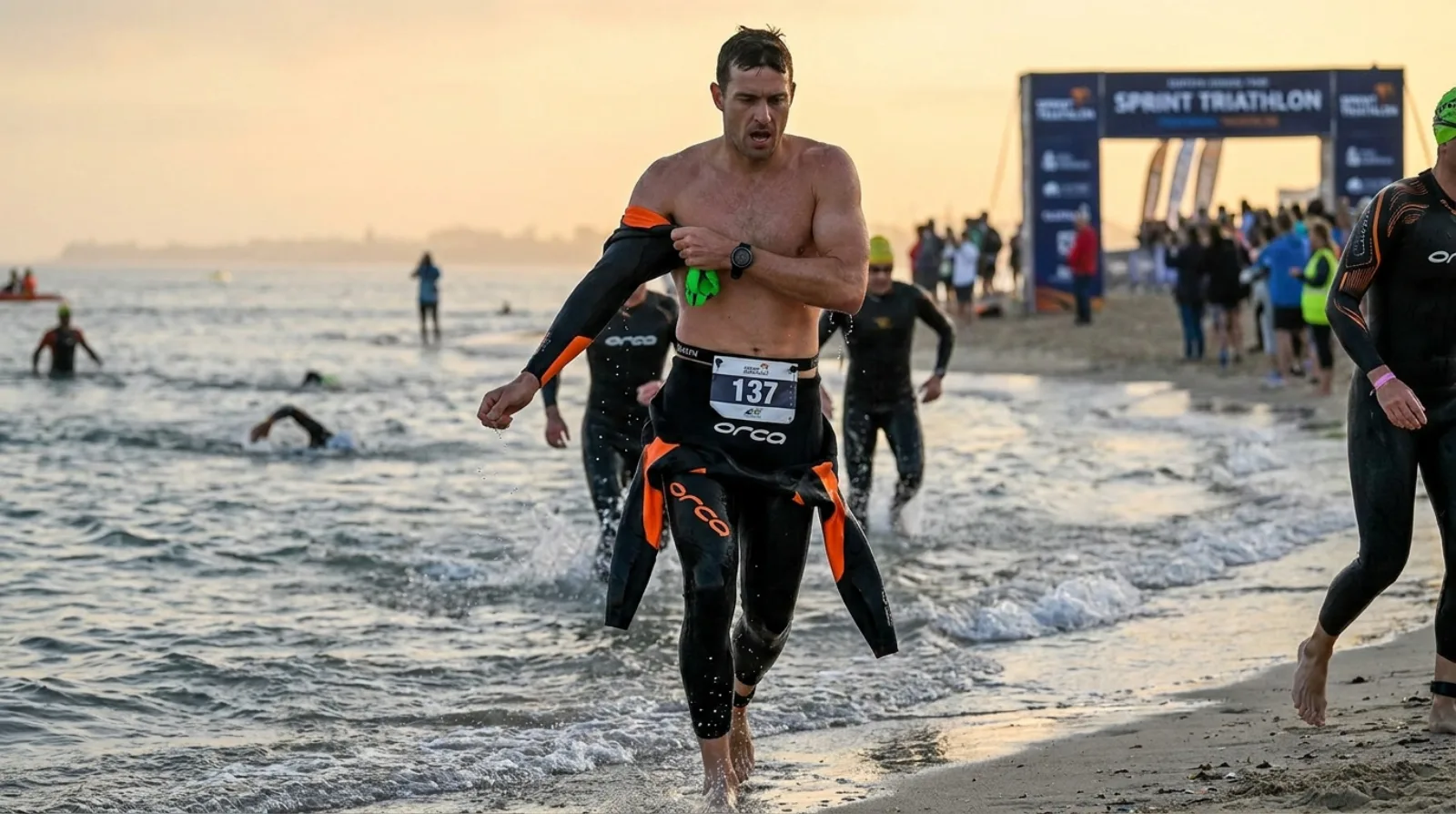
The Physiology Reality: This Is Not an Endurance Event
Let's get the science out of the way first, because it reframes everything.
An Ironman is an aerobic event. You're working at 65–75% VO2max. Your fat oxidation is doing serious work. Your pacing strategy is built around preservation — staying under the threshold where things fall apart.
A sprint tri is not that. A competitive age grouper racing a sprint tri is working at 85–95% VO2max for the entire event. That's Zone 4 to Zone 5 effort. You're burning glycogen, generating lactate, and running your anaerobic systems hard the whole time. Your body barely has time to clear the lactate before the next leg dumps more in.
What this means practically: your big aerobic base — the kind you'd spend months building for a 70.3 — is nearly irrelevant at this distance. It's a floor, not a ceiling. The ceiling is your VO2max, your lactate threshold, and your neuromuscular ability to sustain near-maximal power output across three different sports in sequence.
If you've been training mostly at low intensity and showing up to sprint tris hoping your fitness "covers it," this is why it hasn't been covering it. The energy systems you've built are the wrong ones for the job.
Sprint-Specific Training: What's Different
Sprint tri training looks closer to 5K run training or a short cycling criterium program than it does to Ironman prep. Here's what actually matters:
More VO2max work
You need to train at and above your VO2max pace/power. That means efforts of 3–8 minutes at maximum sustainable intensity (roughly 95–105% of FTP on the bike, or 3K–5K pace in running). Classic sessions: 5×4 min at VO2max with 3 min rest on the bike; 6×800m at 5K effort on the run.
More lactate threshold intervals
The threshold is where you race a sprint. Sweet spot and threshold work (91–105% FTP on the bike, tempo-to-threshold pace running) should dominate your program. 20-minute threshold efforts, tempo runs at 85–90% max heart rate, long cruise intervals. This is your bread and butter.
Less long slow distance
You still need an aerobic foundation — without it, your recovery stinks and you can't absorb training load. But four-hour rides and 90-minute easy runs are largely wasted training time for a sprint tri specialist. Cap your long bike at 90 minutes, your long run at 45–50 minutes. Use the time you save to add a second quality session per week instead.
Brick work is essential
The bike-to-run transition in a sprint tri is brutal because you go from 85% max heart rate on the bike to 90% max heart rate on the run within 60 seconds of racking your bike. Your legs need to learn that transition. Short, sharp brick sessions — 30 min threshold bike → 15 min at goal race pace run — train your body to make that shift without imploding.
Race Strategy: Going Out Hard Is Not the Same as Going Out Stupid
Here's where most people sabotage themselves: they misread "go hard" as "sprint from the gun and hope for the best."
The swim: Yes, go hard. In a sprint tri, a moderate swim exit is a gift to everyone behind you. Push the first 100m hard to get clear water, then settle into your 85–90% effort and hold it. Don't sprint and blow up — sustain hard.
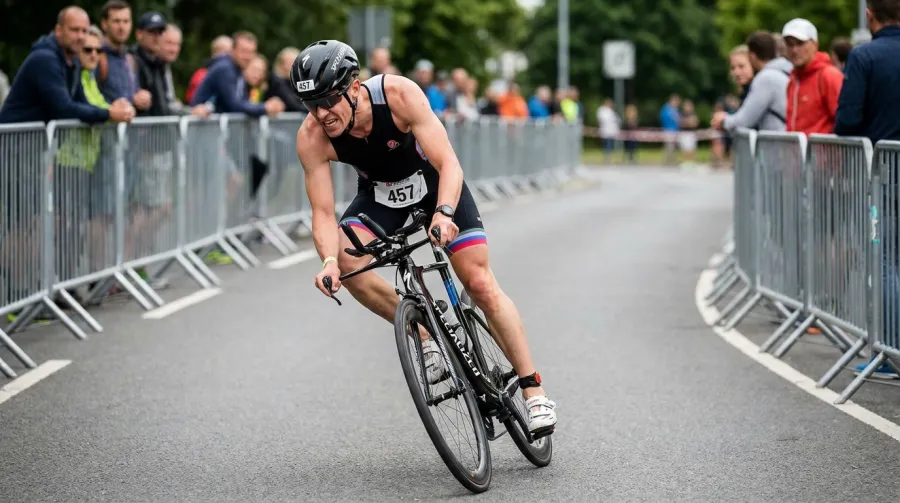
The bike: This is where the race is won or lost for most age groupers. The bike leg of a sprint tri should feel like a 20km time trial, which is almost exactly what it is. Your target is right at or slightly above your lactate threshold. Not your long-ride pace. Not "comfortable." Uncomfortable-sustainable. If you can talk in full sentences on the sprint tri bike course, you're leaving time on the road — and you're going to feel great on the run, which means you didn't go hard enough on the bike.
The run: If you rode correctly, the first kilometer of the run will feel terrible. Your legs will feel like concrete and your lungs will already be screaming. This is normal. This is correct. It means you raced the bike. Settle in, let the legs turn over, and by kilometer 2 you'll find your rhythm. Hold on and empty the tank across the finish.
T1 and T2: The Free Speed Nobody Takes
Transitions are where sprint tri racing separates itself from every other distance.
At Ironman, a slow transition costs you 90 seconds. That's maybe 0.5% of your total race time. Annoying, but not race-changing.
At a sprint tri, 30 seconds in T2 is 5% of your total race time if you're finishing around 60 minutes. That's enormous. That's the difference between podium and off-podium. That's something you'd spend weeks of training to gain — and here it is, sitting in the transition tent waiting for you to claim it.
Practice your transitions. Lay out your gear the same way every time. Rack your bike helmet on the handlebars so you can grab and go. Elastic laces on your run shoes. Sunglasses on top of your helmet. Know the layout of the transition area before race morning. A practiced T1 should take 45–60 seconds. T2 should be under 30. If yours are taking 2+ minutes, you're essentially adding a whole kilometer of run time just standing in transition.
It sounds unglamorous. It is. Do it anyway.
The 8-Week Sprint Tri Training Block
Here's a sample block structure for an athlete with a solid aerobic base training 8–10 hours per week. Intensities use RPE (1–10) and % of FTP for cycling.
Weeks 1–2: Foundation & Aerobic Sharpening
- Mon: Rest or 30 min easy swim (technique focus)
- Tue: Bike — 60 min with 3×8 min at threshold (RPE 7–8); Run — 20 min easy off the bike
- Wed: Swim — 2,000m with main set 8×100m at CSS (critical swim speed)
- Thu: Run — 40 min with 4×5 min at tempo (RPE 7)
- Fri: Rest or easy 45 min spin
- Sat: Bike — 75 min at 75–80% FTP (steady aerobic); Run brick — 15 min at race pace
- Sun: Swim — 2,500m with 400m threshold efforts
Weeks 3–5: VO2max Block
- Tue: Bike — 5×4 min at 110–120% FTP (VO2max), 3 min rest; Run — 15 min easy
- Wed: Swim — 2,500m with 6×150m at threshold pace
- Thu: Run — 6×800m at 5K effort (RPE 8.5–9), 90 sec rest
- Sat: Race-sim brick — 40 min at race effort on bike → 20 min at race pace run
- Sun: Swim — 2,000m with sprint sets 10×50m at 95% effort
Weeks 6–7: Race Specificity
- Tue: Bike — 45 min with 2×12 min at threshold; Run brick — 15 min at goal race pace
- Wed: Swim — Race-pace sets: 3×400m at goal sprint tri pace with 2 min rest
- Thu: Run — 30 min with 2×10 min at threshold
- Sat: Full race simulation — sprint distance swim, bike, run at goal effort
Week 8: Taper
- Cut volume by 40%, keep a few short sharp efforts (4×1 min at VO2max on bike, 4×200m fast on run)
- No new workouts. Trust the training. Sleep.
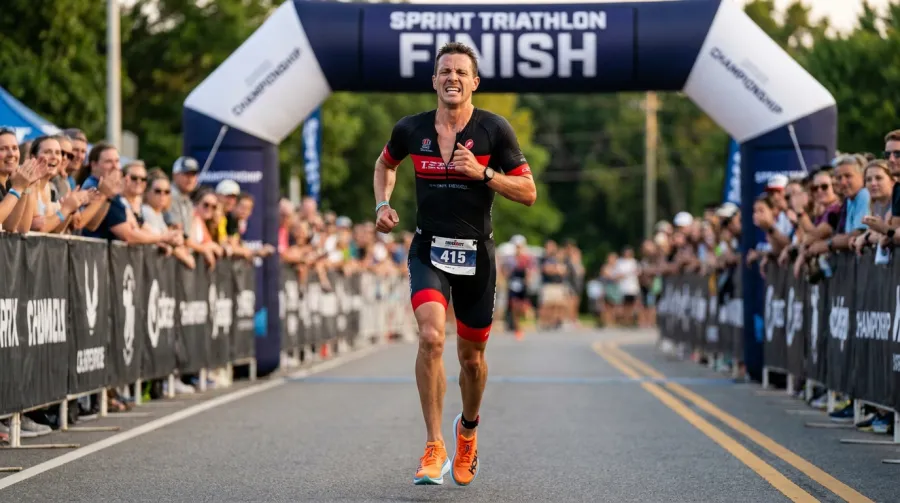
The Case for Racing Sprint Seriously
Here's the argument that rarely gets made: sprint triathlon is the best speed developer in the sport.
Ironman and 70.3 athletes who spend all their time training slow get slow. The body adapts to the demands placed on it — and 18-hour weeks of Zone 2 builds an engine that's efficient at Zone 2. Want to actually get faster at those long distances? Train the top end. VO2max training raises the ceiling for everything below it. A higher threshold makes your long-course race pace feel easier. The neuromuscular sharpness you build racing sprint carries directly into 70.3 intensity work.
Sprint tris are also race-day reps. You get to practice start-line nerves, transition execution, pacing judgment, and nutrition strategies (hint: for a sprint, you mostly don't need any) — all at low physical cost and high frequency compared to half or full iron racing.
The athletes who take sprint racing seriously, who train for it specifically rather than treating it as an afterthought, tend to be sharper, faster, and better rounded than those who only grind long. The sprint distance rewards qualities the sport doesn't celebrate enough: raw speed, pain tolerance, and the ability to hold near-maximal effort without backing off.
So next time someone calls it "the beginner distance," smile and let your run split do the talking.
The Bottom Line
Sprint triathlon is not a stepping stone. It is not easy. It is not what you do before you're ready for a "real" race. It's a 40–75 minute near-maximal effort that demands specific training, smart pacing, practiced transitions, and the ability to hurt consistently from gun to tape.
Train for it accordingly. Race it with respect. And stop calling it baby triathlon.


