
The recovery industry is worth billions. Ice baths, compression boots, massage guns, cryotherapy chambers, infrared saunas — all sold with the implicit promise that elite performance lives or dies on the quality of your post-training rituals. Most triathletes buy into at least part of this narrative. Some go deep. And nearly all of them are prioritizing the wrong things.
Here's the truth: the hierarchy of recovery is well-established by research, and it looks nothing like a sponsored Instagram post. Sleep and nutrition do the heavy lifting. Everything else is marginal at best — useful in context, but not worth obsessing over until the fundamentals are locked in. Let's go through the evidence, modality by modality, without the sales pitch.
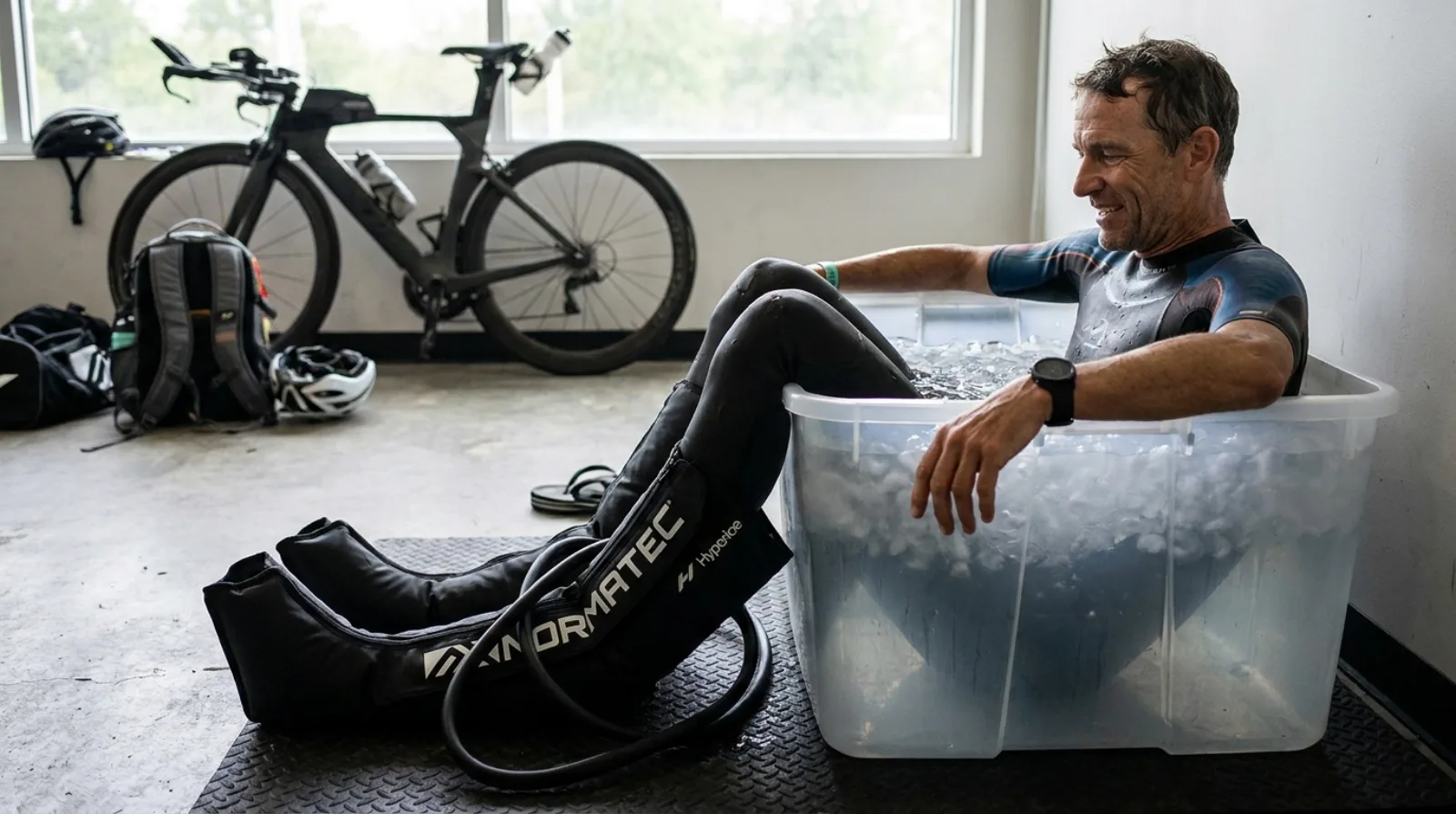
Cold Water Immersion: Real Benefits, Real Trade-offs
Ice baths have been a staple of elite recovery for decades, and the evidence actually supports their use — with important caveats. A 2022 meta-analysis in the British Journal of Sports Medicine found that cold water immersion (CWI) at 10–15°C for 10–15 minutes significantly reduces delayed-onset muscle soreness (DOMS) and perceptions of fatigue in the 24–96 hours following high-intensity training. Compared to passive rest, CWI consistently wins on subjective recovery markers.
But here's where it gets complicated. A landmark 2015 study by Roberts et al., published in The Journal of Physiology, demonstrated that regular post-training cold water immersion blunted long-term strength and muscle mass gains compared to active recovery. The mechanism: the acute inflammatory response following resistance training is not purely a symptom of damage — it's a signal. Satellite cells, mTOR activation, and the downstream anabolic cascade that drives adaptation all depend on that inflammation window. Dunk it in cold water, and you partially short-circuit the process.
More recent work has extended this finding. A 2021 paper in Medicine & Science in Sports & Exercise confirmed that CWI after strength sessions reduced acute anabolic signalling markers, including phosphorylated p70S6K, by a statistically significant margin. Practically: if you're doing a heavy bike-and-lift combination session, an ice bath afterward might be working against you.
The practical takeaway: Cold water immersion is genuinely useful for reducing soreness and accelerating perceived recovery between back-to-back sessions — particularly relevant during race week or multi-day training blocks. Use it strategically after long runs or high-volume swim sessions, not habitually after every strength or power workout. The tool works; the timing matters.
Compression Garments: Modest but Real
Compression tights, socks, and recovery boots (think Normatec or NormaTec-style pneumatic compression) occupy a different tier of evidence. The research is consistent enough to be credible, but modest enough to keep expectations in check.
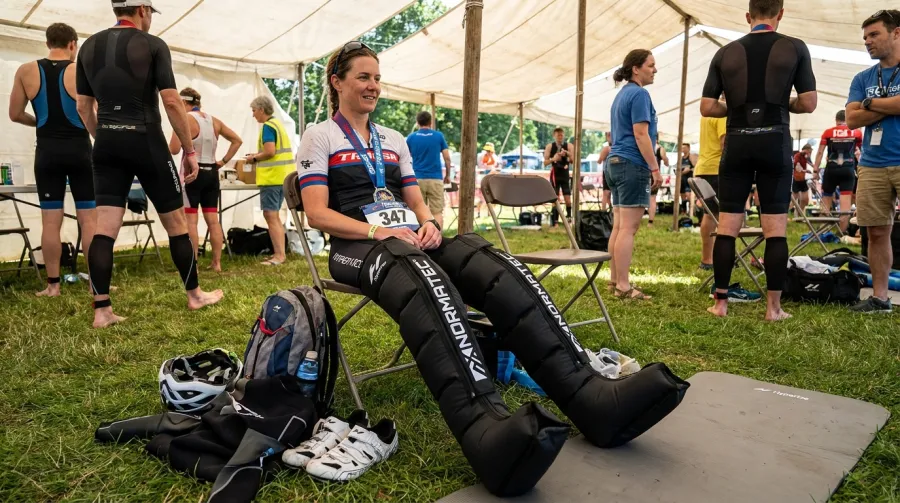
A 2019 systematic review in Frontiers in Physiology covering 23 trials found that graduated compression garments reduced perceived muscle soreness and perceived exertion in recovery across multiple sports. The effect was statistically significant but small-to-moderate in magnitude. Objective markers — things like creatine kinase levels (a proxy for muscle damage), lactate clearance, and actual performance tests — showed less consistent improvement.
Pneumatic compression devices (sequential inflatable boots) show a slightly stronger signal, likely because of the active pumping mechanism's effect on lymphatic drainage and venous return. A 2020 randomized controlled trial in the Journal of Strength and Conditioning Research found that 20 minutes of pneumatic compression post-exercise reduced perceived leg heaviness and improved self-reported readiness for next-day training more than passive rest — though, again, objective performance metrics were not significantly different at 24 hours.
The practical takeaway: Compression garments are worth using, particularly after long run and bike sessions where leg fatigue and fluid pooling are real issues. They're most useful for perceived recovery and comfort, which itself has value — feeling better translates to training better the next day. Don't expect them to substitute for sleep or nutrition. Do expect them to make long travel days, post-race recovery, and heavy training blocks more comfortable.
Massage and Foam Rolling: The Perception Gap
Of all the modalities on this list, massage has the largest gap between perceived benefit and objectively measured physiological effect. Athletes universally report feeling better after massage. The physiological markers tell a more complicated story.
A frequently cited 2020 meta-analysis in the British Journal of Sports Medicine pooling data from 29 studies found that post-exercise massage reduced DOMS by approximately 30% and improved perceived recovery — meaningful numbers. But the same analysis found minimal effects on strength recovery, power output, or inflammatory markers like IL-6 and TNF-α. The predominant mechanism appears to be neurological and psychological: massage alters pain perception and activates the parasympathetic nervous system, creating genuine subjective benefit without necessarily accelerating the underlying physiological repair process.
Manual therapy from a skilled therapist outperforms self-massage (foam rolling, massage guns) on subjective recovery metrics, likely because of the added therapeutic relationship, the ability to modulate pressure and technique in real time, and the parasympathetic activation that comes from relaxing under expert hands. Self-massage tools are not useless — a 2019 review in the Journal of Athletic Training found foam rolling reduced perceived stiffness and improved range of motion in the short term — but the effects are smaller and more transient.
The practical takeaway: Regular massage (even bi-weekly) is one of the better investments a serious triathlete can make — not for the physiology, but for the recovery experience, injury prevention, and early identification of tissue issues. Foam rolling pre-session to improve mobility is evidence-supported. Post-session foam rolling for recovery is beneficial but more modest. If budget forces a choice between a foam roller and a sports massage, book the massage.
Sleep: The Non-Negotiable Foundation
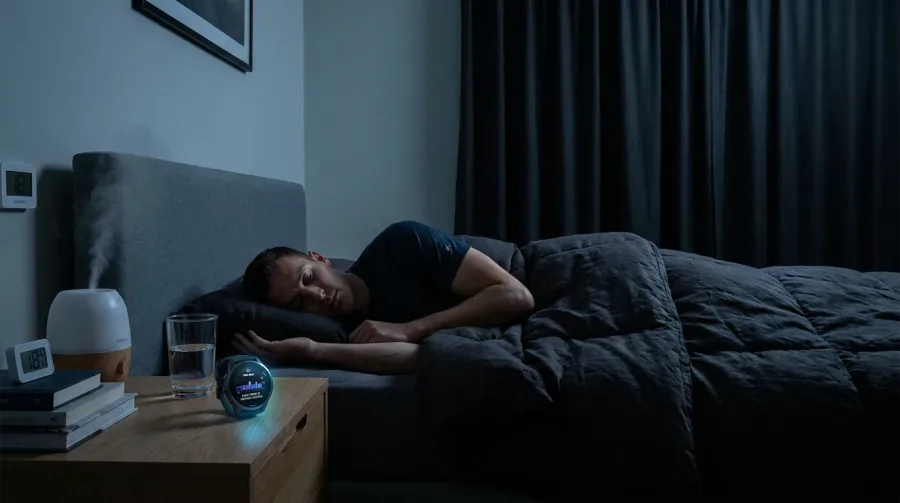
If you take one thing from this article, let it be this: no recovery tool exists that meaningfully compensates for insufficient sleep. Not even close. The research on sleep and athletic performance is among the strongest and most consistent in all of sports science.
A 2021 review in the International Journal of Sports Physiology and Performance synthesizing data across endurance and strength sports found that athletes sleeping fewer than seven hours per night showed significantly impaired reaction time, reduced time to exhaustion, elevated RPE, compromised immune function, and slower recovery of muscle glycogen. The effects compounded over multiple nights of restriction — two weeks of sleeping six hours per night produced cognitive impairments equivalent to 24 hours of total sleep deprivation.
The seven-to-nine hour recommendation for athletes isn't arbitrary. Sleep architecture matters as much as duration. Slow-wave (deep) sleep — stages N3 — drives the release of growth hormone, which is critical for tissue repair and adaptation. REM sleep consolidates motor learning and technical skill acquisition. Both are compressed when total sleep time is cut short. A 2019 study from Stanford's sleep lab found that basketball players who extended sleep to 10 hours per night improved sprint times, reaction time, and shooting accuracy — results achievable without any other intervention.
Practical sleep strategies for athletes:
- Temperature: Core body temperature must drop 1–2°C to initiate sleep onset. A bedroom at 16–19°C (60–66°F) accelerates this process. This is well-supported by thermoregulation research and is one of the easiest environmental modifications to make.
- Consistency: Sleep timing regulates circadian rhythm, which in turn governs cortisol, melatonin, insulin sensitivity, and dozens of repair processes. A consistent wake time — even on weekends — is more important than most athletes realize.
- Pre-sleep nutrition: A 2018 study in Medicine & Science in Sports & Exercise found that 40g of casein protein consumed 30 minutes before sleep increased overnight muscle protein synthesis rates by approximately 22% compared to placebo. This is one of the few nutritional interventions with a clean sleep-specific mechanism.
- Screen and light management: Blue light exposure within 90 minutes of sleep delays melatonin onset. Amber-tinted glasses or simply dimming lights after 9 PM is underrated.
Nutrition Timing: The 30–60 Minute Window
Post-training nutrition is not glamorous, but it is evidence-backed and controllable. The concept of the "anabolic window" has been somewhat overstated in fitness culture — the urgency matters more after fasted training and less after sessions where you've fueled properly — but the fundamentals hold up.
A 2013 meta-analysis in the Journal of the International Society of Sports Nutrition found that co-ingestion of carbohydrate (0.8g/kg/hour) and protein (0.3–0.4g/kg) in the first 30–60 minutes post-exercise maximized muscle glycogen resynthesis and initiated muscle protein synthesis more effectively than delayed feeding. For triathletes training twice daily or on back-to-back long sessions, this window matters considerably more.
On creatine: a 2021 review in Nutrients confirmed that creatine monohydrate supplementation (3–5g/day) has meaningful evidence not just for power output, but for reducing training-induced muscle damage markers and accelerating recovery between high-intensity sessions. It's cheap, safe, and one of the most researched supplements in exercise science. If you're not using it, it's worth considering — particularly during heavy training blocks.
The Honest Stack: What to Actually Prioritize
Most triathletes have this backwards. They spend $600 on compression boots and $20/month on sleep. They book weekly massage but go to bed at midnight after scrolling their phone. The evidence doesn't support that hierarchy — not even a little.
Here's the honest prioritization, in order of evidence strength and practical impact:
- Sleep (7–9+ hours, consistent timing, cool dark room) — The largest single intervention available. Nothing else comes close. If you're serious about triathlon performance, protect this above everything else.
- Post-training nutrition (carbs + protein within 60 minutes) — Cheap, evidence-backed, requires only planning. Casein before bed if you have the habit.
- Cold water immersion (strategic, not habitual) — Useful for back-to-back days and race week. Avoid after strength sessions. 10–15 minutes at 10–15°C.
- Compression (garments or pneumatic) — Worthwhile for perceived recovery and comfort. Best after long-course training, travel, and race week.
- Massage (manual > self-massage) — Regular professional massage has genuine value for perceived recovery, mobility, and injury prevention. Foam rolling is useful but modest.
The recovery tools your favourite pro triathlete posts about are real — they do something. But they're also the last five percent of a recovery stack, not the foundation. Build the foundation first: sleep like it's your job, eat before and after sessions, manage training load intelligently. Then — and only then — does the rest of the stack actually matter.
The $600 boots work better when you're not chronically sleep-deprived. Almost everything does.


