
Let me set the scene. It's February, and I am standing at the edge of an outdoor pool at 6 AM, staring at the lane lines and already deeply regretting everything that led to this moment. My "fitness" consists of occasional walks and an elliptical machine I bought during the pandemic that now mostly holds laundry. In 16 weeks, I have agreed — voluntarily, apparently — to swim 750 meters in open water, bike 20km, and run 5km in front of strangers.
This is my diary. The unfiltered version. I'm including the humiliating parts because nobody posts those on Instagram, and you deserve the truth.
Weeks 1–2: The Humbling
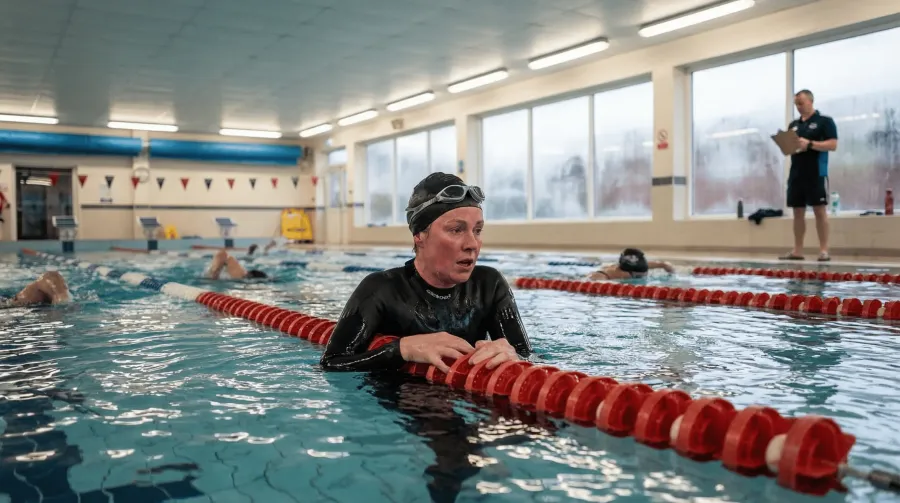
The training plan said "easy 20-minute swim." I managed 200 meters before stopping, panting, gripping the lane rope, and wondering if I had secretly developed asthma. I had not. I was simply very, very out of shape in the water.
Running was marginally better — I could manage 15 minutes of jogging before my lungs issued a formal protest. On the bike, I felt okay. Cycling was where my ego survived the first two weeks relatively intact.
Week 2 included my first "brick" workout — a 20-minute bike followed immediately by a 10-minute run. My legs felt like they'd been replaced with sandbags. The coach had warned me about "brick legs." I thought he was exaggerating. He was not.
Weeks 3–4: The Swimming Reality
I joined a Masters swim group. This was simultaneously the best and most humbling decision of the training block. The slowest person in the group swam circles around me — sometimes literally. But the coaching feedback was invaluable: I was swimming with my head too high, killing my body position and dragging my legs through the water like a human anchor.
One drill changed everything: the "downhill swimming" drill, where you press your chest slightly down to pop your hips up. My times dropped by 15 seconds per 100 meters in a single session. The coach had been telling me this for two weeks. I should have listened sooner.
Weeks 5–7: The Open Water Question
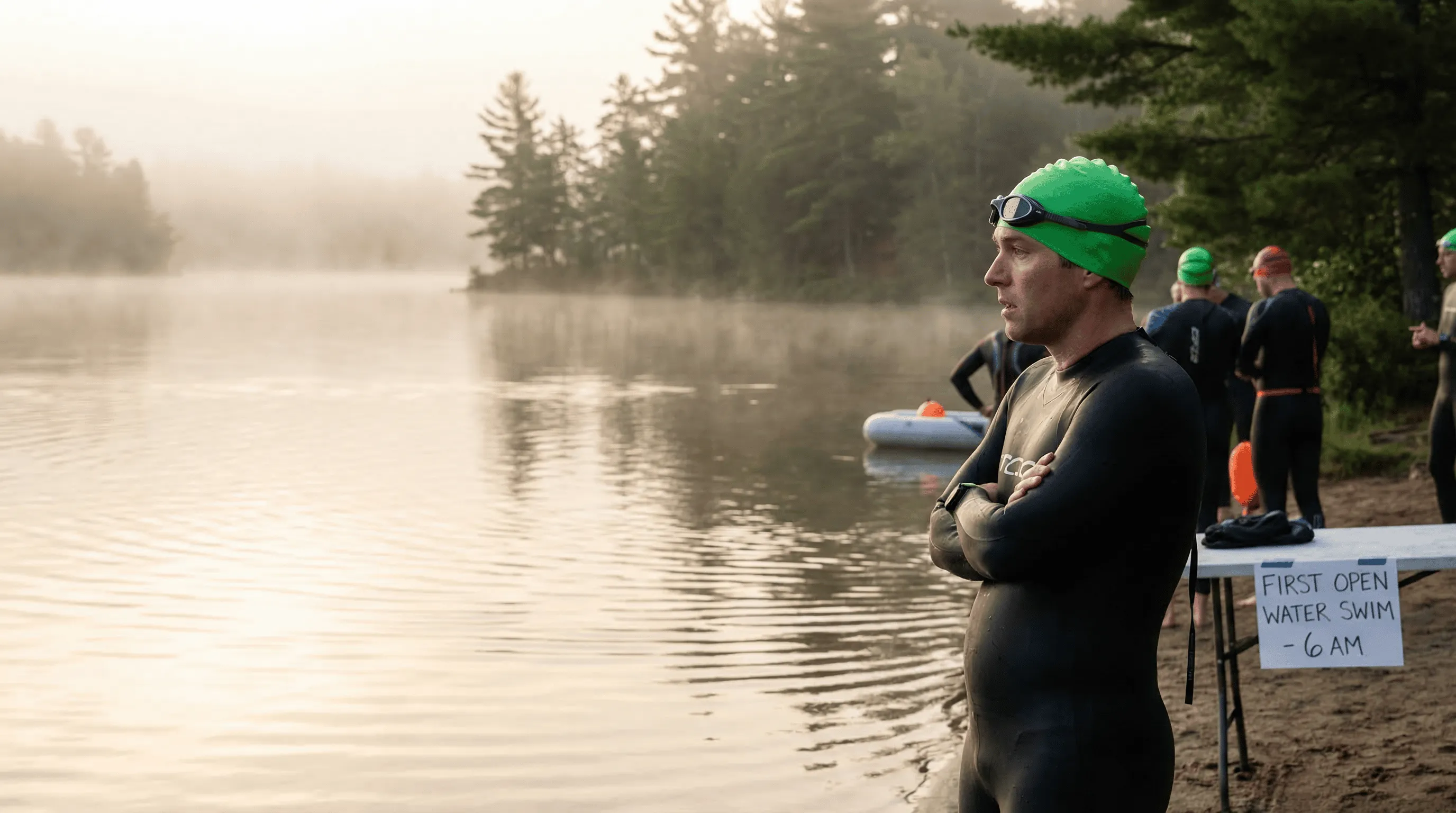
A local lake opened for open water swimming in May. I went. I should tell you I was calm and confident. I was neither.
There is something profoundly different about swimming in water you cannot see the bottom of, surrounded by other people's legs, with weeds occasionally brushing your ankle. The first 200 meters I spent primarily in a low-grade panic, breathing far too frequently and sighting every 5 strokes like a nervous periscope. By 400 meters, something clicked. The rhythm came. The breathing settled. I swam 700 meters without stopping and felt, for the first time, like this might actually be possible.
Weeks 8–10: Building Consistency
The training was now eating 8–10 hours of my week. I started waking up at 5:30 AM on Saturdays for long bikes, which is a sentence I would not have believed six months earlier. My partner remains saintly on the subject of early alarms and sweaty kit drying on the bathroom rail.
Week 9 included a 2-hour bike followed by a 30-minute run — my longest brick to date. Somewhere around kilometer 3 of the run, my legs stopped feeling like cement and started feeling almost normal. This is apparently what triathlon training feels like when it's working. I celebrated with a gel and a mild sense of triumph.
Weeks 11–13: The Dark Patch
Every training block has one. Mine arrived in week 11, in the form of a week of terrible sleep, a work deadline that ate my long ride day, and a swim session so bad I seriously considered pulling out of the race.
I texted my coach: "Feeling like this is too much." He replied: "That means the training is working. Absorb it. Rest this weekend. Don't quit."
I didn't quit. Week 12 felt measurably better. Week 13 felt almost good. Training has a way of looking like failure right before it looks like progress.
Weeks 14–16: The Taper and the Terror
Two weeks out, volume drops. Your body recovers. Your mind, liberated from the structure of heavy training, starts inventing new problems. What if the wetsuit is too tight? What if I get stung by a jellyfish? What if I forget how to swim entirely in the days between my last pool session and race day?
None of these things happened. But I checked my transition bag approximately nine times the night before the race.
Race Day
The 4:30 AM alarm. The parking lot at dawn, full of athletes who all looked like they knew exactly what they were doing (they told me later they did not). Body marking. The wetsuit going on with the ungainly ceremony that wetsuits always require. Standing at the water's edge listening to the pre-race briefing.
And then: the cold lake.
I don't care how much open water swimming you've done in training. The race start is its own experience. The mass start (even in a small sprint), the splashing, the brief moment of spatial chaos — it takes about 100 meters to find your rhythm and stop swimming defensively. I found mine at about 120 meters. The rest of the swim was, genuinely, fun.
Transition 1 was slower than I'd planned (wetsuit removal is an art form I have not mastered). Bike felt strong. I passed people, which I had not expected to do. The 20km flew by. Transition 2: shoes on, helmet off, race belt clicked. And then the run.
The brick legs were back, amplified. The first kilometer felt like running in wet sand. By kilometer 2, something settled. By kilometer 4, I was running properly — running racing — and I could see the finish chute ahead.
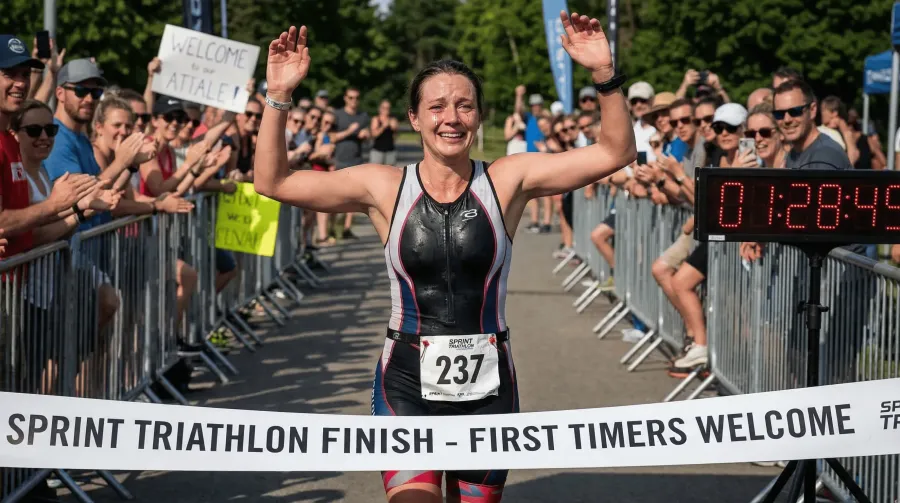
I crossed the line in 1:28:47. I was not the fastest person. I was not the slowest. I cried in a way that surprised me, which I assume is the standard reaction to completing something you genuinely didn't know if you could do.
What I Learned
- The swim is trainable. It feels most foreign at the start, but it responds fastest to technique work. Get coaching early.
- Brick legs are real and temporary. Train through them and they become manageable. Skip brick workouts and race day will introduce you to them forcibly.
- Open water is different but not dangerous. The fear is mostly in your head. Practice it and it becomes normal.
- Transition is a skill. Practice T1 and T2 before race day. It sounds silly. Do it anyway.
- The dark patch is part of the plan. When training feels impossible, it usually means the adaptation is happening. Rest, recover, continue.
I've already registered for a second race. Obviously.


