
Your swim form has been getting away with murder. For years, it has been hiding in the dark — literally — while you churned out lap after lap in the pool, blissfully unaware that your catch was 40 milliseconds late, your stroke rate was dropping every 200 meters, and your head position was pointing somewhere in the general direction of the ceiling. The swim leg of a triathlon is the one discipline that has historically been the hardest to get real-time feedback on. You can glance at your bike computer. You can check your watch on the run. But in the water? You were flying blind.
That changes now. HUD (Heads-Up Display) swim goggles — goggles with augmented reality displays built directly into the lens — have matured from a cool concept into race-legal, genuinely useful training tools. The gear story of 2026 isn't a new tri bike or a faster wetsuit. It's data appearing in front of your eyes while you swim, in real time, without stopping.
Whether that changes your training depends entirely on what your actual problem is. This article explains the tech, reviews the two main options, and gives you an honest answer on whether dropping $250–$330 on smart goggles is the best use of your gear budget or a very expensive way to watch your stroke rate decline in high definition.
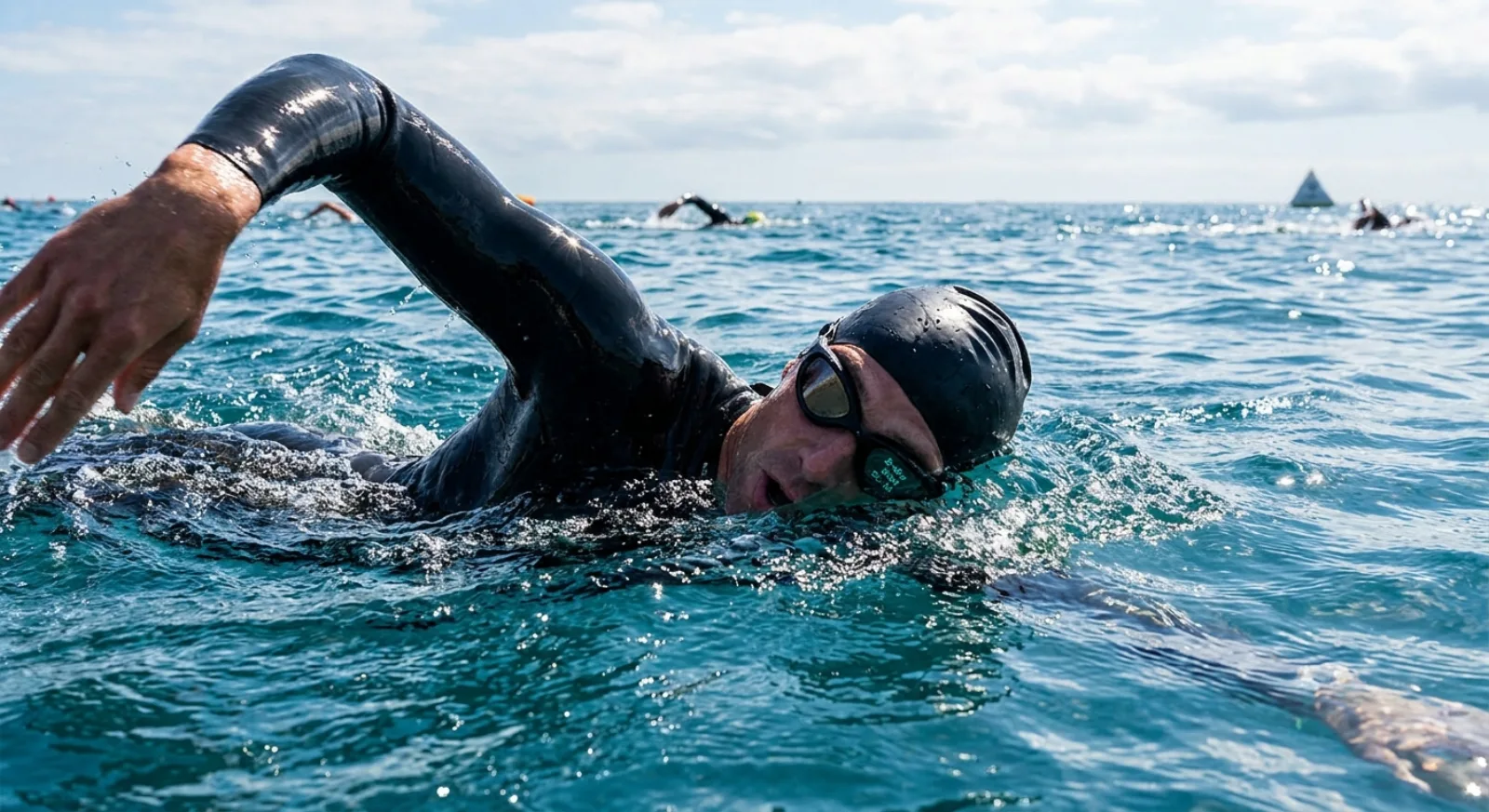
What HUD Goggles Actually Do (And How They Do It)
The core technology is augmented reality in a very practical, very focused form. A small display module — roughly the size of a large aspirin — is embedded into one side of the goggle frame. It projects a transparent overlay directly onto the lens in front of one eye. You see the water, the lane line, the buoy 40 meters ahead, and also — superimposed over all of that — a data readout updated every 1–2 seconds.
The metrics available vary by model and subscription tier, but the essentials are universal: pace per 100 meters, stroke count per length, stroke rate (strokes per minute), distance completed, interval time, and in the more advanced models, heart rate via an optical sensor built into the frame. Load a structured workout from the companion app beforehand and the goggles will guide you through intervals, rest periods, and target paces in real time — no more miscounting lengths or squinting at a pace clock mid-set.
For open water — which is where triathletes actually race — the better models add GPS integration (via pairing with a Garmin or Apple Watch), real-time distance and pace display, and a digital compass that tells you whether you're drifting off course between sighting strokes. That last feature alone is worth serious consideration for anyone who has "sighted" a buoy 200 meters into a swim and realized they were heading for the kayak instead.
The hardware is race-legal. Both FORM goggles and Holoswim are approved by World Triathlon, USAT, PTO, and most major sanctioning bodies. You can show up to race day wearing these without a penalty.
The FORM Smart Swim 2 and 2 Pro: The Standard-Bearer
FORM has owned this category since they launched the original smart goggles in 2019, and the current generation — the Smart Swim 2 ($279) and Smart Swim 2 Pro ($329) — represents meaningful refinement of a product that was already the market leader. The 2 Pro launched in summer 2025 and is the version most serious triathletes should be looking at in 2026.
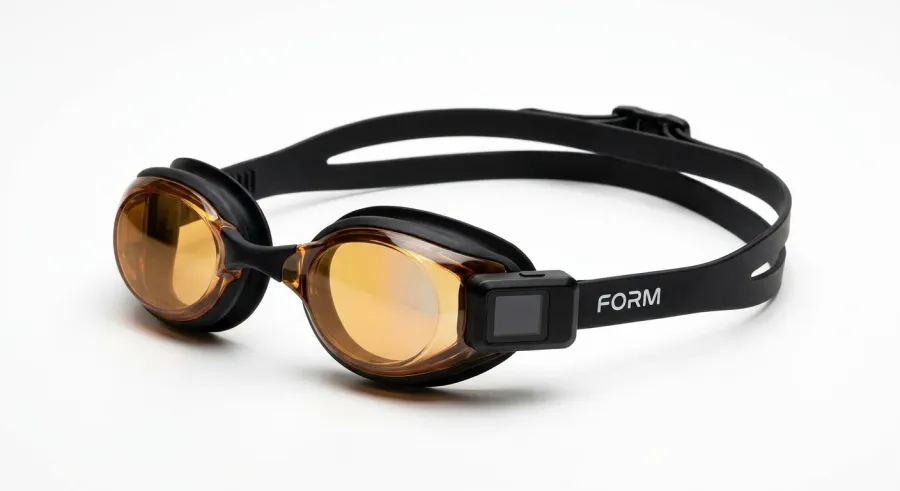
The display is positioned in the right lens (left-eye options exist), and it is genuinely unobtrusive in use. First-timers tend to over-read it — constantly flicking their gaze toward the HUD instead of watching where they're going — but within a few sessions it becomes background awareness rather than a distraction. You glance, you register the number, you adjust. Same muscle memory as looking at a bike computer mid-descent.
What's new in the 2 Pro: Corning Gorilla Glass 3 lenses mean the lens won't scratch through a season of hard use. The tech pack (the display module) has been slimmed down 15% for a more hydrodynamic profile. Battery life is an impressive 14 hours, which means you can leave the house without obsessing over charge state. The anti-fog solution has been improved — the company now ships a user-applied coating rather than relying on a factory treatment that degrades with cleaning.
Real-time metrics on the 2 Pro: pace per 100m, interval pace, stroke count, stroke rate (updated every 1.5 seconds), distance, time, heart rate (built-in optical sensor), calories, and SWOLF. The HeadCoach feature — available on the premium subscription ($15/month or $119/year) — adds real-time analysis of head pitch and roll with in-goggle coaching cues. If you've been told your head position is the problem and you don't know why your swim coach looks exhausted when they say it, this is the feature that will finally show you.
Open water: The SwimStraight digital compass is locked behind the subscription, which is mildly annoying given the price of the goggles. It works by displaying a bearing in the HUD — you set your target direction and the display tells you whether you're drifting. Paired with a compatible Garmin or Apple Watch, you also get GPS distance and pace. For triathletes doing open water training, this combination is genuinely excellent.
Ecosystem: The FORM app syncs automatically post-swim and exports to Strava, TrainingPeaks, TriDot, Apple Health, and Final Surge. If your training pipeline already runs through any of these, FORM integrates without friction.
The honest take: FORM is the best-in-class option. The metrics are accurate, the display is clear, the race-legal status is confirmed, and the app ecosystem is mature. The subscription is an additional ongoing cost to factor in — particularly if you want the open water compass and guided workouts that differentiate it from a basic pace clock. If you're training seriously for a 70.3 or Ironman, the total cost of ownership (goggles + annual subscription) is somewhere around $450 in year one. For most triathletes spending $15,000 on the race itself, that math makes sense.
Holoswim 2 Pro: The No-Subscription Alternative
Holoswim's 2 Pro entered the market as the budget-friendlier challenger to FORM, and it makes a compelling case on one specific front: there is no subscription. The features you get on day one are the features you have forever, no monthly fee required.
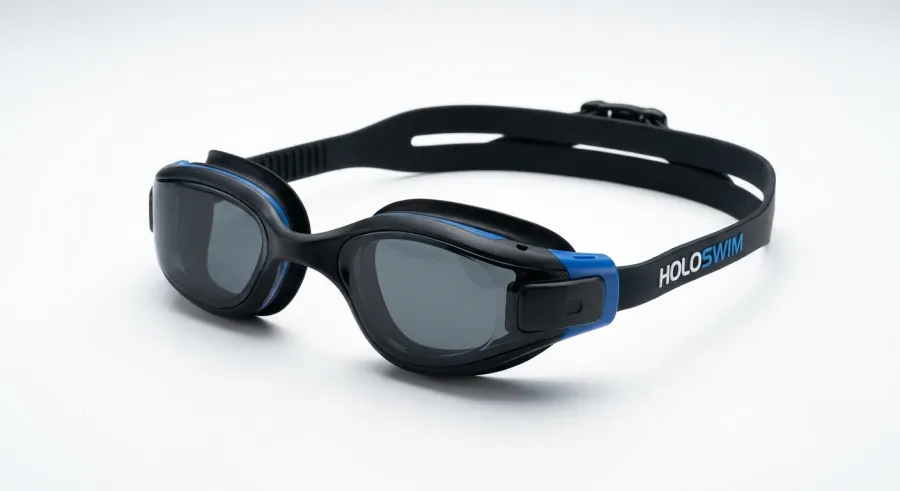
The Holoswim 2 Pro uses OLED holographic display technology with AR diffractive optical waveguides — which sounds impressive and, in practice, delivers a readable HUD in pool conditions. Metrics include pace, distance, laps, stroke count, SWOLF, calories, and rest time. The companion app provides AI-based post-swim analysis. Brightness is adjustable, which matters in outdoor conditions where a dim display can wash out entirely in bright sunlight.
Hardware specs: 8 hours of battery life, IPX8 waterproof rating, Bluetooth 5.3 for device sync, GPS tracking in open water, compatibility with Apple Watch and Garmin Forerunner. Nine interchangeable nose bridges — more options than FORM's five, which matters for athletes who have struggled with goggle fit. The TÜV Rheinland-approved nano anti-fog technology is a genuine selling point; foggy lenses on a HUD goggle are especially frustrating because you lose both visibility and data simultaneously.
The honest take: Holoswim is a solid product with one significant caveat: a subset of users report fit issues, specifically minor water leakage around the seal and discomfort during longer swims. This is not universal, and the nine nose bridge options help — but it's worth noting because a leaky goggle mid-race is significantly more inconvenient than a non-smart goggle that leaks. In open water, in a wetsuit, at 6 AM, you do not want to be adjusting your goggles. If you can try the Holoswim before buying, do it. If you're ordering blind and you know you have a difficult face shape for goggles, FORM's fit profile has been more consistently reported as reliable across a wider range of athletes.
The no-subscription model is genuinely appealing for budget-conscious athletes. If you want basic HUD metrics, open water GPS, and no ongoing cost, Holoswim 2 Pro delivers that.
What The Data Actually Shows You (That Your Coach Already Knows)
Here is the thing about HUD goggles that nobody in the marketing materials will tell you: the data is only useful if you know what to do with it. Knowing your stroke rate is 52 strokes per minute is information. Knowing whether 52 is too slow, too fast, or exactly right for your pace and distance — that requires either a coach, a training plan with targets, or enough experience to interpret it yourself.
The athletes who get the most value from HUD goggles fall into two categories: those who are already experienced enough to know what metrics to target, and those who are working with a coach who can translate raw numbers into actionable adjustments. Athletes in the middle — training alone, without structured targets for stroke rate or pace — will get some benefit from pace feedback but will likely find the data more interesting than useful for the first few months.
The open water navigation features are different. SwimStraight (FORM) and GPS tracking (both brands) deliver immediate, race-relevant value regardless of your experience level. Swimming straight in open water is not about skill so much as it is about feedback — and HUD goggles provide it in real time instead of retrospectively via GPS track analysis on your watch. If you're the kind of triathlete who habitually adds 200+ meters to every open water swim because your sighting is imprecise, a digital compass pointing you at the first buoy will pay for itself in time saved on race day.
Do You Actually Need These?
Blunt answer: probably not for your first three seasons in the sport. The swim leg of a triathlon — especially at sprint and Olympic distance — is primarily a fitness and anxiety management problem, not a real-time data problem. Getting your aerobic fitness up, your open water confidence solid, and your stroke efficient enough not to blow up your heart rate before T1 matters more than knowing your stroke rate to one decimal place.
The case for HUD goggles gets stronger the more of these boxes you check: you're already training seriously and know what metrics to target; you're doing significant open water sessions where navigation is a performance issue; you've hit a swim plateau and your coach suspects technique breakdown mid-set; or you're a data-driven athlete who finds feedback loops intrinsically motivating — because if wearing the goggles makes you swim more, that's a real benefit regardless of whether you're fully exploiting the analytics.
The case gets weaker if: you're still working on the fundamentals of your stroke; you're allergic to subscriptions; or you're the kind of athlete who checks the data for two weeks and then ignores it for the rest of the season.
A Quick Note on What Might Be Coming
Garmin was spotted in a March 2026 triathlon promotional video wearing HUD swim goggles with a noticeably different optical module configuration than any current FORM model. Nothing is confirmed. But if Garmin enters this market — and that video suggests they might be close — it will likely mean deep native integration with the Garmin ecosystem, foregoing the watch-pairing workaround that FORM currently requires for GPS data. That's worth knowing if you're on the fence and deeply invested in the Garmin ecosystem. A few more months of patience may be rewarded.
The Verdict
HUD swim goggles are no longer a novelty item for tech-forward early adopters. They're a mature, race-legal training tool with a clear value proposition for athletes who train seriously in the water. The FORM Smart Swim 2 Pro is the best option available in 2026 — accurate, durable, well-integrated with the apps you're already using, and backed by the most mature ecosystem in the category. The subscription adds real cost but the features it unlocks — particularly open water navigation — are legitimately useful for triathlon training.
The Holoswim 2 Pro is a genuine alternative for athletes who want core HUD functionality without an ongoing subscription, and who can confirm the fit works for them before committing.
Your goggle tan is not the problem. But your stroke rate dropping 12 strokes per minute between the 800m mark and the finish? Now you'll know about it the moment it happens.


