
Your legs aren't what quit on mile 18 of an Ironman run. Your brain does. And unlike your quads, your brain is trainable — if you're willing to do the work most triathletes skip entirely because it doesn't involve a Garmin or a new set of carbon wheels.
Mental toughness isn't a personality trait you're born with. It's a skill. David Goggins didn't stumble into 100-mile ultramarathons by accident — he built a mind that could override every signal screaming at him to stop. You don't need to become Goggins. But you do need to stop treating your mental game like an afterthought if you want to stop falling apart when the race gets real.
What Brain Endurance Training Actually Is (And Why It Works)
Brain Endurance Training (BET) is the practice of deliberately stressing your cognitive system during physical training. The science behind it is straightforward: mental fatigue and physical fatigue share neurological pathways. When your brain is already taxed, your perceived effort goes up — meaning the same pace feels harder. Train your brain to handle that tax, and race day feels relatively easier.
In practice, BET looks like this: before a hard bike interval session, you spend 20 minutes on a cognitive task — response inhibition tests, working memory drills, sustained attention tasks. There are apps like BrainHQ or even simple Stroop test sequences that work. Then you go into your training session mentally pre-fatigued. Your body adapts over time to perform under that load.
- Start small: 10–15 minutes of cognitive load before 1–2 sessions per week
- Use simple tools: Stroop tests, math sequences, dual n-back tasks — free online versions work fine
- Track perceived effort: Note your RPE during sessions with and without BET. The gap narrows over months
- Build gradually: Like any training stress, too much too fast leads to mental burnout, not toughness

Visualization: The Mental Dress Rehearsal You're Not Doing
Elite athletes across every discipline use visualization. Most age-groupers think it means "imagining yourself crossing the finish line looking good." That's not visualization — that's a fantasy. Real visualization is detailed, specific, and deliberately uncomfortable.
The goal is to mentally rehearse not just success, but the hard moments. The moment your goggles fog up at the swim start. The headwind on the bike at mile 70. The gut cramp at mile 10 of the run. When you've mentally lived through those scenarios dozens of times before race day, they stop being catastrophes and become familiar territory.
The drill: 3 nights a week, 10 minutes per session. Lie down, close your eyes, and walk through your race course in real time — not sped up, not highlights-reel style. Include transitions. Include the hard segments. Include the moment you want to quit. Then visualize yourself making the choice to keep going anyway. Feel the discomfort. Then override it.
"You have to go to war with yourself to find out what you're actually made of. Most people never start that war — they negotiate a peace treaty at the first sign of discomfort."
Positive Self-Talk That Doesn't Sound Like a Motivational Poster
When you're at mile 18 and your inner monologue sounds like a hostage negotiator trying to talk you into walking, what you say to yourself matters more than anything your coach programmed into your training plan. But here's the catch: generic affirmations don't work under real duress. "I am strong and capable" dissolves the moment the suffering gets serious.
What works is instructional self-talk — short, specific, action-oriented cues that redirect focus to execution. Research backs this up. Cue phrases like "smooth stroke," "fast feet," or "stay low" outperform motivational phrases in high-stress conditions because they give your brain something concrete to do instead of just registering the pain.

Build your personal cue library this week:
- Swim: "Long pull, high elbow" — keeps form when you're gasping
- Bike: "Smooth circles, relax shoulders" — breaks tension that kills efficiency
- Run: "Quick cadence, forward lean" — the two things that break down first under fatigue
- The dark moment: "This is the race. Right here." — a cue that reframes suffering as the point, not the obstacle
Practice using these cues during training — especially during the hard efforts. By race day they're automatic. Your prefrontal cortex checks out when you're suffering; these cues let the habit brain drive.
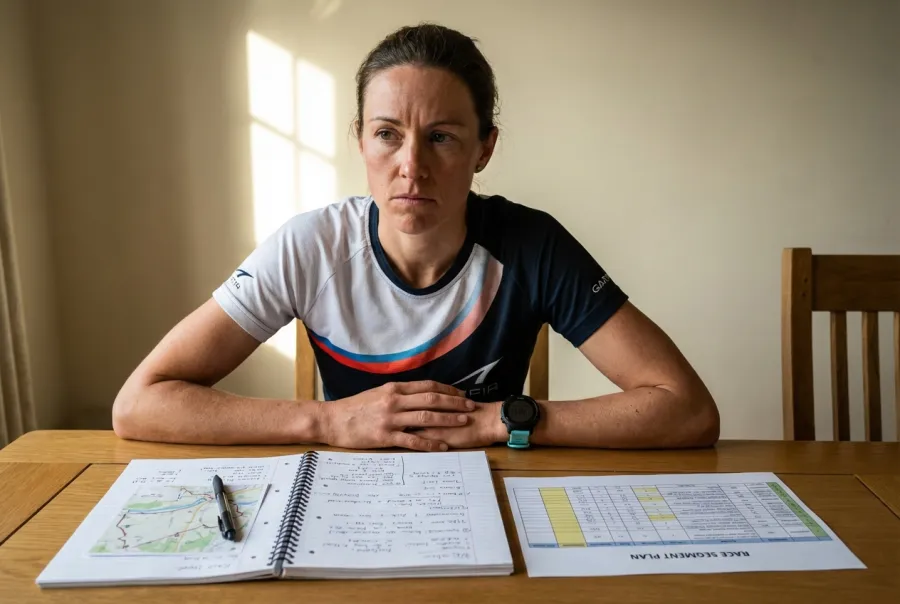
Race Segmentation: Eating the Elephant One Bite at a Time
The brain hates open-ended suffering. Tell someone to run until they can't, and they stop earlier than if you tell them to run for exactly 8 minutes. The mental weight of "140.6 miles to go" is crushing. The mental weight of "just make it to the next aid station" is manageable.
Race segmentation is how you keep yourself functional across long-course racing. You're not racing 140.6 miles. You're racing a series of much smaller challenges, each with a defined end point. The discipline is refusing to let your mind jump ahead to mile 18 when you're still in the water.
How to set up your segments:
- Break the swim into buoy-to-buoy legs — never think past the next orange buoy
- Divide the bike into thirds: settle in, execute, and protect your run legs
- On the run, use aid stations as reset points — each one is a new micro-race
- At every transition: full reset. You're starting fresh, not carrying what just happened
The Goggins version of this is his "40% Rule" — when your mind says you're done, you're actually at 40% of your real capacity. Segmentation is how you access that other 60%. You can't face the whole abyss at once. You can absolutely face the next 400 meters.
Your Week-One Mental Training Plan
You don't need to overhaul everything. Here's what you can start doing in the next seven days:
- Monday: 15-minute Stroop test session before your interval workout. Note RPE
- Tuesday: Write your 4 personal cue phrases. One per discipline, one for the dark moment
- Wednesday: First visualization session — 10 minutes, your next race, full course, hard moments included
- Thursday: Use your cue phrases during your long run. Every time you want to slow down, use the cue first
- Friday: Segment your next long ride on paper before you do it. Aid stations, turnaround points, landmarks
- Weekend long session: Practice race segmentation in real time. No looking at total distance — only look at next segment
The Bottom Line: The Mind Is the Limiter
You can have a $12,000 Canyon Speedmax, a perfectly dialed nutrition plan, and 18 months of structured training behind you — and your brain will still be the thing that decides whether you finish strong or shuffle to a walk on the run course. The athletes who understand this train the mind as deliberately as they train the body.
The hard truth is that mental toughness training is uncomfortable. BET sessions feel unpleasant. Visualization of suffering isn't fun. Sitting with race-day anxiety in your mind weeks before the start line takes courage. That's exactly why most people skip it. And exactly why doing it gives you an edge over most of the field.
Your brain is trainable. Start training it. The finish line isn't 140.6 miles away — it's the next buoy, the next aid station, the next 400 meters. See you out there.


