
Here's a number that should make you put down your coffee: a recreational triathlete averaging 25 km/h on the bike can save roughly 11 minutes on a 40km leg simply by getting into an aero position. A pro cruising at 45 km/h? They save around 6 minutes doing the same thing.
Read that again. The slower rider saves more time in absolute minutes — and dramatically more as a percentage of their race — than the elite athlete with a $12,000 carbon missile between their legs.
That's the aero paradox. And if you're an amateur who hasn't fully committed to riding in your aerobars yet, it means you're leaving some of the easiest free speed in triathlon sitting on the table, every single race. Let's fix that.
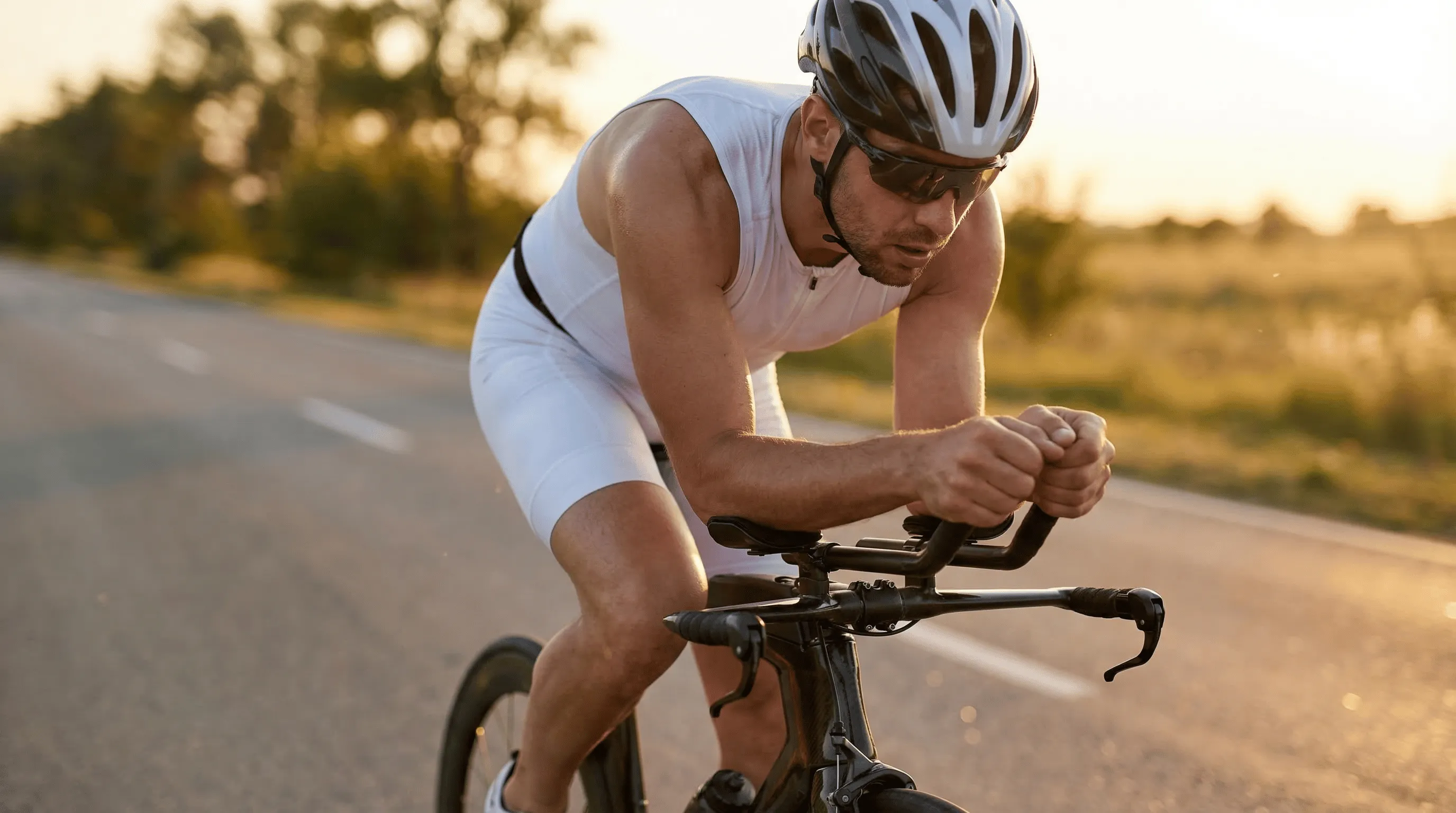
The Physics (Without Making Your Eyes Glaze Over)
You don't need a fluid dynamics degree to understand why this works. You just need to understand one core relationship: aerodynamic drag increases with the square of your speed.
The drag force acting on you as you ride looks like this:
F_drag = ½ × ρ × CdA × v²
Where: ρ = air density | CdA = your drag coefficient × frontal area | v² = your velocity, squared
That squared term is everything. Because the power required to overcome drag scales with the cube of velocity, pros fighting massive drag at 45 km/h are already in a constant war with aerodynamics — and they've already optimized everything. Aero helmets, skin suits, $4,000 wheels, position dialed on a wind tunnel rig. There's not much juice left to squeeze.
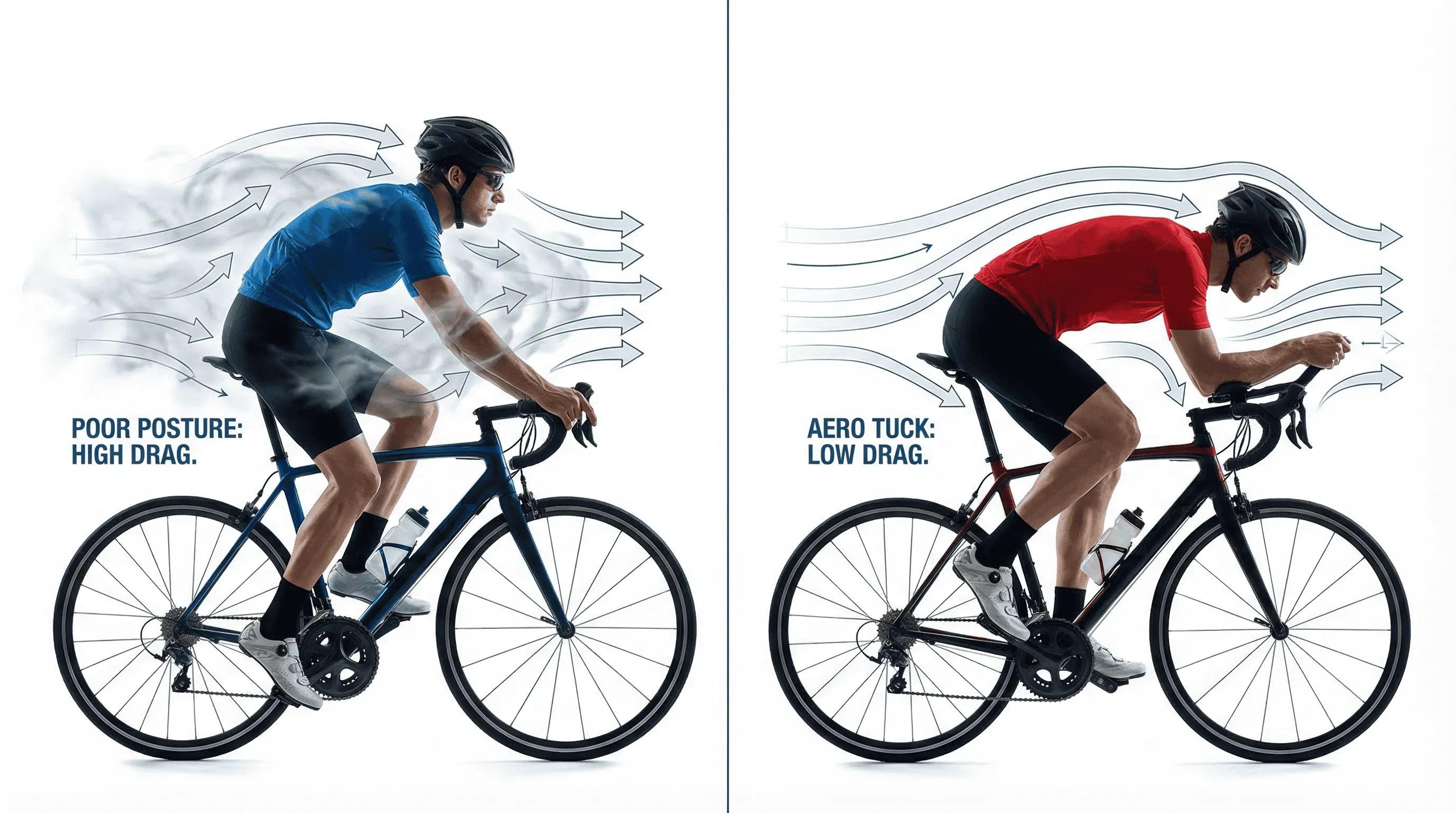
You, on the other hand, are riding at 25 km/h. Drag forces are significantly lower in absolute terms, but your position may be absolutely catastrophic — back arched like a nervous cat, elbows flared, chest puffed into the wind. Getting aero doesn't just trim a little drag. It fundamentally transforms your aerodynamic profile.
The Numbers, Simply
At slow speeds, drag is your biggest resistive force relative to what you're producing. Cutting your CdA meaningfully by tucking into aero position might drop it by 20–30%. At 25 km/h, that saves you enormous effort over 40km — effort you can redirect into going faster, or saving your legs for the run.
At 45 km/h, drag dominates everything — it's over 80% of resistive force. But the pros have already minimized their CdA as much as humanly possible. Their marginal gains from position alone are small because they've already captured them. You haven't.
The takeaway: Aero position gives you access to gains you haven't captured yet. The slower you go, the bigger the uncaptured opportunity.
"But I Can't Hold That Position for Five Hours"
Fair. And this is where the rubber meets the road, because getting into an aero position for 30 seconds at the start of a ride is not the same as sustaining it at mile 75 of an Ironman when your lower back is on fire and your quads have filed a formal complaint.
This is also why most amateur athletes get fitted, ride aero for the first 20 miles, and then quietly sit up and abandon their aerobars for the rest of the race. Their fit might be technically correct. Their body just isn't ready for it.
The solution isn't a better bike fit. It's aero endurance.
Building Aero Endurance: The Drills That Actually Help
Think of your aero position like a muscle group. You don't deadlift your one-rep max on day one. You train it progressively. Same logic applies here.
Drill 1: The Aero Interval
On your next easy ride, spend the first 10 minutes sitting up as normal. Then drop into your aerobars and stay there for 5 full minutes. Sit up for 2. Repeat. Not glamorous. But it trains your hip flexors, lower back, and neck to tolerate the position under load. Increase the aero intervals by a minute or two each week. After a month, you're doing 15 minutes on, 2 minutes off. After two months, you're holding aero for extended stretches without thinking about it.
Drill 2: The "Last 20%" Rule
Whatever your long ride is — 60 miles, 80 miles, 100 miles — make it a personal rule to stay aero for the final 20% of the ride, no matter what. This is the part of your race where position collapses. Training your body to hold form when it's fatigued is arguably more valuable than training aero when you're fresh.
Drill 3: Brick Aero Focus
Do a 45-minute ride with the final 15 minutes locked in aero, then run immediately after. Notice where you feel it. Tight hip flexors? Low back fatigue? Neck strain? These are your limiters — and now you know exactly what to strengthen off the bike. Core work (planks, dead bugs, bird dogs) isn't optional for aero riding. It's the support structure that lets your body maintain the position without defaulting to passive slouching onto your spine.
Drill 4: The Slow Road Test
Here's a counterintuitive one: practice your aero position at low intensity. When you're working too hard, your instinct is to sit up for more air. But if you can learn to breathe comfortably in aero at Zone 2, your body starts to accept it as a normal state rather than an emergency one.
Why Your Bike Fit Is Only Half the Story
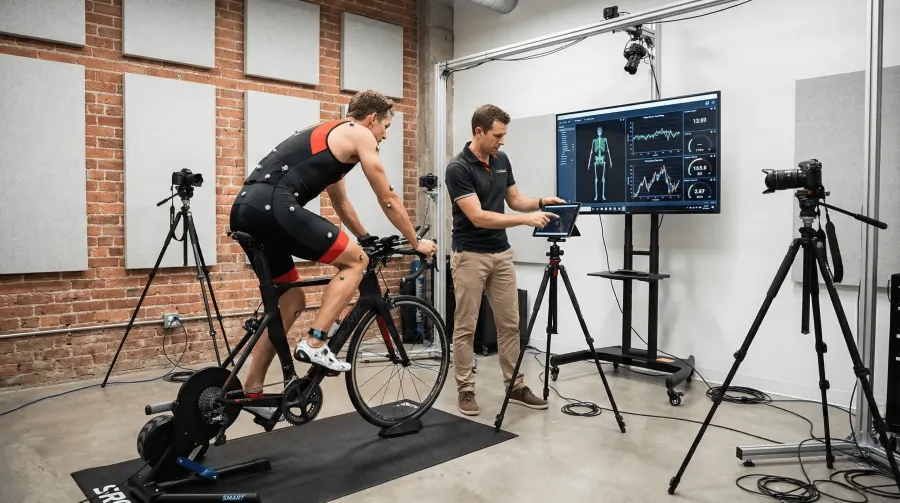
A good bike fit matters. A great fitter will set you up in a position that's both aerodynamic and sustainable — hip angle, reach, drop, pad width, all of it calibrated to your body.
But here's the uncomfortable truth: most bike fits are performed while you're fresh.
You sit on the trainer in the shop. You pedal for 15 minutes. The fitter adjusts. It looks great. You feel good. Then you race 80 miles and your body breaks down. The hamstrings tighten. The hip flexors protest. The lower back rounds. You pop up off the aerobars and ride the last 30 miles of your Ironman like you're out for a Sunday cruise, bleeding minutes you'll never get back.
This isn't a fit problem — it's a conditioning problem. A few things that actually help:
- Ask your fitter for a "fatigued fit" — some progressive fitters will fit you after a hard 2–3 hour ride, not before.
- Record yourself on video at the 60-minute mark and the 90-minute mark. Is your back rounding? Are your elbows drifting out?
- Don't chase the most aggressive position you can hold for 5 minutes. Chase the most aggressive position you can hold for the duration of your event.
The fastest aero position is the one you can actually maintain.
Common Mistakes That Kill Your Aero Gains
Mistake 1: Hands Too Wide
Wide hands on the pads significantly increase your frontal area. Keep your elbows shoulder-width or narrower and your hands close together. If your bars are forcing your elbows out, get them adjusted.
Mistake 2: Head Up, Chest Down
Some riders tuck their torso nicely but then crane their neck skyward to see the road, turning their head into a sail. Practice looking up with your eyes, not your chin. A slight head tilt is fine. A periscope neck is not.
Mistake 3: Skipping Aero in Training
You can't race aero if you don't train aero. Full stop. If you're doing all your long rides sitting upright and only touching the aerobars in races, you're setting yourself up for exactly the kind of mid-race collapse described above. Ride aero in training. Period.
Mistake 4: Conflating Aero with Suffering
Some riders associate getting on the aerobars with discomfort, and so they unconsciously resist it. The goal of the drills above is to reframe aero as normal. Sitting up should eventually feel like the unusual choice, not the relief valve.
The Takeaways (No Fluff)
- The physics are real. Slower riders gain more from aero position — in absolute time saved — than faster riders. This is not a motivational platitude. It's math.
- Your CdA is your biggest lever. More impactful than your wheels, your frame, or your power output, for most amateur athletes.
- Aero endurance is a trainable quality. Build it progressively. Treat your position like fitness, not furniture.
- Bike fit is necessary but not sufficient. A fit that doesn't account for race fatigue is only solving half the problem.
- The last 20% of your ride is where races are won and lost. Train your body to hold position when it's screaming at you to sit up.
Stop Donating Minutes to the Wind
Here's the thing: you probably paid good money for a triathlon bike, or at the very least, a decent set of clip-on aerobars. You've trained your run, hammered your swim sets, and agonized over your nutrition plan. But if you're spending more than 20% of your bike leg sitting upright, you've left one of the biggest performance variables in the sport almost entirely unaddressed.
The pros have squeezed every last watt from their aerodynamic setup. They've earned those gains. You haven't captured yours yet — and unlike the years of training required to get faster legs or a stronger engine, the aero gains are right there, waiting. Get low. Stay low. And watch the minutes come back to you.
Have questions about building your aero position? Drop them in the comments below — or share your experience from your last race.


