
Somewhere around mile 65 of the Ironman bike leg, something happens. The novelty of the race has worn off. The finish line is abstract and distant. Your legs hurt in ways you had theoretically prepared for but didn't fully believe. And your brain — the same brain that signed you up for this — starts generating creative arguments for why slowing down is, actually, the rational choice.
The four-hour bike leg is as much a psychological challenge as a physical one. We spoke with a sports psychologist and three athletes who've navigated it multiple times to understand what actually happens inside your head during the bike — and how the best athletes manage it.
The Psychological Arc of the Ironman Bike Leg
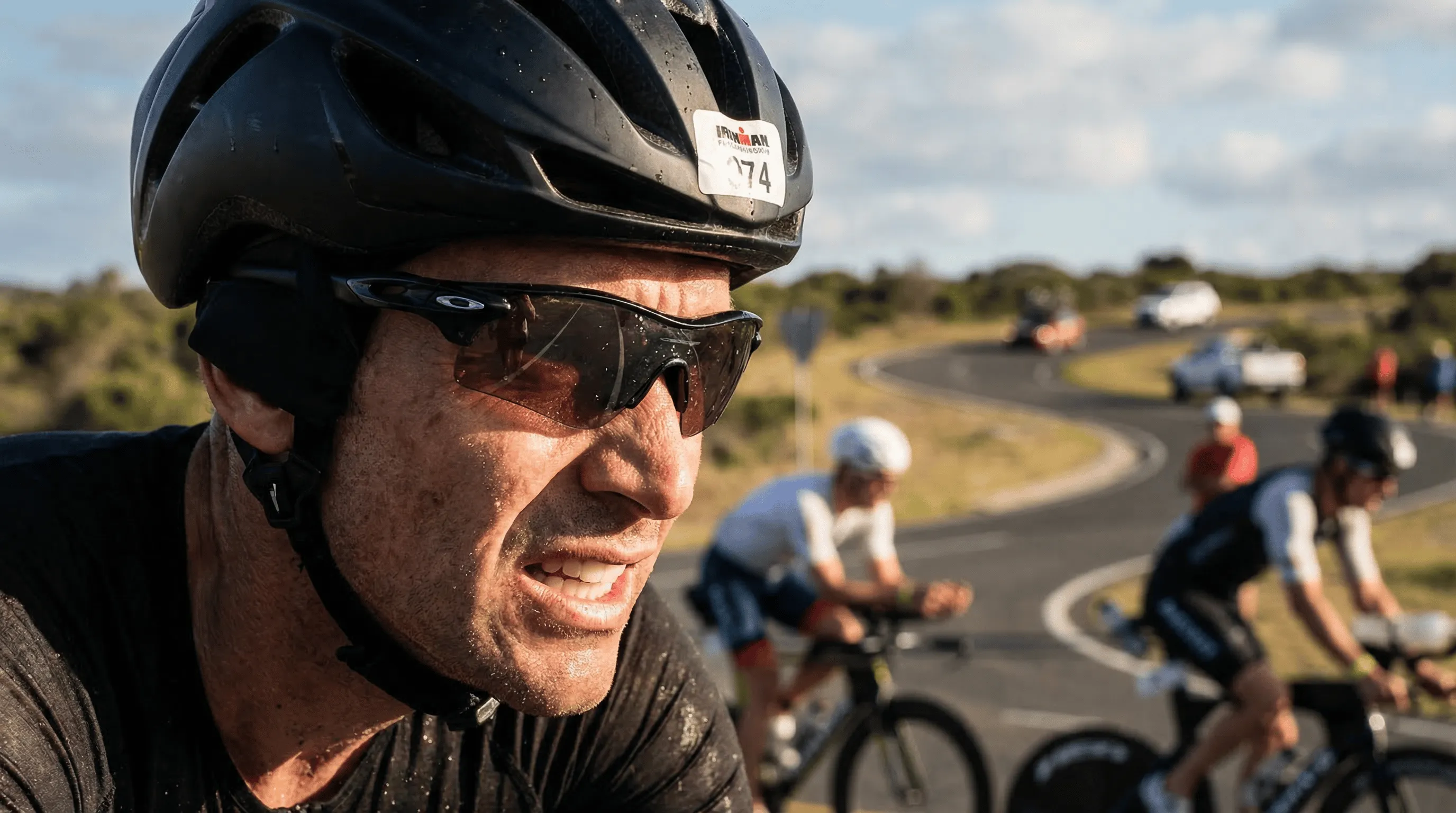
Sports psychologist Dr. Sarah Coelho, who works with age-group and professional triathletes, describes a predictable psychological arc for most Ironman competitors:
- Miles 0–20: The honeymoon. Adrenaline from the swim. Fresh legs. Feeling faster than expected. This is when most athletes go too hard. "The emotional state during this phase is a significant performance liability," Coelho notes. "Athletes make pacing decisions based on how they feel rather than what the data says."
- Miles 20–50: The settling. Reality arrives. Legs begin accumulating fatigue. The rational brain reasserts control. Most well-prepared athletes find their rhythm here.
- Miles 50–80: The reckoning. This is the defining stretch. "This is where the race within the race happens," says Coelho. "Athletes who have a psychological strategy for this phase consistently outperform those who don't."
- Miles 80–112: The survival math. Athletes in this phase are doing constant negotiation — with their bodies, their pacing targets, and their reasons for being there.
Technique 1: Segmentation
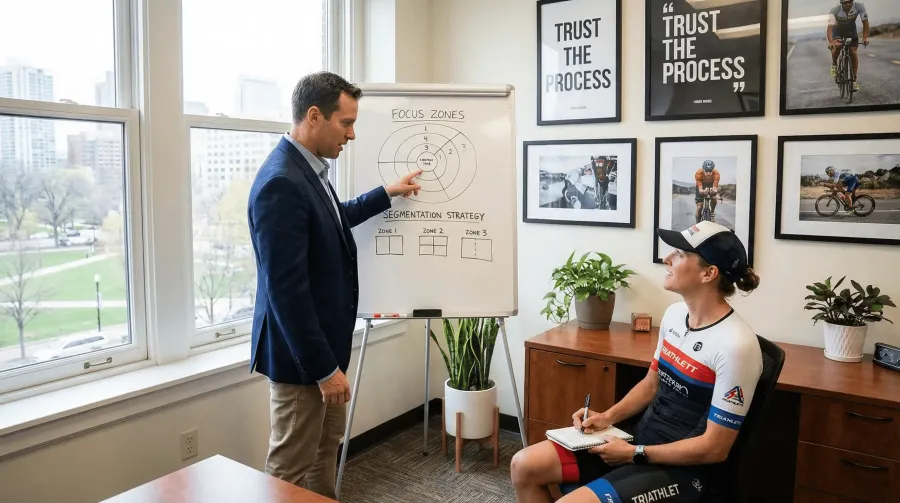
The most widely used mental technique among experienced long-course athletes is segmentation — mentally dividing the bike leg into smaller, more manageable chunks rather than confronting the full distance as a single unit.
Kona finisher and two-time Ironman competitor Marcus Thiele explains his approach: "I never think about the full 112 miles. I think about the next aid station. When I get there, I think about the next one. The race becomes a series of small tasks rather than one overwhelming number."
This isn't just a coping mechanism — it's backed by research. Studies on attention focus and endurance performance show that athletes who use a "dissociative" strategy (focusing on external tasks and segments rather than internal discomfort) maintain better pacing and report lower perceived exertion at equivalent effort levels compared to athletes who focus on bodily sensations.
Technique 2: Process Focus Over Outcome Focus
The athletes who struggle most in the back half of the bike leg are typically those fixated on finish-line outcomes: their target time, their position in the age group, whether they'll qualify for worlds. These are outcomes over which they have zero control in the moment.
The most resilient athletes focus on process: Am I hitting my power targets? Am I drinking on schedule? Is my cadence where I want it? These are questions with immediate, actionable answers that keep the brain productively occupied rather than catastrophizing about the finish time.
"Process goals give you a task to complete every few minutes," says Coelho. "Outcome goals just give you something to worry about."
Technique 3: Mantras That Actually Work
Instructional self-talk — short, specific phrases — outperforms motivational self-talk ("you can do it!") in endurance research by a significant margin. Age-group athlete and Ironman finisher Jamie Sato uses three mantras at different points in the bike leg:
- Early bike (miles 1–40): "Patient. Smooth. Save the run." — a reminder to resist the temptation to respond to the pace of riders around her.
- Mid-bike (miles 40–80): "Power to the pedals." — a technical cue that keeps her attention on mechanics rather than fatigue.
- Late bike (miles 80–112): "Every mile is a mile closer." — not inspirational poetry, but functionally effective at the end of a long day.
The specificity matters. Generic phrases like "believe in yourself" have limited evidence for performance benefit. Concrete, technical cues tied to specific actions keep the athlete's focus where it belongs.
Technique 4: Dealing With Dark Moments
Every long-course triathlete eventually has a dark moment on the bike. Mechanical trouble. Stomach revolt. A bad stretch of headwind. The moment where the internal monologue shifts from "this is hard but manageable" to "this might not be possible."
Coelho recommends a three-step approach:
- Name it. "I'm having a hard time right now." Labeling the experience reduces its emotional intensity. Research in affective labeling suggests that naming a negative state activates the prefrontal cortex and reduces amygdala response — less panic, more problem-solving.
- Identify the next single action. Not the finish line. Not the mile 80 aid station. The very next action: finish this gel, get to the crest of this hill, turn the pedals 10 more times. Granularity helps.
- Remember your "why." The months of training, the reason you signed up, the people you told. Having this articulated before race day and accessible during a dark moment is one of the most reliable psychological anchors in endurance sport.
The Age-Group Advantage: Music
Unlike professional triathletes, age-groupers are permitted to use headphones on the bike at many non-draft-legal events (check your race rules). The research on music and endurance performance is robust: music at the right tempo can reduce perceived exertion by 10–15%, improve power output, and extend time to exhaustion significantly.
For Ironman athletes using music: curate a specific playlist for miles 50–80 — the segment that needs the most psychological support. Don't run music the whole bike (decision fatigue + potential safety issues). Treat it as a tool to deploy strategically, not a constant companion.
Managing Transitions as Mental Resets
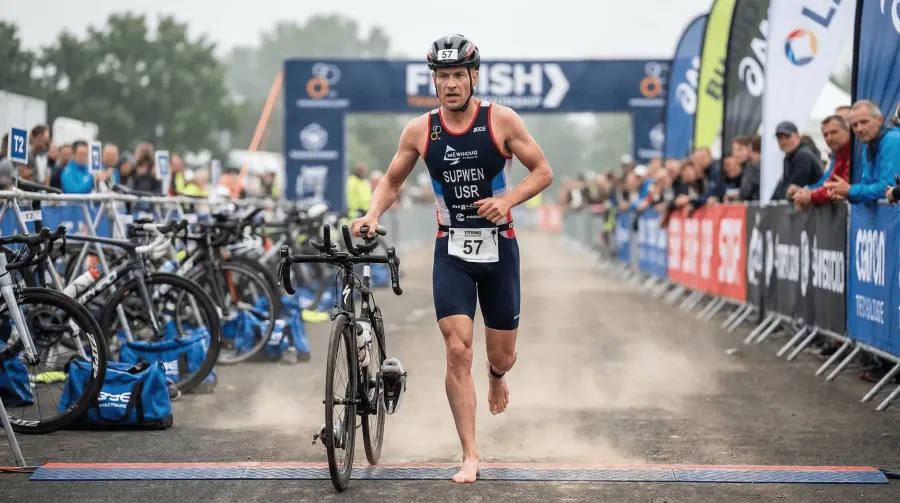
Transitions are the most underrated mental reset in triathlon. T2 — the bike-to-run transition — is a natural opportunity to close the book on the bike leg, regardless of how it went, and begin a fresh psychological chapter. Athletes who enter T2 ruminating on a slow bike split or a missed nutrition window carry that cognitive load into the run.
A simple T2 ritual — a specific phrase you say to yourself, a breath reset, a deliberate "closing" of the bike chapter — helps more athletes than most coaches acknowledge. Decide what yours is before race day. Execute it every time you practice transitions. Make it automatic.
The Bottom Line
The mental game during the Ironman bike leg is not a soft skill — it's a performance variable with meaningful impact on your race outcome. The athletes who finish strongest aren't just the fittest. They're the ones who've thought carefully about what they'll say to themselves at mile 75 when everything hurts and the finish line feels impossibly far away.
Train your mind the way you train your legs. It responds to progressive overload just the same.


