
Your heart rate is 20 beats higher than normal, you're running 90 seconds per mile slower than planned, and you feel like someone wrapped your head in a wet wool blanket. Welcome to your first real summer training session. Welcome to the part nobody warns you about.
Training through summer heat isn't about toughness. It's about understanding what heat does to your cardiovascular system — and using that knowledge to come out the other side faster, not burned out. The athletes who blow up in July didn't suddenly get soft. They skipped the heat acclimatization window.
What Heat Actually Does to Your Body
When ambient temperature rises, your body faces two competing demands: keep the muscles working, and prevent your core temperature from going critical. Blood that would normally power your legs gets diverted to the skin to dissipate heat. Your heart rate climbs to compensate. Plasma volume drops as you sweat. The result: a cardiovascular system running near capacity just to keep you upright at a pace you'd call easy in October.
The numbers are sobering. Sports science consensus research shows that at 86°F (30°C), performance can drop 3–5% compared to racing at 59°F (15°C). Heart rate drifts 5–10 bpm higher at any given pace. Lactate accumulates faster. Perceived exertion climbs. And that's before factoring in dehydration.
The good news: your body adapts. And it adapts faster than most people think.
The Heat Acclimatization Window: 10–14 Days
Heat acclimatization is a real, measurable physiological process. Done correctly, daily heat exposure triggers a cascade of adaptations over 10–14 days:
- Plasma volume expansion: Within 5–7 days, blood plasma volume increases 4–12%, improving cardiac output even as blood is being diverted to cool the skin.
- Earlier, more efficient sweating: Your body starts sweating sooner and produces more sweat — but loses fewer electrolytes per liter of sweat. A net win.
- Lower resting core temperature: Your thermostat resets slightly downward, giving you more buffer before heat becomes dangerous.
- Reduced cardiovascular strain at equivalent effort: The pace that cost you 165 bpm in week one will cost you closer to 155 bpm in week two.
Sports scientists recommend starting a first heat block 6–8 weeks before your goal race, then running a final 6–10 day block during taper — when you want the adaptations fresh and your body isn't being crushed by high training load at the same time.
How to Actually Acclimatize (Four Methods That Work)
You have options depending on your climate, schedule, and how much discomfort you can tolerate.
1. Train in the Heat
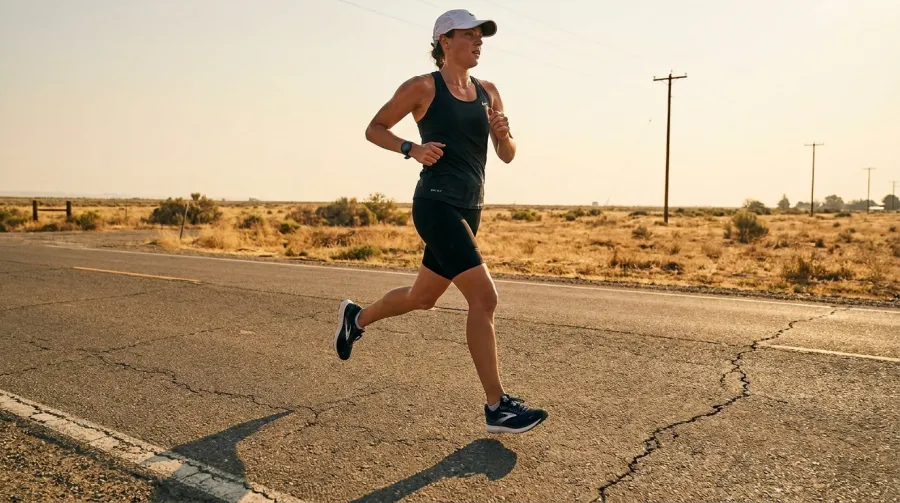
The most effective method: do your sessions outdoors when it's hot. Aim for 60–90 minutes of daily heat exposure during your acclimatization block. Start at lower intensity — Zone 2 only for the first few days — and increase duration and effort as your body adapts. Day one should feel uncomfortably slow. That's expected.
If you live somewhere that doesn't get properly hot until July, front-load this method once the heat arrives. Even training at 75°F builds real adaptation.
2. Hot Bath Protocol
If you're still stuck in 55°F weather, you can trigger many of the same adaptations in your bathtub. After a normal workout, soak at approximately 104°F (40°C) for 15 minutes on day one, adding 5 minutes per day until you reach 40 minutes by day six. The discomfort is real. So are the physiological gains.
This passive heat loading approach is backed by peer-reviewed research and used by elite athletes preparing for hot-weather championships. It's not a perfect substitute for outdoor heat training, but it moves the needle when outdoor temperatures aren't cooperating.
3. Overdressing on Workouts
Add an extra layer for Zone 2–3 runs and bike sessions — a long-sleeve under a jersey, or a jacket you can shed if it gets genuinely dangerous. This raises core temperature during exercise without requiring a climate change. Use it as a supplement to outdoor heat work, not a replacement.
4. Sauna Sessions
20–30 minutes in a sauna post-workout, 4–5 days per week, produces meaningful heat adaptations with minimal added training stress. Best used during high-volume blocks when you can't add more load without breaking down.
Pacing in the Heat: The Numbers You Actually Need
The single biggest mistake in summer racing and training: refusing to accept that your goal pace isn't appropriate for today's conditions. Your ego wants to hit the numbers. The heat doesn't care.
A practical framework:
- At 77°F (25°C): Expect heart rate to run 5–8 bpm higher at identical effort. Heart rate athletes should recalibrate their zones upward by that margin.
- At 86°F (30°C): Target 3–5% slower than cool-weather race pace. On a 4:00 hour 70.3 bike split, that's 7–12 minutes of intentional slowdown — on the bike alone.
- At 95°F+ (35°C+): RPE becomes your primary guide. Your power meter tells you what you're producing, not what it's costing you. Trust how you feel.
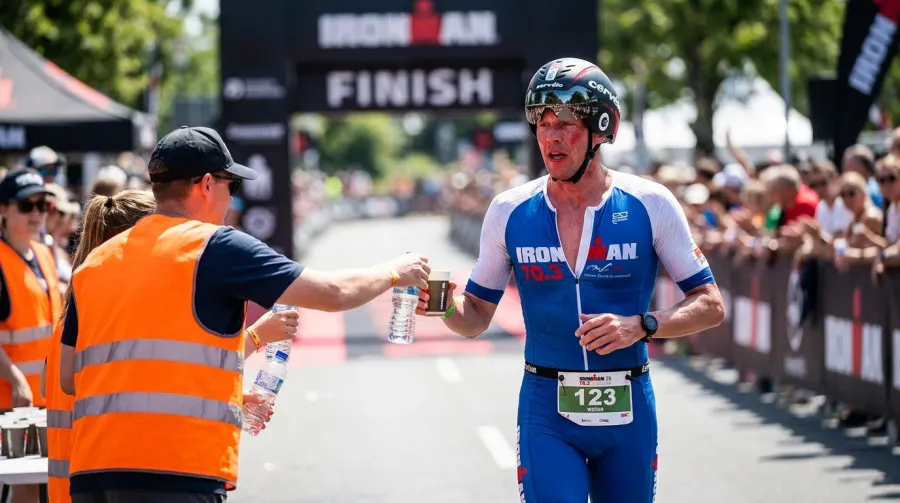
In races like IRONMAN Texas or the summer 70.3s in New Mexico and the Southwest, conservative pacing in the first two-thirds of the bike is where races are won. The athletes who reel you in on the back half of the run didn't suddenly go faster — you went out too hard when the conditions were already telling you to back off.
Electrolytes: What You Actually Need
Sodium is the electrolyte that matters most in hot-weather triathlon. Lose too much and blood sodium drops — hyponatremia — which is usually caused not by sweating too hard, but by replacing fluid losses with plain water and no sodium. The fix is simple: make sure every bottle has electrolytes in it.
Targets for summer training and racing:
- Sodium: 300–600 mg per hour in moderate heat. Heavy sweaters or anyone racing at 90°F+ should target 800–1,200 mg per hour.
- Fluid: 24–32 oz of electrolyte drink per hour on the bike, adjusted to your actual sweat rate and ambient temperature.
- Pre-race sodium loading: Increase intake in the 24–48 hours before a hot race — salty food, extra electrolyte mix, not avoiding the salt shaker.
Products that work well for US athletes: Precision Fuel and Hydration tabs (high sodium, available on Amazon, ~$20 for 10 tubes), Skratch Labs Hydration Mix (~380 mg sodium per serving, $22 for 20 servings at REI), Nuun Sport (low calorie, good for training, ~$8 per tube at Target), and Liquid IV Hydration Multiplier (higher calories and sodium, useful on race day, ~$25 for 16 sticks). Get a sweat test if you're serious — sodium losses vary dramatically between individuals.
One practical rule that separates prepared athletes from not: on race day, keep your hydration separate from your calories. Carry electrolytes in your bottles; take calories from gels and solid food. This lets you increase fluid intake as heat demands without overcalorie-loading your gut and paying for it on the run.
Warning Signs: When to Back Off
Heat training is a training stress. Like any stress, it can tip from productive to harmful. Stop or slow down immediately if you experience:
- Dizziness or disorientation that doesn't clear when you slow down
- Nausea that persists despite easing effort and drinking
- Heart rate that won't drop even as you significantly reduce pace
- Cessation of sweating when conditions say you should still be sweating heavily
- Muscle cramps that don't respond to slowing down and hydrating
The difference between productive heat stress and heat illness is recovery. If you wake up the next morning still feeling wrecked from yesterday's session, that's damage — not adaptation. Pull back the block, prioritize sleep and hydration, and try again in two days at lower intensity.
The 8-Week Game Plan for Summer Racing
If your goal race is a summer 70.3 or full IRONMAN — Texas, Ruidoso, Coeur d'Alene, or any other hot-weather event — here's how to structure the next 8 weeks:
- Weeks 1–2: Begin outdoor training in whatever heat you have access to. If temperatures aren't cooperating yet, start the hot bath protocol. Zone 2 only. No heroics.
- Weeks 3–6: Increase heat exposure and gradually reintroduce intensity. Use heart rate drift as your adaptation progress meter — when it starts coming down at the same effort, the adaptations are taking hold.
- Weeks 7–8 (taper): Final 6–10 day heat block at moderate intensity. Dial in your electrolyte plan in race-like conditions — wear your race kit, use your race-day nutrition products, practice your cooling strategy at simulated aid stations.
If your goal race is September or October, you have a structural advantage: natural heat all summer. Use it. Don't save your heat training for a formal block — train outdoors when it's hot, stay consistent on electrolytes, and let the adaptation happen organically across the season.
Summer triathlon isn't harder than winter triathlon. It's a different problem with different rules. The athletes who show up to July races fit but unprepared for heat are the same athletes who get passed in the final miles and spend the post-race tent wondering what happened to them. Acclimatize early, pace honestly, drink salt. The heat will still be difficult. It just won't catch you off guard.


