Somewhere around mile 40 of the bike, you realize today is not going to go the way you planned. Maybe you flatted and burned ten minutes on the side of the road. Maybe the swim was a washing-machine chaos that spiked your heart rate so high your first mile of running felt like sprinting. Maybe you made the classic mistake of going out too hard because the first five miles of the bike felt incredible, and now your legs are sending you an invoice you cannot pay. The plan is broken. The goal time is gone. And you still have 70 miles to go.
What happens in the next five minutes — not the next five hours, the next five minutes — will determine what kind of race you have. Most athletes blow the mental reset. They spiral into what the race psychologists call rumination: obsessive replaying of the bad event, catastrophizing about what comes next, a mental loop that burns cognitive energy, raises cortisol, and makes the physical work harder than it already is. The athletes who salvage hard days are not superhuman. They have practiced a specific set of mental tools that break the spiral before it takes hold. This is those tools.
Why One Bad Segment Poisons the Rest of the Race
The mechanism is not mysterious. When something goes wrong mid-race, the emotional brain (amygdala) tags the event as a threat, which triggers a stress hormone cascade — cortisol, adrenaline — designed to mobilize resources against danger. In a race context, this translates to elevated heart rate, disrupted breathing rhythm, and the hijacking of cognitive resources by threat-processing. Your prefrontal cortex — the part responsible for tactical decisions, pacing judgment, and rational self-talk — gets partially shut out. You are running on fight-or-flight fuel at a moment when you need measured, economical forward progress.
The spiral compounds because endurance racing is an inherently ego-involved activity. You trained for months. You have a number on your chest. You told people what time you were going to run. When the race goes wrong, the threat is not just physical — it is social and identity-level, which the brain treats as no different from physical danger. The result is that athletes who blow up mentally after a problem are not weak. They are having a completely predictable human response that simply has to be interrupted and redirected with specific technique.
The Five-Minute Window: Catching the Spiral Before It Sets
Sports psychologists consistently identify a window of roughly three to five minutes after a negative race event during which the mental response is still malleable. After that window closes, the rumination loop tends to solidify and become the dominant mental state for the remainder of the race. Your job is to intervene during that window with a deliberate reset sequence.
Step one: Name it and close it. Say — out loud or internally, whatever works — a single closing phrase. Something like: "That happened. It is done. Next." This is not toxic positivity or pretending the event did not occur. It is a deliberate cognitive act of filing the event in the past tense so your brain stops treating it as an ongoing, unresolved threat. The specifics of the phrase matter less than the act of saying something definitive. "Okay. Moving on." "Bad swim. On to the bike." "Flat. Dealt with. Let's ride." Make it concrete, past-tense, and final.
Step two: Reset your breathing before you reset anything else. A bad event almost always disrupts breathing rhythm — either shortening the exhale or causing you to breathe shallowly from the chest. This feeds the stress response directly. Before you reassess your goal, before you recalculate your pacing, take three slow, controlled breaths with full exhales. This activates the parasympathetic nervous system, lowers cortisol slightly, and restores the oxygen/CO2 balance that your thinking brain needs to work properly. It takes about twenty seconds. It is worth twenty seconds.
Step three: Redirect to the next immediate action. The mind dislikes a vacuum. If you close the loop on the bad event without immediately giving your attention something specific to do, it will drift back to the problem. So the moment after your closing phrase and breathing reset, give yourself a concrete instruction: "Get to T2 by effort, not by time." "Hit the next aid station and assess." "Find a sustainable cadence for the next mile." One sentence, one action, near-term and achievable. Do not try to re-plan the entire race in this moment. Just the next thing.
Adjusting Your Goal Mid-Race (Without Giving Up)
The hardest part of a race going wrong is not the physical adjustment — it is the goal revision. Athletes resist it because it feels like quitting, like settling, like admitting something. This resistance is counterproductive and sometimes dangerous. An athlete determined to chase a time goal after losing ten minutes to a flat is an athlete who will go too hard on the run to "make it back" and end up walking the last six miles. The goal revision is not defeatism. It is tactical intelligence.
The framework that works is a tiered goal structure. Build this before race day: Goal A is your best-case scenario — everything goes right. Goal B is your realistic expected outcome. Goal C is what you commit to no matter what: finish, race smart, do not quit. When something goes wrong, you do not abandon all goals — you shift down one tier. Going from Goal A to Goal B is not failure. It is adaptation. And if the day is really bad, Goal C still gives you something real to race toward.
The specific language matters here too. Athletes who frame the goal shift as "I'm just trying to finish now" tend to dramatically underperform their actual capability, because "just finishing" provides almost no motivational fuel. Athletes who frame it as "I'm racing smart for a strong finish despite a hard day" — same physical situation, radically different outcome, because the second frame still calls for effort and skill.

Specific Scenarios and What to Do in Each
The Blown Swim
You exited the water two or three minutes slower than planned, probably with elevated heart rate and disrupted breathing. The instinct is to hammer the first miles of the bike to "get time back." This is almost always wrong. A blown swim typically produces elevated physiological stress — high cortisol, dysregulated breathing, residual anxiety. Hammering the bike on top of this state almost guarantees a blown run. The correct response is to spend the first five minutes of the bike in an easy gear, breathing deliberately, letting your physiology settle. You will make up more time with a controlled bike and a strong run than by going hard on the bike and walking half the run. Use T1 and those opening miles as the reset window, not as a time-recovery sprint.
The Mechanical
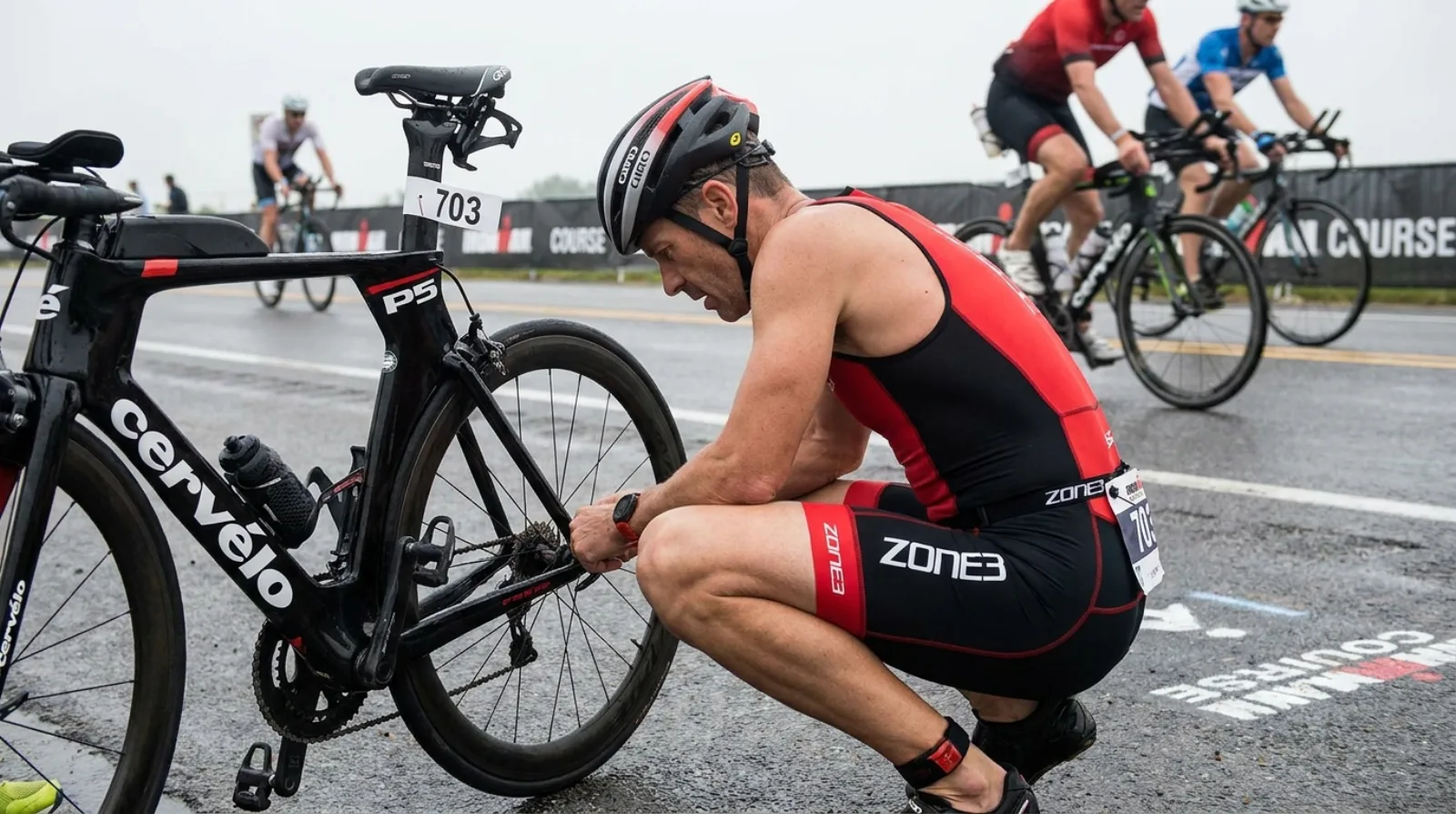
A flat, a dropped chain, a derailleur issue: you have lost time you cannot recover, and you know it. The emotional response — rage, despair, frantic rushing — costs additional time and physiological resources. The functional response is: fix the problem as efficiently as possible (carry CO2 cartridges and know how to use them before race day, not at the side of the road), accept the loss as a fixed cost, and ride the remainder as if the mechanical never happened. Do not soft-pedal the rest of the bike because you have "given up" on the goal. The run is still ahead. Race the run you can race regardless of the bike split.
Going Out Too Hard on the Bike
You feel it at about mile 45: the legs that were singing at mile 20 are now speaking a different language. You went fifteen to twenty watts over target power and the account is overdrawn. The standard response — try to hold the pace and hope — does not work. Glycogen depletion and early fatigue are physiological, not motivational. The correct response is to immediately drop to a sustainable effort, eat aggressively at every aid station, and accept that your run target has shifted. A runner who bikes too hard runs the risk of not finishing at all; a runner who backs off at mile 45 and runs smart still crosses the line. There is always more race left than the moment of crisis suggests.
GI Distress Mid-Race
Stomach issues mid-race are one of the most demoralizing race problems because they sit at the intersection of physical discomfort and uncertainty about how they will progress. The standard advice applies: stop fueling with whatever triggered the problem, switch to water and plain carbohydrates only (banana, flat cola at aid stations), reduce intensity enough to allow blood flow to return to the gut (high effort shunts blood away from digestion), and if necessary, use a porta-potty without shame or hesitation. Time lost to a two-minute bathroom stop is far less than time lost to cramping and walking the run. Do not push through GI distress at race intensity. Manage it.
Falling Way Off Pace on the Run
The run splits are blowing up. You planned a 9:30 pace and you are running 11:30. The temptation is either to force the planned pace (which leads to cramping and walking) or give up and jog it in. Neither is correct. The functional approach: run by effort or heart rate, not by pace. Find a rate of perceived exertion that is hard but sustainable — say, a 7 out of 10 — and hold that. The splits will be what they will be. Athletes who shift from pace targets to effort targets in a blown run almost always run faster than athletes who keep watching the numbers spiral down. The pace will come back as you fuel, hydrate, and warm up mid-run if the fitness is there. Give it a few miles before concluding the day is lost.
What Elite Athletes Do That Age-Groupers Do Not
Research on elite triathlete race psychology identifies a consistent pattern: elite athletes use what is called associative attentional focus — attending closely to internal signals (breath, effort, pace, body feedback) — while age-groupers, particularly when under stress, tend to use dissociative focus (distracting themselves from the discomfort). In a controlled training session, dissociation can manage perceived effort. In a race that has gone wrong, dissociation is catastrophic because you lose contact with the feedback signals you need to make intelligent adjustments. Elite athletes in a bad race lean harder into monitoring: heart rate, power, breathing, cadence. They make micro-adjustments continuously. They stay in dialogue with what their body is actually doing rather than tuning it out.
The other distinguishing characteristic is the use of pre-planned contingency self-talk. Elite athletes do not improvise their mental response to crisis mid-race. They have rehearsed it. Before every major race, they have thought through the specific scenarios that might go wrong and have a prepared response — a mantra, a protocol, a decision rule. "If I flat, I fix it and ride the race I can ride." "If the swim goes badly, I use the first mile of the bike to reset." These are not platitudes. They are decision trees that reduce cognitive load at moments of maximum stress, when cognitive resources are most depleted. The athlete who has to think through how to respond to a flat mid-race for the first time is the athlete who panics. The athlete who executes a rehearsed response is the one who salvages the day.
Race the Race You Are In
Here is what elite triathlon coaches say more consistently than almost anything else: the athletes who finish well on hard days are not the ones who suffer less. They are the ones who suffer and stay present. They do not leave the race mentally when it stops going to plan. They stay in it — adjusting, problem-solving, executing — because they know that any race still in progress is a race still winnable at some level. Not always at the original goal. But at something.
The finish line does not care about your pre-race plan. It only asks whether you kept moving forward. Races fall apart. The protocol above does not prevent that. It gives you a repeatable, proven way to keep moving when they do.