
You've put in the training. You've laid out your transition gear seventeen times. You've watched more YouTube race recaps than you care to admit. You think you're ready. And maybe you are. But there are five mistakes that blindside first-timers with almost clockwork predictability — and knowing about them beforehand is the difference between a race that builds you and one that breaks you.
This isn't a scare tactic. Triathlon is hard, and it's supposed to be. But suffering because you trained for it is entirely different from suffering because you made an avoidable rookie error in the first ten minutes. Let's make sure you do the former, not the latter.
Mistake #1: Going Out Too Hard in the Swim
What It Looks Like
The start horn fires. Adrenaline floods your system. You feel incredible — stronger than you ever have in the pool. You sprint. Within 90 seconds you're gasping, heart rate through the roof, water going places it shouldn't. You panic-breathe. You switch to breaststroke. You grab the kayak. You finish the swim 4 minutes slower than your training pace while burning twice the energy you planned.
Why It Happens
Race-day adrenaline is real, and it's deceptive. Your body feels capable of more than it is. The mass start adds chaos — people swimming over you, swallowing water, losing your sighting line. Your heart rate spikes before you've even taken a stroke. And then you go out at sprint pace because everyone around you is, and the competitive instinct kicks in before the rational brain catches up.
The Fix
Seed yourself honestly at the start. If the race has corral seeding based on estimated swim times, be truthful. Position yourself toward the outside of the pack to avoid the blender effect of the mass start. For the first 200 meters, actively slow down — your perceived easy pace will still be faster than you think due to adrenaline. Focus on bilateral breathing and sighting every 6-8 strokes.
Practice open water swimming at least once before race day. The pool doesn't prepare you for the disorientation of no lane lines, murky water, and people kicking you in the face. One or two open water sessions will inoculate you against the panic response that tanks so many first-timer swims.
The swim is the shortest leg. Your goal is to exit the water feeling like you could have gone harder — not like you already raced. Save it for the bike and run where the time differences actually accumulate.

Mistake #2: Skipping Brick Workouts
What It Looks Like
You've been running. You've been cycling. Separately, you feel great at both. Then race day comes and you dismount the bike and immediately feel like your legs belong to someone else — someone who has never run before in their life. They're heavy, stiff, slightly numb, and moving with all the elegance of a baby deer. This is "jelly legs," and it's completely normal. But only if you've trained for it.
Why It Happens
When you cycle, your body recruits specific muscle groups in a specific pattern — hip flexors, quads, glutes — and your cardiovascular system routes blood accordingly. When you switch to running, the recruitment pattern changes, the biomechanics shift, and your body has to redistribute blood flow rapidly. If you've never done this transition in training, your neuromuscular system has no protocol for it. The result is the jelly leg experience, which can last 5-10 minutes into the run and costs real time.
The Fix
Do brick workouts. They don't have to be long. A 30-minute bike ride followed by a 15-minute run is enough to start building the neural adaptation you need. Do these at least 4-6 times in the 8 weeks before your race. As race day approaches, bump the run segment up and add some race-pace effort. The goal isn't just physical adaptation — it's teaching your brain and nervous system the pattern of this specific stress so race day doesn't feel like a surprise.
Bonus: use your brick sessions to practice transitions. Know exactly how you'll take off your helmet, rack your bike, slip on your running shoes. Rehearse it until it's automatic. Transitions are called the "fourth discipline" of triathlon for a reason — they're free speed if you practice them.
Mistake #3: T2 Meltdowns
What It Looks Like
You dismount the bike. You jog into T2 (the bike-to-run transition). And then everything goes sideways. You can't find your rack. Your running shoes are upside down. You're trying to tie laces with hands that are still in cycling mode. You forget your race belt. You run out without your number and have to go back. You've just donated 3-4 minutes to the clock for free.
Why It Happens
Fatigue reduces cognitive function. Decision-making under physical stress is genuinely harder than decision-making when fresh. Add race-day anxiety and a chaotic, crowded transition area, and tasks that seem trivially simple — put on shoes, attach race belt — suddenly require focused effort. First-timers also often over-pack their transition areas with gear they won't need, creating visual noise that slows everything down.
The Fix
Keep it simple. Your T2 setup should have exactly what you need, nothing more: running shoes (with elastic laces or speed laces already threaded, preferably open and ready to slip into), race belt with number already attached, and anything you need to eat or drink in the first few minutes of the run. That's it.
On race morning, walk the transition area before it fills up. Find your rack. Count the rows from the run-out point so you can navigate back to your spot when your brain is running at 60% capacity. Know the T2 flow: bike in, rack, helmet off, shoes on, belt on, run out. Rehearse it in your head multiple times. Then practice it in real life during your brick workouts.
One non-negotiable: helmet off before you rack the bike. Every race official knows to watch for this. If you rack your bike with your helmet still on, that's a time penalty waiting to happen.
Mistake #4: Nutrition Fails on the Bike
What It Looks Like
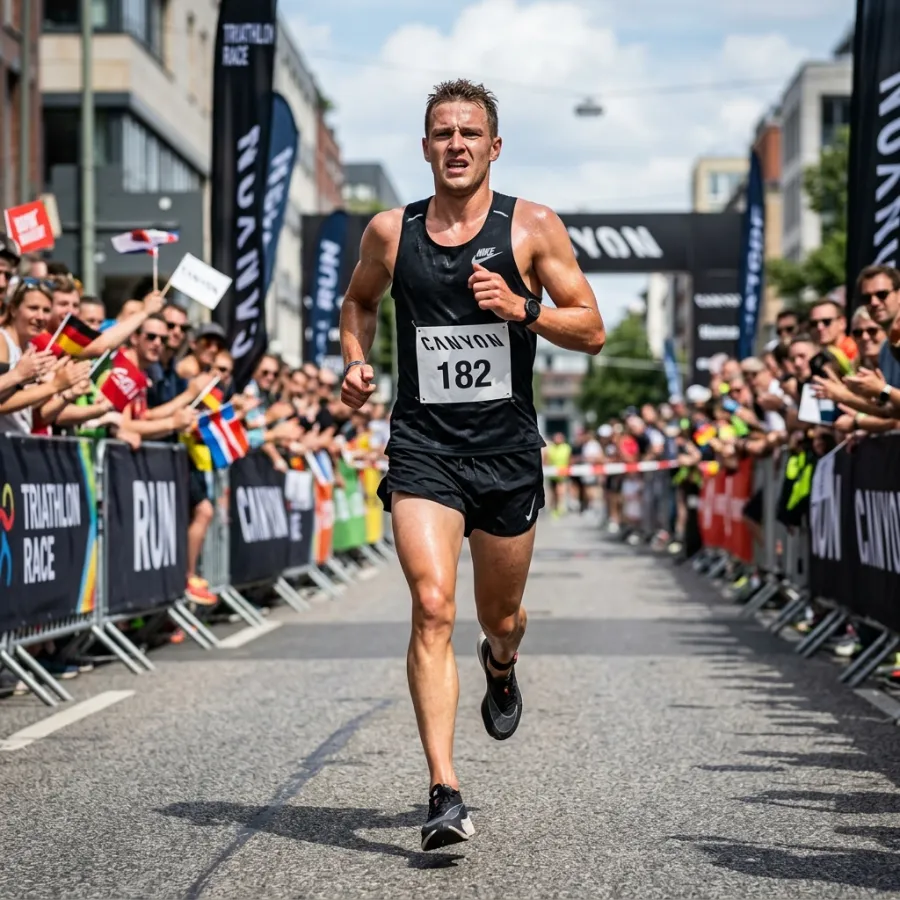
Two-thirds through the bike leg you start feeling hollow. The legs get heavier. Focus drifts. Then you hit the run and within 2km you're in a full bonk — glycogen depleted, energy non-existent, questioning every decision that led you to this moment. This is what under-fueling looks like. It is deeply unpleasant and entirely preventable.
Alternatively: you try a new gel brand that was available at registration. Your stomach disagrees violently. You spend your run making urgent decisions that have nothing to do with pace.
Why It Happens
The bike leg is long enough to deplete glycogen stores significantly — especially at race pace. First-timers either forget to eat (it feels counterintuitive to eat during exercise), leave it too late to start fueling, or make the cardinal error of experimenting with nutrition on race day. Your gut is a creature of habit. Anything it hasn't processed at race intensity before is a gamble.
The Fix
For races lasting more than 60 minutes, you need to eat. Aim for 45-60 grams of carbohydrates per hour on the bike — start eating in the first 20-30 minutes, not when you feel hungry (by then you're already behind). Whatever you plan to use on race day — a specific gel brand, chews, sports drink — train with it. Practice eating and drinking in aero position during your long rides.
Build a simple nutrition plan: "I'll take a gel at 20 minutes, another at 45 minutes, and drink from my water bottle every 15 minutes." Write it on your hand if you need to. Execute it automatically, not reactively. And the absolute rule: nothing new on race day. Not a new gel, not a new electrolyte drink, not a new bar someone hands you at registration. If your body hasn't processed it in training, it doesn't exist on race day.
Mistake #5: Racing in New Gear
What It Looks Like
You bought new running shoes two weeks before the race because you saw them on sale. You wear them for the first time on race day. By kilometer 3 of the run you have a hot spot developing on your left heel. By kilometer 5 it's a blister. The last 2 kilometers are grimly educational. You learn things about your pain threshold that you did not want to know.
Or: you bought a new tri suit because your old one didn't feel fast enough. The new one chafes in a location you will not disclose. Twelve hours of topical discomfort follow.
Why It Happens
Excitement, pre-race shopping anxiety, and the marketing industrial complex of triathlon gear convince new athletes that new gear means better performance. Sometimes that's true. But gear needs to be broken in, tested under actual effort, and confirmed to work with your specific body at race pace before you trust it in a race environment.
The Fix
The rule is simple: nothing new on race day. Not shoes, not shorts, not socks, not goggles, not a wetsuit, not a tri suit. Everything you wear and use on race day should have been tested in at least 2-3 significant training sessions at comparable intensity. Your Garmin should be a watch you've raced in before, not one you charged the night before for the first time. Your goggles should fit without leaking. Your shoes should have at least 50km on them.
If you genuinely want to race in new gear, buy it early enough to break it in properly. New shoes? Start wearing them on easy runs 4-6 weeks out. New tri suit? Wear it for a brick workout or two. If it causes problems in training, it will cause catastrophic problems in a race. Testing gear in training is not optional — it's part of your race prep.
The Bottom Line
Triathlon is hard. That's the point. You're combining three disciplines, managing transitions, pacing your effort across hours, and asking your body to do things it has never done before. That's genuinely impressive, and on race day you should feel that weight and that pride.
But the goal is to suffer productively — to suffer because you pushed your limits, not because you went out too hard in the swim, skipped brick training, fumbled through T2, bonked from poor nutrition, or destroyed your feet in new shoes. The mistakes above are entirely avoidable. The suffering on the run? That's on you to earn.
Train smart. Race prepared. And when it gets hard out there — and it will — remember that you chose this. That's exactly what makes it worth it.


